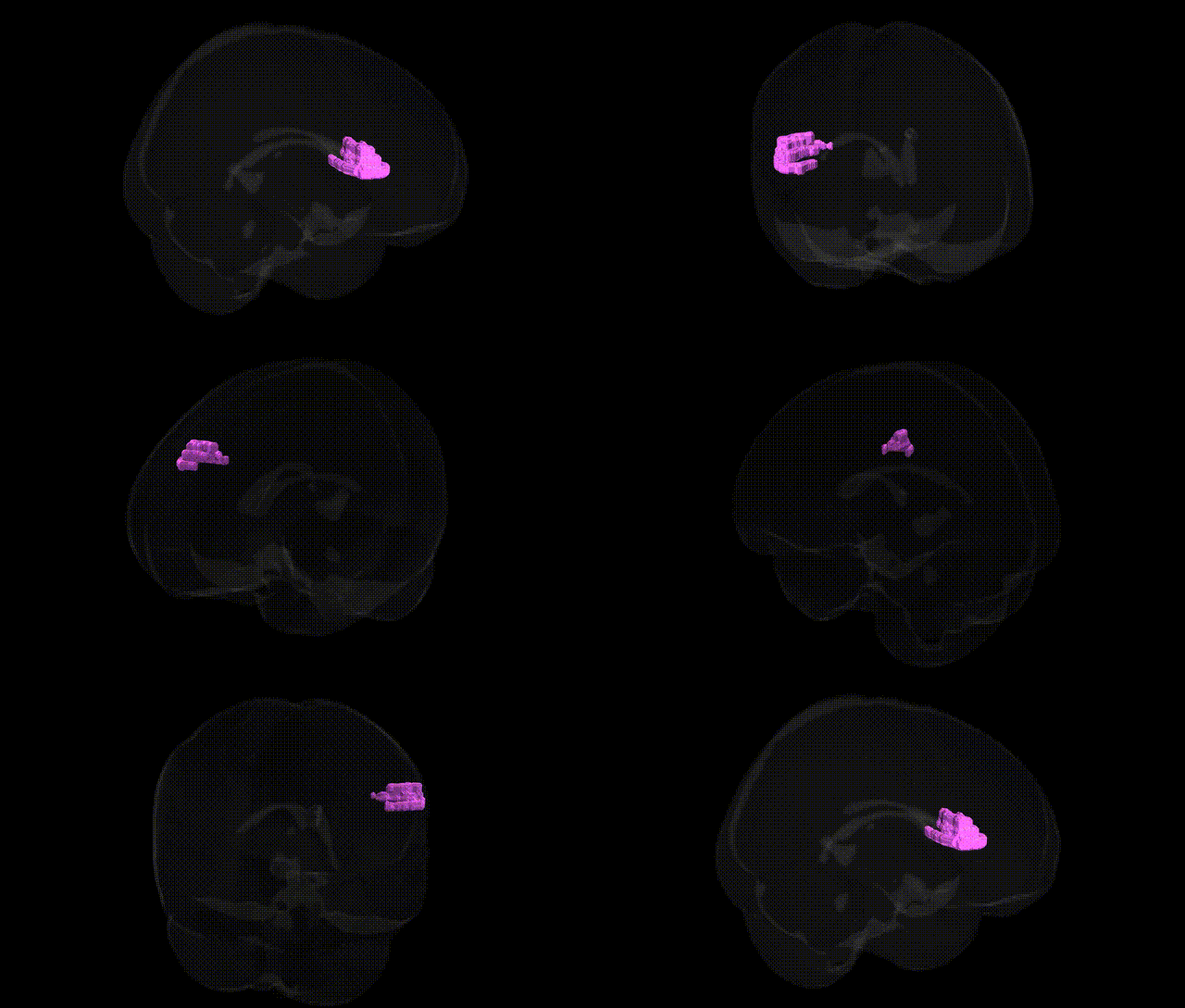
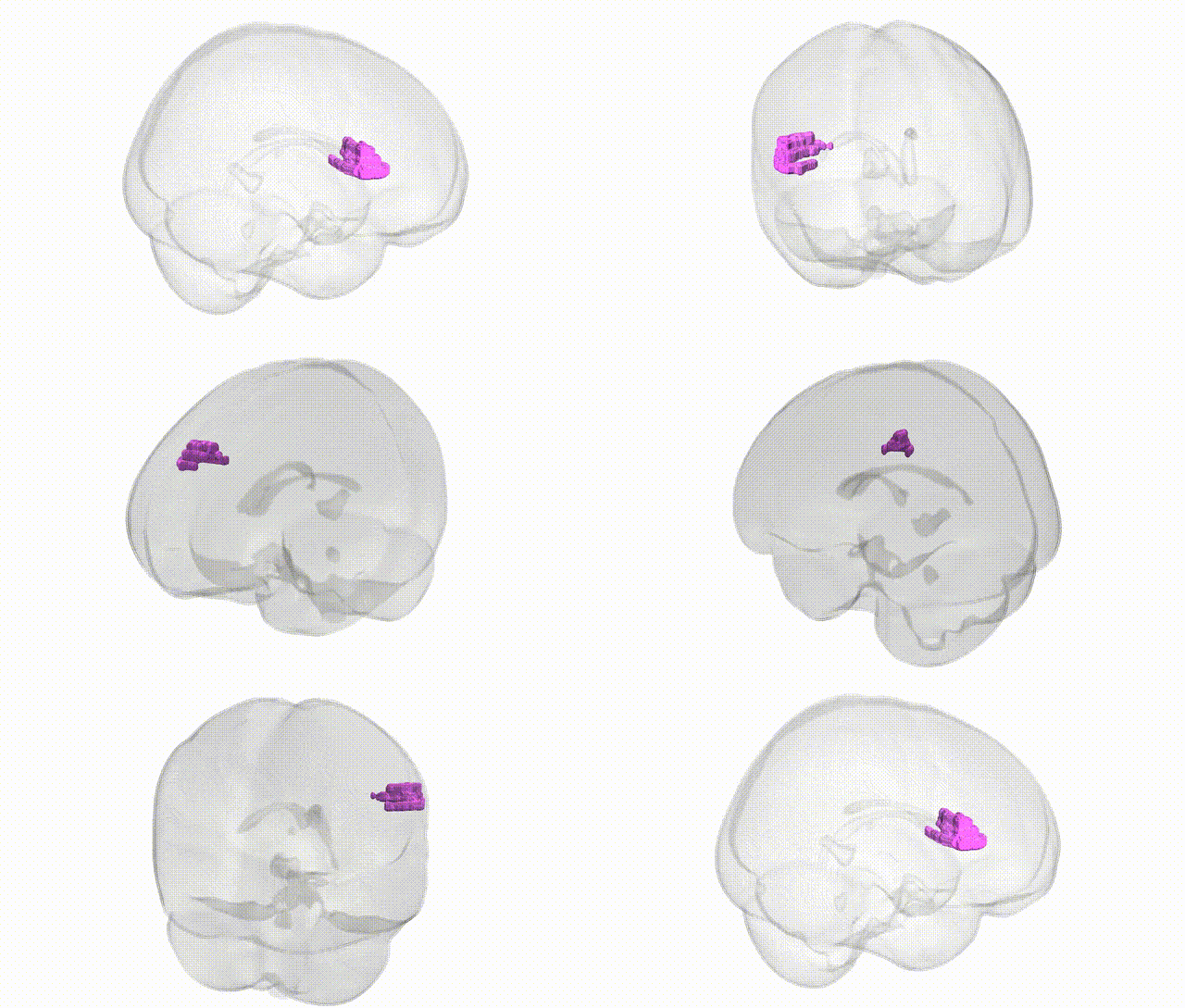
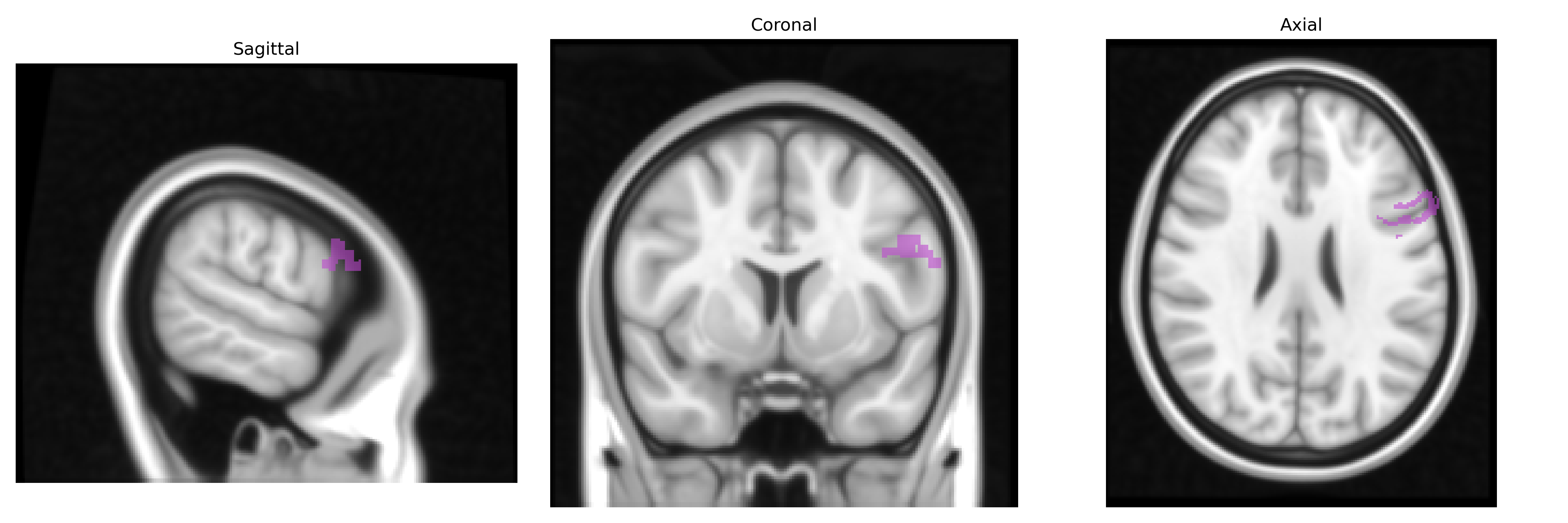
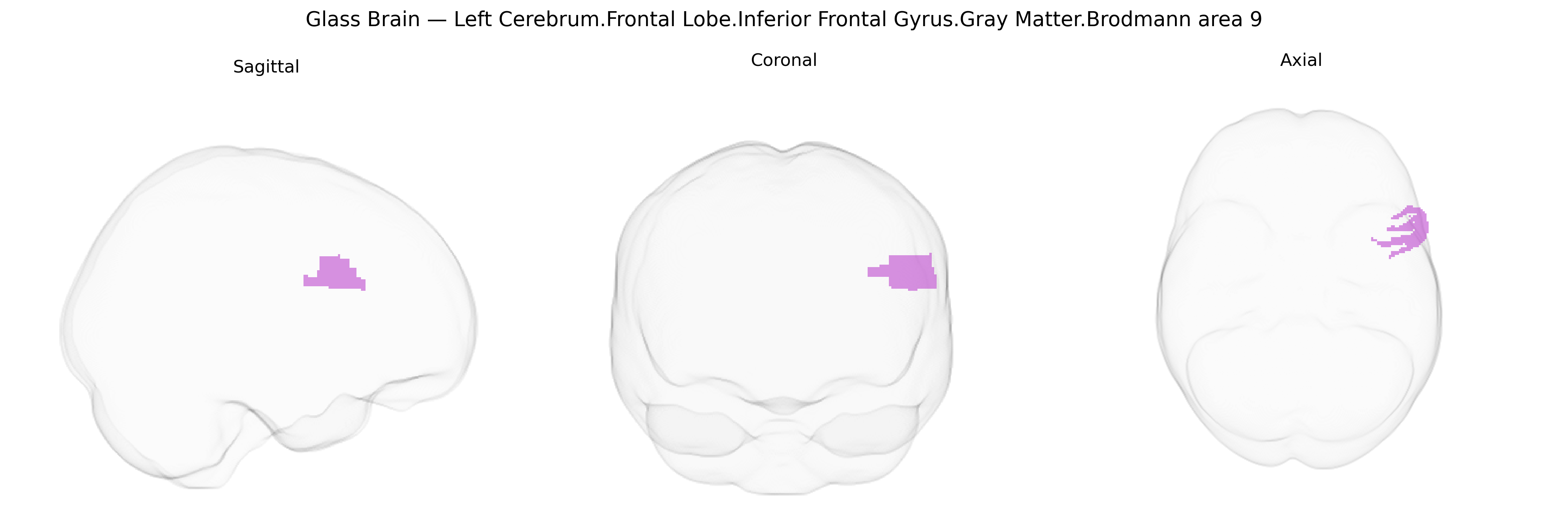
The bilateral Left Cerebrum.Frontal Lobe.Inferior Frontal Gyrus.Gray Matter.Brodmann area 9, as defined in the Talairach 1 mm atlas, corresponds to a dorsolateral prefrontal cortical sector situated on the superior portion of the inferior frontal gyrus, extending anterior to the premotor regions and superior to more ventral language-related territories. Cytoarchitectonically, Brodmann area 9 is characterized by a well-developed granular layer IV and distinct pyramidal cell organization, and functionally it is implicated in higher-order executive processes, including working memory, planning, cognitive control, and aspects of metacognition, often interacting with adjacent prefrontal fields (e.g., areas 46 and 10) within large-scale frontoparietal networks. This region participates in integrating internal goals with external stimuli, modulating attention, and sustaining complex rule-based behavior, and shows hemispheric interactions and partial lateralization depending on task demands, particularly when overlapping with language and cognitive control circuits in the frontal lobe. Brodmann area 9
The bilateral left inferior frontal gyrus (Brodmann area 9) in the dorsolateral prefrontal/frontal region has been repeatedly implicated in genetic and GWAS-based studies of cognition, psychiatric risk, and brain morphology, although most findings arise from imaging-genetics consortia (e.g., ENIGMA, UK Biobank) that label this area within broader dorsolateral or middle/inferior frontal parcels rather than the specific Talairach BA9 ROI. Common variants in genes affecting synaptic plasticity and cortical development—such as BDNF, COMT, DISC1, and NRG1—have been associated with gray matter volume, cortical thickness, or activation in this region in candidate-gene and imaging-genetics studies, often in the context of working memory and executive function. Large-scale GWAS of cortical thickness and surface area have identified multiple loci (e.g., near genes like HMGA2, FGFR3, MEF2C, and others) that influence frontal cortical structure encompassing BA9, with polygenic scores for educational attainment, general cognitive ability, and intracranial volume showing associations with morphology in this territory. Psychiatric GWAS—particularly for schizophrenia, bipolar disorder, major depressive disorder, ADHD, and autism spectrum disorder—support a convergence between polygenic risk scores and altered structure or function of dorsolateral/inferior frontal regions, including BA9, in case–control and population cohorts. Additionally, genetic variants related to neurodegenerative and neurodevelopmental pathways (e.g., in or near APOE for dementia risk, and various synaptic/axonal genes for neurodevelopmental disorders) have been linked to frontal gray matter changes that include BA9, indicating that this region serves as a common anatomical substrate through which diverse polygenic influences on cognition, psychiatric liability, and brain maturation are expressed.
Overview generated by GPT-4o (2026).
Region ID: 899
Hemisphere: bilateral
Atlas: Talairach labels 1mm
Full Quality Version: Download MP4
Full Quality Version: Download MP4
Wali Sidiqyar*, Gaurav Rudravaram*, Elyssa M. McMaster, Trent M. Schwartz, Adam M. Saunders, Kurt G. Schilling, Bennett A. Landman "Introducing SPINS: A Shared Public Visualization Library of Neuroanatomical Structures." Medical Imaging with Deep Learning- short paper
This resource is licensed under CC0 1.0 Universal (Public Domain).