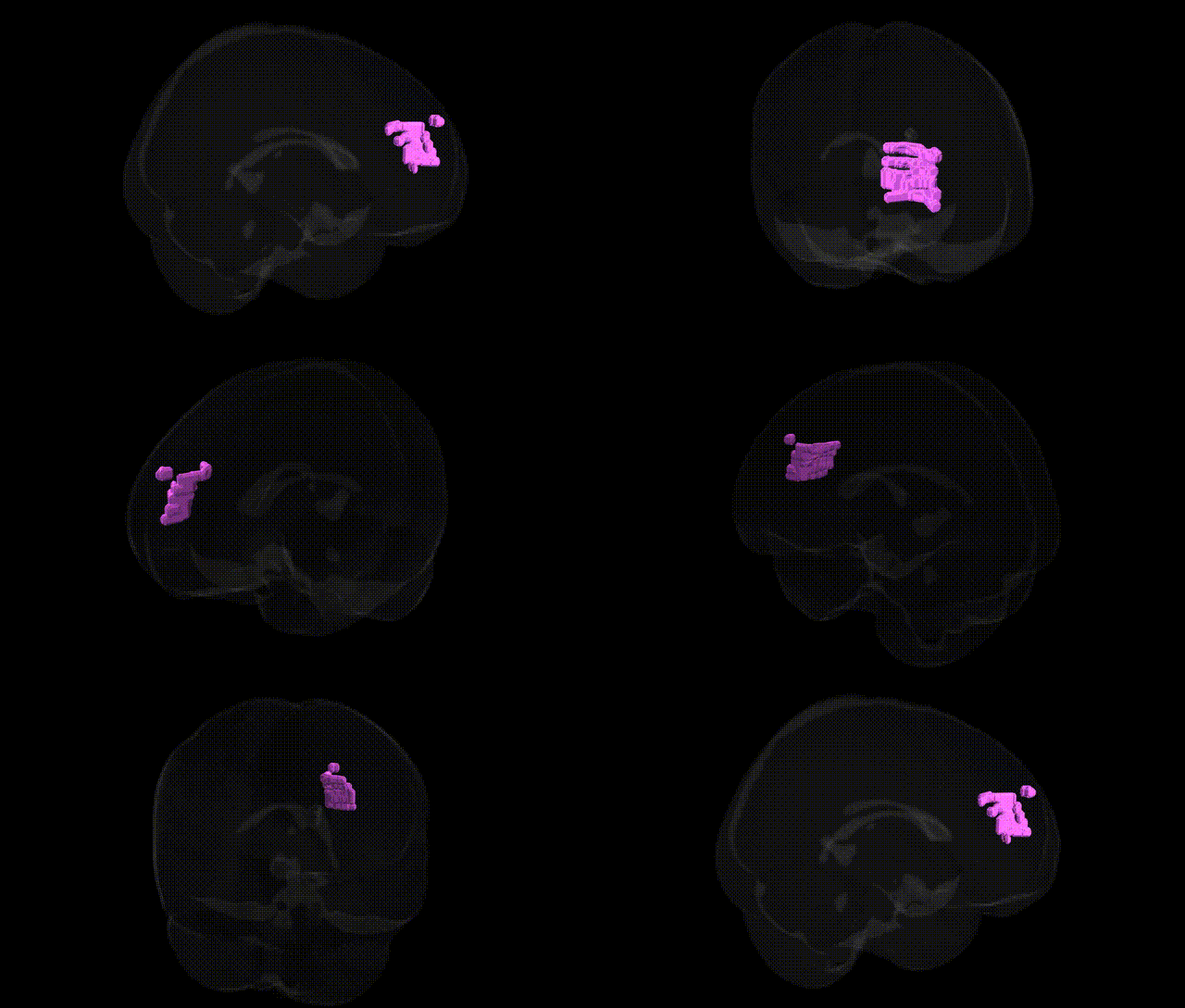
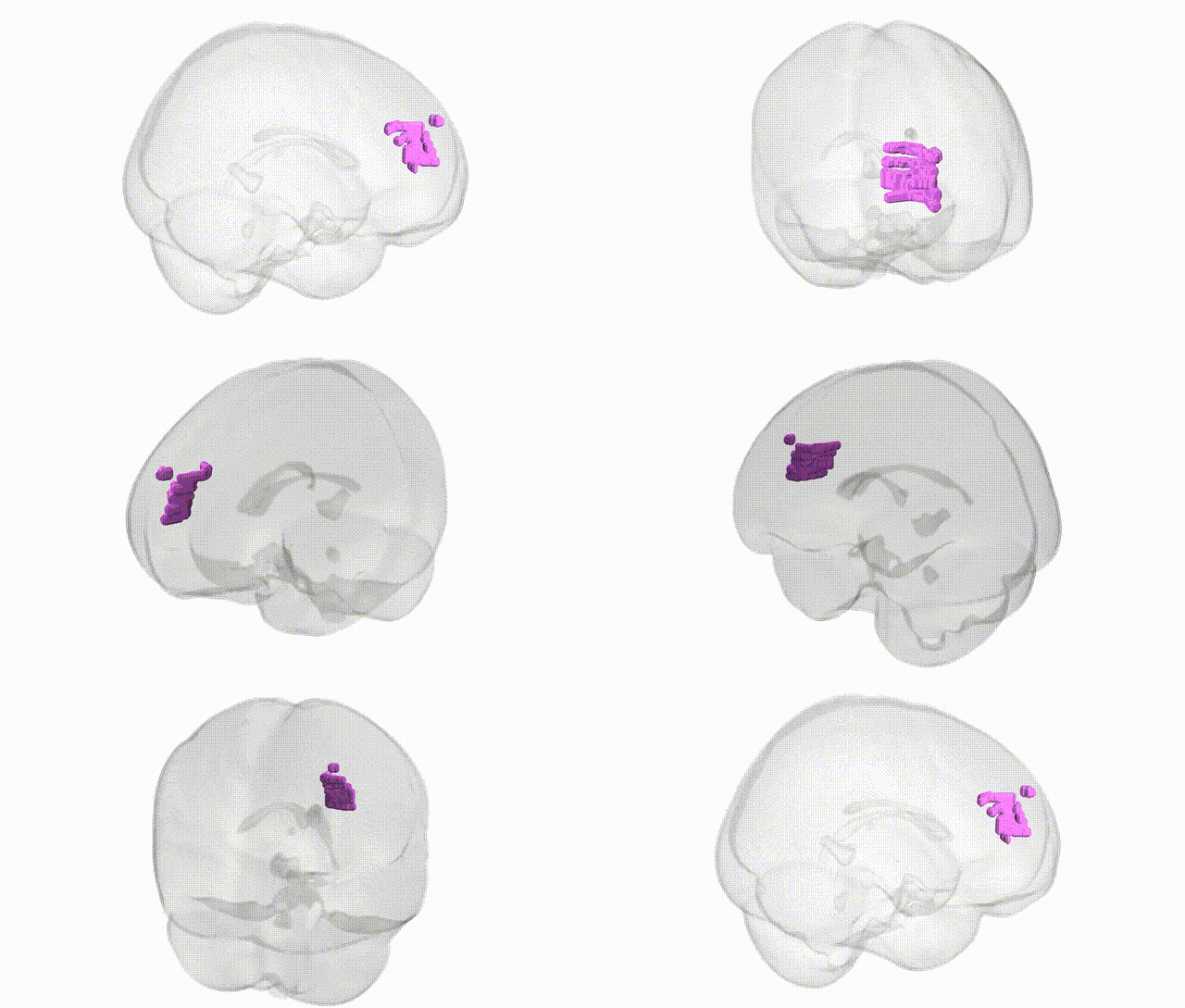
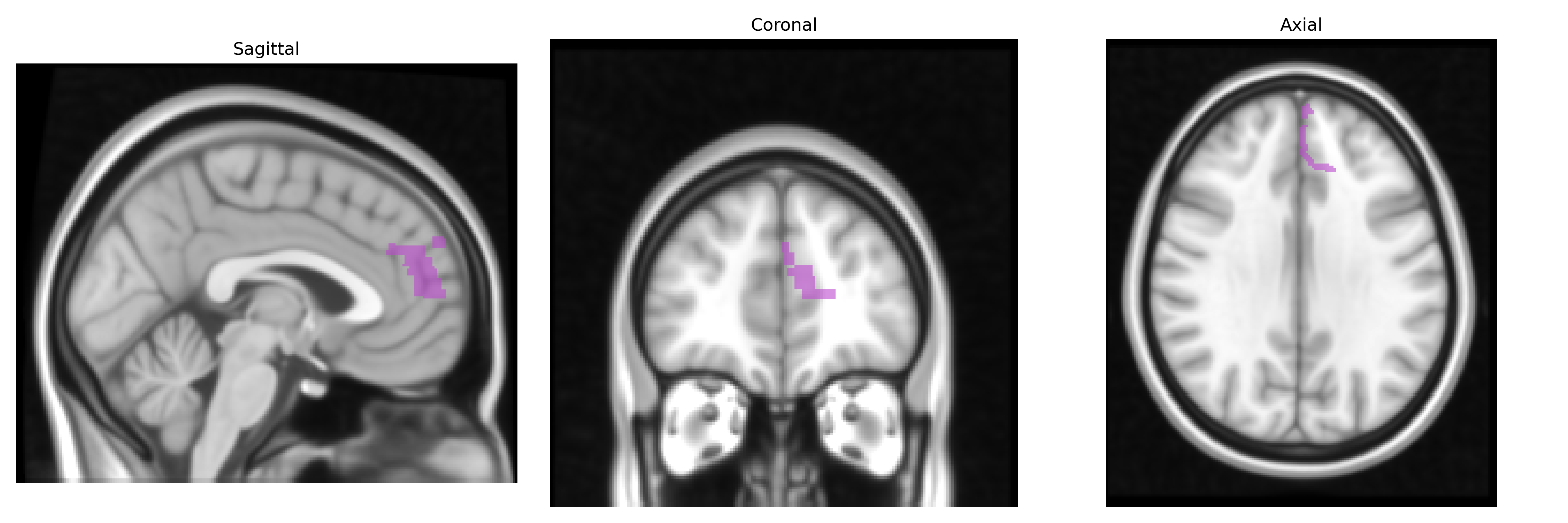
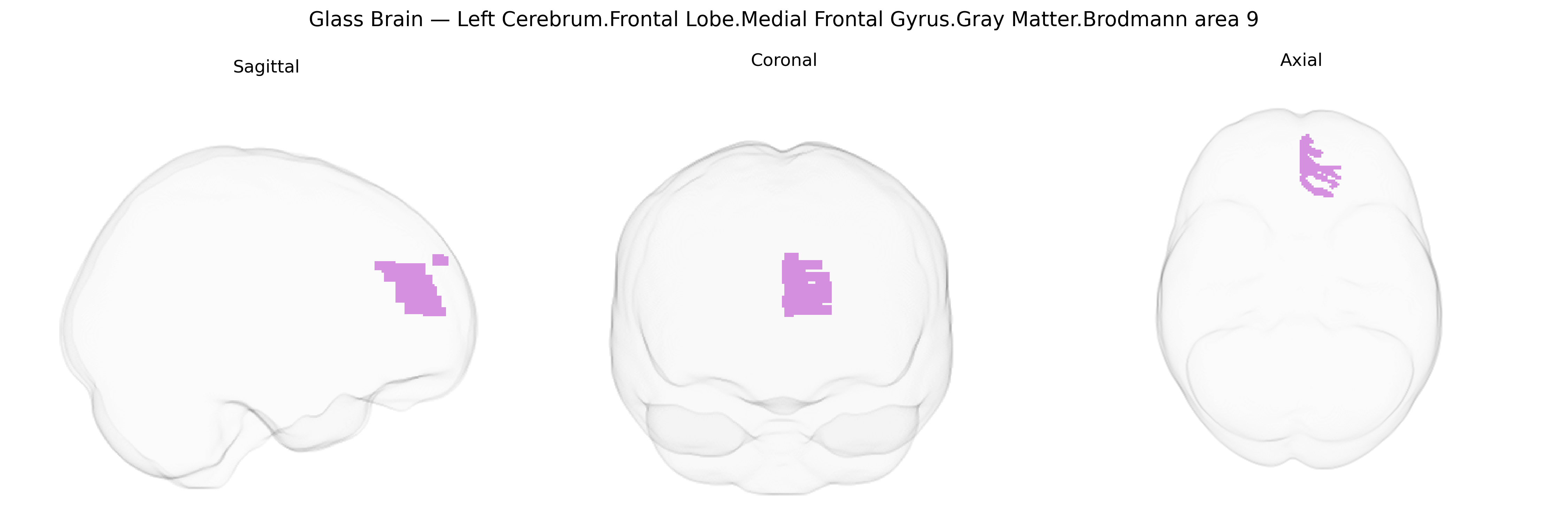
The bilateral Left Cerebrum.Frontal Lobe.Medial Frontal Gyrus.Gray Matter.Brodmann area 9 corresponds to a portion of the dorsomedial prefrontal cortex, a granular frontal region implicated in higher-order cognitive and executive functions, including working memory, sustained attention, error monitoring, and aspects of social cognition such as mentalizing and evaluative judgment. Cytoarchitectonically, Brodmann area 9 is characterized by a well-developed granular layer IV and distinct pyramidal cell organization in layers III and V, supporting extensive reciprocal connections with other prefrontal, cingulate, and parietal association areas, as well as subcortical structures (e.g., thalamus and basal ganglia). Functionally, this region contributes to the regulation of behavior in accordance with internal goals, strategic planning, and the integration of affective and cognitive information during decision-making and self-related processing. There is no single dedicated Wikipedia article for this exact Talairach label; a closely related structure is Brodmann area 9.
The medial frontal gyrus of the left frontal lobe, including Brodmann area 9, is a key node in the dorsomedial prefrontal cortex and has been repeatedly implicated in genetic and genome-wide association studies of psychiatric, cognitive, and structural brain phenotypes. Imaging–genetics work shows that common variants in genes regulating synaptic plasticity and monoaminergic signaling (for example, COMT, DRD2, SLC6A4, BDNF, and DISC1) modulate gray matter volume, cortical thickness, and functional activation in this region during working memory, cognitive control, and emotion regulation tasks. Large GWAS of cortical morphology (e.g., ENIGMA and UK Biobank–based analyses) have identified multiple loci influencing surface area and thickness in medial/dorsomedial prefrontal regions overlapping BA9, often near genes involved in neurodevelopmental patterning (such as PAX6- and WNT-pathway–related loci) and neuronal differentiation. Polygenic risk scores for schizophrenia, major depressive disorder, bipolar disorder, and autism spectrum disorder correlate with structural and functional alterations in BA9, and post-mortem transcriptomic studies in dorsolateral/medial prefrontal cortex report differential expression of synaptic, GABAergic, and immune-related genes in these conditions. In addition, GWAS of personality traits (notably neuroticism and conscientiousness), general cognitive ability (g), educational attainment, and risk-taking behavior show associations with variants that influence medial frontal and BA9-related networks, suggesting that BA9 serves as a convergence zone where genetic variation impacting higher-order cognition, affective regulation, and psychiatric vulnerability is expressed at the level of gray matter structure and function.
Overview generated by GPT-4o (2026).
Region ID: 814
Hemisphere: bilateral
Atlas: Talairach labels 1mm
Full Quality Version: Download MP4
Full Quality Version: Download MP4
Wali Sidiqyar*, Gaurav Rudravaram*, Elyssa M. McMaster, Trent M. Schwartz, Adam M. Saunders, Kurt G. Schilling, Bennett A. Landman "Introducing SPINS: A Shared Public Visualization Library of Neuroanatomical Structures." Medical Imaging with Deep Learning- short paper
This resource is licensed under CC0 1.0 Universal (Public Domain).