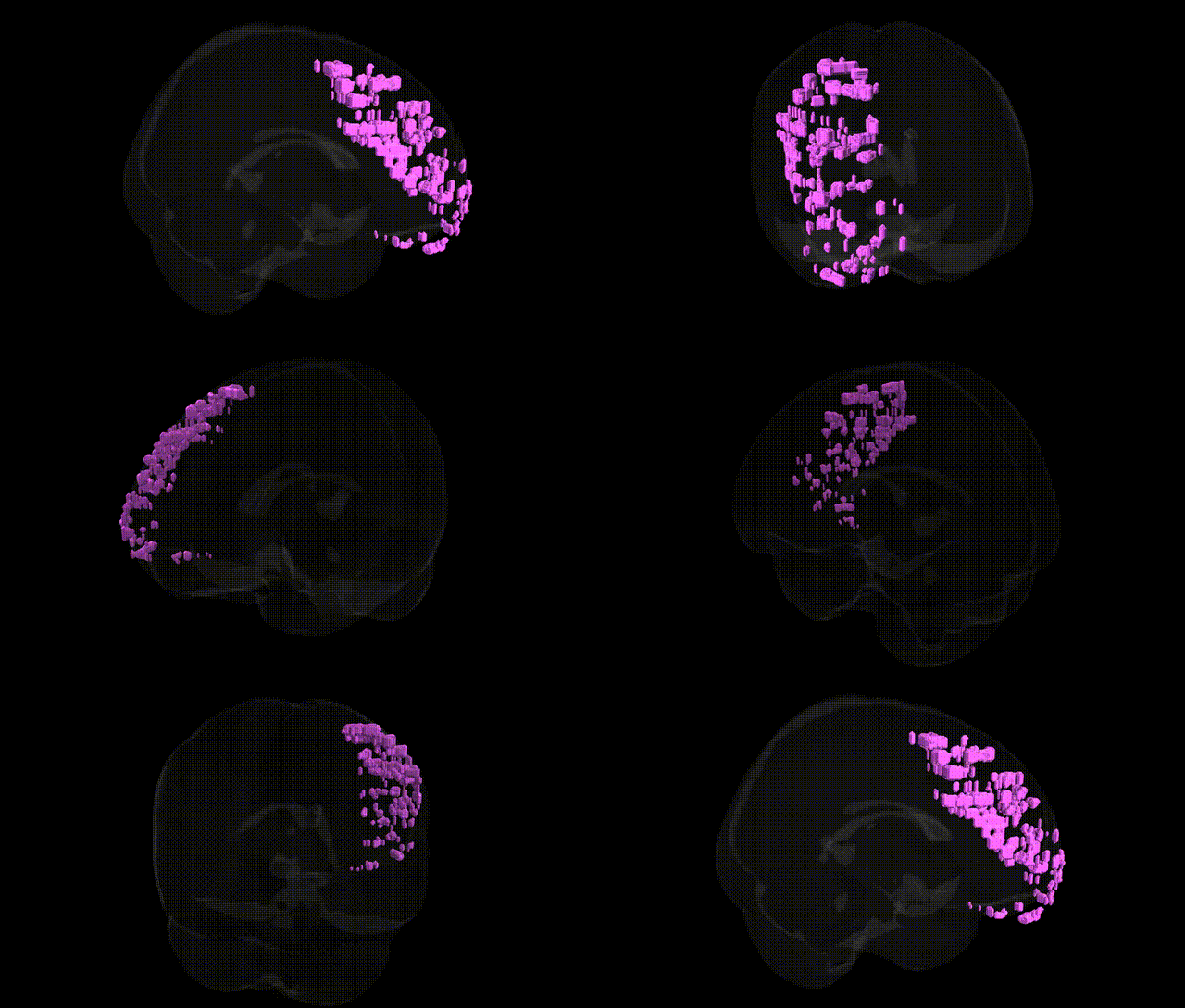
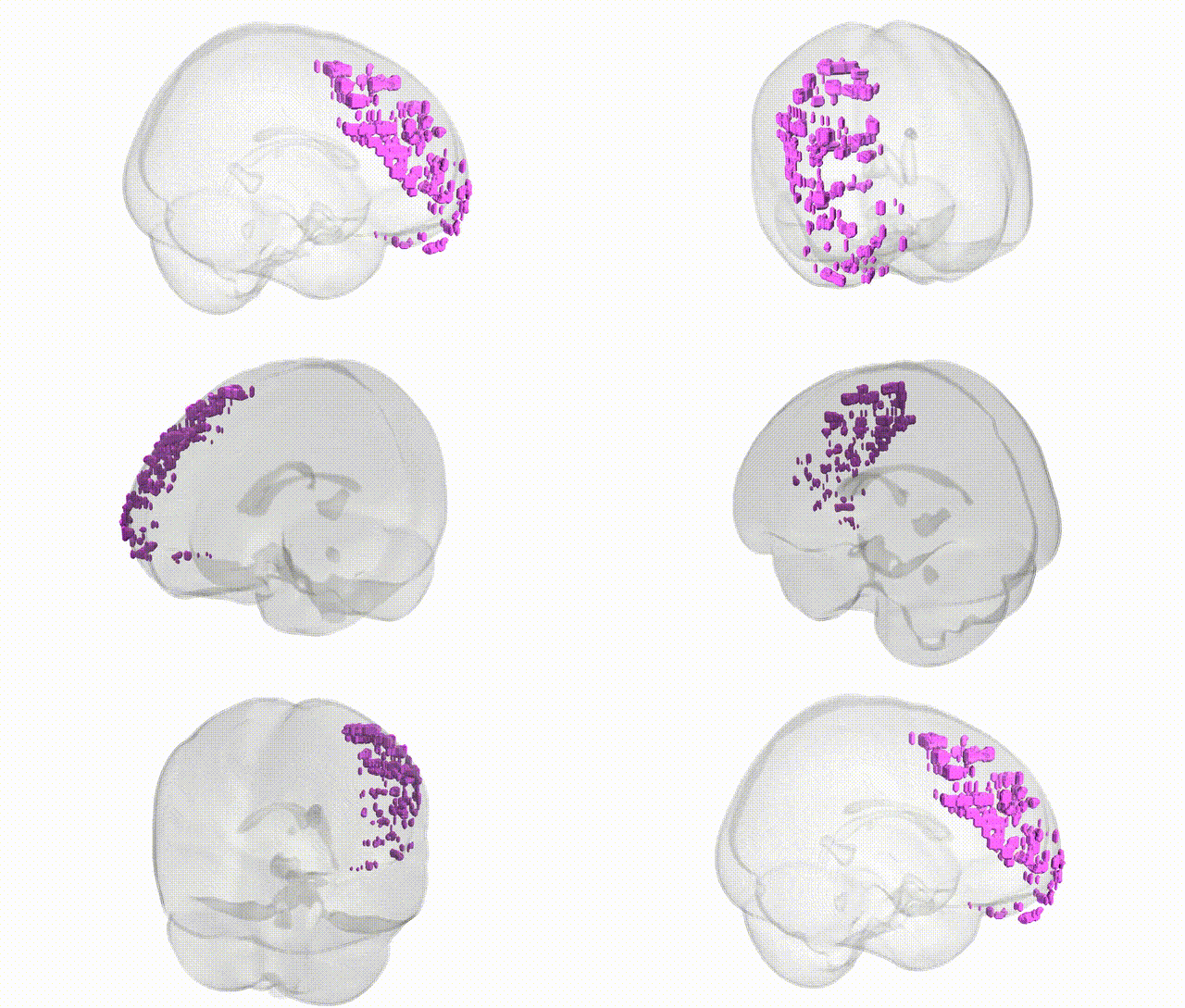
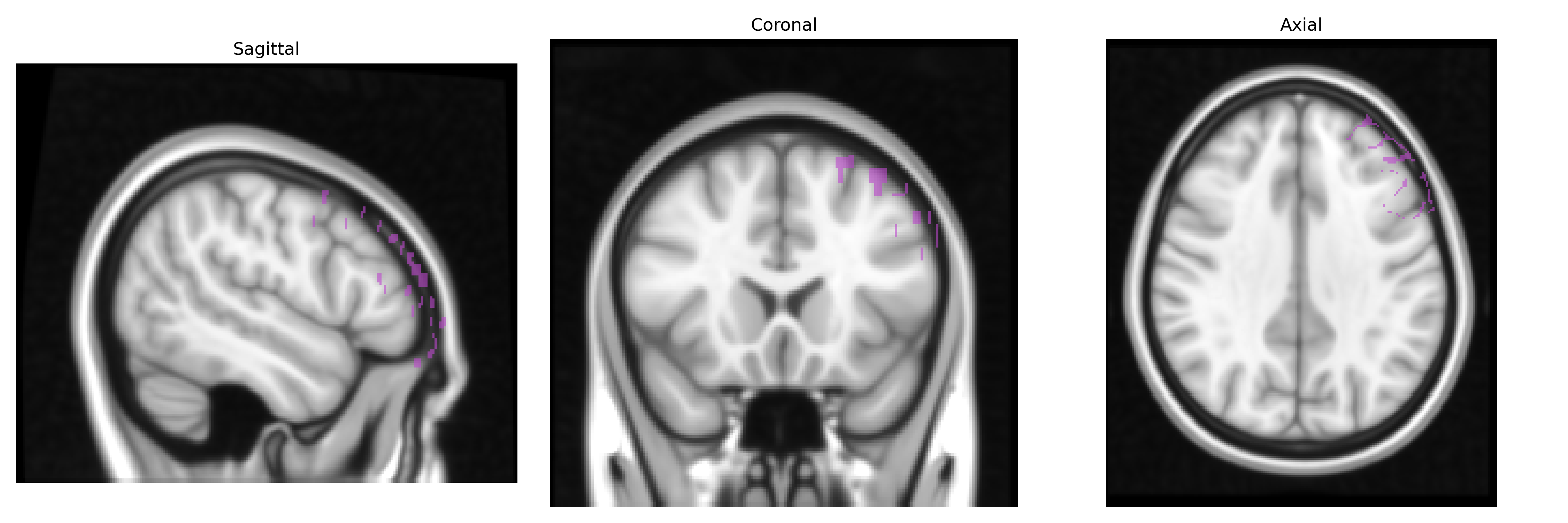
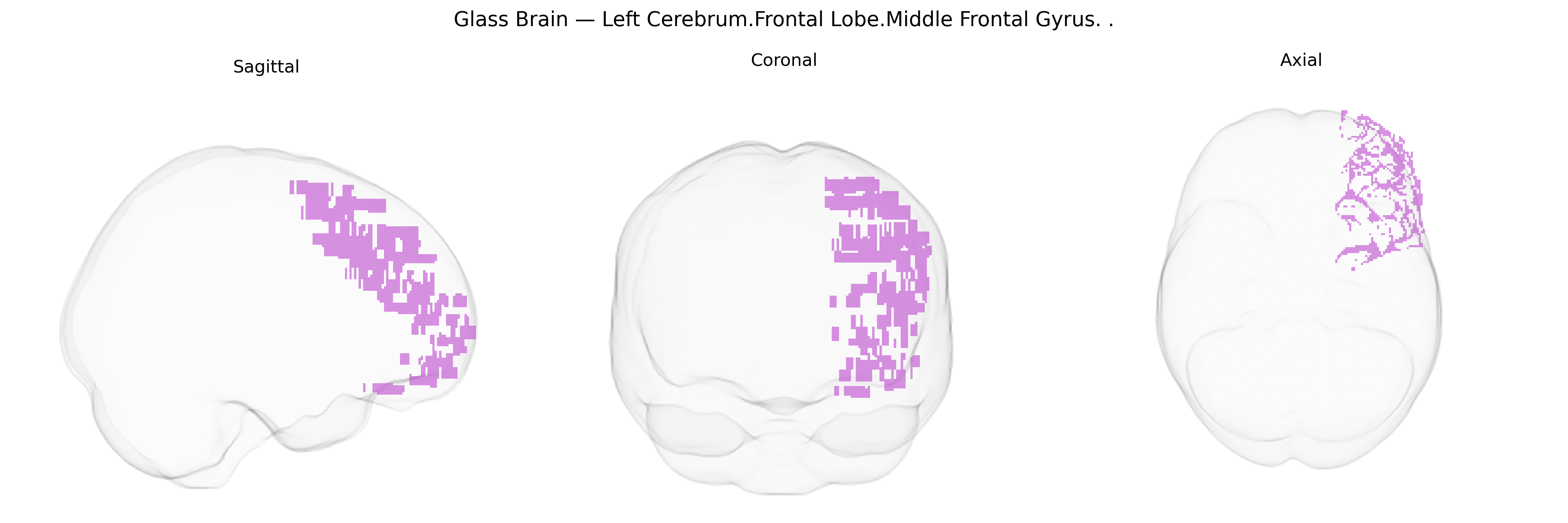
The bilateral Left Cerebrum Frontal Lobe Middle Frontal Gyrus corresponds to the dorsal and lateral portion of the frontal lobe located between the superior and inferior frontal sulci, extending from the prefrontal cortex anteriorly toward premotor areas posteriorly. This gyrus is heavily involved in higher-order executive functions, including working memory, attentional control, planning, and decision-making, and it contributes to aspects of cognitive flexibility and goal-directed behavior. Functionally, it forms part of the dorsolateral prefrontal cortex and is interconnected with parietal, temporal, and subcortical structures, supporting integration of sensory information with internal goals and rules. In the Talairach 1 mm atlas, this region is defined anatomically by gyral boundaries within the frontal lobe and is often implicated in neuroimaging studies of executive control, attention, and complex cognition. Middle frontal gyrus
The bilateral left middle frontal gyrus (Talairach “Left Cerebrum.Frontal Lobe.Middle Frontal Gyrus”) is a core component of the dorsolateral prefrontal cortex, and genetic association studies consistently implicate it in cognitive, psychiatric, and neurodevelopmental traits. Twin and heritability studies show substantial genetic influence on its cortical thickness and surface area, with common variants in genes related to neurodevelopment (e.g., MAPT, MIR137, BDNF, CNTNAP2, GRIN2B) repeatedly associated with prefrontal morphology and function. Large-scale imaging–genetics GWAS (e.g., ENIGMA, UK Biobank) report that polygenic scores for general cognitive ability, educational attainment, and working memory are positively associated with middle frontal gyrus volume and activation, while polygenic risk for schizophrenia, bipolar disorder, major depression, ADHD, and autism spectrum disorder correlates with altered structure and connectivity in this region. Disorder-specific GWAS and candidate-gene studies link risk variants in dopaminergic (COMT, DRD2), glutamatergic, and GABAergic genes to middle frontal gyrus activation differences during executive tasks, aligning with its role in working memory, cognitive control, and decision making. Additional associations involve risk alleles for neurodegenerative conditions (e.g., APOE in Alzheimer’s disease) that relate to prefrontal atrophy patterns, and variants influencing personality and emotional regulation (e.g., 5-HTTLPR) that have been tied to altered prefrontal–limbic coupling involving the middle frontal gyrus.
Overview generated by GPT-4o (2026).
Region ID: 233
Hemisphere: bilateral
Atlas: Talairach labels 1mm
Full Quality Version: Download MP4
Full Quality Version: Download MP4
Wali Sidiqyar*, Gaurav Rudravaram*, Elyssa M. McMaster, Trent M. Schwartz, Adam M. Saunders, Kurt G. Schilling, Bennett A. Landman "Introducing SPINS: A Shared Public Visualization Library of Neuroanatomical Structures." Medical Imaging with Deep Learning- short paper
This resource is licensed under CC0 1.0 Universal (Public Domain).