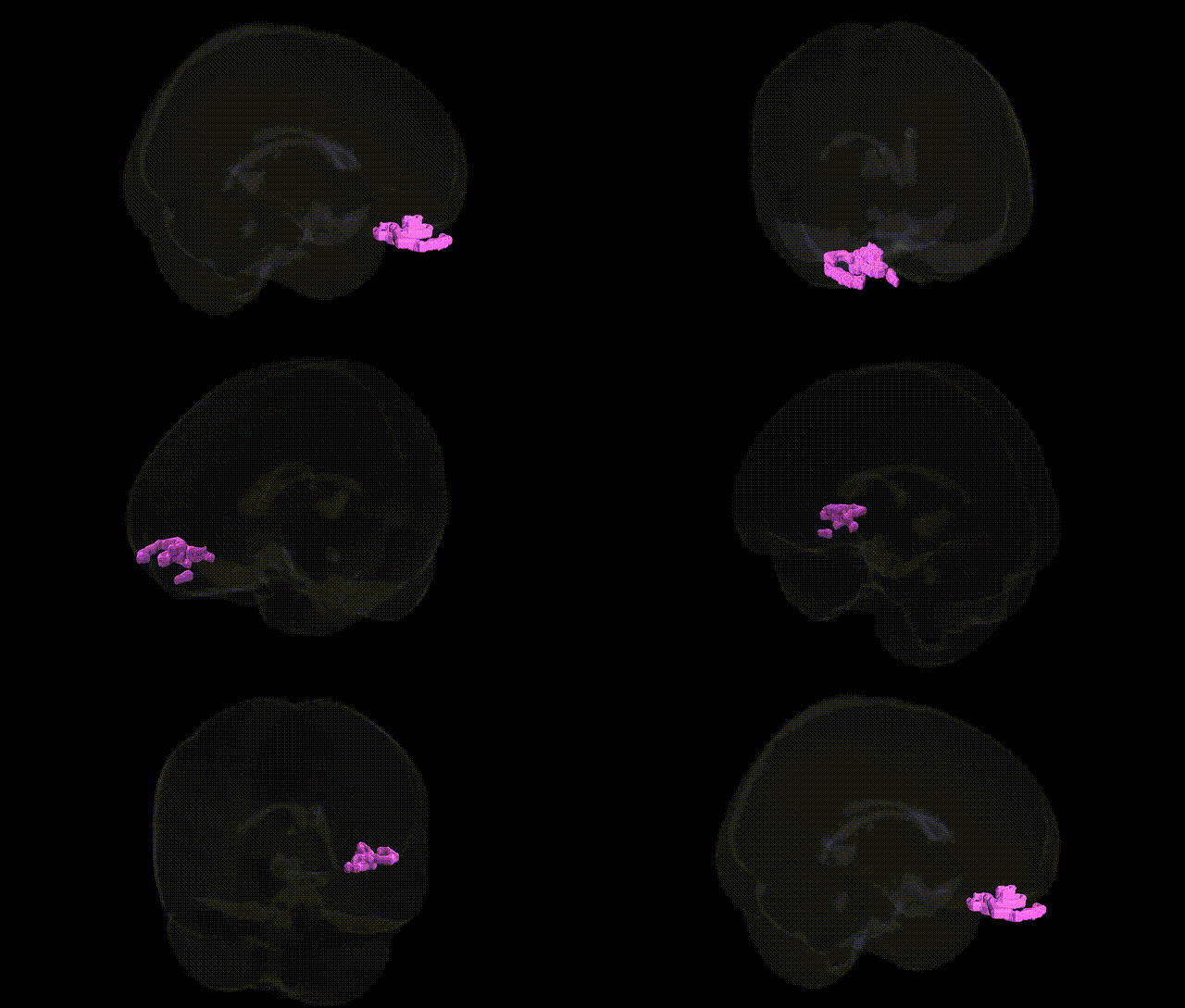
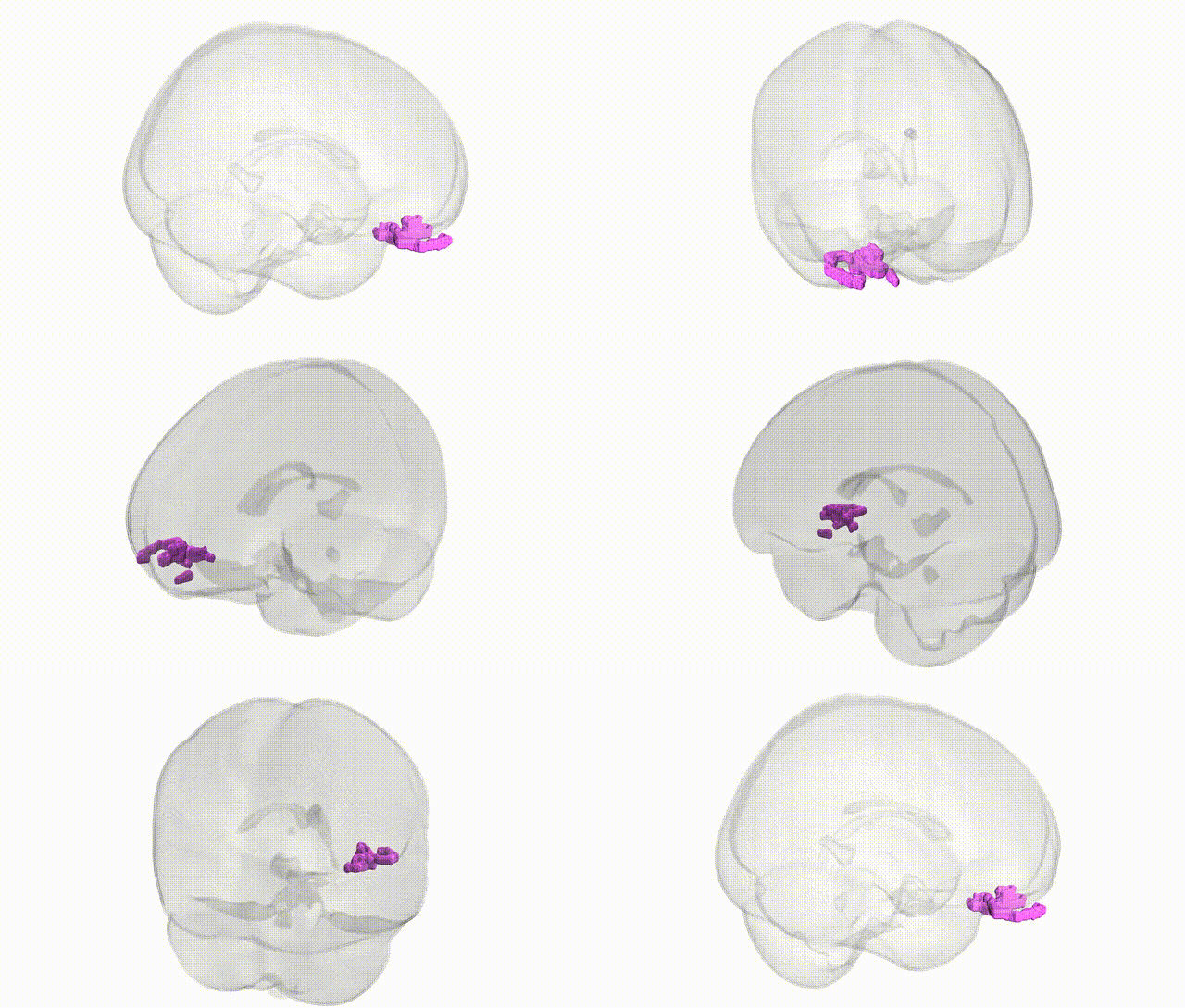
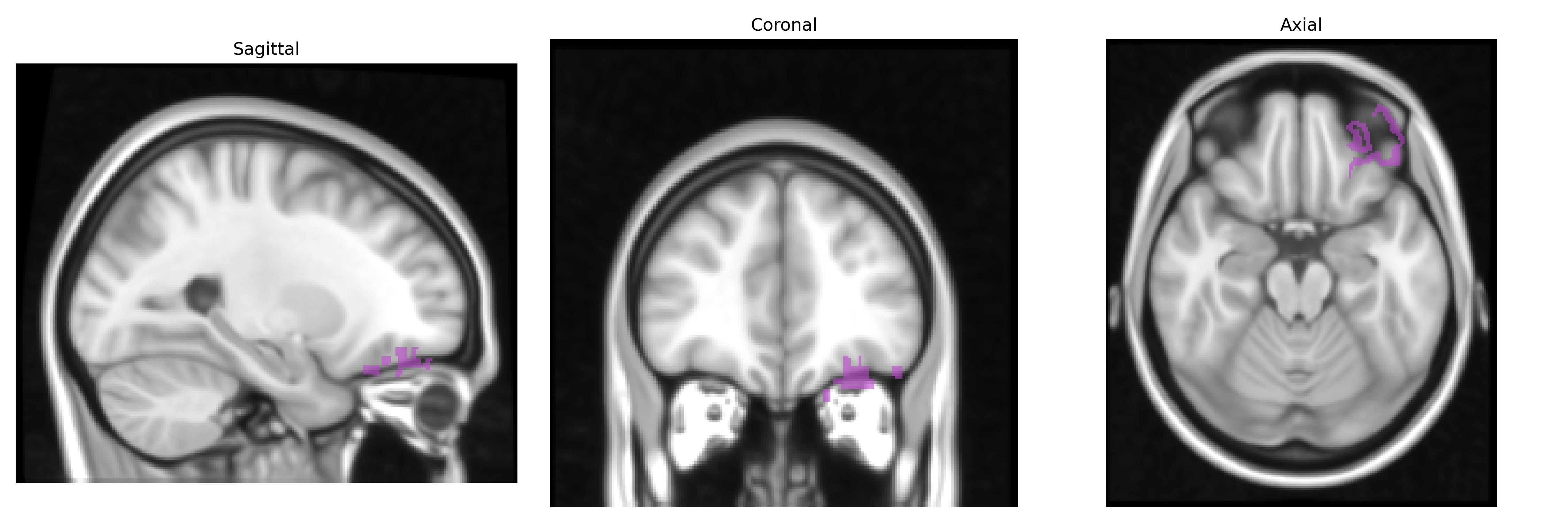
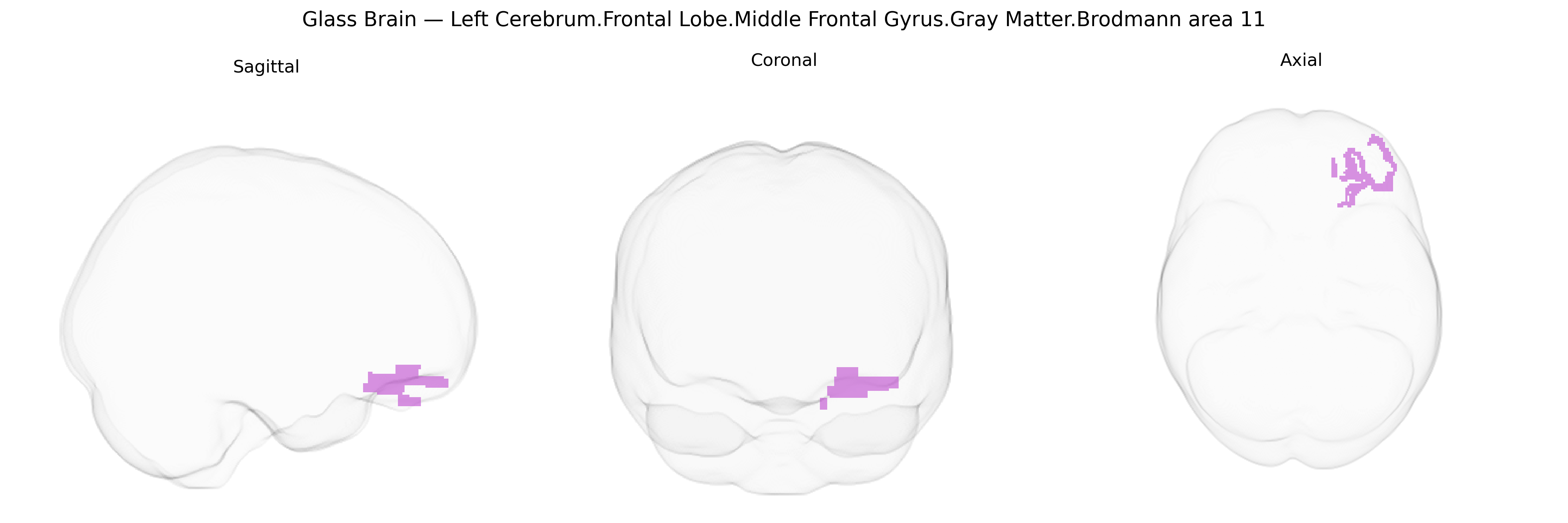
Bilateral Left Cerebrum.Frontal Lobe.Middle Frontal Gyrus.Gray Matter.Brodmann area 11 corresponds to a segment of the orbitofrontal cortex located in the ventromedial and orbital portions of the frontal lobe, anterior to the premotor and prefrontal regions and above the orbital surface of the frontal bone. This agranular cortical field is implicated in higher-order functions including valuation of rewards and punishments, decision-making under uncertainty, emotional regulation, and integration of sensory and limbic inputs to guide goal-directed behavior. Neuronal populations in Brodmann area 11 participate in associative learning and the updating of stimulus–reward contingencies, and are heavily interconnected with limbic structures such as the amygdala and hippocampus, as well as with other prefrontal areas. There is no direct link for this specific Talairach-defined region; a related area is the orbitofrontal cortex: Orbitofrontal cortex.
The bilateral left middle frontal gyrus (Brodmann area 11, orbitofrontal part of the frontal lobe) shows convergent genetic associations through imaging‑genetics and GWAS of brain structure, cognition, and psychiatric risk, although findings are generally at the level of the broader orbitofrontal or middle frontal cortex rather than this precise Talairach label. Large-scale ENIGMA and UK Biobank imaging GWAS have identified common variants (including loci near genes such as HMGA2, IGF1, and others involved in neurodevelopment, synaptic function, and cell growth) that influence cortical thickness and surface area in orbitofrontal and adjacent middle frontal regions, which encompass BA11. Polygenic risk scores for schizophrenia, bipolar disorder, major depressive disorder, and ADHD have been associated with structural and functional alterations in medial and lateral orbitofrontal/middle frontal cortex, including reduced gray matter volume or altered activation during reward, decision‑making, and emotion tasks. Genetic variants in serotonin (e.g., SLC6A4/5‑HTTLPR), dopamine (e.g., DRD2, COMT), and glutamatergic pathways, as well as in risk genes such as CACNA1C and ZNF804A, have been linked to orbitofrontal/middle frontal activity and connectivity, implicating BA11‑adjacent regions in mood and psychotic disorders, impulsivity, substance use, and neuroticism. Additionally, GWAS of personality, risk‑taking, and cognitive traits show that polygenic influences on these behaviors partially converge on prefrontal and orbitofrontal morphometry, suggesting that BA11 participates in genetically mediated variation in higher‑order executive, affective, and reward‑related functions, even though region‑specific associations for “Left Cerebrum.Frontal Lobe.Middle Frontal Gyrus.Gray Matter.Brodmann area 11” per the Talairach 1 mm atlas remain relatively coarse and inferred from broader parcellations.
Overview generated by GPT-4o (2026).
Region ID: 197
Hemisphere: bilateral
Atlas: Talairach labels 1mm
Full Quality Version: Download MP4
Full Quality Version: Download MP4
Wali Sidiqyar*, Gaurav Rudravaram*, Elyssa M. McMaster, Trent M. Schwartz, Adam M. Saunders, Kurt G. Schilling, Bennett A. Landman "Introducing SPINS: A Shared Public Visualization Library of Neuroanatomical Structures." Medical Imaging with Deep Learning- short paper
This resource is licensed under CC0 1.0 Universal (Public Domain).