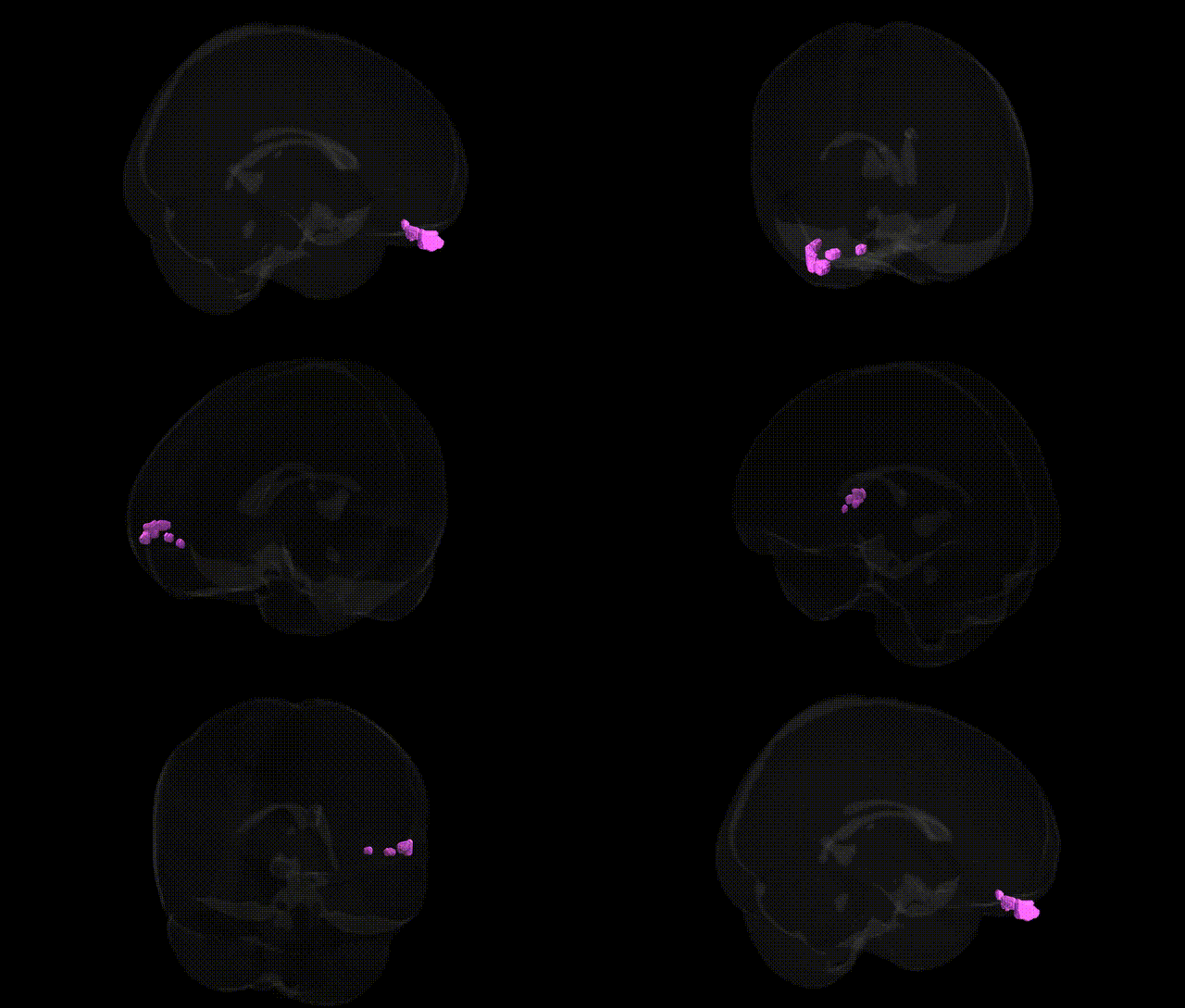
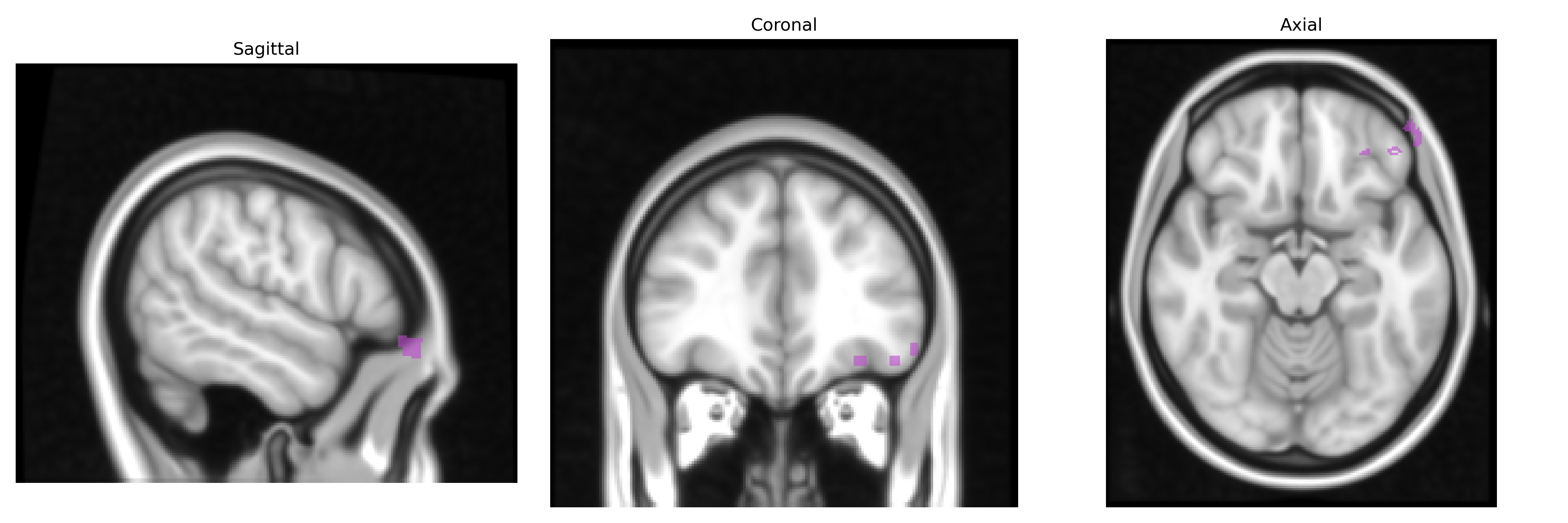
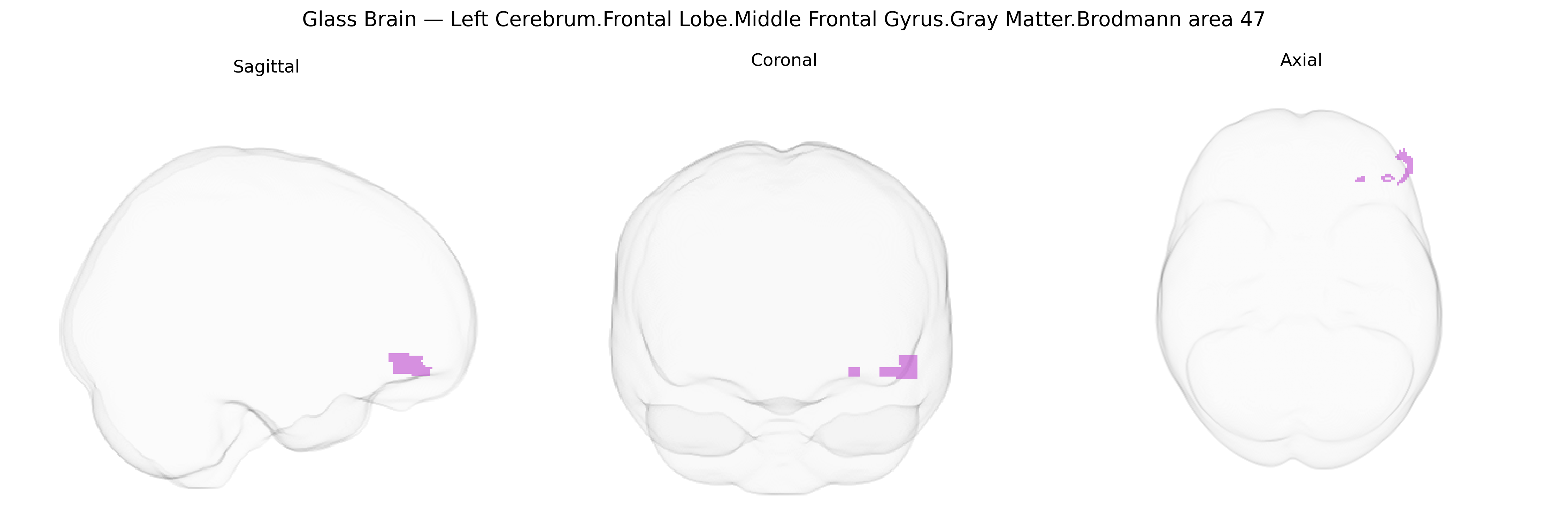
The bilateral Left Cerebrum.Frontal Lobe.Middle Frontal Gyrus.Gray Matter.Brodmann area 47 corresponds to a ventrolateral prefrontal cortical territory located in the inferior portion of the middle frontal gyrus, bordering the orbitofrontal cortex and often considered part of the orbitofrontal or ventrolateral prefrontal region. This area is implicated in higher-order cognitive and affective processes, including semantic processing, language-related functions (especially aspects of syntax and semantic retrieval), decision-making under uncertainty, integration of reward and punishment information, and modulation of emotional responses. It is interconnected with temporal, limbic, and other prefrontal areas, supporting its role in integrating sensory, mnemonic, and affective inputs into goal-directed behavior and complex cognitive evaluation. Related article: Brodmann area 47.
The bilateral left middle frontal gyrus gray matter in Brodmann area 47 (inferior frontal gyrus/ventrolateral prefrontal cortex) has been implicated in genetic studies of language, executive function, and psychiatric risk, though most findings come from broader frontal or inferior frontal regions rather than BA47-specific analyses. GWAS of brain structure report common variants influencing cortical thickness and surface area in frontal regions, including loci near genes such as FOXP2 (speech and language), CNTNAP2 (language and neurodevelopment), and genes involved in synaptic function and neurodevelopment (e.g., GRIN2B, DISC1), which in turn show associations with functional activation in BA47 during language, semantic processing, and response inhibition tasks. Imaging–genetics work links polygenic risk for schizophrenia, bipolar disorder, and major depression to altered frontal gray matter and functional connectivity patterns encompassing BA47, and some risk loci (e.g., CACNA1C, ZNF804A, MIR137-related variants) have been associated with abnormal activation or connectivity in inferior/middle frontal regions during working memory and emotion regulation. BA47 activation and morphology have also been connected to genetic liability for substance use and impulsivity through variants in dopaminergic and glutamatergic genes (e.g., DRD2, COMT), while autism-spectrum and social cognition GWAS and candidate gene studies implicate frontal–temporal circuits including BA47 via synaptic and cell-adhesion genes such as SHANK3 and NRXN1. Overall, genetic influences on BA47 appear to converge on neurodevelopmental, synaptic, and neurotransmitter pathways that contribute to risk for language-related traits, executive dysfunction, and major psychiatric disorders, though few GWAS isolate this Talairach-defined region with high anatomical specificity.
Overview generated by GPT-4o (2026).
Region ID: 409
Hemisphere: bilateral
Atlas: Talairach labels 1mm
Full Quality Version: Download MP4
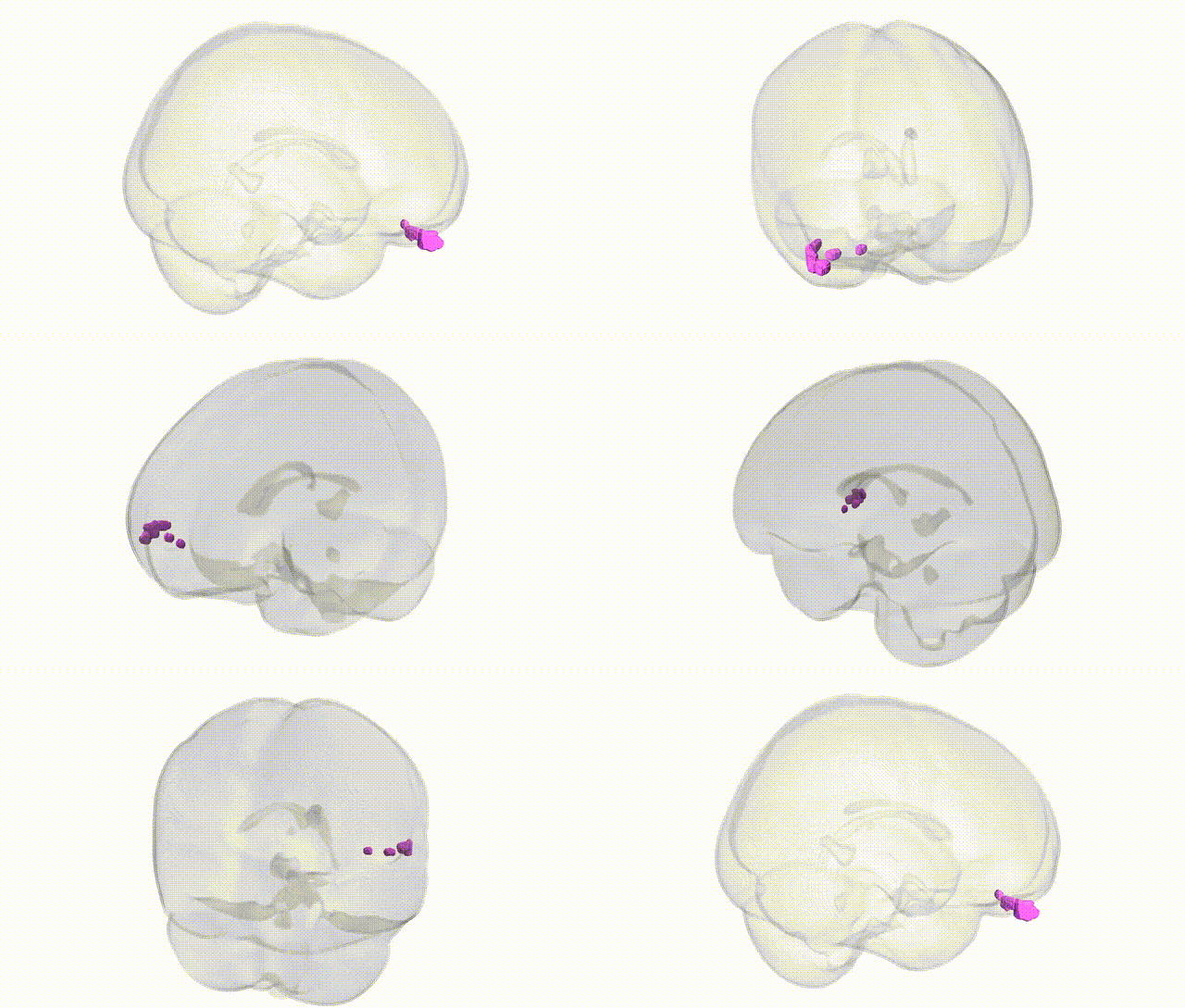
Full Quality Version: Download MP4
Wali Sidiqyar*, Gaurav Rudravaram*, Elyssa M. McMaster, Trent M. Schwartz, Adam M. Saunders, Kurt G. Schilling, Bennett A. Landman "Introducing SPINS: A Shared Public Visualization Library of Neuroanatomical Structures." Medical Imaging with Deep Learning- short paper
This resource is licensed under CC0 1.0 Universal (Public Domain).