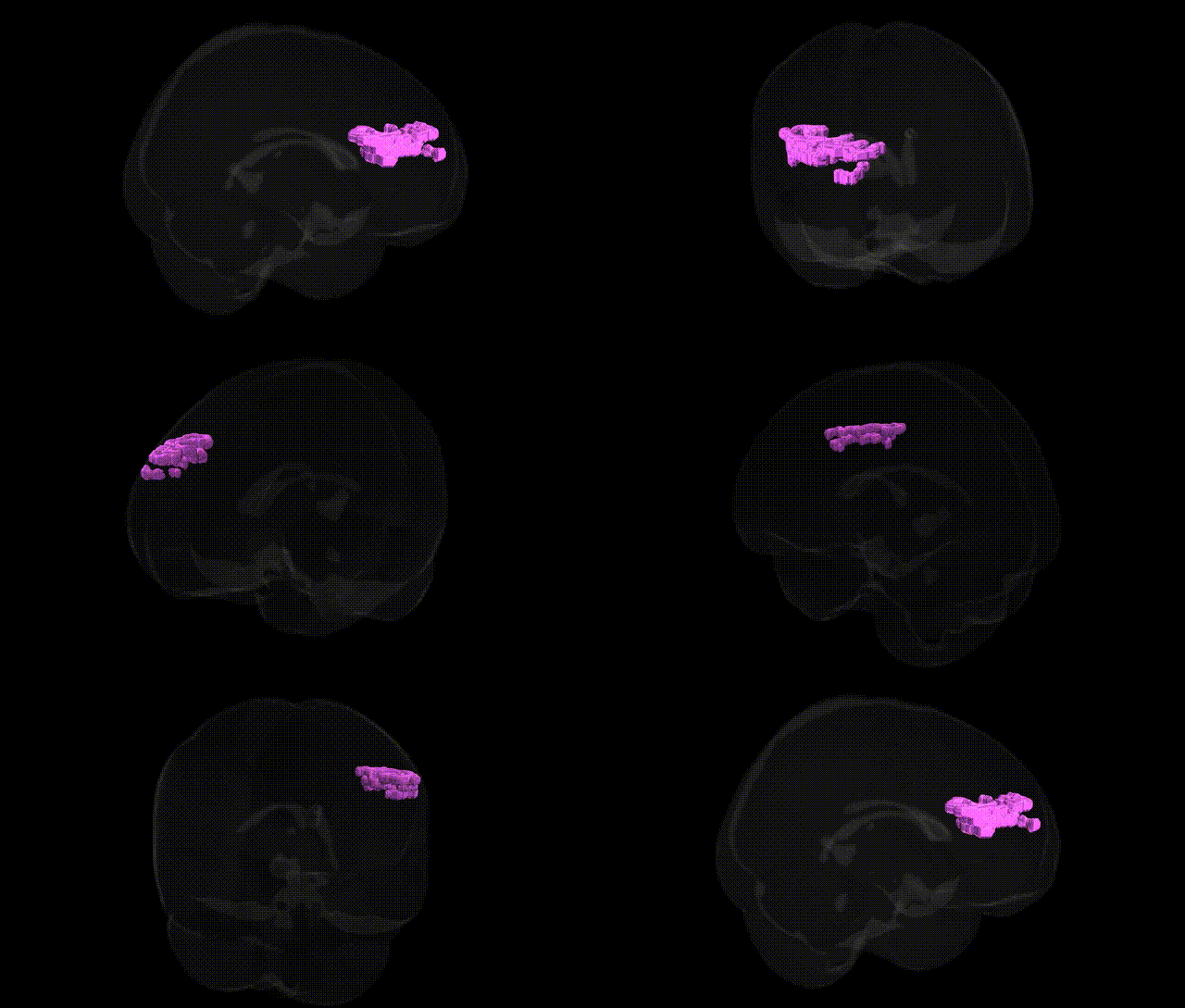
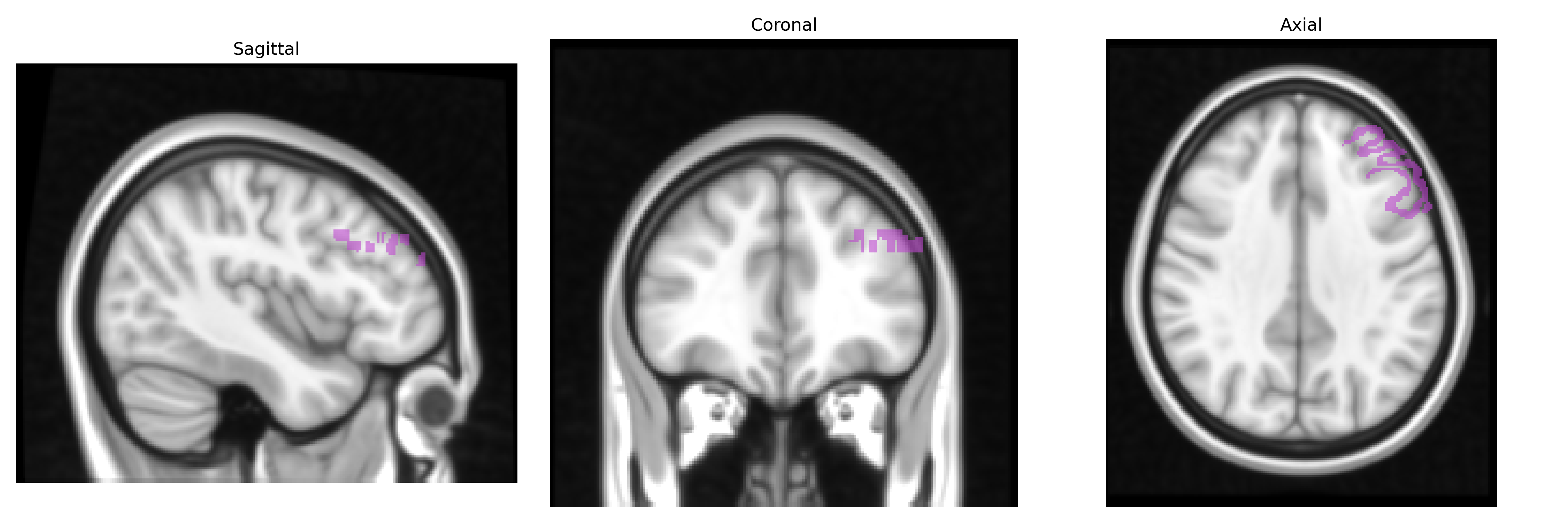
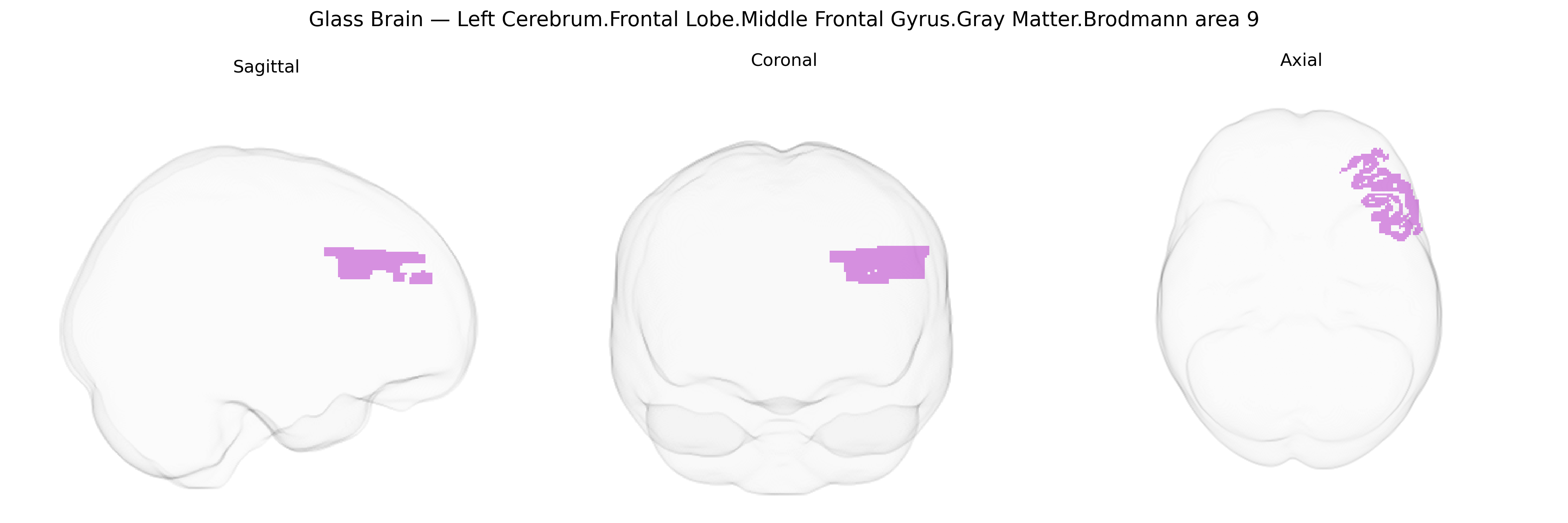
The bilateral Left Cerebrum.Frontal Lobe.Middle Frontal Gyrus.Gray Matter.Brodmann area 9 corresponds to a dorsolateral prefrontal cortical region situated in the middle frontal gyrus anterior to premotor areas and superior to the orbitofrontal cortex, forming part of the executive control network. Cytoarchitectonically defined as Brodmann area 9, it exhibits characteristic granular frontal cortex organization and dense reciprocal connections with other prefrontal fields, posterior parietal cortices, premotor areas, and limbic structures, including the anterior cingulate. Functionally, this region is implicated in higher-order cognitive operations such as working memory, sustained attention, cognitive flexibility, planning, and aspects of metacognition and social cognition (e.g., mentalizing and perspective-taking), as well as top-down modulation of behavior and emotional responses. Brodmann area 9
The bilateral middle frontal gyrus of Brodmann area 9, a dorsolateral prefrontal cortex region in the Talairach 1 mm atlas, has been repeatedly implicated in genetic studies of cognitive control, working memory, and psychiatric vulnerability, with imaging–genetics work showing that common variants in genes such as COMT (e.g., Val158Met), DRD2, and BDNF (e.g., Val66Met) modulate gray matter volume, cortical thickness, or functional activation in this area. Large-scale GWAS of brain morphology (e.g., ENIGMA and UK Biobank consortia) have identified loci near genes involved in neurodevelopment, synaptic signaling, and neuronal differentiation (such as those in the major histocompatibility complex region, microtubule-associated genes, and multiple glutamatergic and GABAergic pathway genes) associated with middle frontal and dorsolateral prefrontal cortical surface area and thickness, although specific SNP-to-region mappings are still evolving. BA9 structural and functional measures show heritability and are genetically correlated with general intelligence (g), educational attainment, and executive function, and they partly mediate genetic risk for disorders such as schizophrenia, bipolar disorder, major depressive disorder, ADHD, and autism spectrum disorder in polygenic risk score studies. Moreover, risk alleles in schizophrenia- and depression-associated loci (including variants in ZNF804A, CACNA1C, and genes regulating calcium signaling and synaptic plasticity) have been linked to altered BA9 activation during working memory and emotion regulation tasks, while neurodegenerative GWAS (e.g., for Alzheimer’s disease and frontotemporal dementia) show that polygenic risk burdens relate to atrophy patterns that prominently involve the middle frontal gyrus, underscoring this region as a key anatomical substrate through which diverse genetic liabilities influence higher-order cognition and psychopathology.
Overview generated by GPT-4o (2026).
Region ID: 943
Hemisphere: bilateral
Atlas: Talairach labels 1mm
Full Quality Version: Download MP4
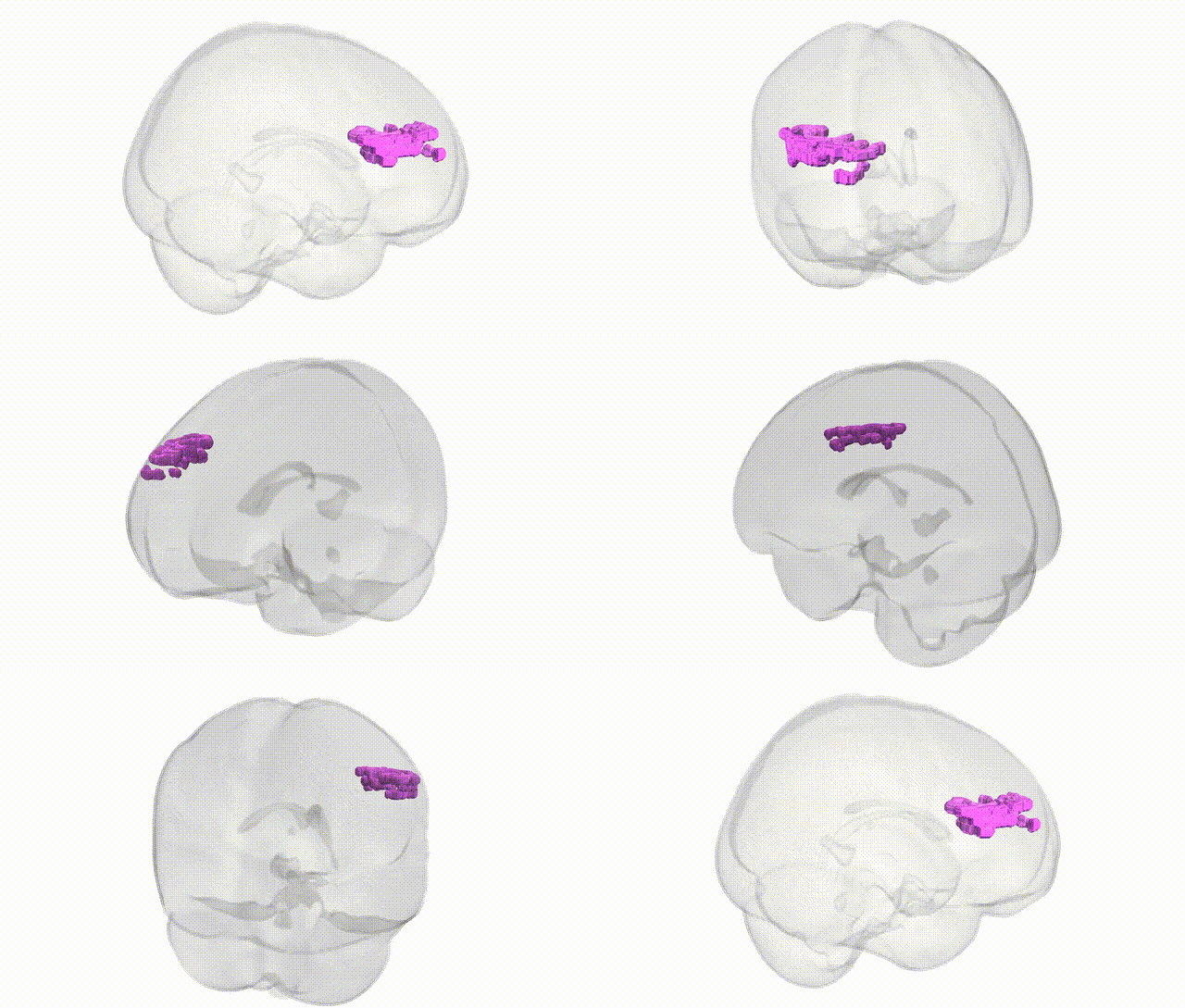
Full Quality Version: Download MP4
Wali Sidiqyar*, Gaurav Rudravaram*, Elyssa M. McMaster, Trent M. Schwartz, Adam M. Saunders, Kurt G. Schilling, Bennett A. Landman "Introducing SPINS: A Shared Public Visualization Library of Neuroanatomical Structures." Medical Imaging with Deep Learning- short paper
This resource is licensed under CC0 1.0 Universal (Public Domain).