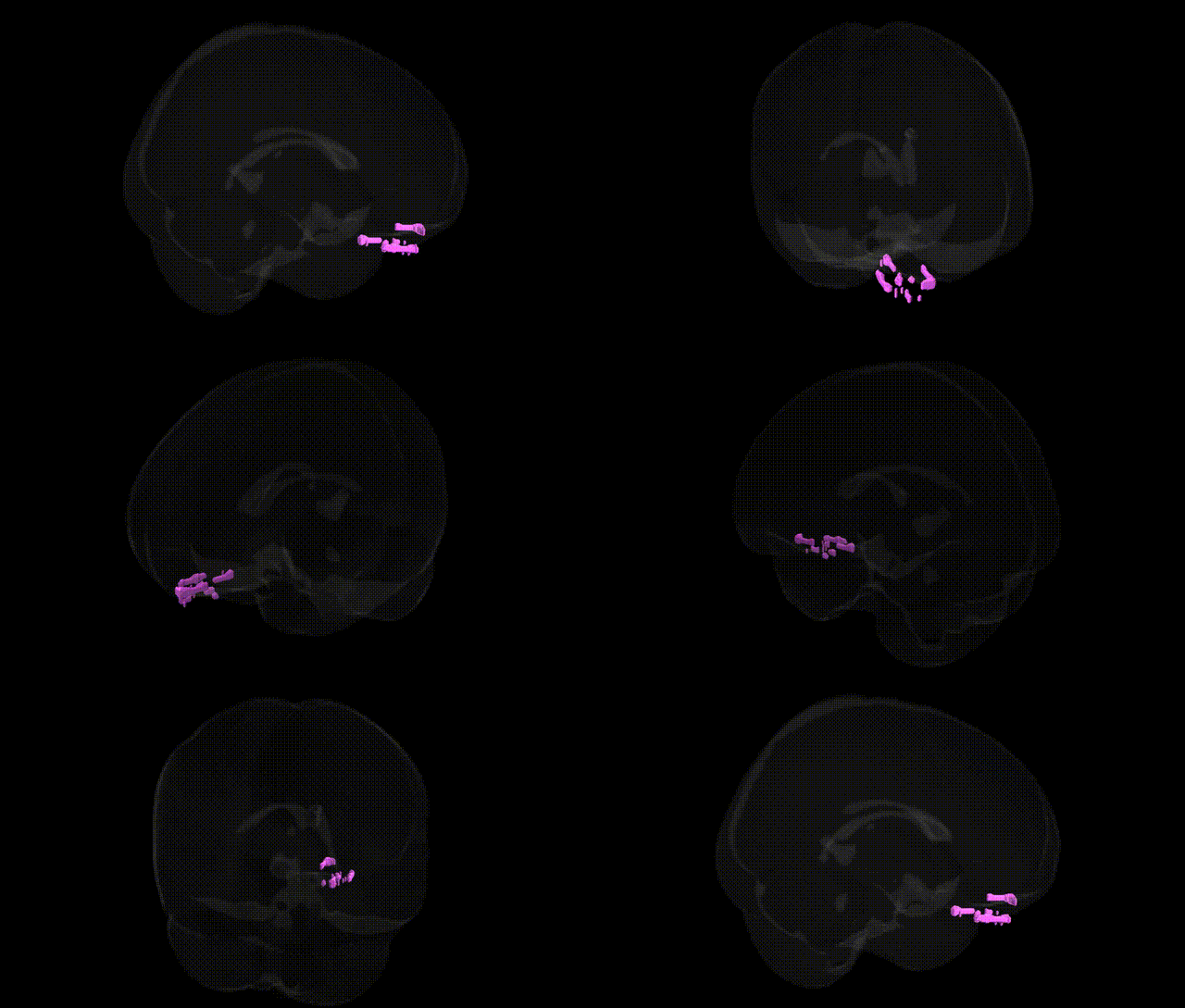
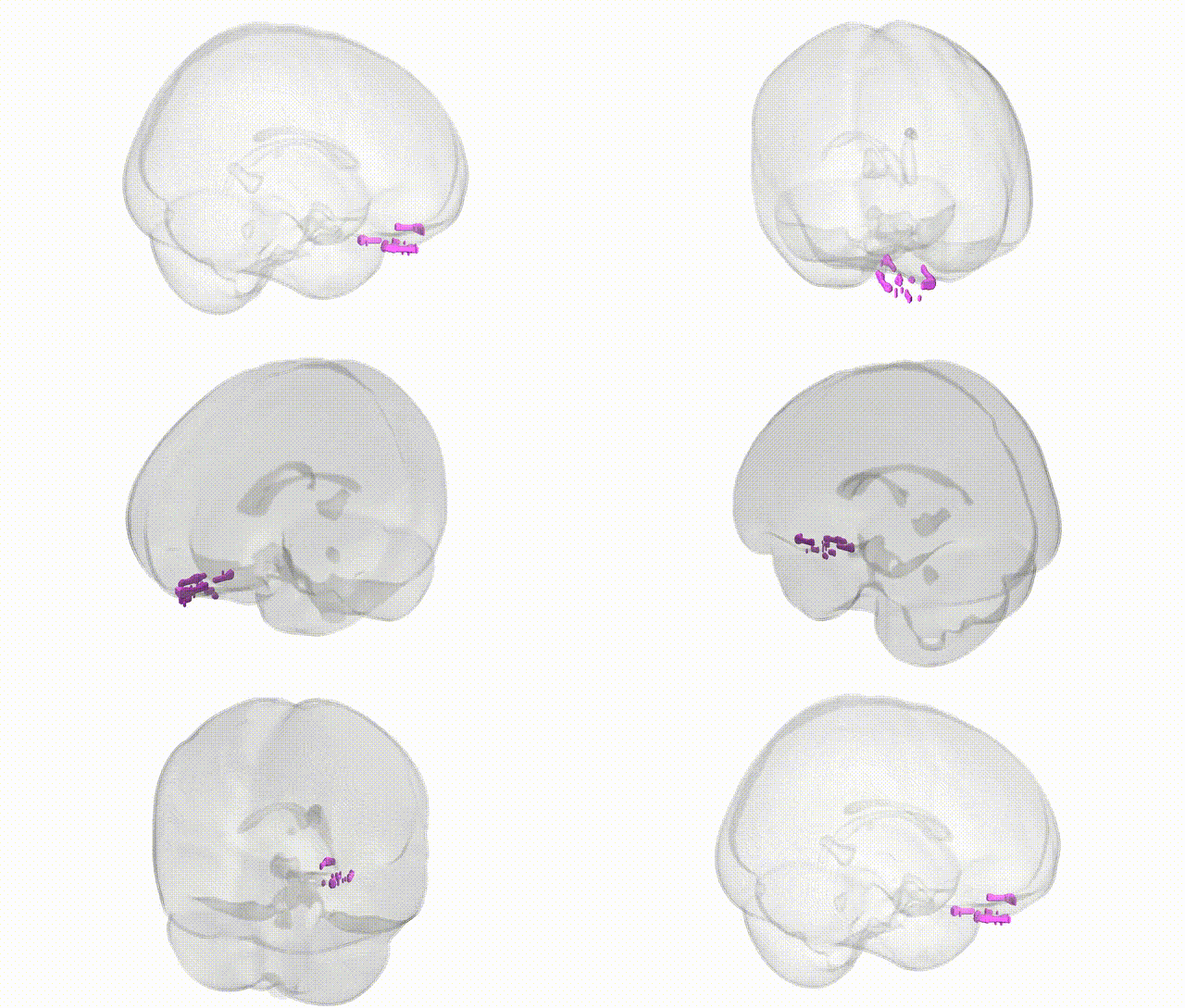
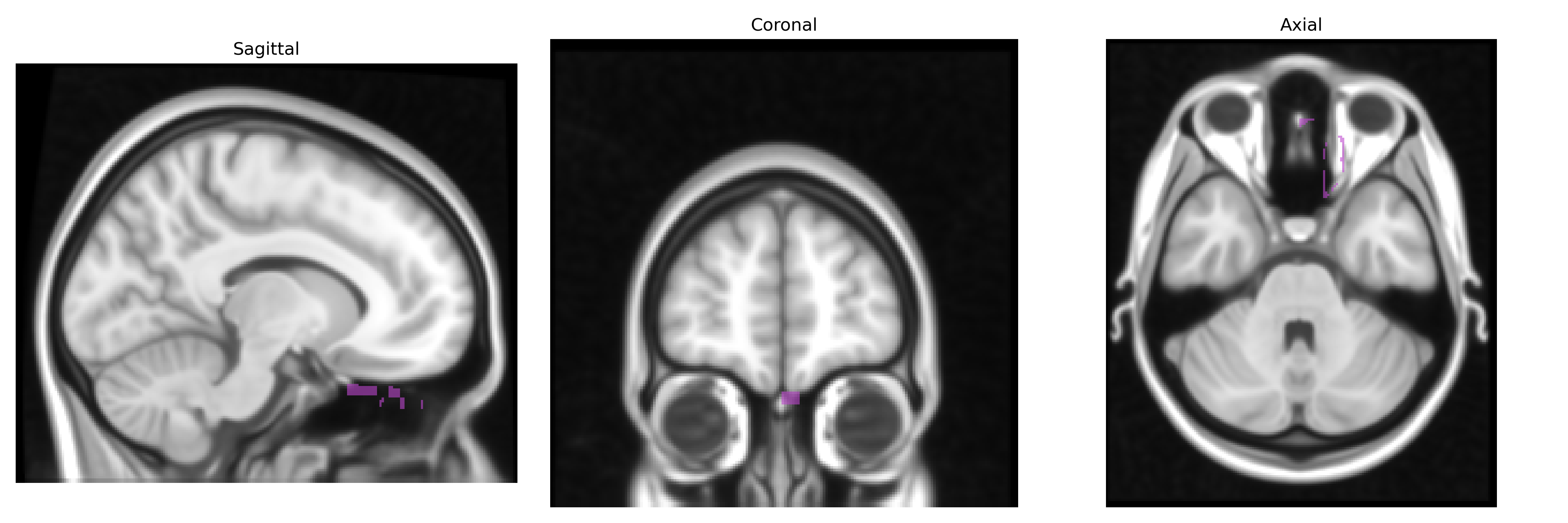
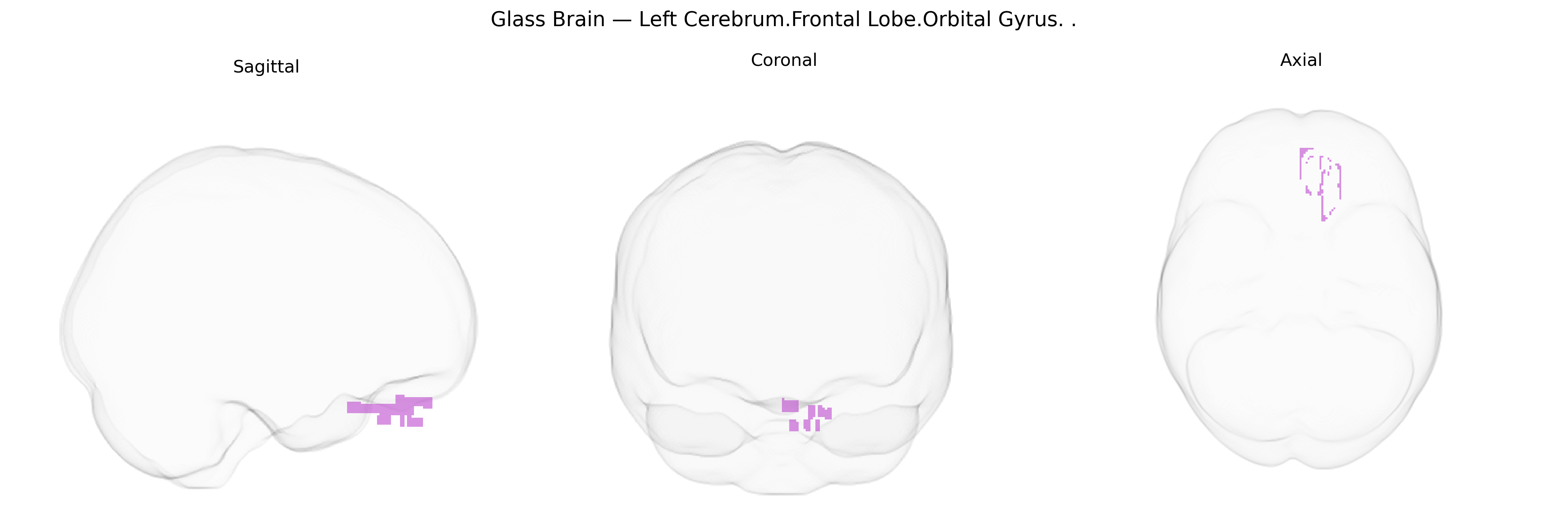
The bilateral Left Cerebrum.Frontal Lobe.Orbital Gyrus refers to cortex located on the ventral (orbital) surface of the frontal lobe, overlying the orbits. This region is part of the orbitofrontal cortex and is involved in higher-order processes including reward evaluation, decision-making, emotion regulation, and the integration of sensory and visceral information to guide adaptive behavior. Neuronal populations here receive extensive inputs from sensory association areas, limbic structures (such as the amygdala), and subcortical reward systems, and in turn project to other prefrontal, limbic, and striatal targets. Damage or dysfunction in the orbital gyri has been associated with impairments in social behavior, altered reward sensitivity, and disinhibition or impulsivity. There is no direct Wikipedia article for this specific Talairach label; a closely related structure is the Orbitofrontal cortex.
The bilateral left orbital frontal gyrus (Left Cerebrum.Frontal Lobe.Orbital Gyrus) is a key component of the orbitofrontal cortex (OFC), and genetic associations identified through imaging–genetics and GWAS broadly implicate this region in reward processing, decision-making, affect regulation, and psychiatric vulnerability. Variants in genes related to monoaminergic signaling (e.g., SLC6A4, DRD2, COMT, MAOA) and neurotrophic or synaptic plasticity pathways (e.g., BDNF, NRG1) have been associated with structural or functional differences in OFC/orbital gyrus, including altered gray matter volume, cortical thickness, and activation during reward, punishment, and emotional tasks. Large-scale neuroimaging GWAS consortia (such as ENIGMA and UK Biobank–based studies) have reported polygenic influences on orbitofrontal morphology, showing that polygenic risk scores for major depressive disorder, bipolar disorder, schizophrenia, and autism spectrum disorder correlate with variations in OFC structure and connectivity, including in orbital gyri. OFC/orbital gyrus abnormalities linked to specific risk variants or polygenic profiles have been reported in mood and anxiety disorders, obsessive–compulsive disorder, substance use disorders, and impulse-control related traits, with dopaminergic, glutamatergic, and GABAergic genes frequently implicated. Some GWAS of personality and behavioral traits (e.g., neuroticism, risk-taking, impulsivity) identify loci whose effects appear partially mediated by orbitofrontal/orbital gyrus structure and function, and imaging–genetics studies suggest that genetic risk for metabolic and body-weight traits (e.g., FTO and other obesity-related loci) may influence OFC responses to food cues. Overall, the left orbital frontal gyrus emerges as a convergence point where polygenic variation affecting neurotransmission, synaptic development, and cortical maturation contributes to vulnerability to psychiatric and behavioral phenotypes, though most findings are regionally defined at the level of broader OFC rather than the specific Talairach “Left Cerebrum.Frontal Lobe.Orbital Gyrus” label.
Overview generated by GPT-4o (2026).
Region ID: 105
Hemisphere: bilateral
Atlas: Talairach labels 1mm
Full Quality Version: Download MP4
Full Quality Version: Download MP4
Wali Sidiqyar*, Gaurav Rudravaram*, Elyssa M. McMaster, Trent M. Schwartz, Adam M. Saunders, Kurt G. Schilling, Bennett A. Landman "Introducing SPINS: A Shared Public Visualization Library of Neuroanatomical Structures." Medical Imaging with Deep Learning- short paper
This resource is licensed under CC0 1.0 Universal (Public Domain).