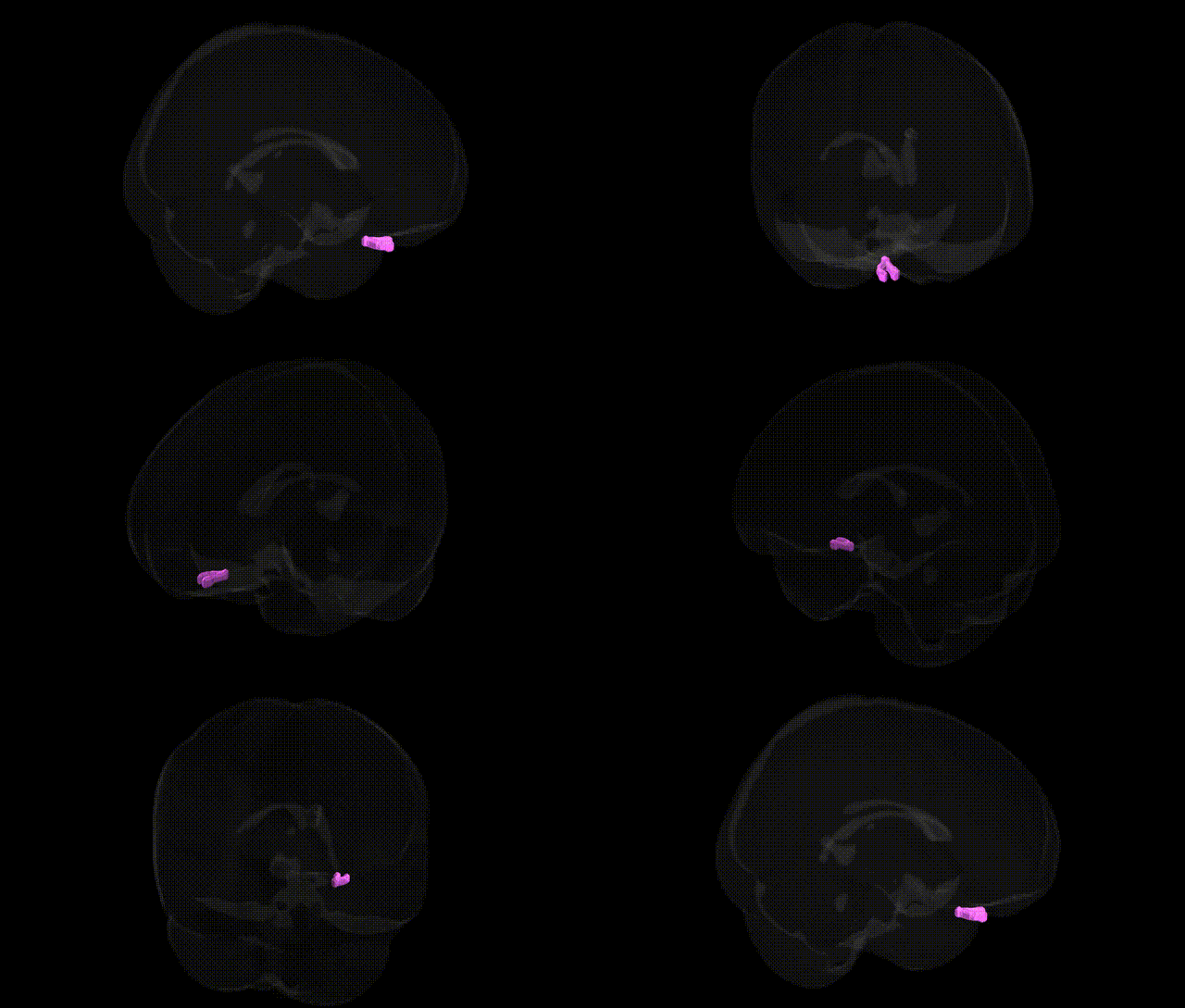
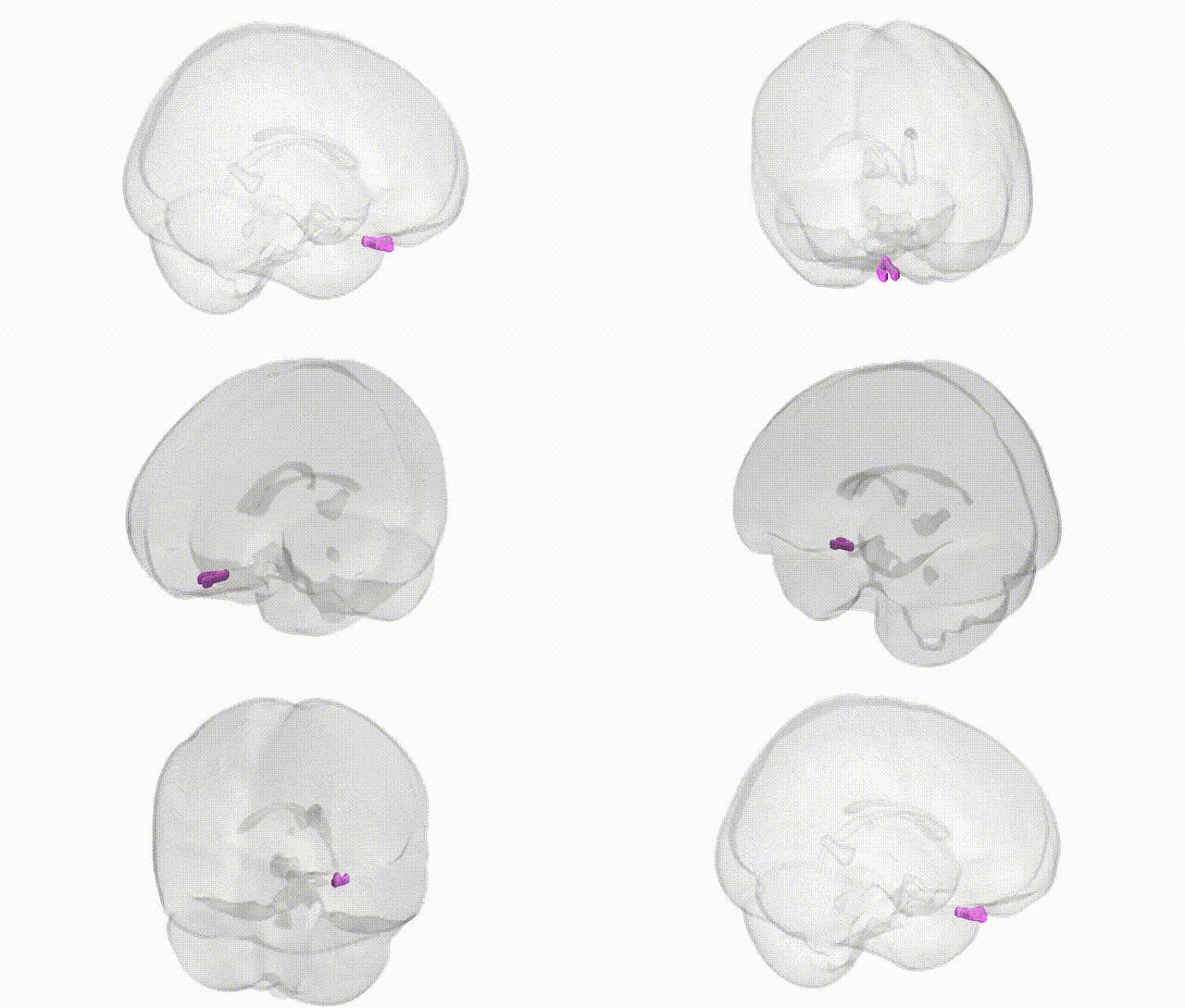
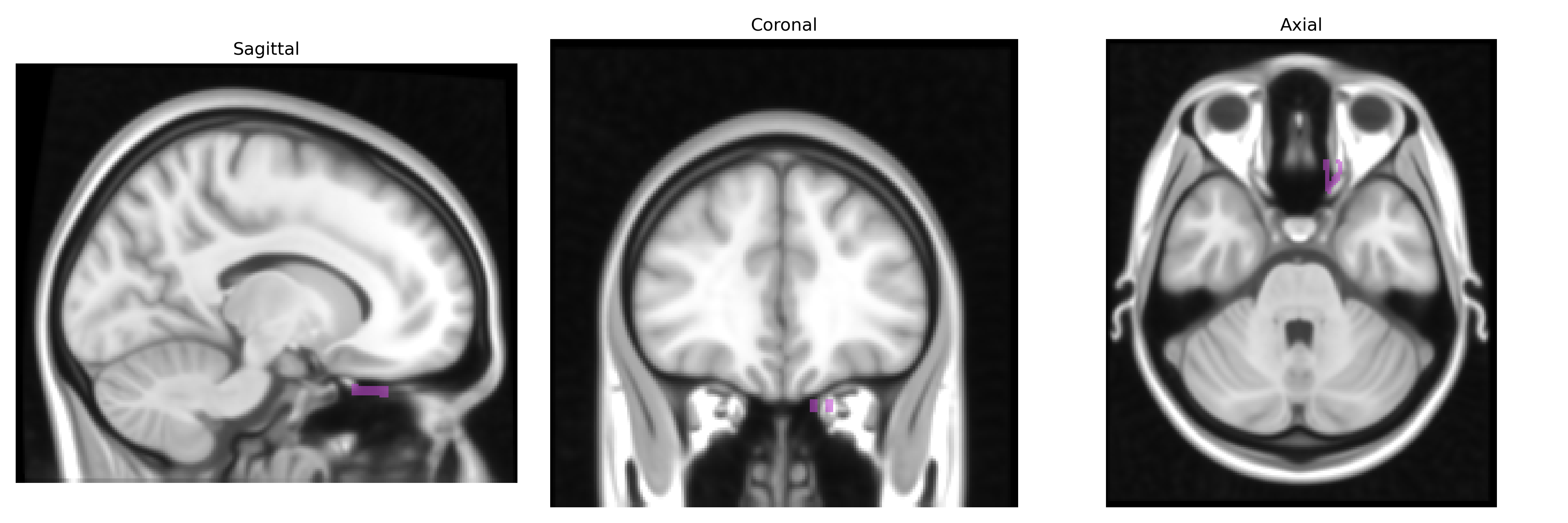
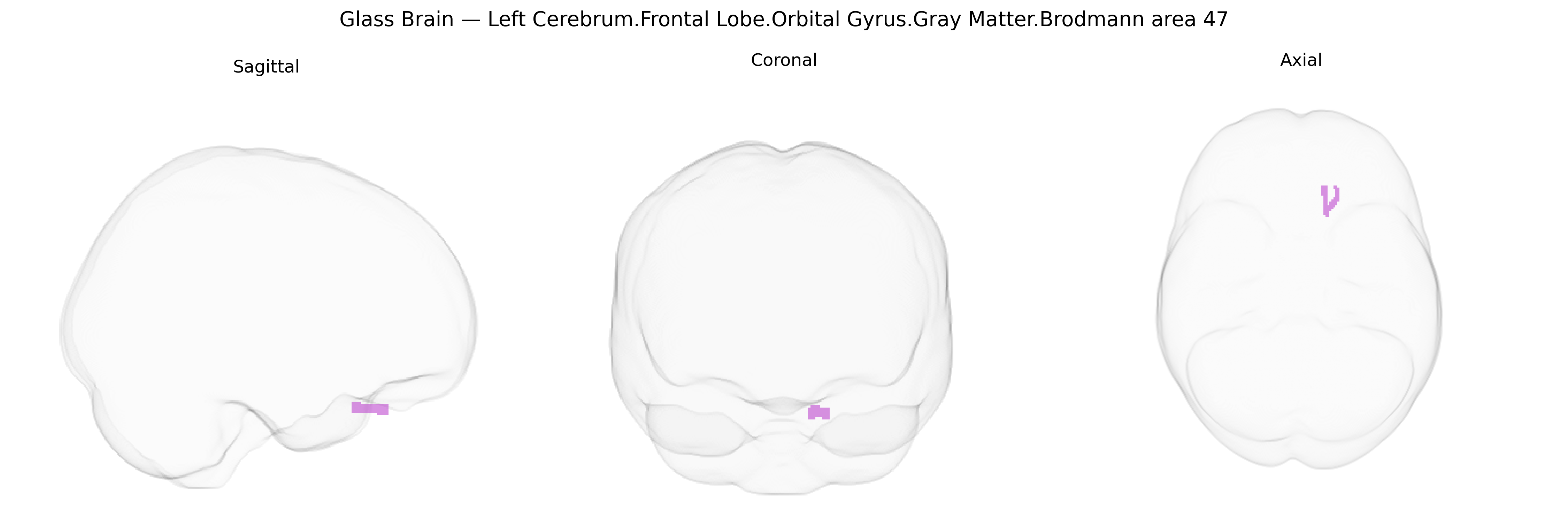
The bilateral Left Cerebrum.Frontal Lobe.Orbital Gyrus.Gray Matter.Brodmann area 47 corresponds to the ventrolateral portion of the orbitofrontal cortex (OFC), situated on the inferior surface of the frontal lobe above the orbits. This association cortex region is characterized cytoarchitectonically by Brodmann area 47 and is implicated in higher-order cognitive and affective functions, including reward evaluation, decision-making, language processing (particularly semantic and syntactic aspects), and the integration of emotional and sensory information to guide behavior. It maintains extensive connections with limbic structures, other prefrontal regions, temporal association cortices, and sensory areas, supporting roles in adaptive learning, social cognition, and the modulation of goal-directed actions in response to changing environmental contingencies. There is no direct link for this exact composite label; a related structure is the Orbitofrontal cortex.
Brodmann area 47 (inferior frontal/orbitofrontal cortex) shows convergent genetic associations from GWAS and imaging-genetics studies, particularly for psychiatric and cognitive phenotypes: common variants influencing cortical thickness and surface area in this region have been identified in large ENIGMA and UK Biobank analyses, implicating loci near genes such as HMGA2, MAPT, and others involved in neurodevelopment, synaptic function, and neuronal migration; polygenic risk scores for schizophrenia, bipolar disorder, major depressive disorder, and autism spectrum disorder have been associated with structural and functional alterations in BA47, which is frequently implicated in meta-analytic maps of genetic liability for these conditions. Variants in serotonin (e.g., SLC6A4/5-HTTLPR) and dopamine-related genes (e.g., DRD2, COMT) have been linked to orbitofrontal and inferior frontal activation patterns and gray-matter differences during tasks involving emotion regulation, reward processing, and inhibitory control, while GWAS of impulsivity, risk-taking, and substance use disorders often highlight frontal–orbitofrontal networks that include BA47. This region’s gray matter and activation have also been associated with genetic risk for obsessive–compulsive disorder and anxiety traits, as well as language-related phenotypes (e.g., semantic processing, verbal fluency) in imaging-genetics work, reflecting BA47’s role in semantic integration and affective evaluation. Although Talairach label “Left Cerebrum.Frontal Lobe.Orbital Gyrus.Gray Matter.BA47” is anatomically specific, most large-scale genetic studies operate at coarser parcellations, so current evidence largely maps to the broader left inferior frontal/orbitofrontal territory rather than to this exact Talairach-defined subregion.
Overview generated by GPT-4o (2026).
Region ID: 146
Hemisphere: bilateral
Atlas: Talairach labels 1mm
Full Quality Version: Download MP4
Full Quality Version: Download MP4
Wali Sidiqyar*, Gaurav Rudravaram*, Elyssa M. McMaster, Trent M. Schwartz, Adam M. Saunders, Kurt G. Schilling, Bennett A. Landman "Introducing SPINS: A Shared Public Visualization Library of Neuroanatomical Structures." Medical Imaging with Deep Learning- short paper
This resource is licensed under CC0 1.0 Universal (Public Domain).