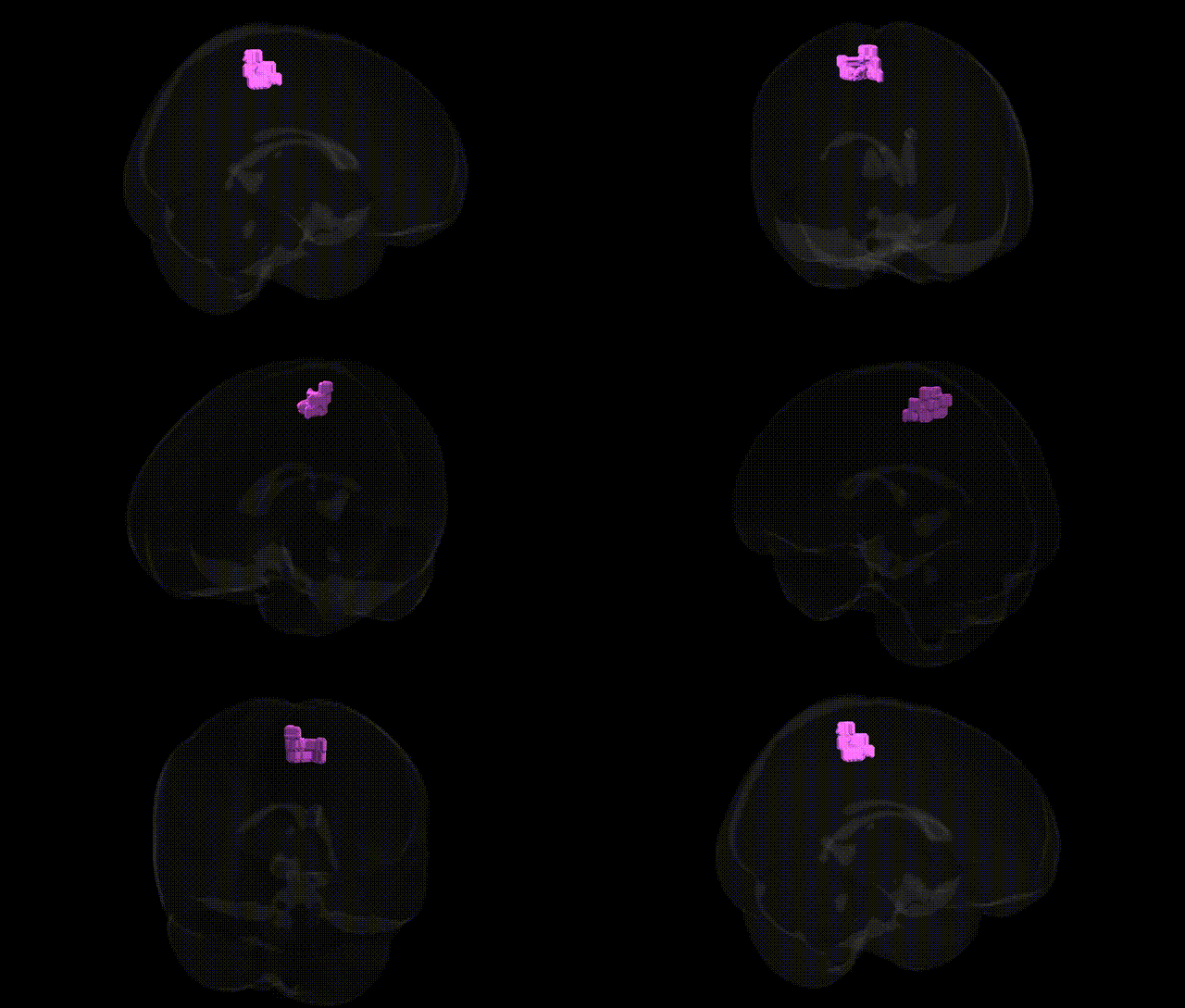
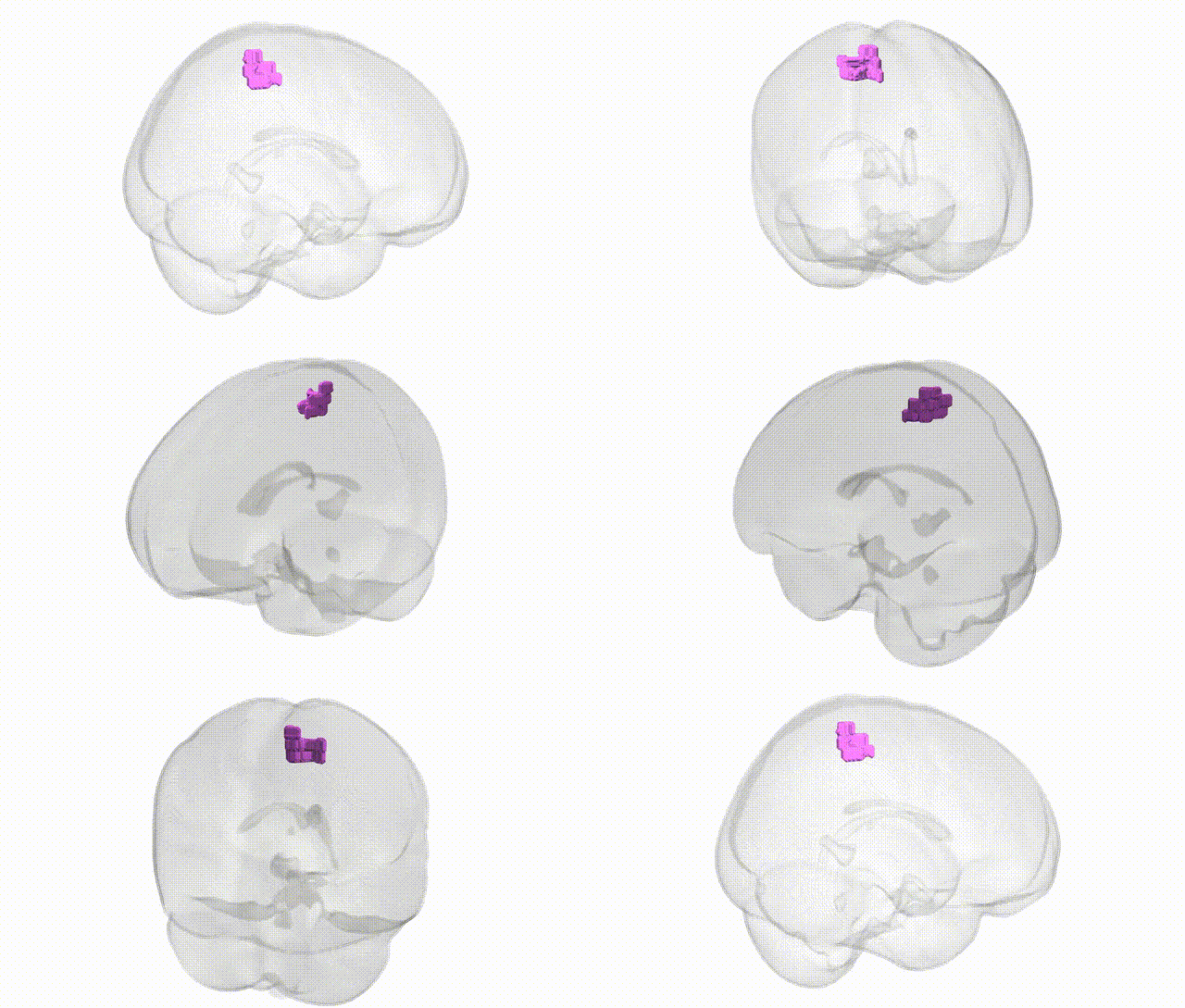
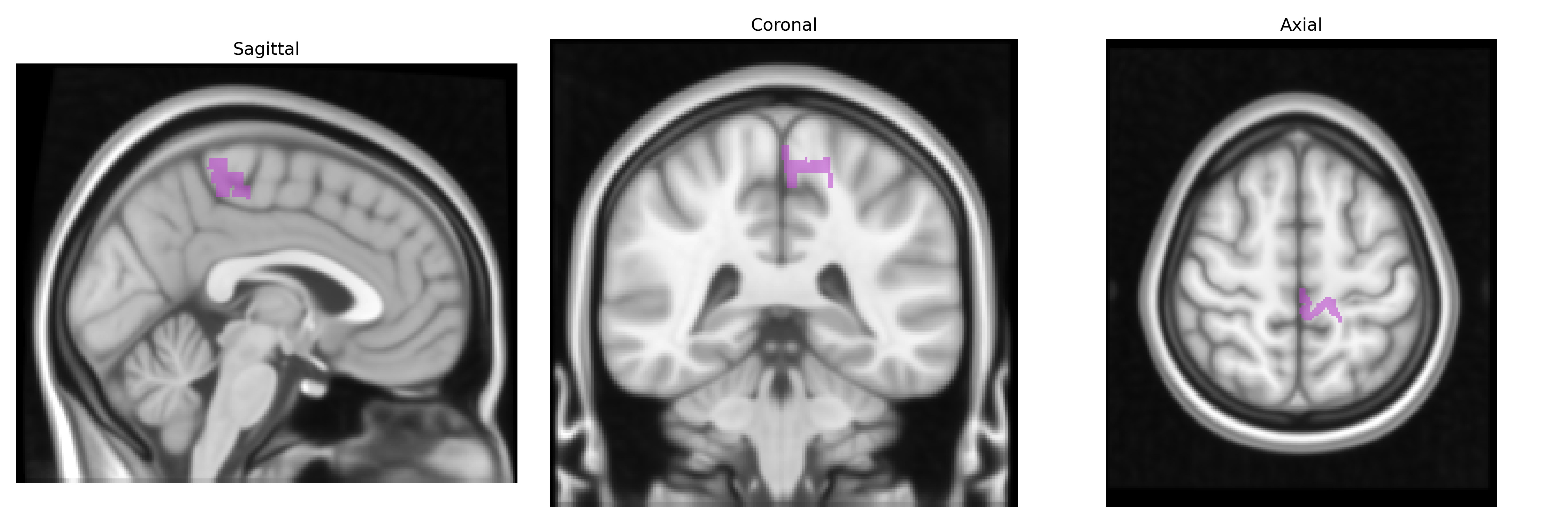
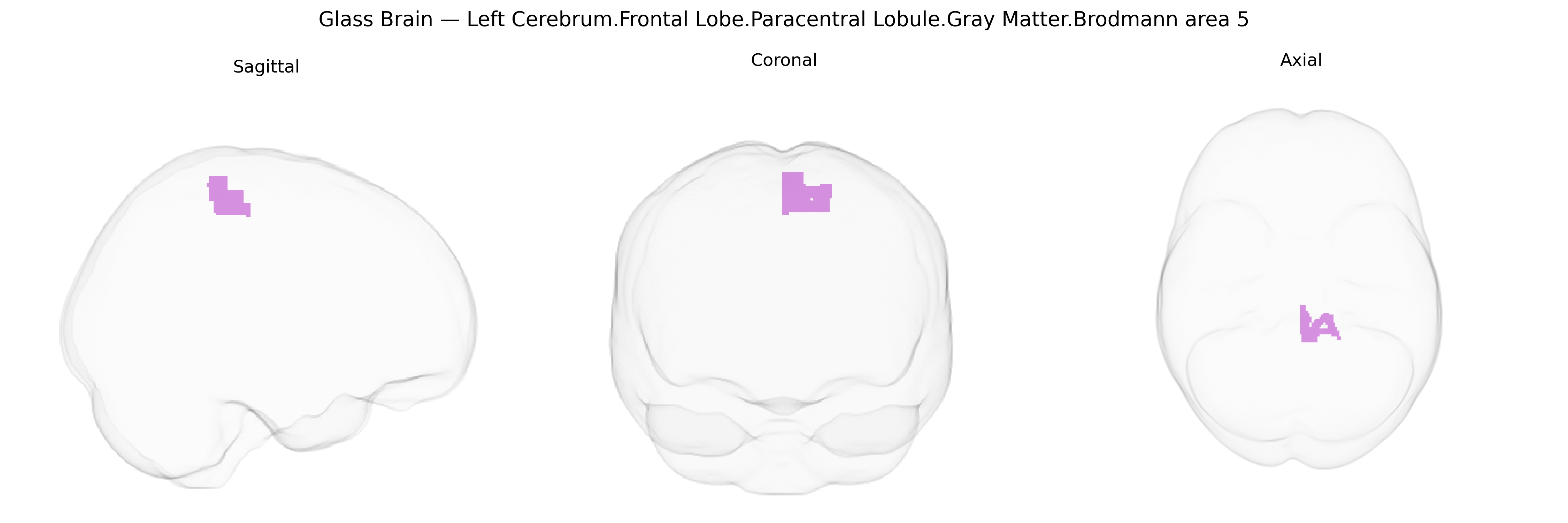
The bilateral Left Cerebrum.Frontal Lobe.Paracentral Lobule.Gray Matter.Brodmann area 5 corresponds to a portion of the superior frontal/paracentral region that extends onto the medial surface of the hemisphere and forms part of the posterior frontal lobe bordering the parietal cortex. Histologically defined as Brodmann area 5, it is a higher-order somatosensory association region that receives dense input from primary and secondary somatosensory cortices and integrates proprioceptive and tactile information to support sensorimotor coordination, body schema representation, and planning of complex movements, particularly involving the lower limb and trunk. Functionally, this region participates in transforming somatosensory signals into motor-relevant representations and contributes to tasks requiring spatial guidance of movement and integration of sensory feedback with voluntary action. No direct Wikipedia article exists for this exact composite label; a related structure is Brodmann area 5.
The bilateral left paracentral lobule (Talairach 1 mm atlas: Left Cerebrum.Frontal Lobe.Paracentral Lobule.Gray Matter.Brodmann area 5) has been implicated in several genetic and genome‑wide association studies through its roles in sensorimotor integration, somatotopy, and motor control of the lower limbs and pelvic floor. Imaging‑genetics and GWAS of cortical thickness and surface area repeatedly implicate common variants in neurodevelopmental genes such as MIR137, MAPT, and genes in the WNT and FGF signaling pathways as influencing paracentral morphology, while large ENIGMA‑consortium analyses show heritable variation in this region’s structure associated with polygenic scores for education, intelligence, and general cognitive ability. Paracentral gray matter alterations and volume differences linked to risk alleles have been reported in schizophrenia and bipolar disorder (for example, in association with CACNA1C and ZNF804A), major depressive disorder polygenic burden, and autism‑spectrum–related loci, suggesting that genetic risk for psychiatric illness partly converges on this sensorimotor and higher‑order integration area. Motor‑system GWAS and imaging studies connect variants near or within genes involved in cortico‑spinal tract development and myelination (e.g., NTRK2, CNTNAP2, and oligodendrocyte‑related genes) with structural and functional measures in the paracentral lobule, consistent with its central role in voluntary lower‑limb and sphincter control; this overlaps with genetic risk architectures for traits such as gait speed, balance, continence, and, in some studies, multiple sclerosis and other demyelinating or motor neuron disorders that show paracentral involvement on imaging.
Overview generated by GPT-4o (2026).
Region ID: 1068
Hemisphere: bilateral
Atlas: Talairach labels 1mm
Full Quality Version: Download MP4
Full Quality Version: Download MP4
Wali Sidiqyar*, Gaurav Rudravaram*, Elyssa M. McMaster, Trent M. Schwartz, Adam M. Saunders, Kurt G. Schilling, Bennett A. Landman "Introducing SPINS: A Shared Public Visualization Library of Neuroanatomical Structures." Medical Imaging with Deep Learning- short paper
This resource is licensed under CC0 1.0 Universal (Public Domain).