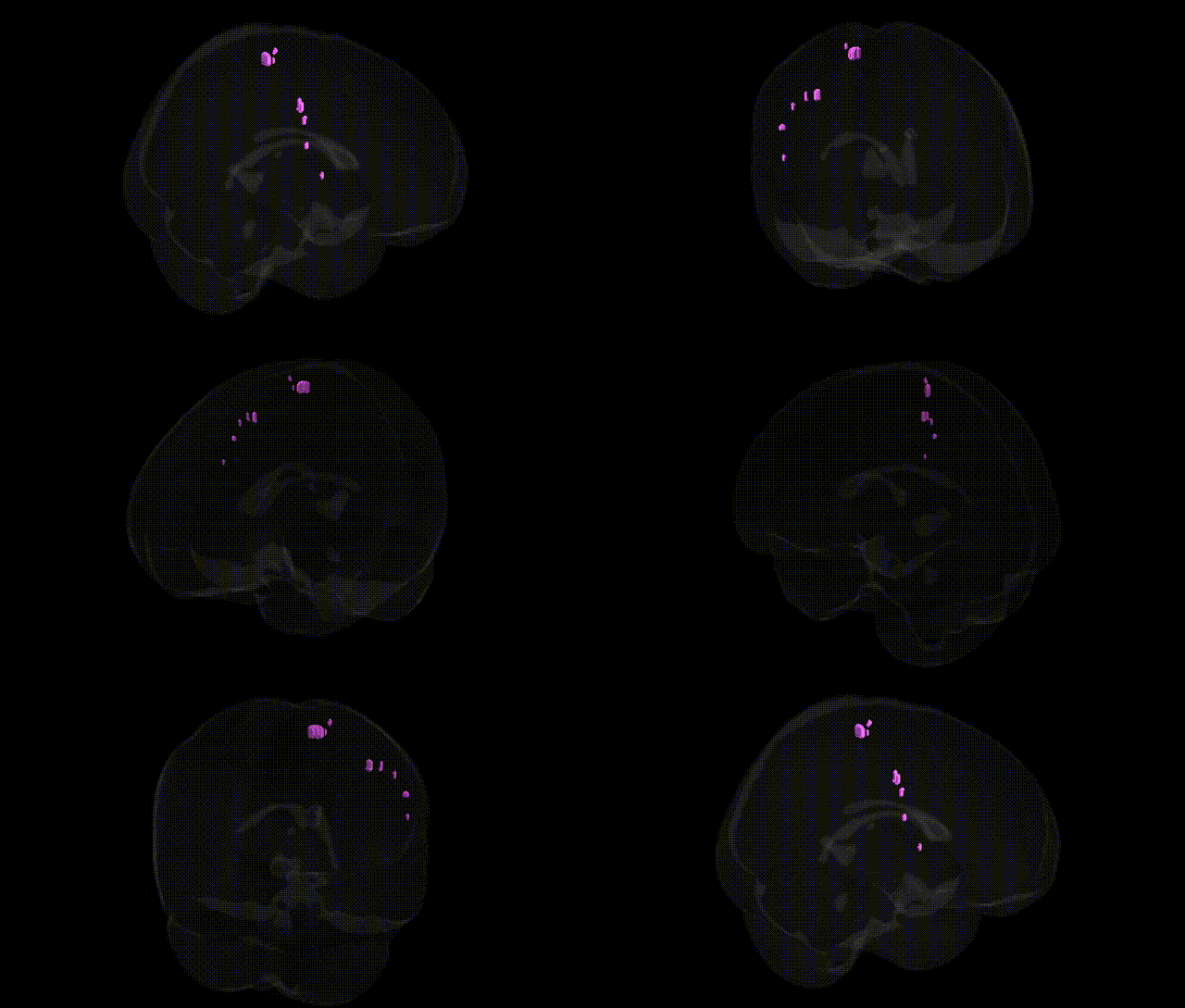
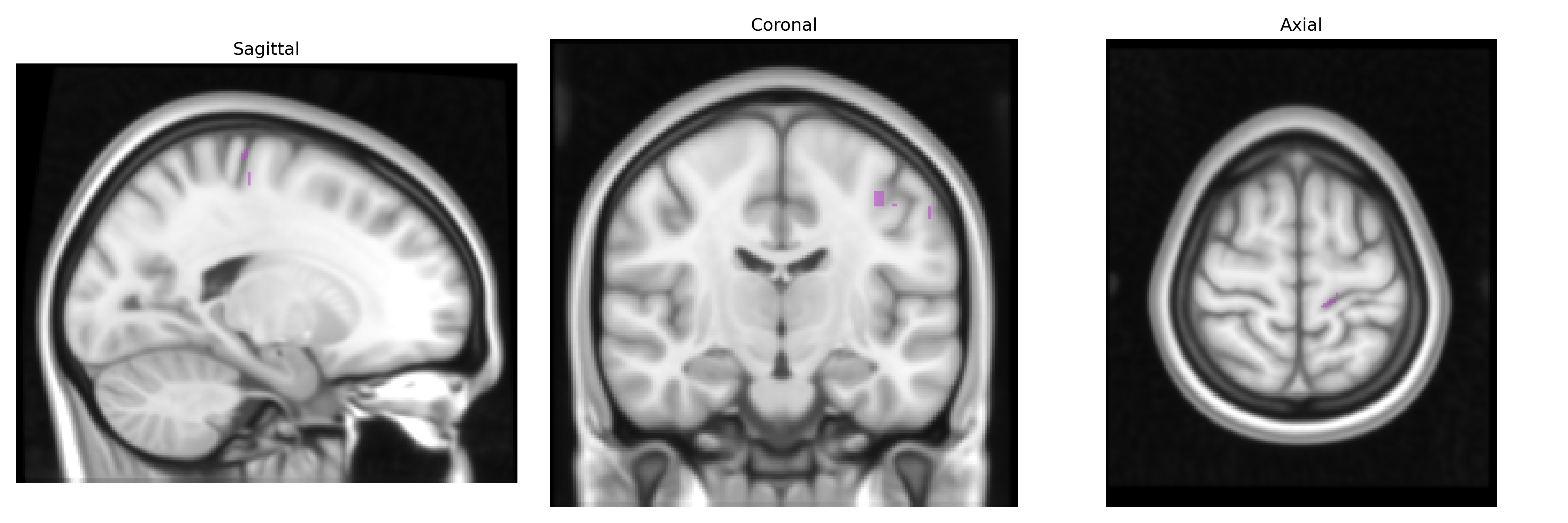
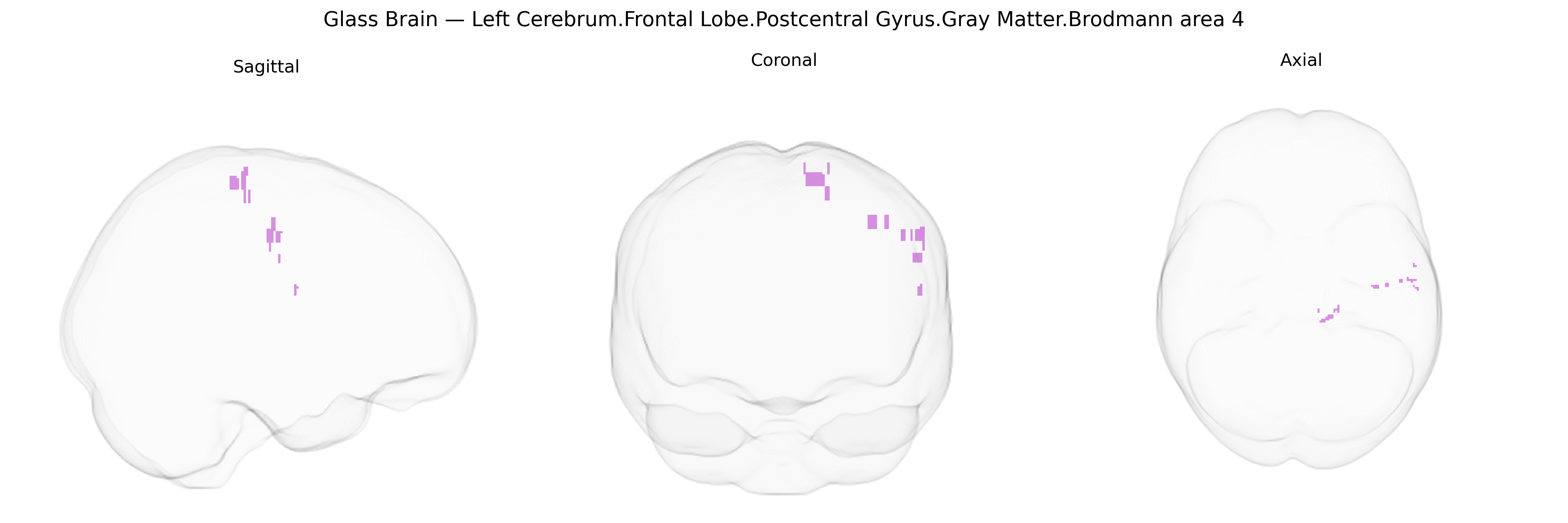
The bilateral Left Cerebrum.Frontal Lobe.Postcentral Gyrus.Gray Matter.Brodmann area 4, as labeled in the Talairach 1 mm Atlas, corresponds functionally to the primary motor cortex, which is more commonly situated in the precentral gyrus of the frontal lobe; the “postcentral” designation here reflects atlas nomenclature or minor registration variation rather than a distinct anatomical entity. Brodmann area 4 is a granular to agranular cortical field characterized by a prominent layer V containing large pyramidal (Betz) cells whose axons form a major component of the corticospinal and corticobulbar tracts, subserving voluntary control of contralateral skeletal musculature in a somatotopically organized fashion (motor homunculus). This region integrates descending motor commands with sensory feedback to produce fine, fractionated movements, particularly of the distal limbs, face, and tongue, and is critically involved in the initiation and execution of purposeful motor behavior. There is no direct Wikipedia article for this exact Talairach composite label; a closely related structure is the Primary motor cortex.
The bilateral left cerebrum frontal lobe/postcentral gyrus gray matter region corresponding roughly to Brodmann area 4 (primary motor cortex) has been implicated in several genetic and GWAS-based associations, though most findings reference primary motor or precentral rather than “postcentral” labels in Talairach space. Variants in genes affecting motor system development and function (for example, BDNF, CNTNAP2, and dopaminergic genes such as DRD2/DRD3) have been associated with structural and functional differences in primary motor cortex volume, thickness, and activation, as shown in imaging–genetics studies. Large-scale ENIGMA and UK Biobank GWAS of cortical morphology have identified multiple loci (e.g., near genes such as HMGA2, MIRSNP-containing regions, and neurodevelopmental genes including those involved in axon guidance and synaptic formation) associated with motor cortex surface area and thickness, although these are typically reported at the level of precentral gyrus or global motor regions rather than a specific Talairach-defined BA4 parcel. Clinically, genetic factors influencing this region have been linked to motor-related disorders, including amyotrophic lateral sclerosis, hereditary spastic paraplegia, and some forms of dystonia, where risk variants or familial mutations are associated with motor neuron and corticospinal tract degeneration that prominently affects primary motor cortex. In addition, polygenic risk scores for neurodevelopmental and psychiatric conditions such as ADHD and schizophrenia have shown associations with altered motor cortex structure or connectivity, suggesting that common variants contributing to these disorders also shape BA4-related motor circuitry; however, precise gene–region mappings at the level of the Talairach 1 mm “Left Cerebrum.Frontal Lobe.Postcentral Gyrus.Gray Matter.Brodmann area 4” label remain indirect and are typically inferred from broader motor cortex GWAS and imaging–genetics analyses rather than region-specific genetic studies.
Overview generated by GPT-4o (2026).
Region ID: 835
Hemisphere: bilateral
Atlas: Talairach labels 1mm
Full Quality Version: Download MP4
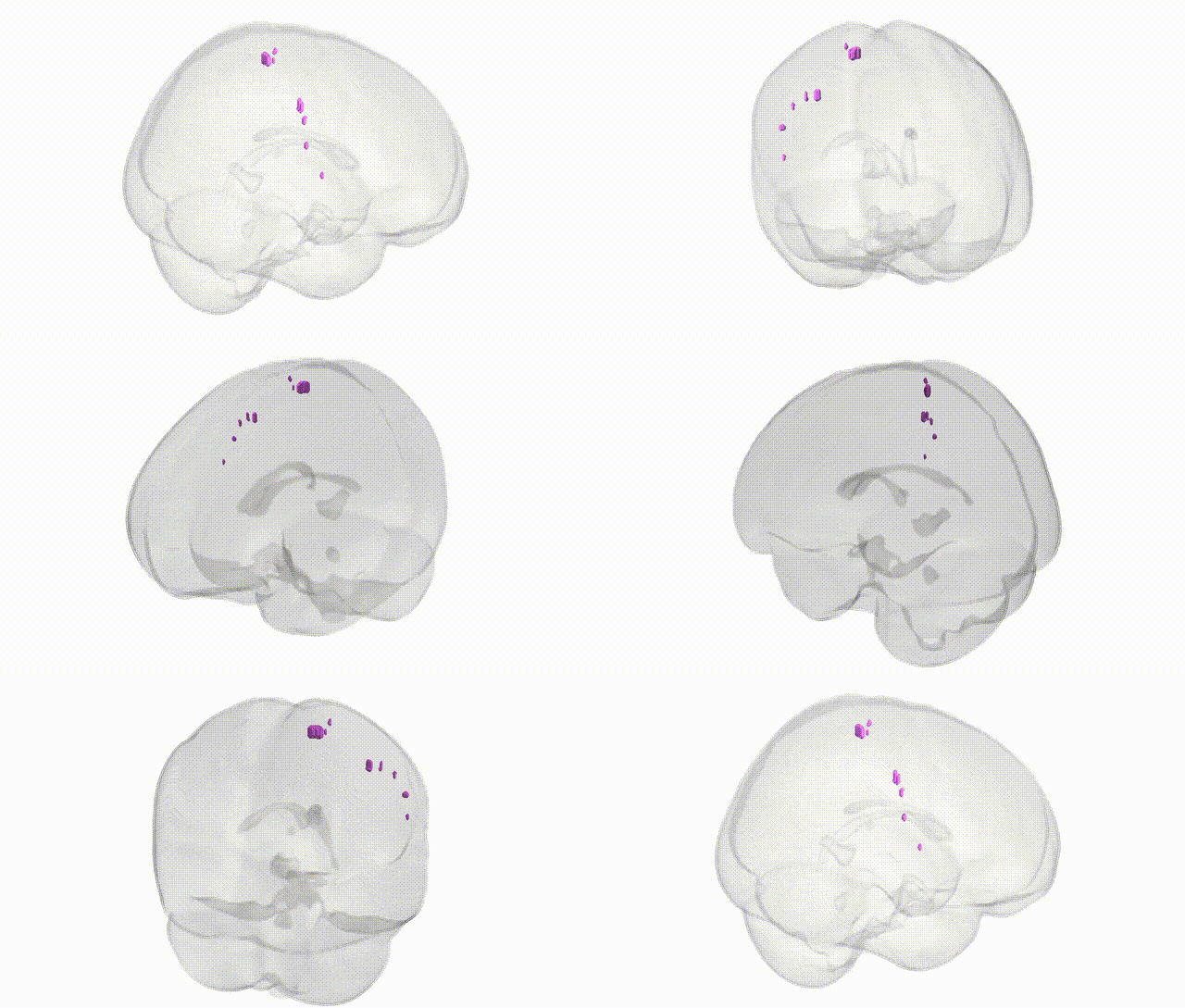
Full Quality Version: Download MP4
Wali Sidiqyar*, Gaurav Rudravaram*, Elyssa M. McMaster, Trent M. Schwartz, Adam M. Saunders, Kurt G. Schilling, Bennett A. Landman "Introducing SPINS: A Shared Public Visualization Library of Neuroanatomical Structures." Medical Imaging with Deep Learning- short paper
This resource is licensed under CC0 1.0 Universal (Public Domain).