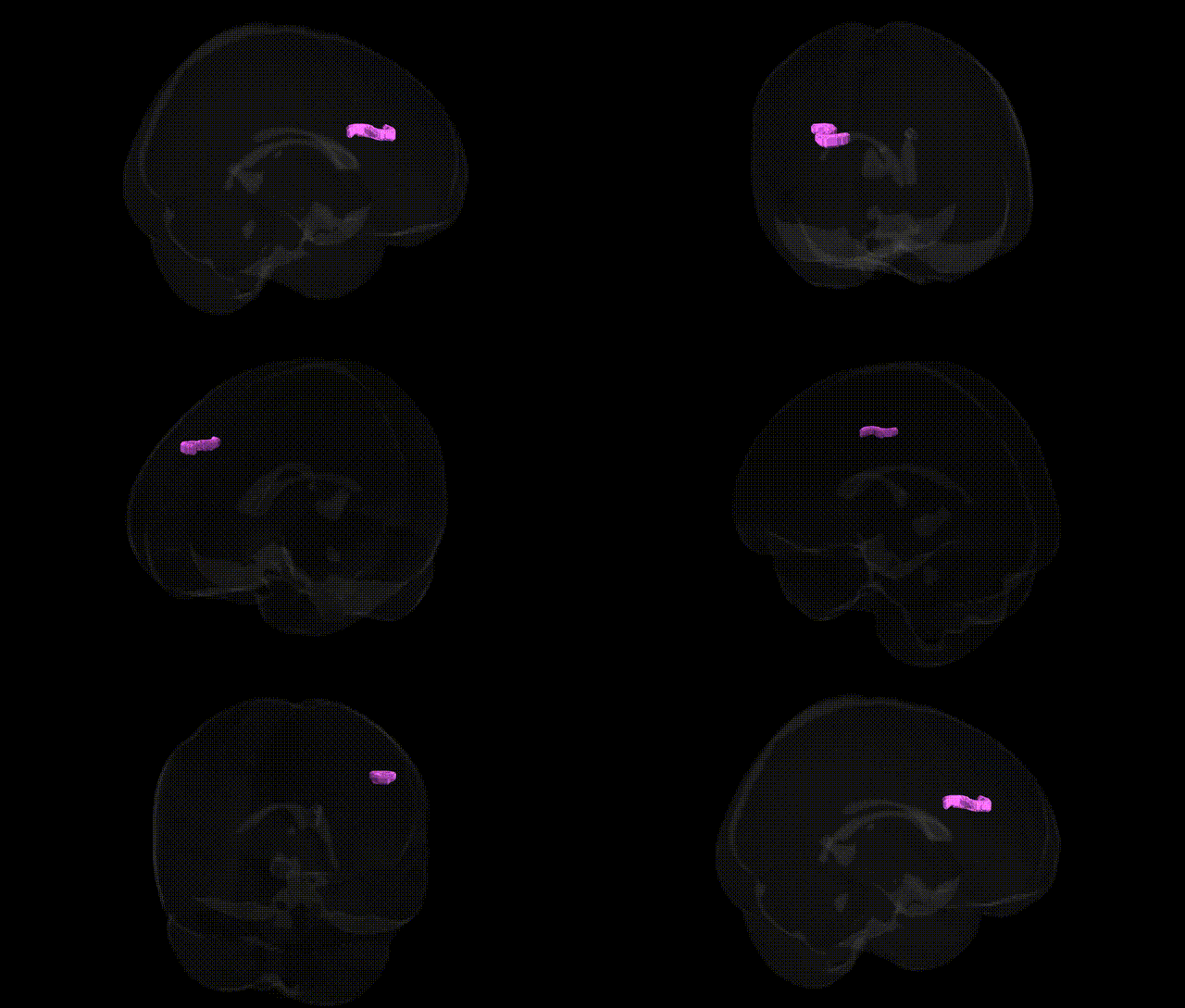
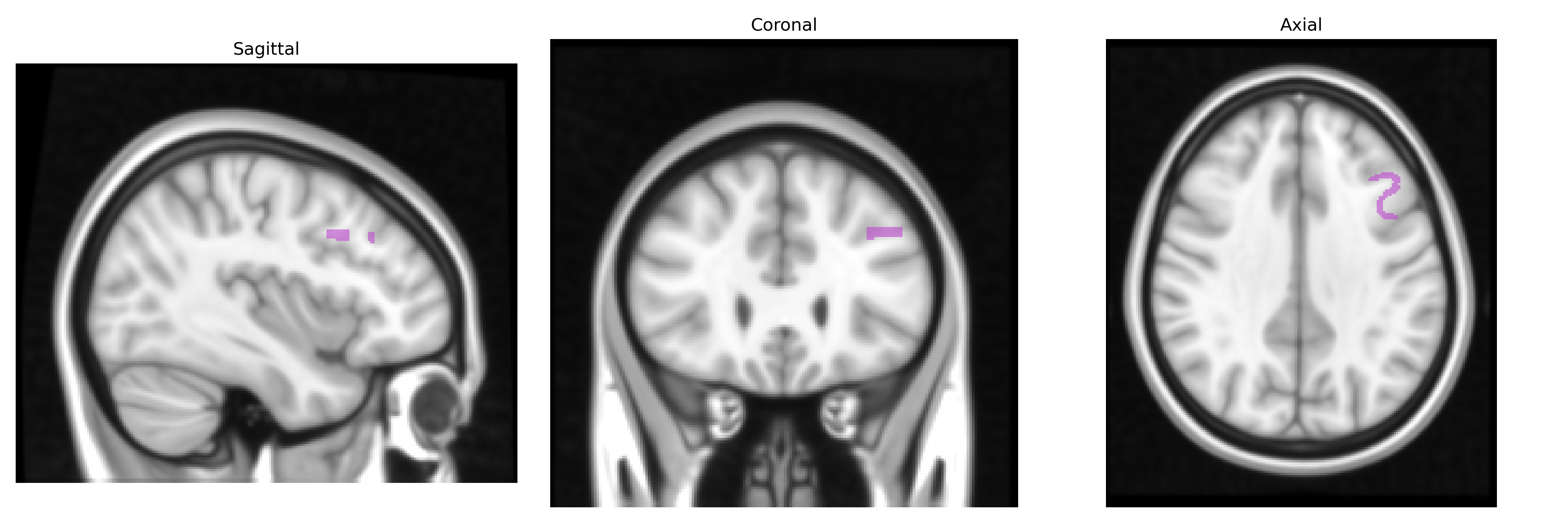
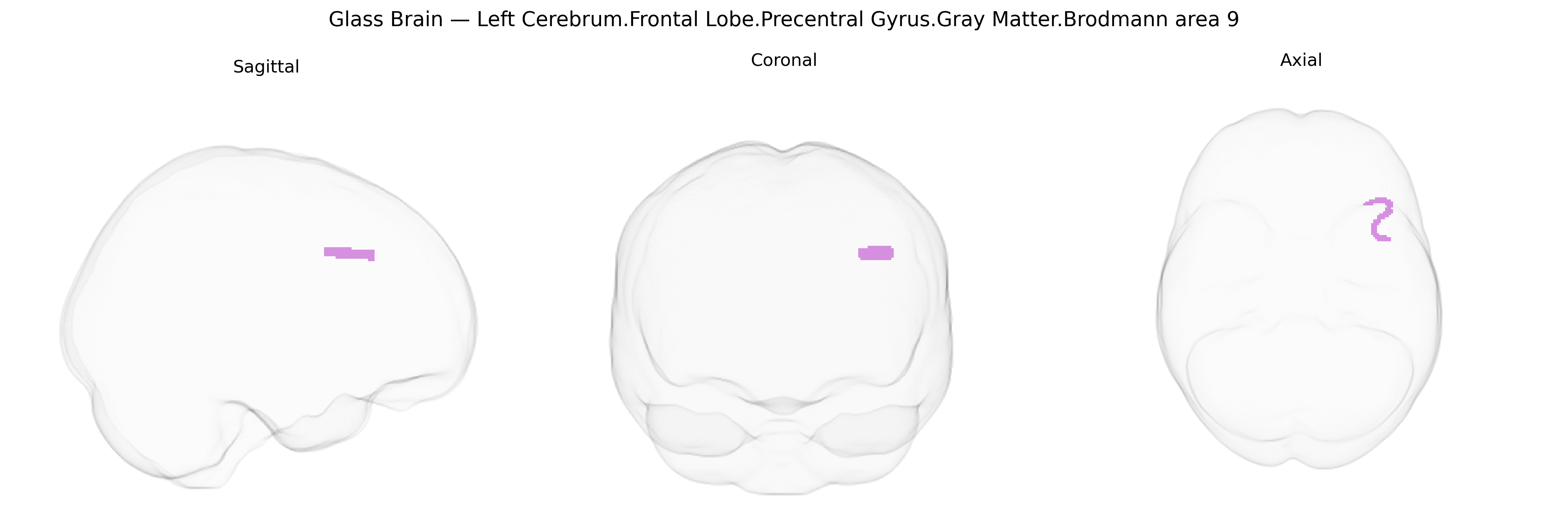
The bilateral Left Cerebrum.Frontal Lobe.Precentral Gyrus.Gray Matter.Brodmann area 9 corresponds primarily to a segment of the dorsolateral prefrontal cortex (DLPFC) located anterior to the primary motor cortex within the frontal lobe, as defined in the Talairach 1 mm Atlas. This agranular frontal region is characterized cytoarchitectonically by moderately developed granular layers and prominent pyramidal neurons, and is heavily interconnected with other prefrontal, premotor, and parietal association areas, as well as thalamic and limbic structures. Functionally, Brodmann area 9 is implicated in higher-order executive processes, including working memory, sustained attention, planning, decision-making, and aspects of social cognition such as perspective-taking and behavioral inhibition, with a role in integrating internal goals with external stimuli to guide complex, goal-directed behavior. Brodmann area 9
The bilateral Left Cerebrum.Frontal Lobe.Precentral Gyrus.Gray Matter.Brodmann area 9 region, located at the dorsal/rostral border of primary motor and dorsolateral prefrontal cortex, has been implicated in several genetic and GWAS-based associations involving brain structure, function, and neuropsychiatric traits. Imaging–genetics and large-scale GWAS of cortical thickness and surface area (e.g., ENIGMA, UK Biobank) have identified common variants in genes involved in neurodevelopment, synaptic signaling, and neuronal differentiation (such as MIR- and WNT-pathway–related loci, and general neurodevelopmental genes like MAPT and CNTN family members) that influence frontal cortical morphology including BA9-adjacent precentral and superior frontal areas, though precise Talairach BA9-precentral parcels are rarely isolated. Functionally, this region participates in motor planning and higher-order executive control, and voxel-based morphometry or task fMRI studies linking genetics to BA9/precentral activation or volume have implicated risk variants for schizophrenia, major depression, bipolar disorder, ADHD, and autism spectrum disorder—often in genes regulating dopamine and glutamate signaling (e.g., DRD2, CACNA1C, GRIN2A) and synaptic plasticity (e.g., BDNF), where allelic variation modulates frontal cortical activation or gray-matter integrity. Polygenic risk scores for schizophrenia, depression, and neuroticism have also been associated with reduced frontal gray-matter measures in BA9/adjacent precentral regions, while motor-related traits (e.g., fine motor performance, reaction time) show genetic correlations with precentral/frontal structural and functional variation. Overall, genetic associations for this specific Talairach-defined BA9 precentral parcel are typically inferred from broader frontal or precentral GWAS parcellations, highlighting convergent roles for neurodevelopmental and synaptic genes in shaping its structure and contribution to neuropsychiatric vulnerability and motor–executive traits.
Overview generated by GPT-4o (2026).
Region ID: 1004
Hemisphere: bilateral
Atlas: Talairach labels 1mm
Full Quality Version: Download MP4
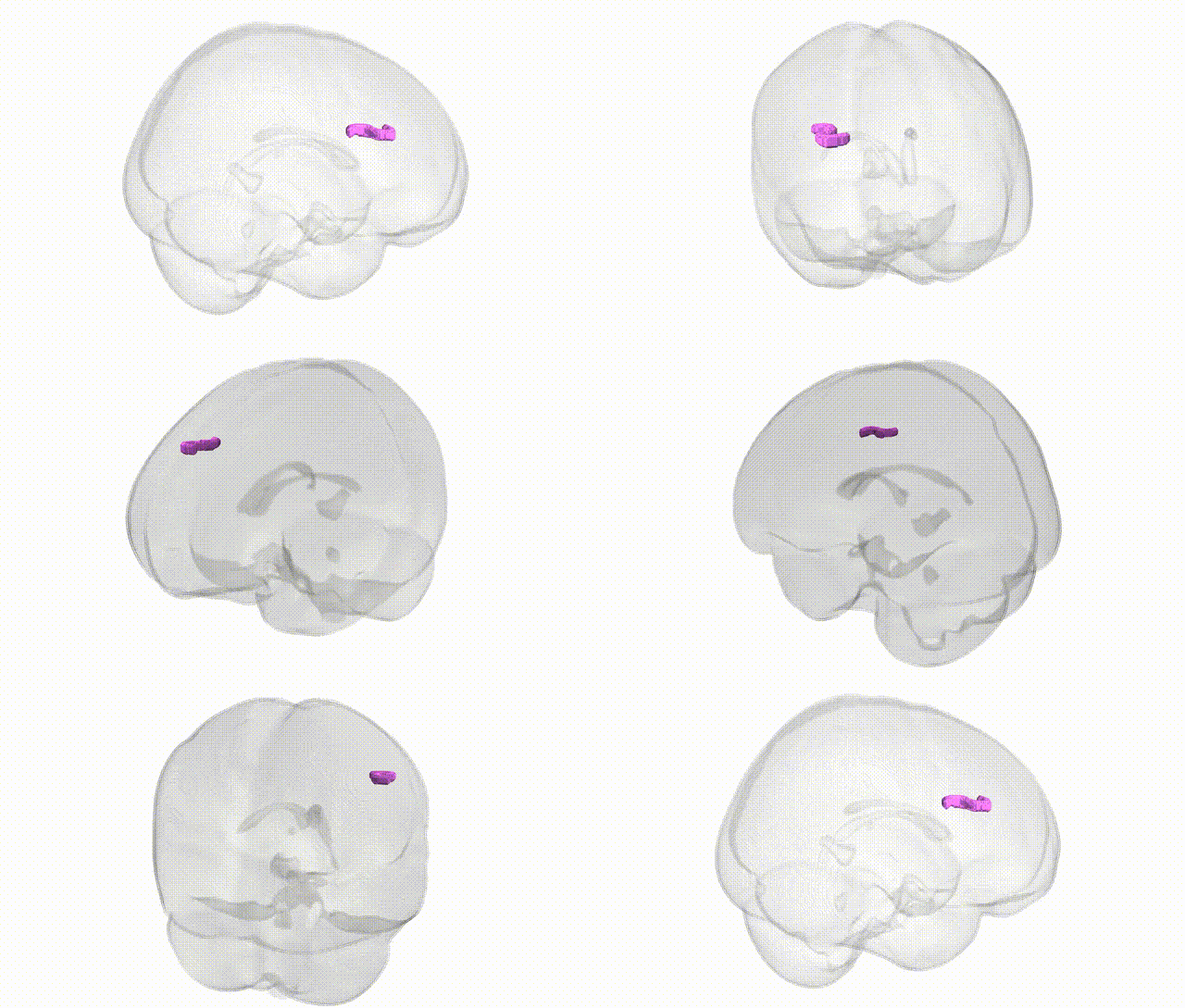
Full Quality Version: Download MP4
Wali Sidiqyar*, Gaurav Rudravaram*, Elyssa M. McMaster, Trent M. Schwartz, Adam M. Saunders, Kurt G. Schilling, Bennett A. Landman "Introducing SPINS: A Shared Public Visualization Library of Neuroanatomical Structures." Medical Imaging with Deep Learning- short paper
This resource is licensed under CC0 1.0 Universal (Public Domain).