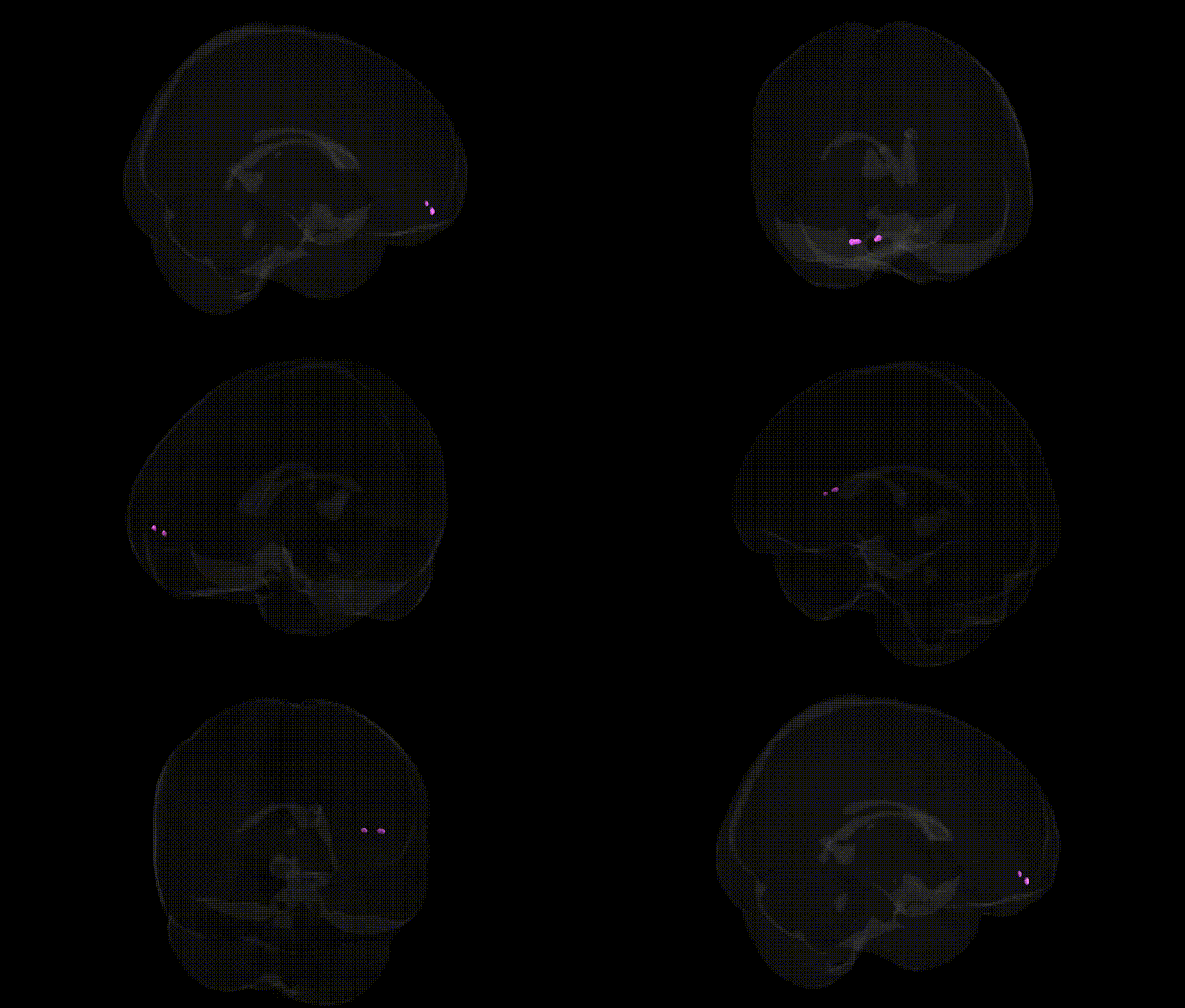
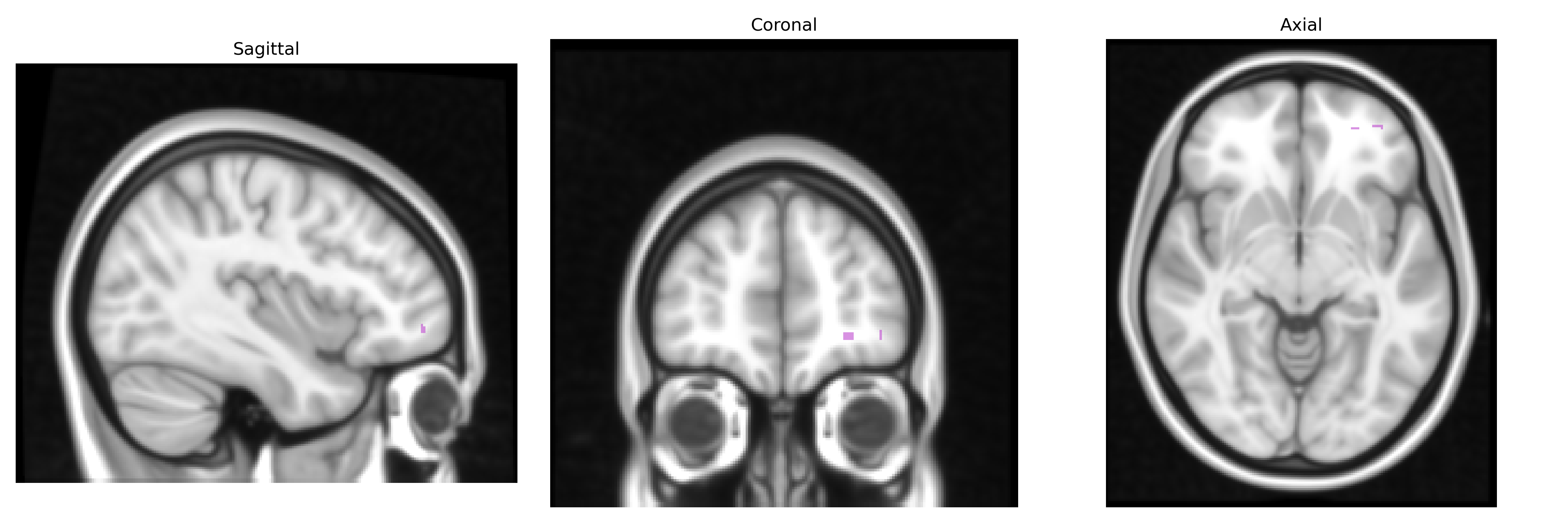
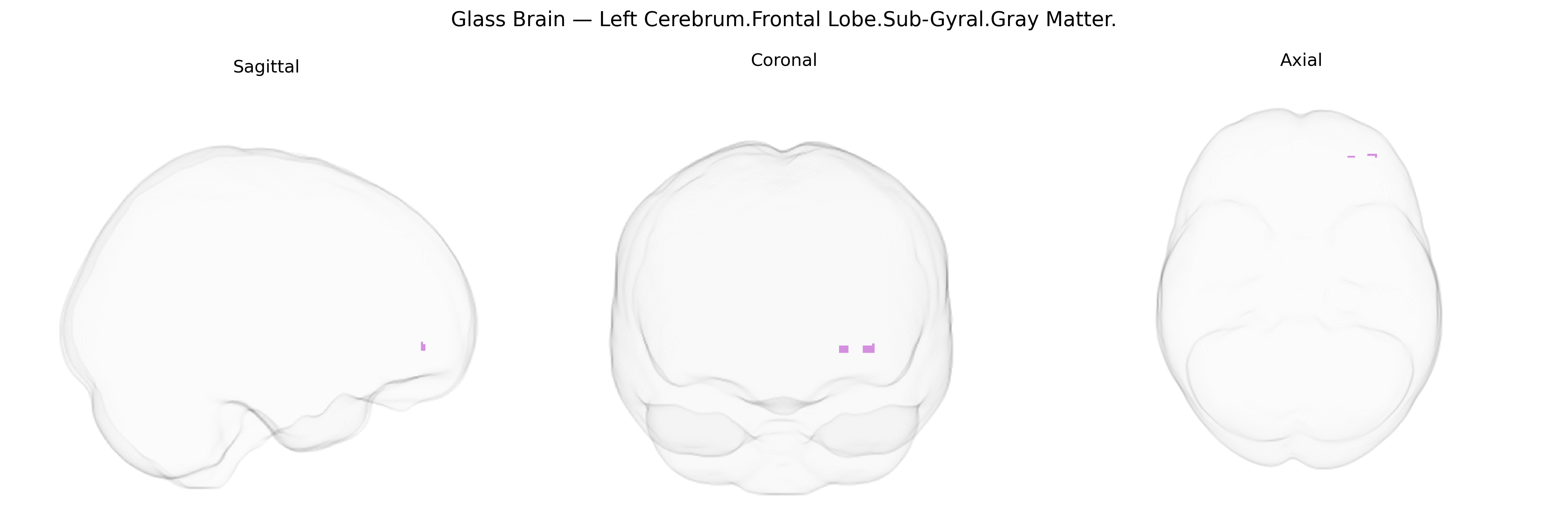
The bilateral Left Cerebrum.Frontal Lobe.Sub-Gyral.Gray Matter refers to gray matter located beneath the cortical gyri of the left frontal lobe, encompassing portions of premotor, supplementary motor, and prefrontal territories that contribute to higher-order motor planning, working memory, decision-making, and aspects of language and executive control. This sub-gyral gray matter contains neuronal cell bodies, dendrites, and local circuits that integrate inputs from other cortical and subcortical regions, modulating goal-directed behavior, attentional processes, and voluntary movement initiation. Functionally, it participates in organizing complex actions, regulating social and emotional behavior, and coordinating cognition with motor output, reflecting the broader integrative roles of the frontal lobe in human behavior and thought. There is no direct link for this specific sub-gyral designation; a related structure is the Frontal lobe.
The bilateral left frontal sub-gyral gray matter (Talairach: Left Cerebrum.Frontal Lobe.Sub-Gyral.Gray Matter) has been implicated in multiple genetic and GWAS findings through its involvement in higher-order cognitive, affective, and psychiatric traits rather than via a single specific gene–region association. Large-scale imaging-genetics consortia (e.g., ENIGMA, UK Biobank) have reported SNP-based heritability and polygenic influences on cortical thickness and surface area in lateral and medial frontal sub-gyral regions, with notable contributions from genes involved in neurodevelopment, synaptic function, and myelination (such as variants near MAPT, DRD2, GRIN2B, and CNTNAP2), as well as widespread polygenic overlap with general cognitive ability, educational attainment, and intracranial volume. GWAS of major depressive disorder, bipolar disorder, schizophrenia, ADHD, and autism have repeatedly identified polygenic risk that correlates with structural and functional alterations in left frontal sub-gyral territories, including dorsolateral and ventrolateral prefrontal areas, often manifesting as reduced gray-matter volume or altered resting-state connectivity. In addition, frontal sub-gyral morphometry shows genetic correlations with impulsivity, risk-taking, and substance use traits, and with neurodegeneration-related loci (e.g., APOE in aging and preclinical Alzheimer’s disease), reflecting shared genetic architectures that influence both regional gray-matter integrity and susceptibility to neuropsychiatric and cognitive disorders, although precise one-to-one mappings between individual genes and this specific Talairach parcel remain coarse and highly polygenic.
Overview generated by GPT-4o (2026).
Region ID: 609
Hemisphere: bilateral
Atlas: Talairach labels 1mm
Full Quality Version: Download MP4
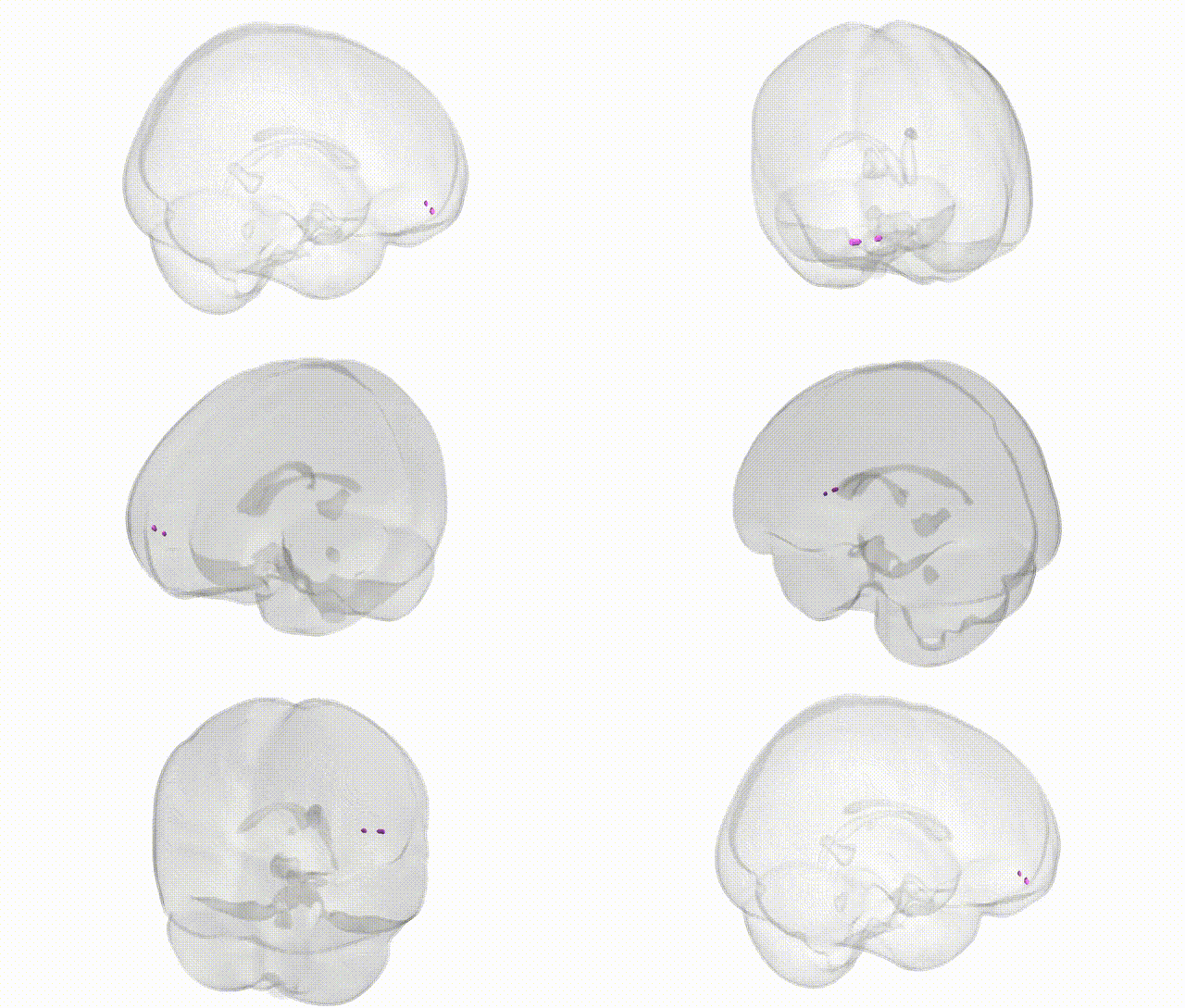
Full Quality Version: Download MP4
Wali Sidiqyar*, Gaurav Rudravaram*, Elyssa M. McMaster, Trent M. Schwartz, Adam M. Saunders, Kurt G. Schilling, Bennett A. Landman "Introducing SPINS: A Shared Public Visualization Library of Neuroanatomical Structures." Medical Imaging with Deep Learning- short paper
This resource is licensed under CC0 1.0 Universal (Public Domain).