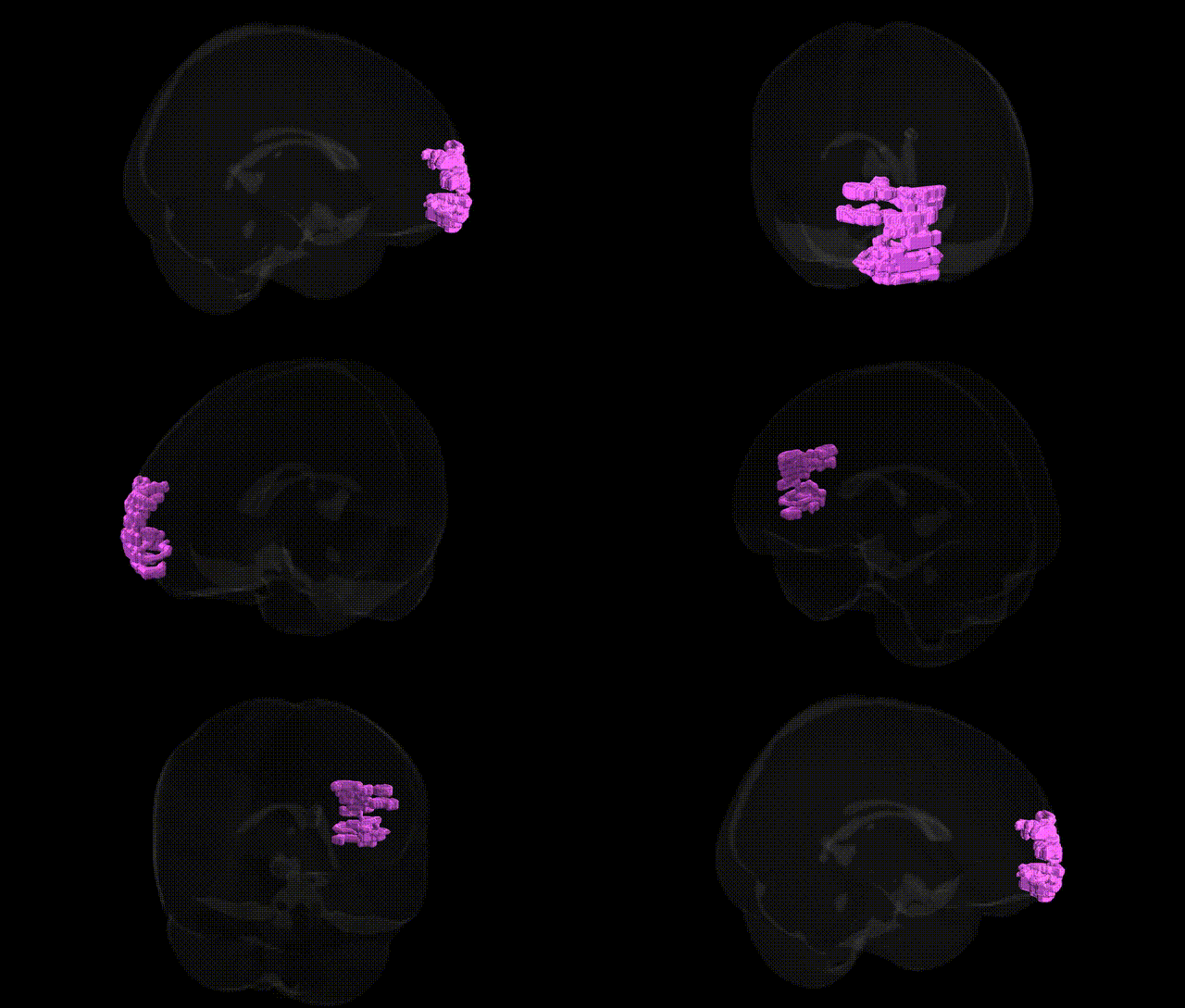
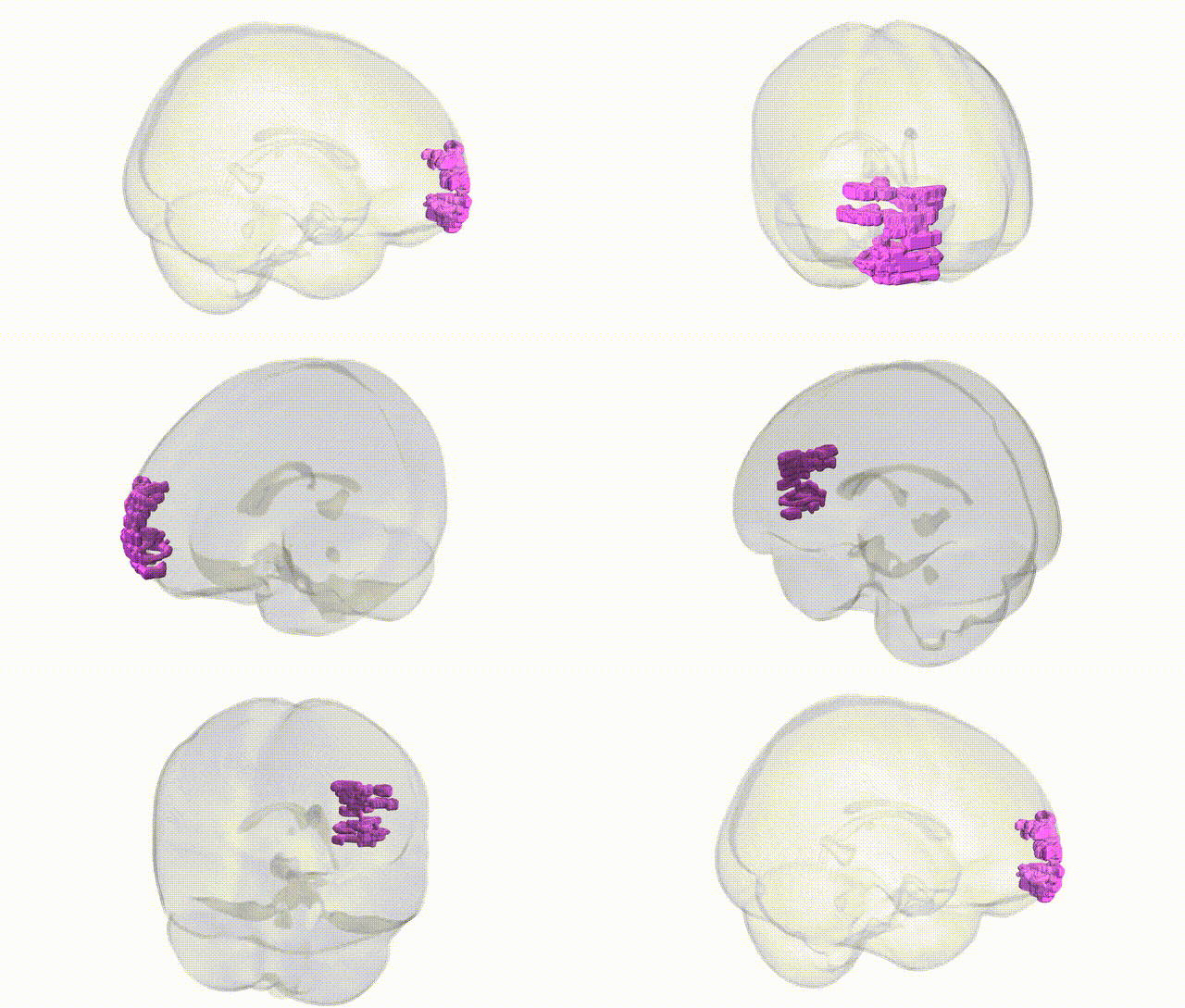
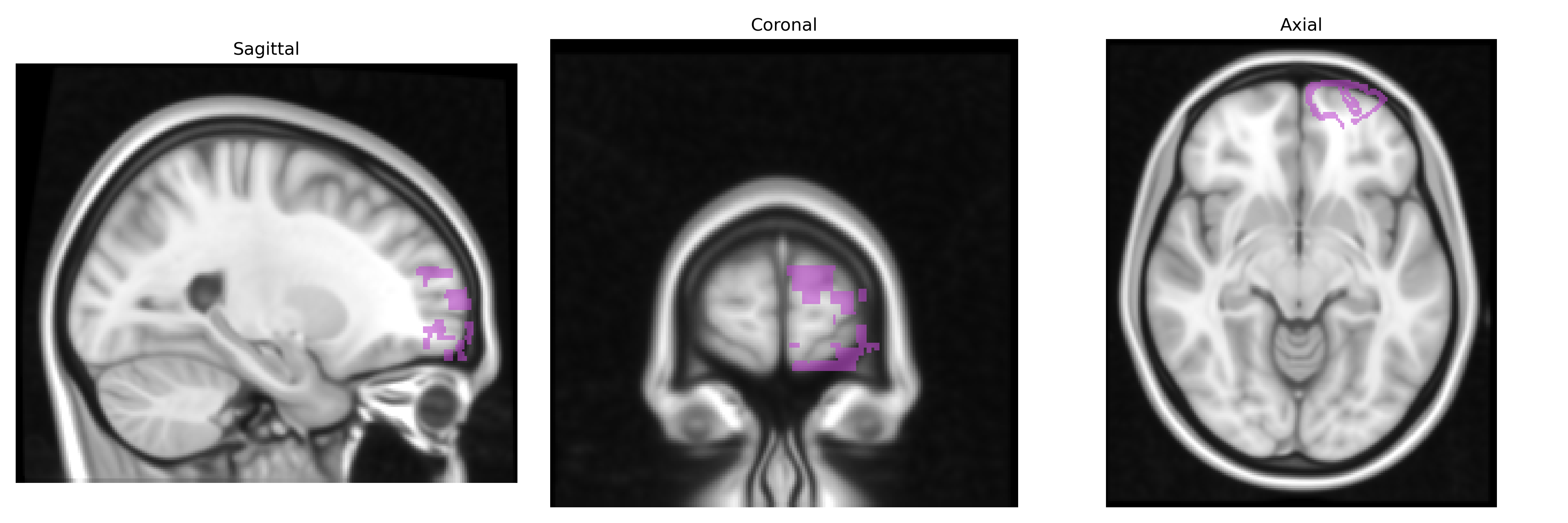
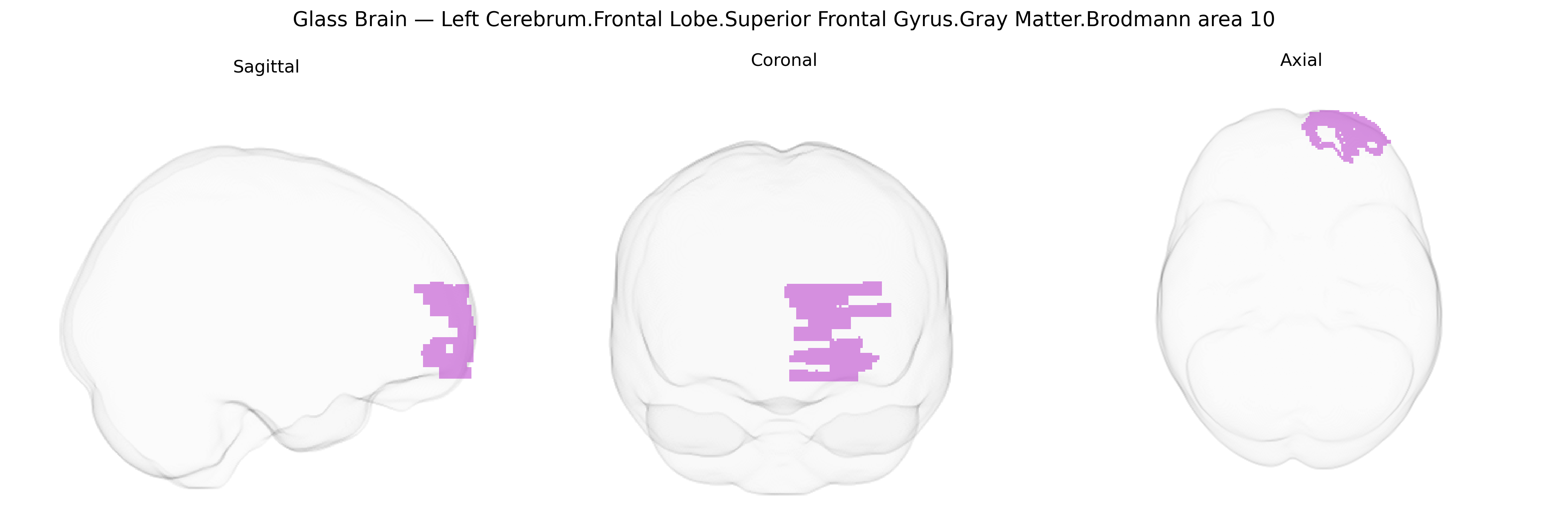
The bilateral Left Cerebrum.Frontal Lobe.Superior Frontal Gyrus.Gray Matter.Brodmann area 10 corresponds to the most anterior portion of the prefrontal cortex, often called the frontopolar cortex, located on the superior and medial aspects of the frontal lobe just anterior to Brodmann areas 9 and 46. This region is characterized by granular cortex typical of higher-order association areas and is heavily interconnected with other prefrontal, parietal, limbic, and subcortical structures, supporting integrative, high-level cognitive processes. Functionally, BA10 has been implicated in prospective memory, complex decision-making, abstract reasoning, multitasking, and the management of internally generated thoughts versus externally driven stimuli, playing a role in the coordination of multiple goals and in social-cognitive operations. There is no direct link for this exact Talairach label; a closely related structure is the Brodmann area 10.
The bilateral left superior frontal gyrus gray matter in Brodmann area 10 (anterior prefrontal cortex) has been repeatedly implicated in genetic studies of brain structure and function, with many findings emerging from large-scale MRI–GWAS consortia such as ENIGMA and UK Biobank. Common variants in genes involved in neurodevelopment and synaptic function, including pathways related to axon guidance (e.g., ROBO and SLIT family members), neuronal proliferation and differentiation (e.g., genes in Wnt and Notch signaling), and cortical patterning (e.g., loci near EOMES/TBR2 and other transcription factors regulating upper-layer frontal neurons), have been associated with regional cortical thickness, surface area, or volume in frontal pole/superior frontal regions that approximate BA10. Polygenic risk scores for schizophrenia, bipolar disorder, major depressive disorder, ADHD, and autism spectrum disorder show associations with morphometry and activation in this area, and specific risk loci for schizophrenia (e.g., in MIR137 and CACNA1C regions) and depression (e.g., in the MDD-associated 3p25/ANK3 and 12q24 regions) have been reported to influence prefrontal measures encompassing BA10 in imaging-genetics analyses. GWAS of cognitive traits, including general cognitive ability, educational attainment, working memory, and decision-making, identify frontal pole–related structural and functional correlates, and genetic variants in dopaminergic and glutamatergic systems (such as COMT, DRD2, and GRM3 in candidate and polygenic frameworks) have been linked to BA10-related activation during higher-order executive tasks. Collectively, these studies support BA10 as a genetically influenced hub for executive function, prospective memory, social cognition, and mood regulation, with shared polygenic architecture across psychiatric disorders and cognitive traits reflected in its structure and activity.
Overview generated by GPT-4o (2026).
Region ID: 413
Hemisphere: bilateral
Atlas: Talairach labels 1mm
Full Quality Version: Download MP4
Full Quality Version: Download MP4
Wali Sidiqyar*, Gaurav Rudravaram*, Elyssa M. McMaster, Trent M. Schwartz, Adam M. Saunders, Kurt G. Schilling, Bennett A. Landman "Introducing SPINS: A Shared Public Visualization Library of Neuroanatomical Structures." Medical Imaging with Deep Learning- short paper
This resource is licensed under CC0 1.0 Universal (Public Domain).