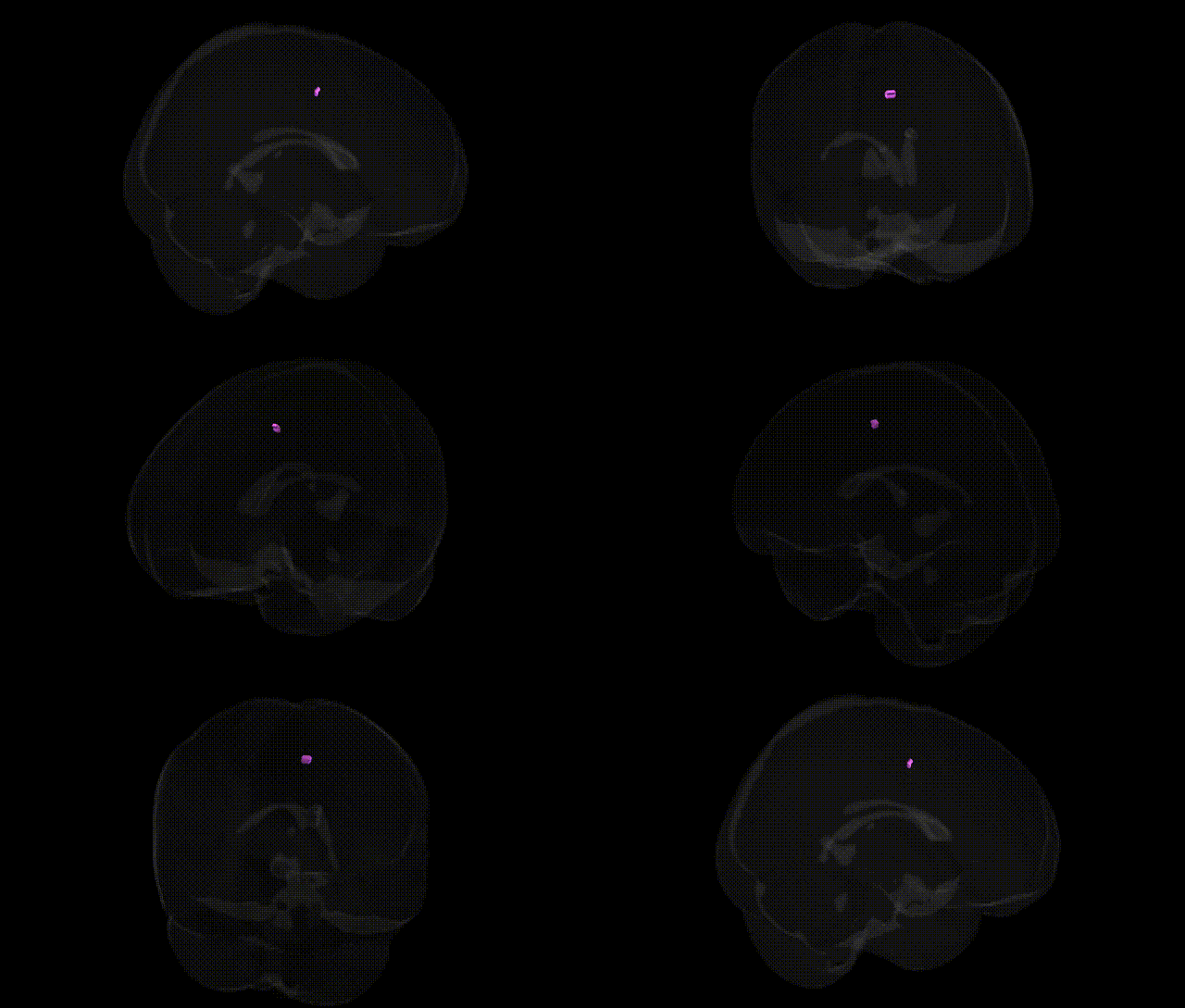
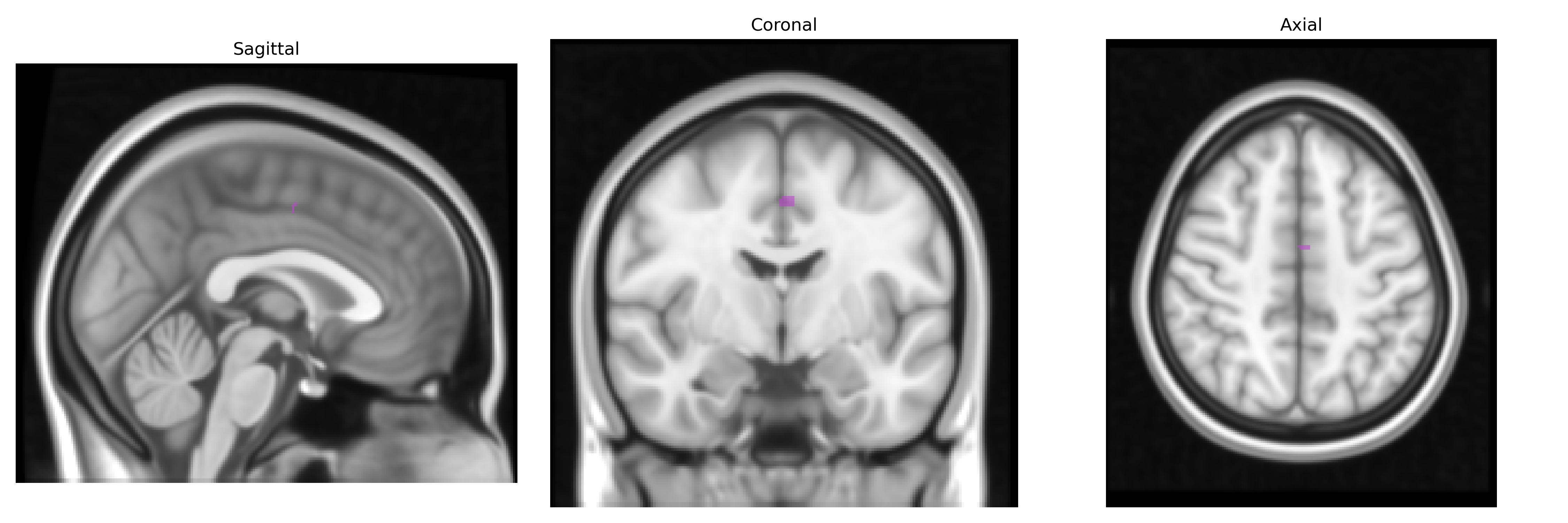
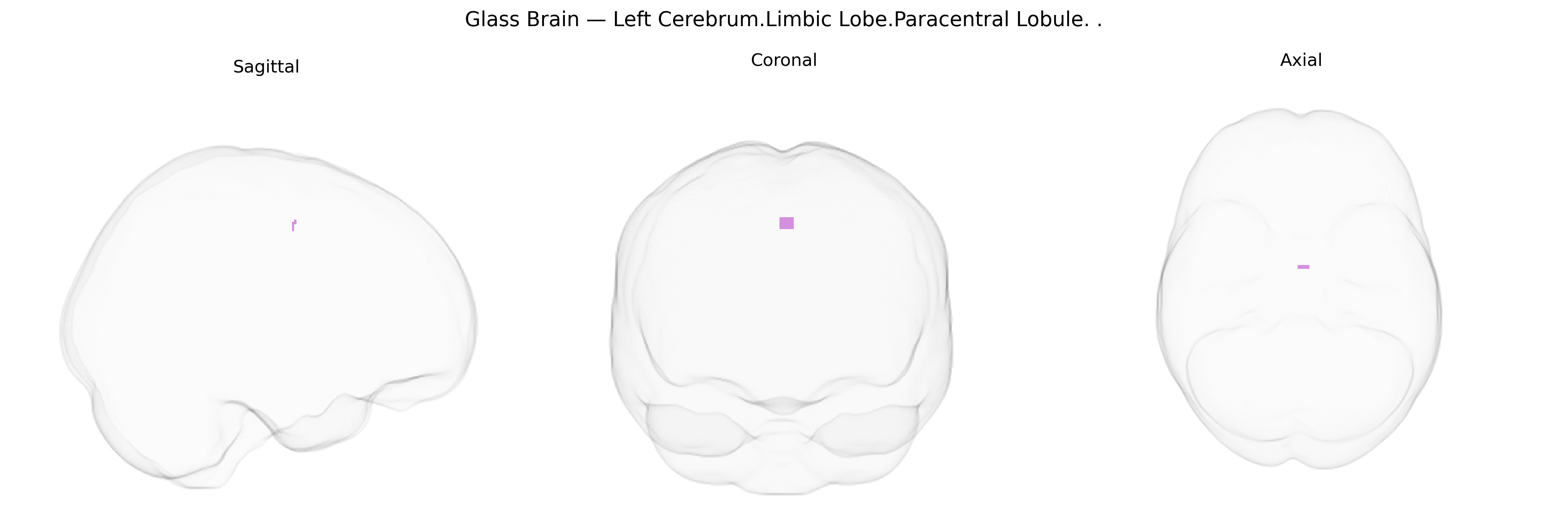
The bilateral Left Cerebrum.Limbic Lobe.Paracentral Lobule, as labeled in the Talairach 1 mm atlas, refers to the paracentral lobule region located on the medial surface of the cerebral hemisphere near the midline, functionally spanning parts of the primary motor and primary somatosensory cortices that represent the lower limb and perineal regions. Although the Talairach label places it within the “limbic lobe” grouping, anatomically it is typically considered part of the medial frontal-parietal cortex, continuous with the precentral and postcentral gyri around the central sulcus. This region plays a crucial role in voluntary motor control and somatosensory processing of the contralateral lower extremity, as well as in aspects of sphincter control and gait-related functions. There is no direct Wikipedia article for the Talairach-designated “Limbic Lobe.Paracentral Lobule,” but the closely related cortical region is described under Paracentral lobule.
The bilateral paracentral lobule in the limbic/medial sensorimotor region of the left cerebrum—encompassing primary motor and somatosensory cortex for the lower limbs—has been implicated in several genetic and GWAS-based associations, primarily through imaging-genetics and neuropsychiatric studies rather than region-specific candidate gene work. Large-scale brain MRI GWAS (e.g., ENIGMA and UK Biobank) have identified common variants in genes involved in neurodevelopment, axon guidance, and synaptic function (such as MAPT, WNT pathway genes, and cell-adhesion/migration genes like L1CAM family members) that influence cortical thickness, surface area, and gyrification in medial sensorimotor regions that include or overlap the paracentral lobule. Polygenic risk scores for schizophrenia, bipolar disorder, and major depression have been associated with structural or functional alterations in medial sensorimotor and cingulo-paracentral areas, suggesting that shared psychiatric risk loci partly act through this region’s morphology and connectivity. Variants at loci implicated in motor and gait phenotypes, including genes associated with amyotrophic lateral sclerosis, hereditary spastic paraplegia, and Parkinson’s disease (e.g., C9orf72, SPAST, and LRRK2), are linked to atrophy or functional changes in paracentral regions corresponding to leg motor representations. In addition, GWAS of traits such as lower-limb motor performance, balance, and physical activity have shown enrichment of variants that also modulate sensorimotor cortical structure, indirectly implicating the paracentral lobule. However, precise gene–region mappings at the level of the Talairach Left Cerebrum.Limbic Lobe.Paracentral Lobule label remain coarse, with most findings reflecting broader medial sensorimotor or adjacent cingulate/paracentral territories rather than this subdivision alone.
Overview generated by GPT-4o (2026).
Region ID: 1056
Hemisphere: bilateral
Atlas: Talairach labels 1mm
Full Quality Version: Download MP4
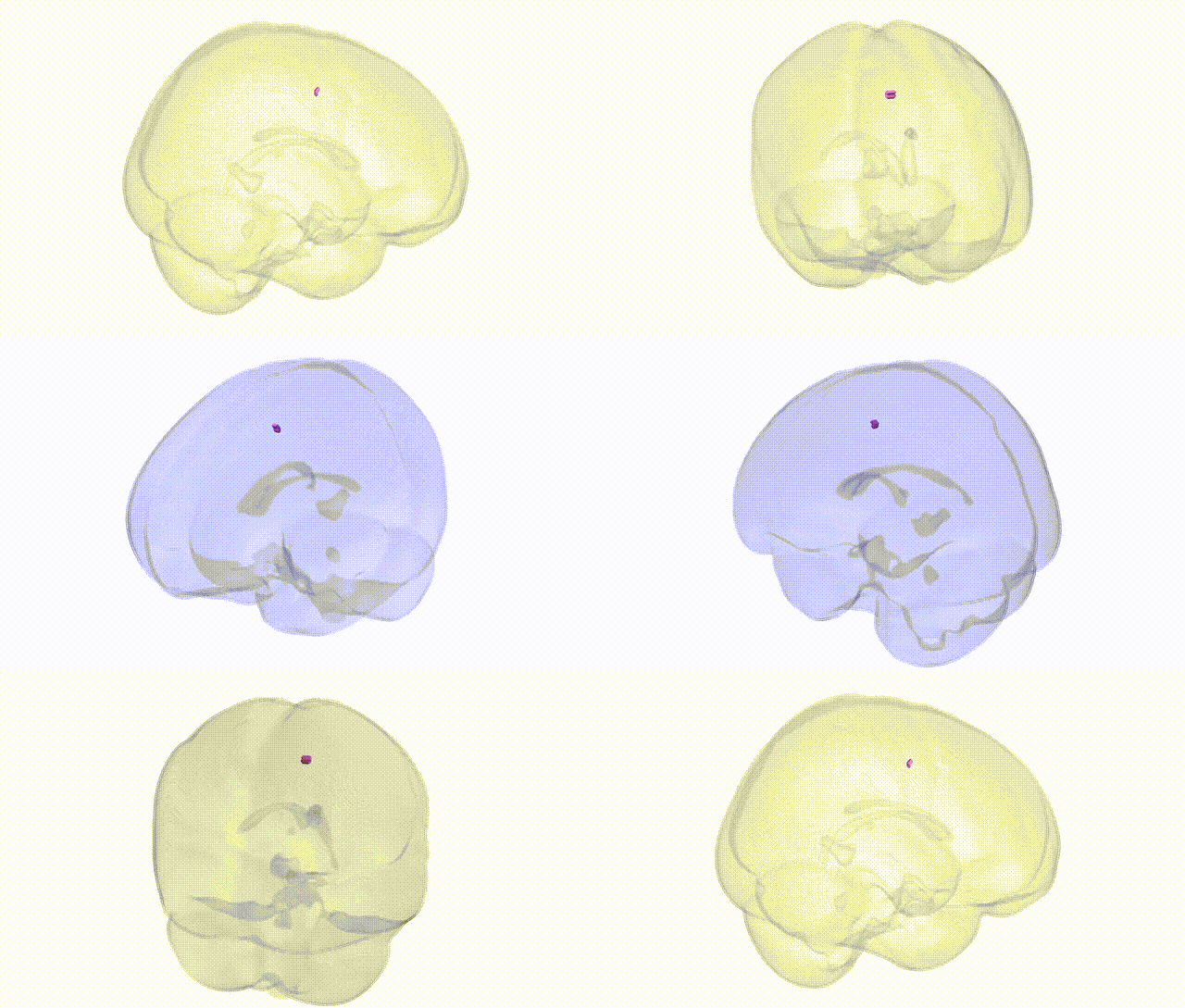
Full Quality Version: Download MP4
Wali Sidiqyar*, Gaurav Rudravaram*, Elyssa M. McMaster, Trent M. Schwartz, Adam M. Saunders, Kurt G. Schilling, Bennett A. Landman "Introducing SPINS: A Shared Public Visualization Library of Neuroanatomical Structures." Medical Imaging with Deep Learning- short paper
This resource is licensed under CC0 1.0 Universal (Public Domain).