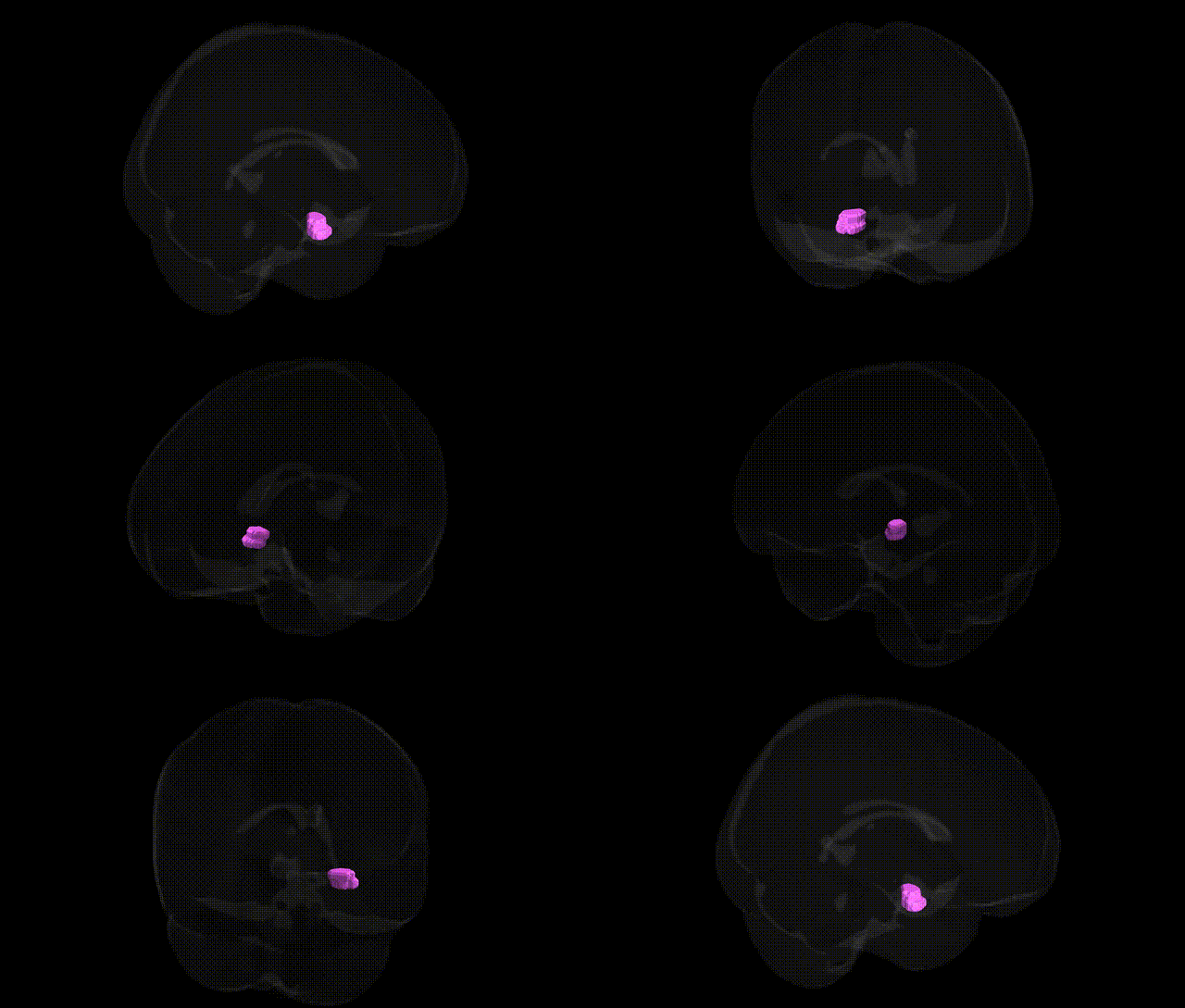
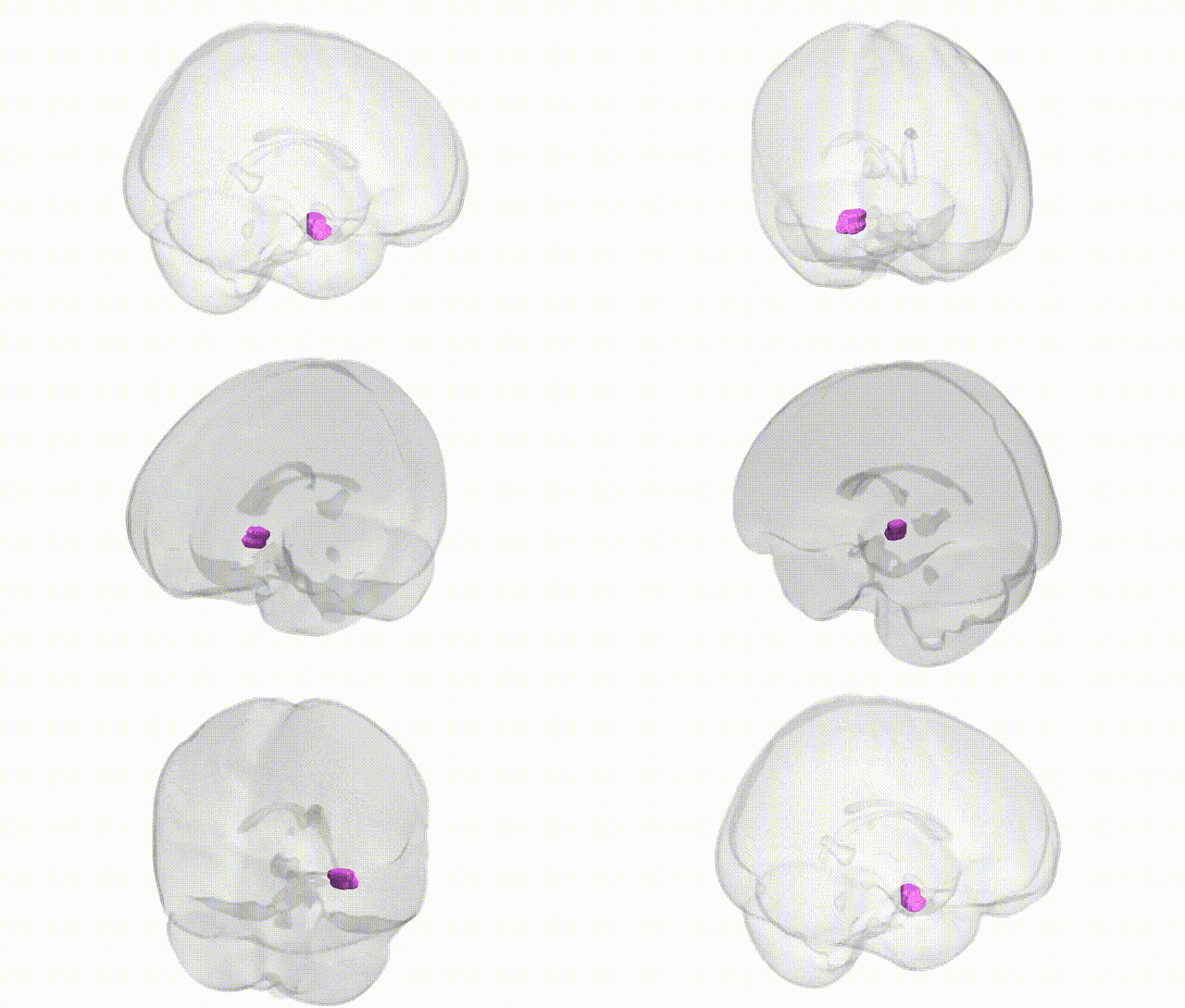
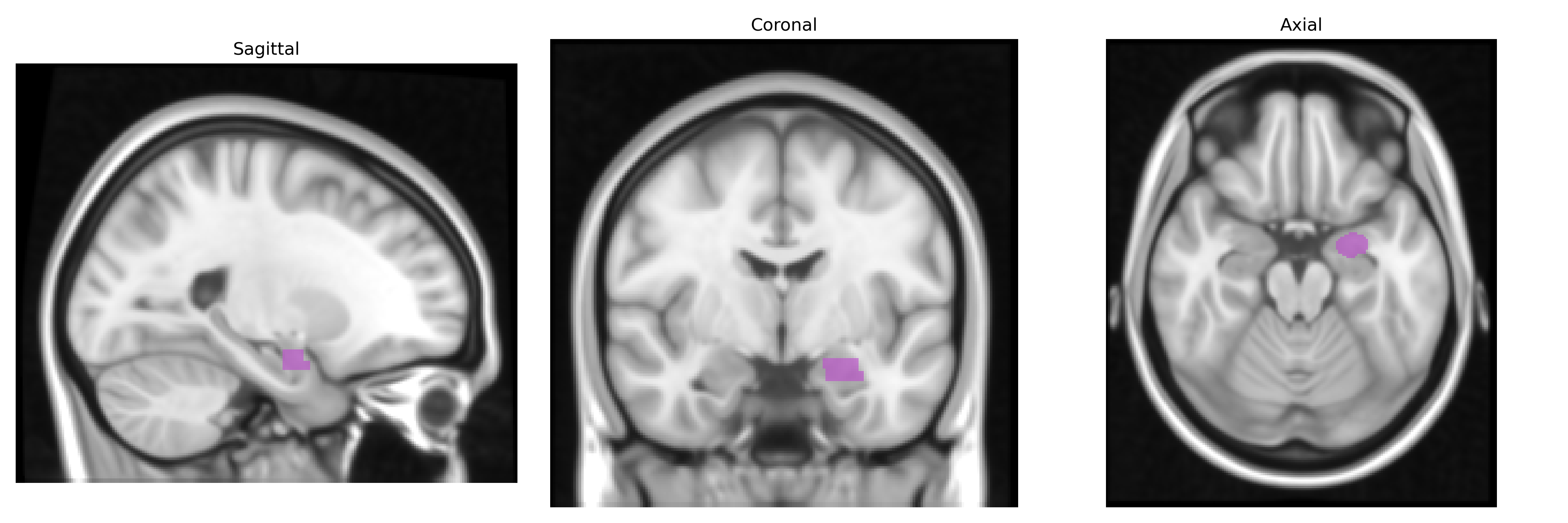
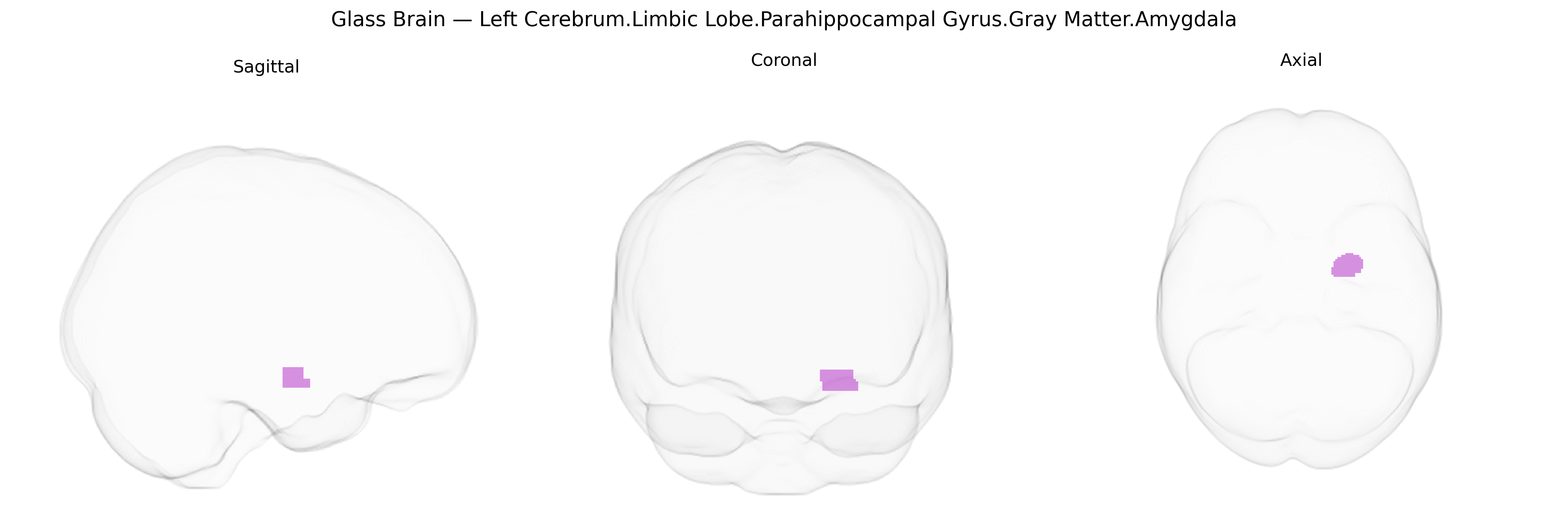
The bilateral Left Cerebrum.Limbic Lobe.Parahippocampal Gyrus.Gray Matter.Amygdala refers to the gray matter nuclei of the amygdala located within the medial temporal lobe, deep to the parahippocampal gyrus and constituting a core component of the limbic system. This region is critically involved in processing emotional valence, particularly fear and threat detection, assigning affective significance to sensory stimuli, and modulating autonomic and endocrine responses via extensive connections with the hypothalamus, brainstem, and prefrontal cortex. The amygdala participates in emotional learning and memory, including fear conditioning, influences social and reward-related behaviors, and interacts with the hippocampal formation to shape consolidation and retrieval of emotionally salient memories. Structurally, it comprises multiple nuclei (e.g., basolateral, centromedial, cortical groups) with distinct input–output patterns, supporting integration of multimodal sensory information and regulation of behavioral responses. Amygdala
The left parahippocampal gyrus and amygdala, as defined in the Talairach 1 mm atlas, show convergent genetic associations from GWAS and imaging-genetics studies implicating both common and rare variants in neurodevelopmental, psychiatric, and neurodegenerative traits. Structural and functional variation in this limbic region has been linked to risk alleles in genes involved in synaptic plasticity and glutamatergic signaling (e.g., BDNF, GRIN2B), serotonin and dopamine pathways (e.g., SLC6A4, DRD2), and stress-response systems (e.g., FKBP5, CRHR1), as well as major psychiatric risk loci identified in large-scale schizophrenia, bipolar disorder, major depressive disorder, and PTSD GWAS consortia. Imaging-GWAS analyses from the ENIGMA and UK Biobank efforts demonstrate that amygdala and parahippocampal volumes and activation patterns exhibit significant SNP-based heritability and associate with loci near genes such as APOE, MAPT, and others relevant to Alzheimer’s disease and cognitive decline, as well as with polygenic scores for anxiety, neuroticism, and risk-taking. Additional associations involve autism spectrum disorder, obsessive–compulsive disorder, and epilepsy, consistent with the region’s role in emotional processing, memory encoding, and fear learning; however, current genetic findings are largely polygenic and distributed, with no single locus uniquely specific to the bilateral left parahippocampal–amygdala complex.
Overview generated by GPT-4o (2026).
Region ID: 219
Hemisphere: bilateral
Atlas: Talairach labels 1mm
Full Quality Version: Download MP4
Full Quality Version: Download MP4
Wali Sidiqyar*, Gaurav Rudravaram*, Elyssa M. McMaster, Trent M. Schwartz, Adam M. Saunders, Kurt G. Schilling, Bennett A. Landman "Introducing SPINS: A Shared Public Visualization Library of Neuroanatomical Structures." Medical Imaging with Deep Learning- short paper
This resource is licensed under CC0 1.0 Universal (Public Domain).