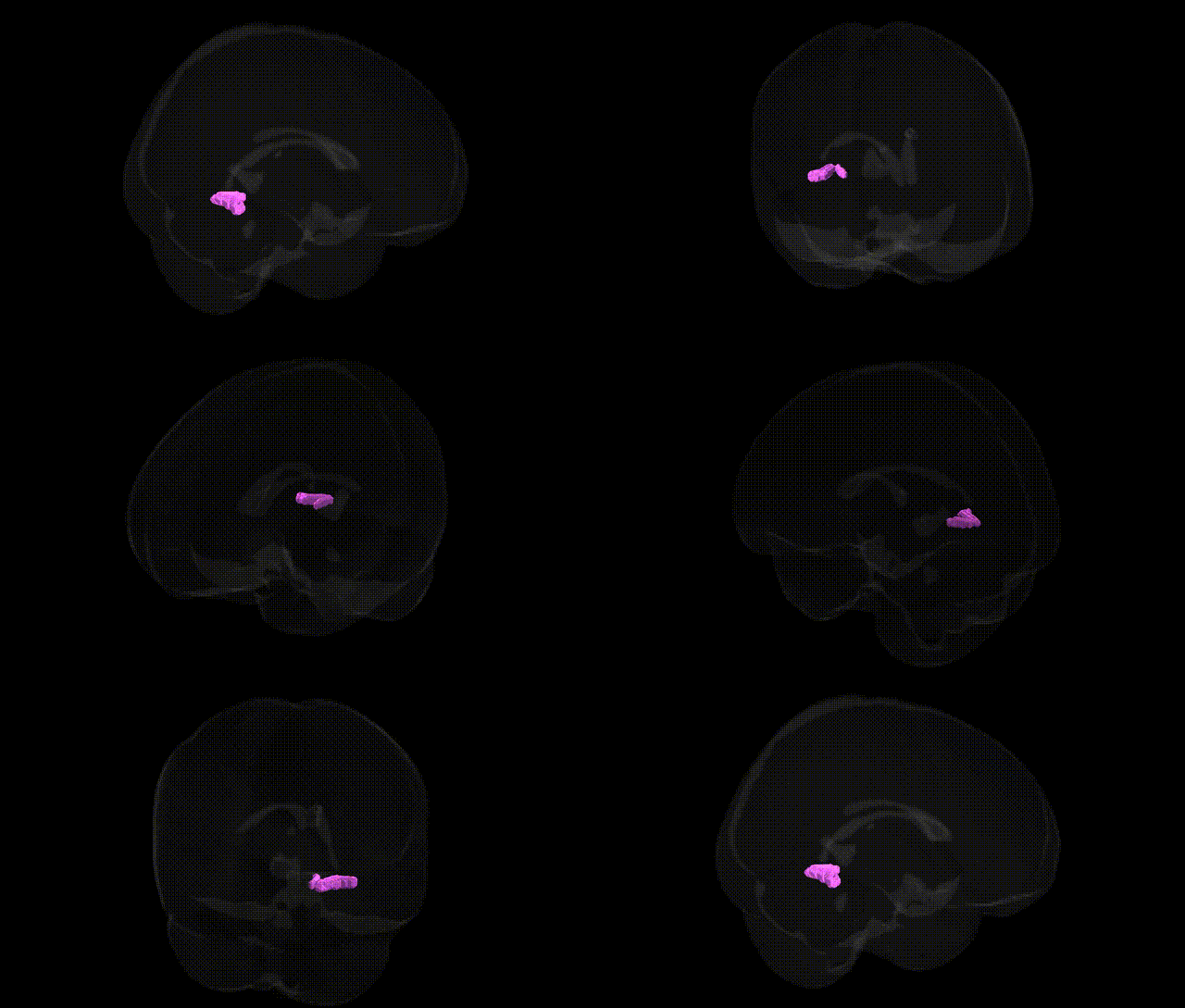
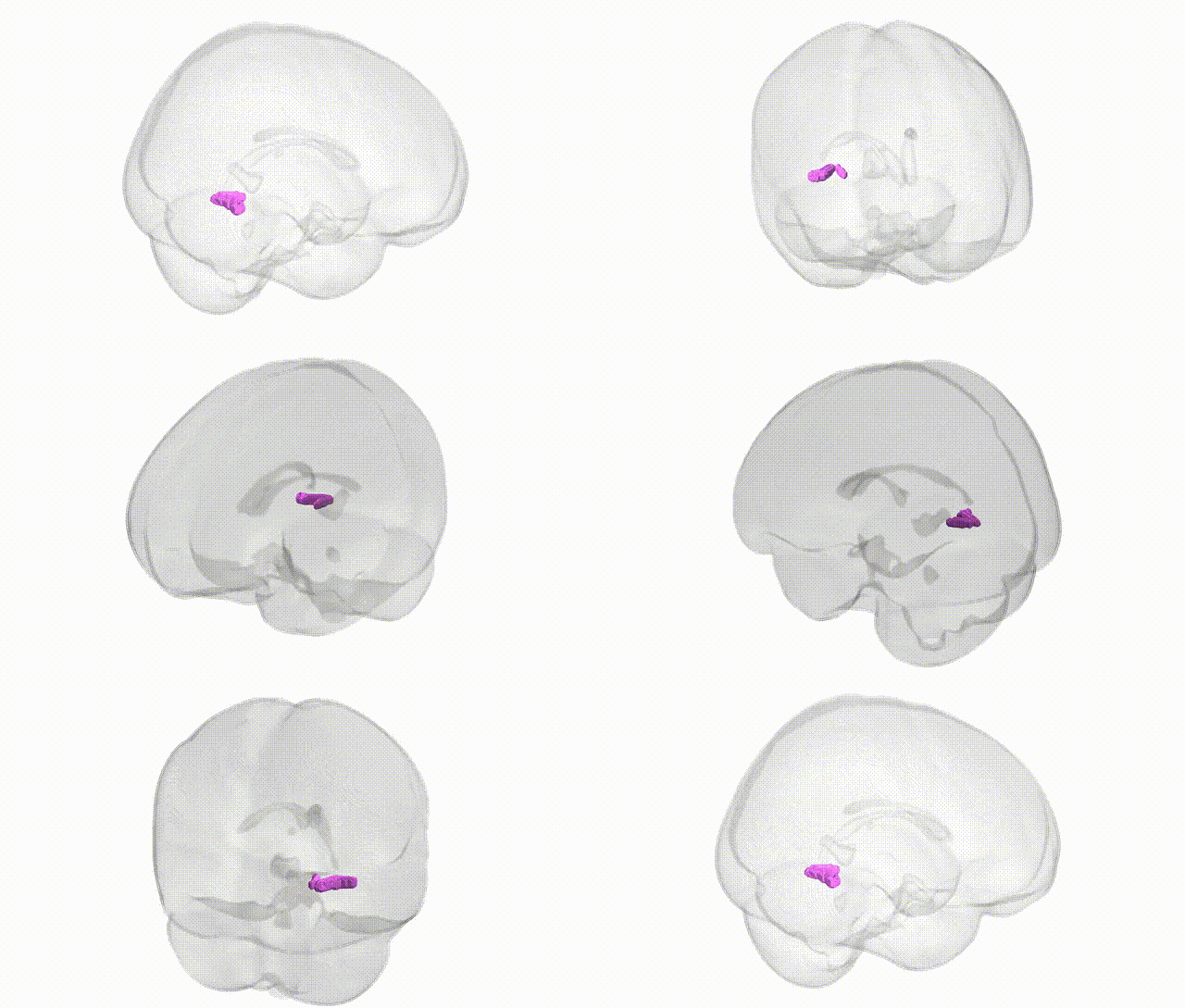
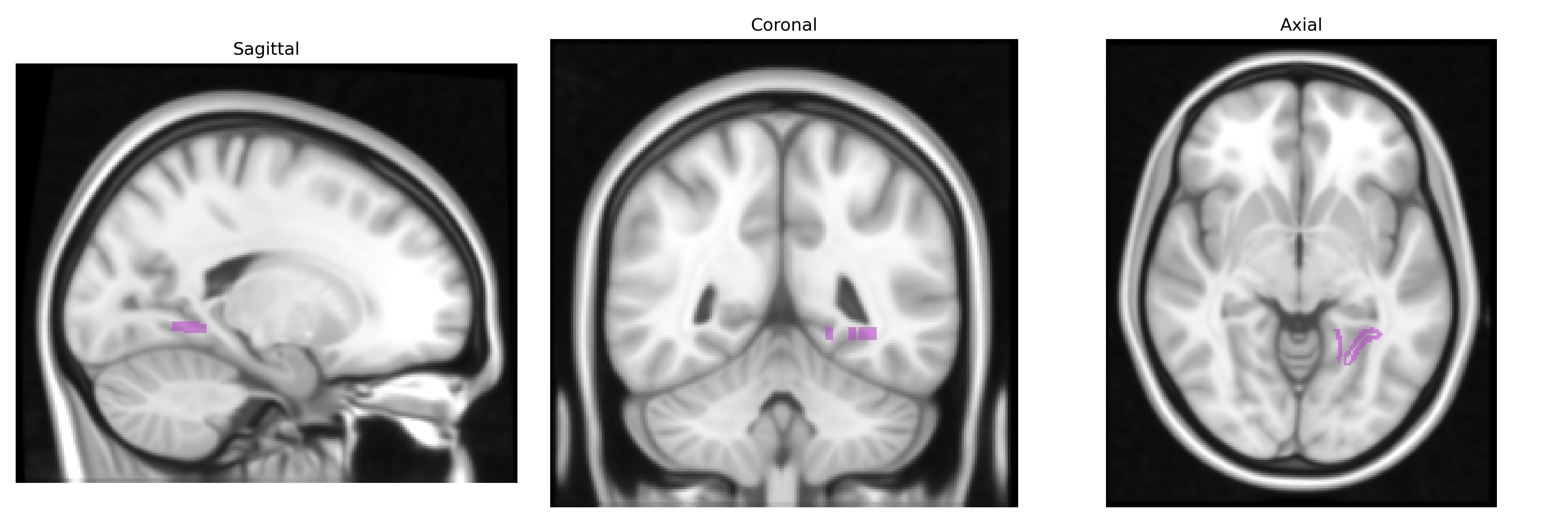
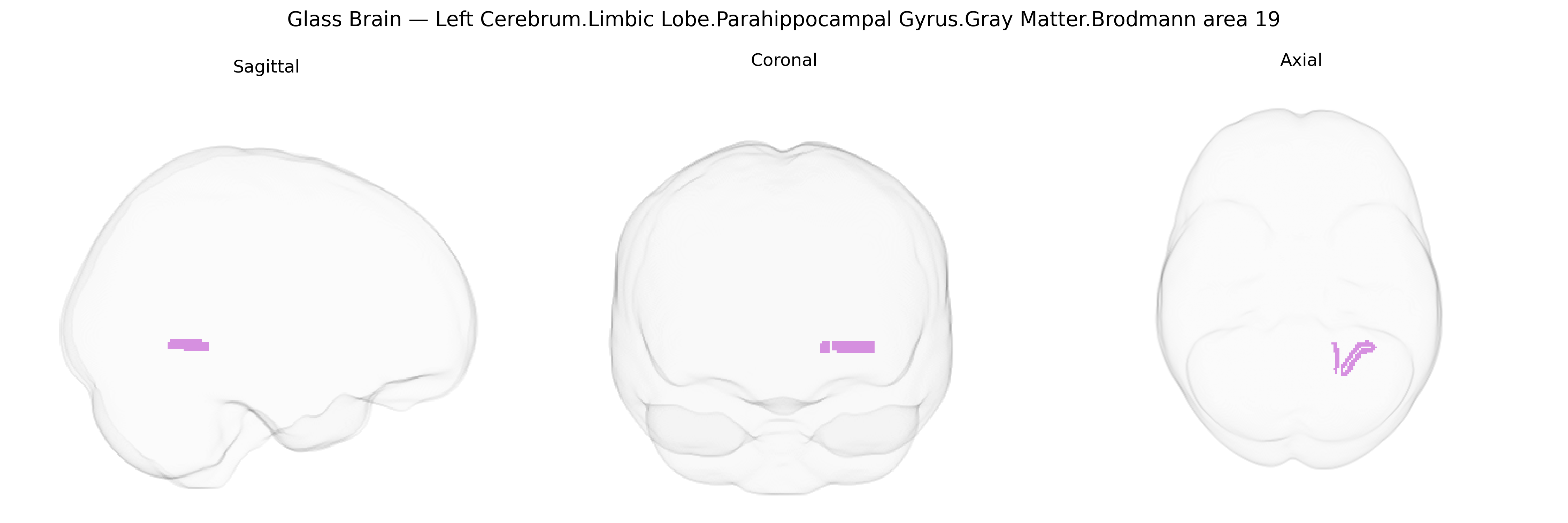
The bilateral Left Cerebrum.Limbic Lobe.Parahippocampal Gyrus.Gray Matter.Brodmann area 19 region, as defined in the Talairach 1 mm atlas, corresponds to gray matter within the parahippocampal gyrus that is assigned to Brodmann area 19, a higher-order visual association cortex traditionally located in the occipital and adjacent temporal lobes. In this limbic–temporal context, BA19 labeling reflects multimodal visual association territories overlapping or adjoining the parahippocampal region, which is crucial for contextual scene processing, visuospatial memory, and integration of visual input with mnemonic and emotional information relayed to the hippocampal formation. Functionally, this region participates in transforming complex visual scenes into context-rich representations used for navigation and episodic memory encoding, linking visual association pathways with limbic circuitry. There is no direct link for this exact composite region; a related structure is the Parahippocampal gyrus.
The bilateral Left Cerebrum Limbic Lobe Parahippocampal Gyrus gray matter region corresponding to Brodmann area 19 in the Talairach 1 mm atlas lies at the interface of medial temporal and occipital cortices, and genetic associations typically emerge through imaging-genetics and GWAS of brain structure and function rather than direct region-specific gene mapping. Variants in genes related to neurodevelopment, synaptic plasticity, and neurodegeneration—such as APOE (particularly ε4), CLU, BIN1, and other Alzheimer’s disease–risk loci—have been associated with reduced parahippocampal and adjacent medial temporal gray matter volume and altered activation, especially in episodic memory and visuospatial tasks. Large-scale GWAS of cortical thickness and surface area (e.g., ENIGMA and UK Biobank–based studies) have identified polygenic influences and specific loci (including genes involved in axon guidance, Wnt signaling, and calcium channel function) that relate to structural variation in medial temporal and occipito-temporal regions overlapping this BA19-defined area. Parahippocampal and nearby BA19/lingual/fusiform regions also show genetic correlations with psychiatric and neurodevelopmental disorders—such as schizophrenia, major depressive disorder, bipolar disorder, and autism spectrum conditions—through shared polygenic architectures affecting cortical morphology and connectivity. Furthermore, GWAS of cognitive traits, including general intelligence, memory performance, and educational attainment, report associations with structural and functional measures in medial temporal-occipital regions that encompass this parahippocampal BA19 zone, suggesting that its morphology and activity represent a heritable intermediate phenotype linking distributed polygenic risk to variation in memory, scene processing, and vulnerability to neuropsychiatric disease.
Overview generated by GPT-4o (2026).
Region ID: 425
Hemisphere: bilateral
Atlas: Talairach labels 1mm
Full Quality Version: Download MP4
Full Quality Version: Download MP4
Wali Sidiqyar*, Gaurav Rudravaram*, Elyssa M. McMaster, Trent M. Schwartz, Adam M. Saunders, Kurt G. Schilling, Bennett A. Landman "Introducing SPINS: A Shared Public Visualization Library of Neuroanatomical Structures." Medical Imaging with Deep Learning- short paper
This resource is licensed under CC0 1.0 Universal (Public Domain).