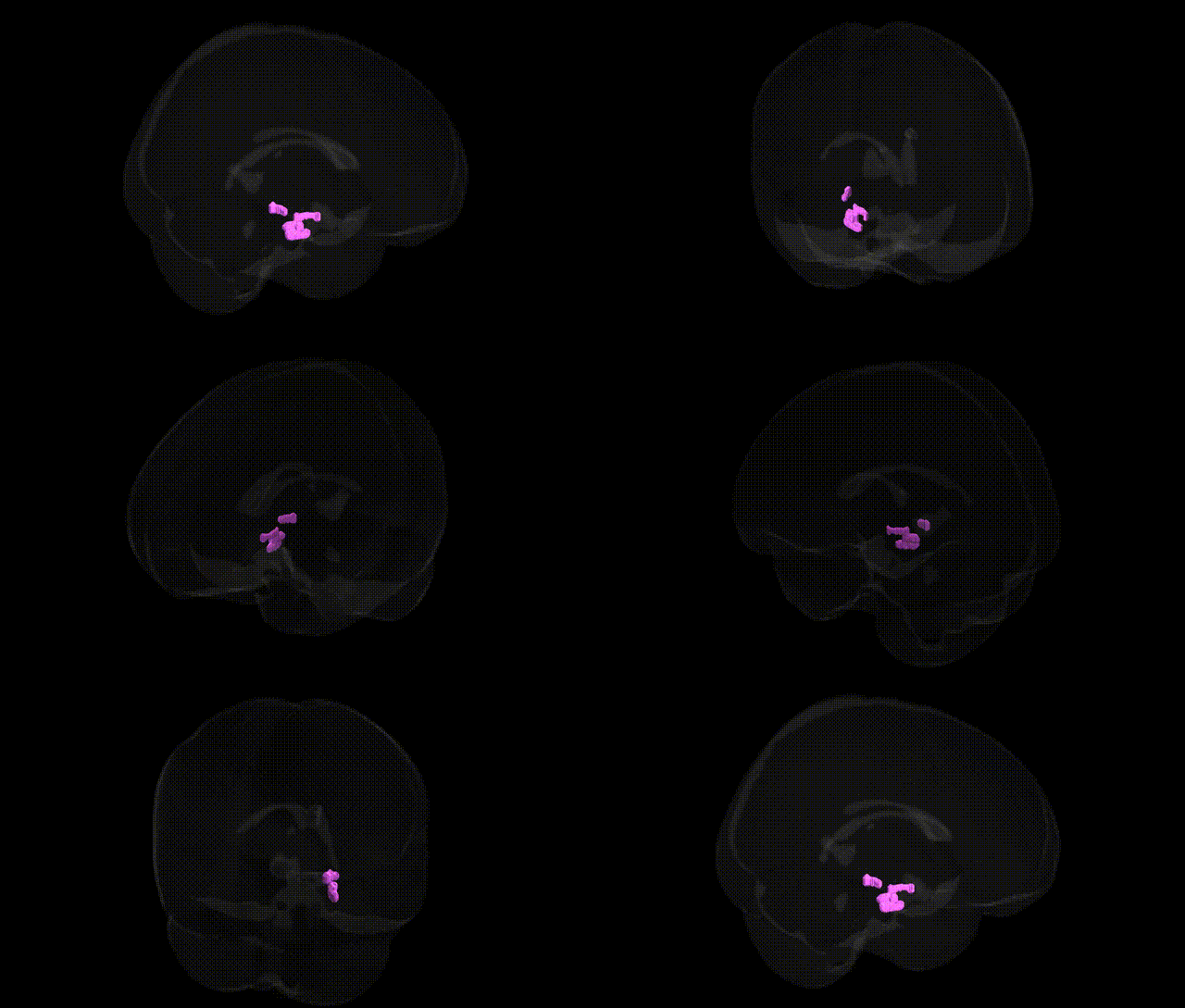
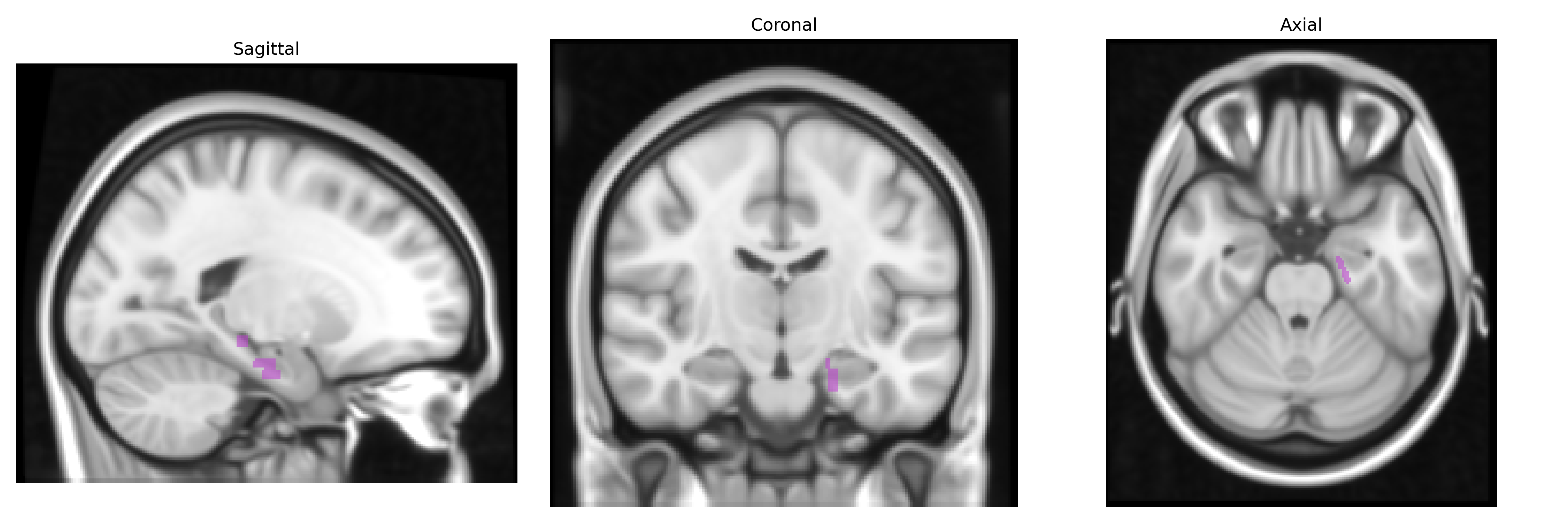
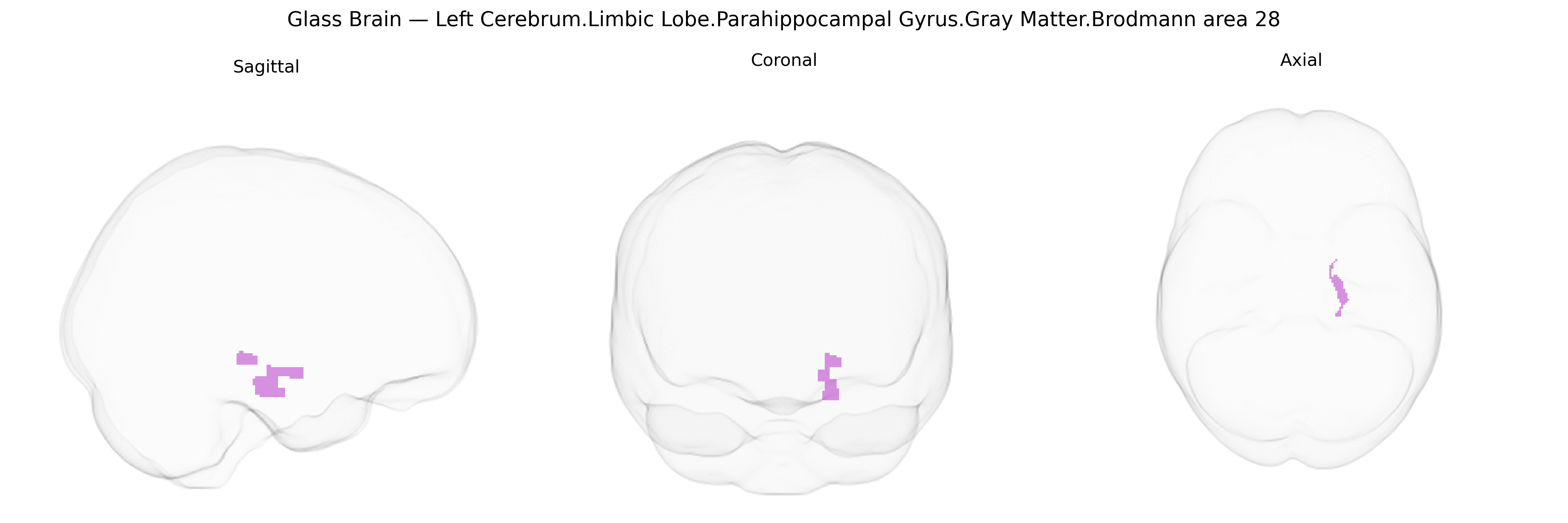
The bilateral Left Cerebrum.Limbic Lobe.Parahippocampal Gyrus.Gray Matter.Brodmann area 28 corresponds primarily to the entorhinal cortex, a cytoarchitectonically defined allocortical region situated in the anterior parahippocampal gyrus of the medial temporal lobe. This area serves as a major interface between widespread neocortical association areas and the hippocampal formation, receiving multimodal sensory and associative inputs and relaying them to hippocampal subfields via the perforant path, while also transmitting hippocampal output back to cortical regions. Brodmann area 28 plays a crucial role in episodic memory formation, spatial navigation, and contextual association, and is among the earliest cortical regions to exhibit neurodegenerative changes in Alzheimer’s disease. The gray matter here contains characteristic layered architecture distinct from neocortex, reflecting its position as a transitional cortex between hippocampus and temporal neocortex within the limbic system. Entorhinal cortex
The bilateral left parahippocampal gyrus gray matter in Brodmann area 28 (entorhinal cortex region), as defined in the Talairach 1 mm atlas, has been implicated in genetic studies primarily through its roles in memory, navigation, and susceptibility to neurodegenerative and psychiatric disorders. Structural and functional variation in this region has been linked in GWAS and imaging‑genetics studies to Alzheimer’s disease risk genes such as APOE (especially ε4), CLU, PICALM, BIN1, and ABCA7, which influence entorhinal and parahippocampal atrophy and amyloid/tau pathology. Variants in genes involved in synaptic plasticity and neurodevelopment, including BDNF, RELN, and DISC1, have shown associations with parahippocampal volume or activation, particularly in relation to episodic memory performance and schizophrenia or schizoaffective spectrum diagnoses, while genes such as ZNF804A and CACNA1C have been linked to altered parahippocampal connectivity and activation patterns in schizophrenia and bipolar disorder. Additional GWAS of brain morphology and functional networks implicate common variants across multiple loci (e.g., in KIBRA/WFS1 region and other cortex‑wide regulatory genes) in individual differences in parahippocampal thickness, surface area, and memory‑related activation, as well as in risk for major depressive disorder and anxiety phenotypes, although these effects are typically modest and highly polygenic.
Overview generated by GPT-4o (2026).
Region ID: 169
Hemisphere: bilateral
Atlas: Talairach labels 1mm
Full Quality Version: Download MP4
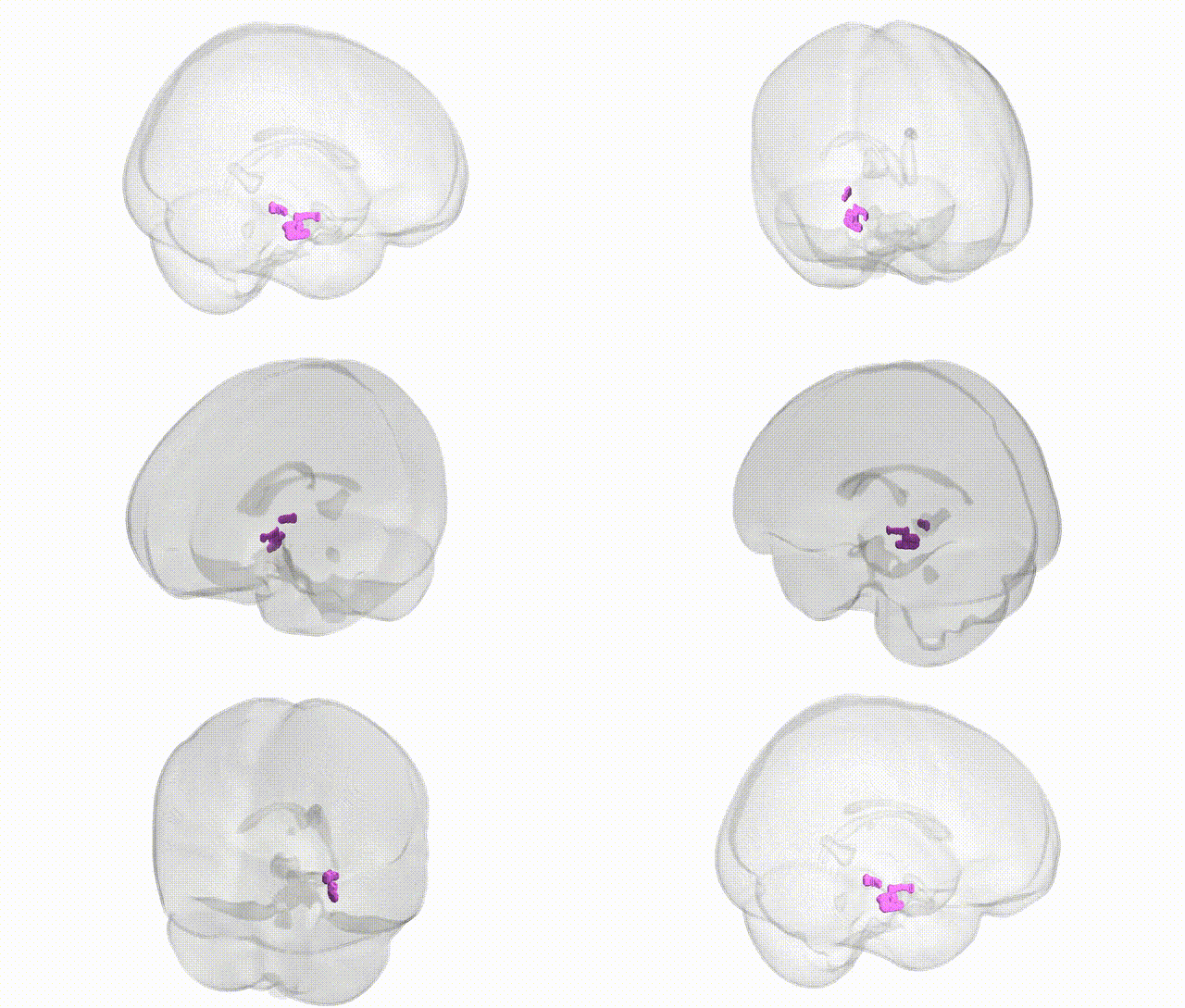
Full Quality Version: Download MP4
Wali Sidiqyar*, Gaurav Rudravaram*, Elyssa M. McMaster, Trent M. Schwartz, Adam M. Saunders, Kurt G. Schilling, Bennett A. Landman "Introducing SPINS: A Shared Public Visualization Library of Neuroanatomical Structures." Medical Imaging with Deep Learning- short paper
This resource is licensed under CC0 1.0 Universal (Public Domain).