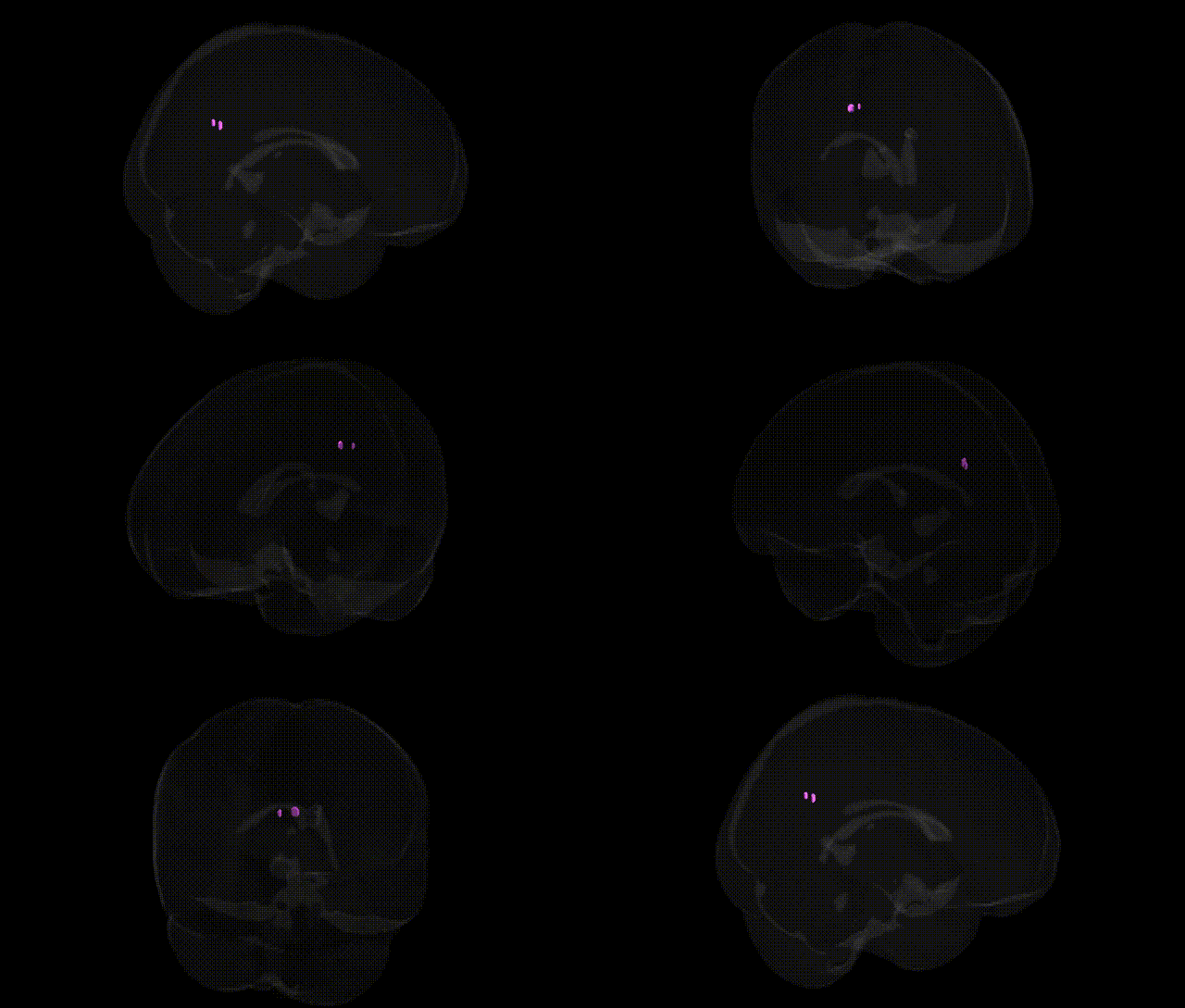
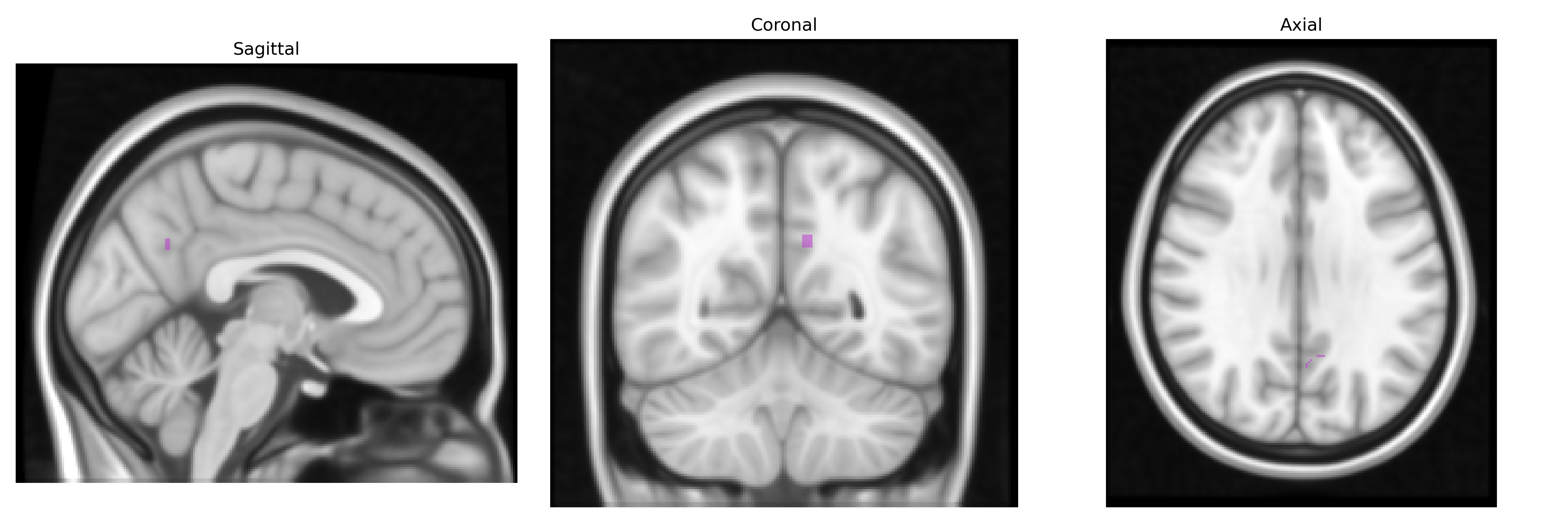
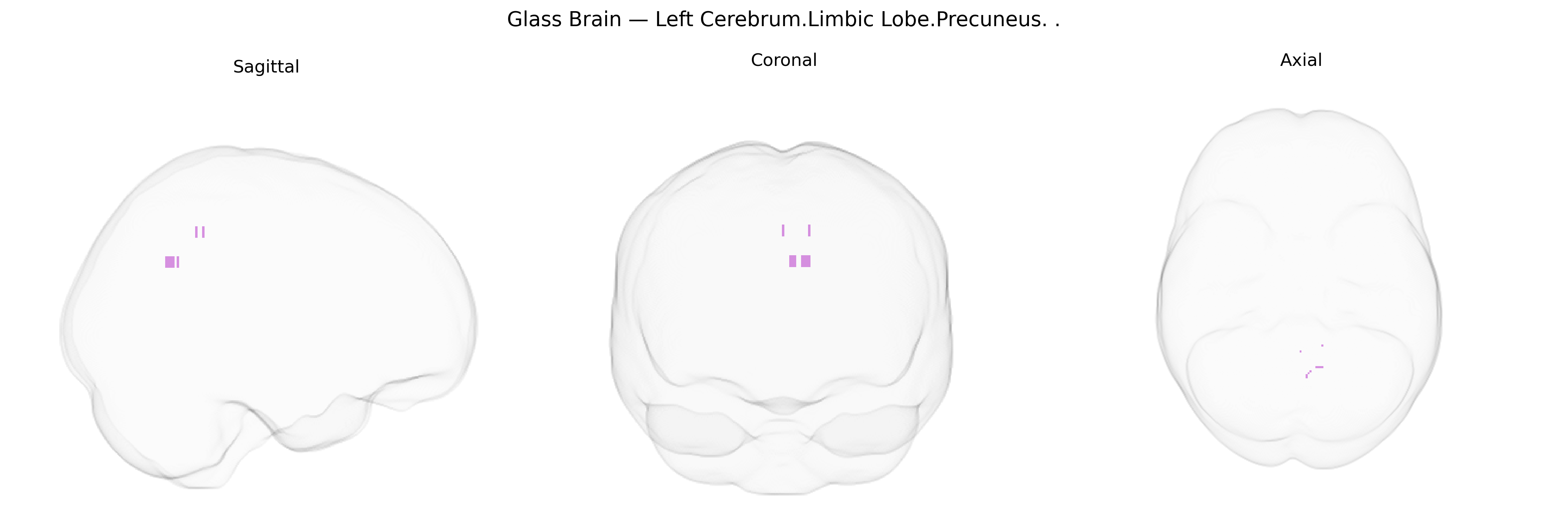
The bilateral Left Cerebrum.Limbic Lobe.Precuneus corresponds to the precuneus region of the medial parietal cortex, situated on the medial surface of the superior parietal lobule between the marginal branch of the cingulate sulcus and the parieto‑occipital sulcus. Functionally, the precuneus is a key hub within the default mode network and is heavily involved in self-referential processing, visuospatial imagery, episodic memory retrieval, and aspects of consciousness and internal mentation. It maintains extensive reciprocal connections with the posterior cingulate cortex, medial prefrontal cortex, lateral parietal cortex, and subcortical structures, reflecting its integrative role in linking sensory information with higher-level cognitive and affective processes. In the Talairach 1 mm atlas, its inclusion within the “limbic lobe” reflects its strong participation in networks subserving memory and emotional-cognitive integration rather than a strictly classical limbic anatomical boundary. Precuneus
The bilateral precuneus within the limbic–parietal transition zone has been repeatedly implicated in imaging–genetics and GWAS-related work as a convergent site where common variants linked to Alzheimer’s disease (e.g., in APOE, CLU, CR1, PICALM, BIN1), frontotemporal dementia, and other neurodegenerative pathways associate with regional atrophy, amyloid burden, or altered connectivity, and where polygenic risk scores for late-onset Alzheimer’s and general cognitive decline correlate with reduced precuneus volume or metabolism. Large-scale ENIGMA and UK Biobank studies have identified SNPs in genes involved in synaptic function, neuronal development, and myelination (including variants near HMGA2, KIBRA/WDR26, and microtubule- or axon-guidance–related loci) that associate with precuneus cortical thickness, surface area, and white-matter microstructure, while schizophrenia and major depression GWAS-derived polygenic risk scores show subtle but reproducible links to precuneus structure and default mode network connectivity. In addition, genetic factors contributing to individual differences in consciousness-related processes, self-referential cognition, and general intelligence have been indirectly mapped onto this region via heritable variations in resting-state default mode activity and task-based activation, and several twin and family studies indicate high heritability of precuneus morphometry and function, supporting a substantial genetic contribution to interindividual variability in this limbic-associated parietal hub.
Overview generated by GPT-4o (2026).
Region ID: 911
Hemisphere: bilateral
Atlas: Talairach labels 1mm
Full Quality Version: Download MP4
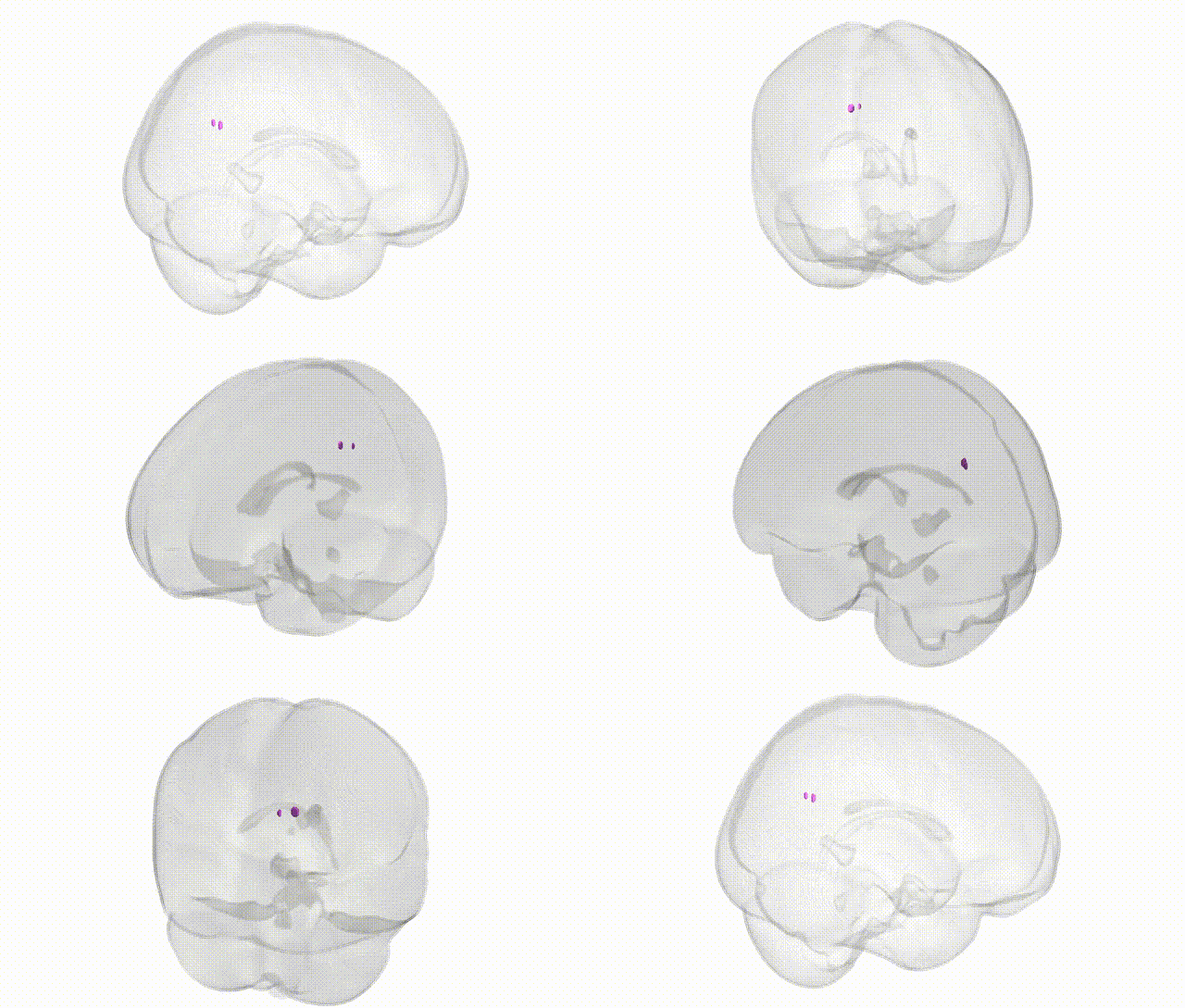
Full Quality Version: Download MP4
Wali Sidiqyar*, Gaurav Rudravaram*, Elyssa M. McMaster, Trent M. Schwartz, Adam M. Saunders, Kurt G. Schilling, Bennett A. Landman "Introducing SPINS: A Shared Public Visualization Library of Neuroanatomical Structures." Medical Imaging with Deep Learning- short paper
This resource is licensed under CC0 1.0 Universal (Public Domain).