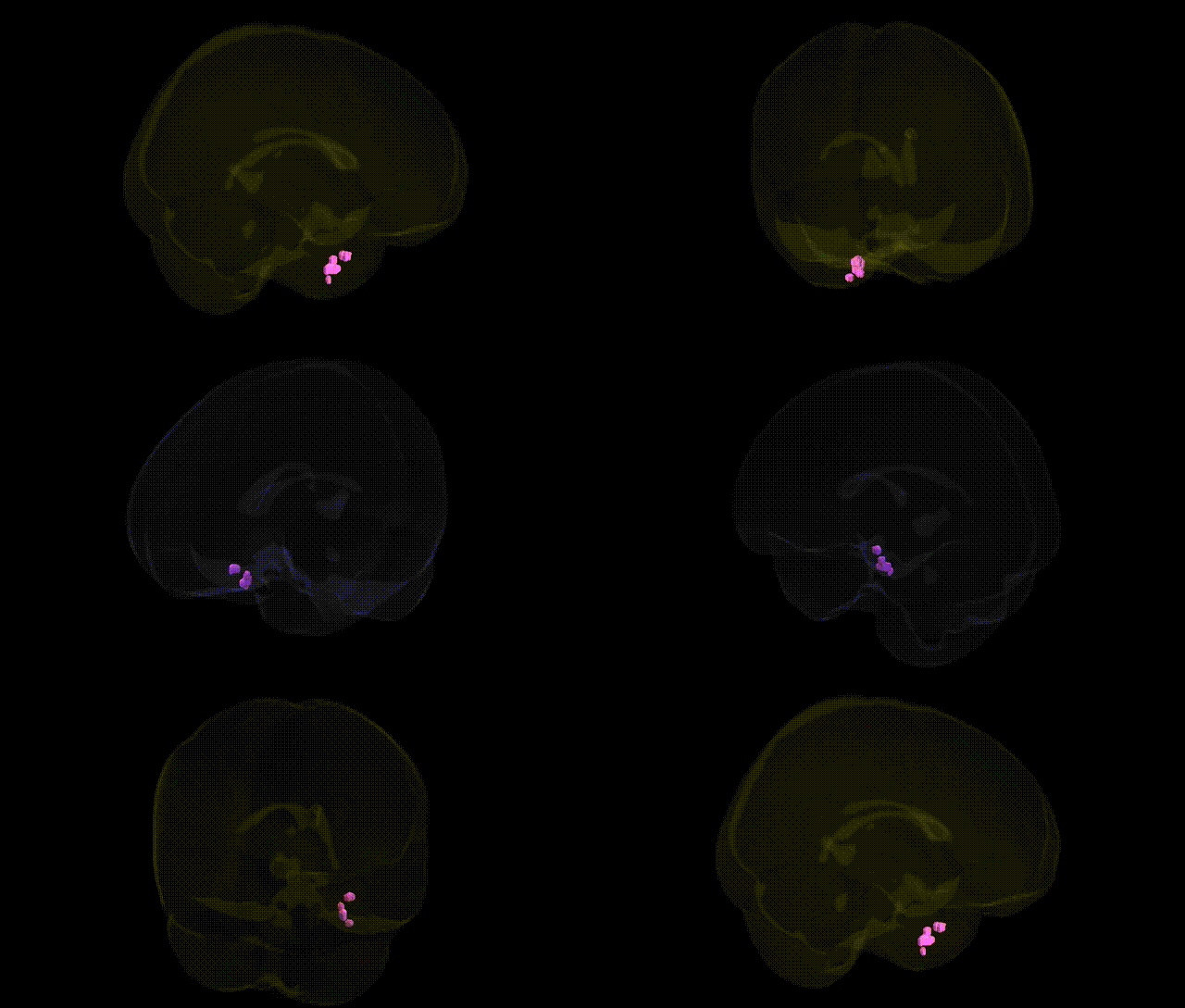
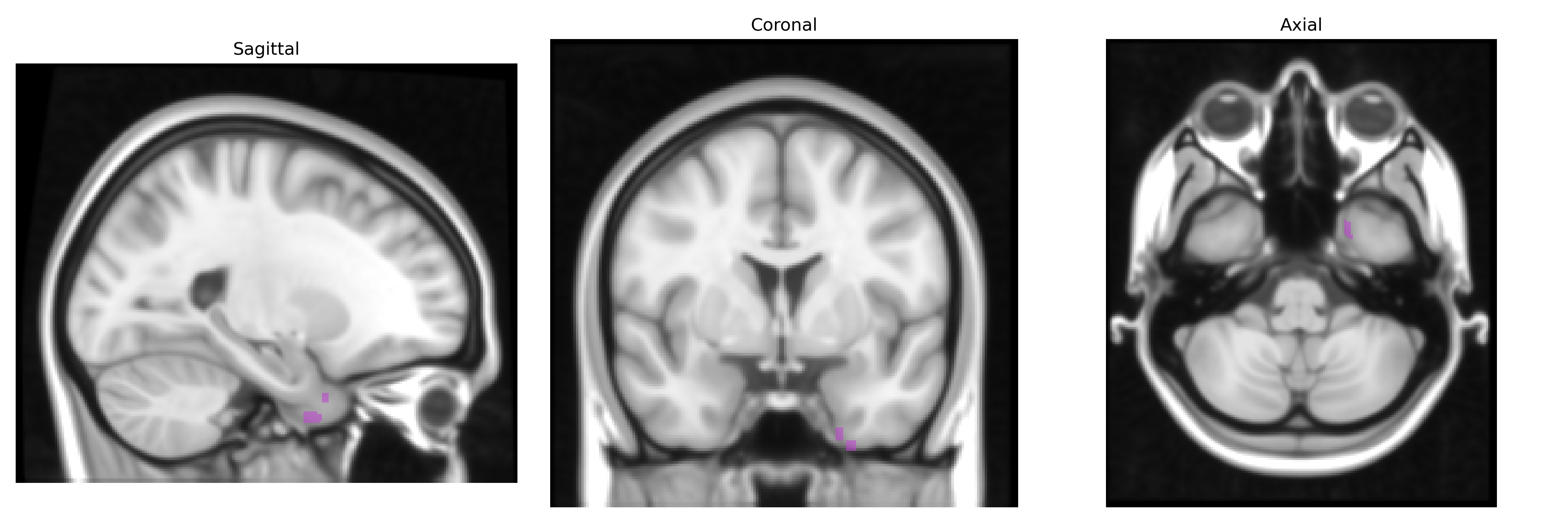
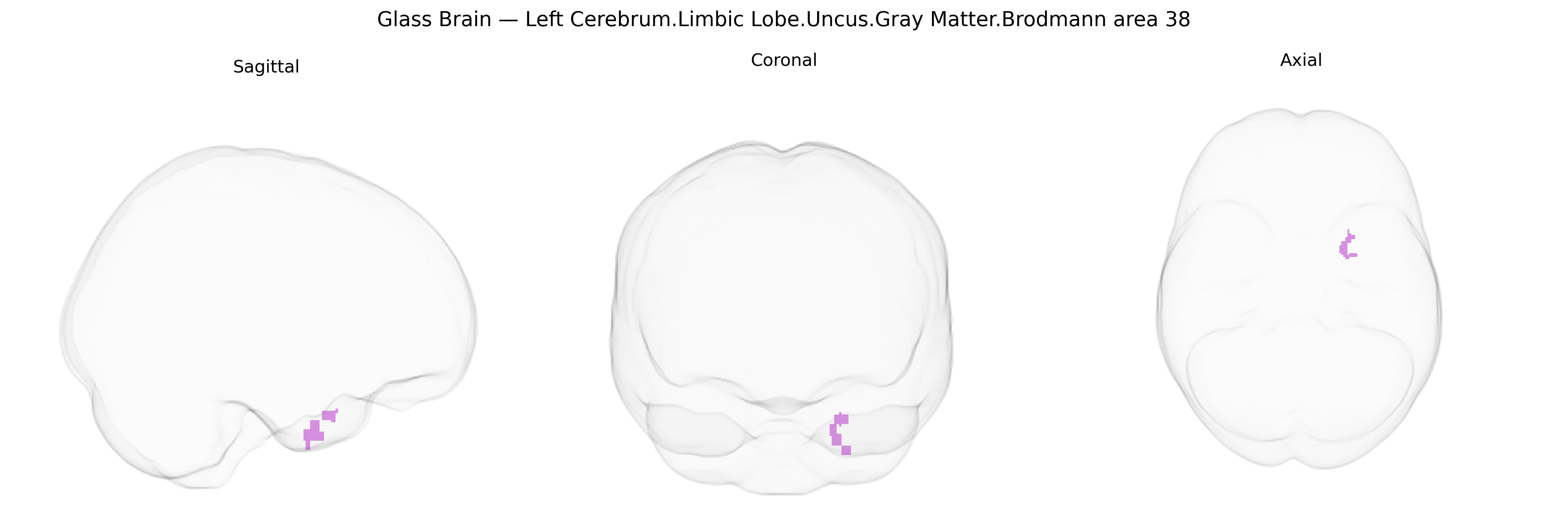
The bilateral Left Cerebrum.Limbic Lobe.Uncus.Gray Matter.Brodmann area 38 corresponds to the anterior portion of the temporal pole within the limbic-associated cortex, situated on the medial aspect of the temporal lobe and closely related to the uncus and amygdaloid complex. This region is part of the paralimbic cortex and is implicated in higher-order socio-emotional processing, semantic memory, multimodal sensory integration, and aspects of olfactory and emotional evaluation, reflecting its extensive connectivity with frontal, limbic, and temporal association areas. Histologically, Brodmann area 38 exhibits agranular to dysgranular cortical lamination consistent with limbic and paralimbic cortex, and lesions or dysfunction in this area have been associated with semantic dementia, alterations in emotional behavior, and disturbances in complex social cognition. There is no dedicated Wikipedia article for this exact region; a closely related structure is the Temporal pole.
The bilateral left uncus in Brodmann area 38 (anterior temporal/temporal pole, part of the limbic system) has been implicated in genetic studies primarily through its involvement in social-emotional processing, semantic memory, and susceptibility to neuropsychiatric and neurodegenerative conditions, although GWAS typically target traits rather than this specific Talairach-defined parcel. Imaging genetics and GWAS of cortical thickness, surface area, and temporal lobe volumes show heritable variation in anterior temporal structures, with loci including variants near genes such as KIAA0586, WNT3, and others associated with temporal pole morphology and broader temporal lobe measures. Functional and structural abnormalities in BA38/uncus have been linked, via genetic and polygenic risk studies, to frontotemporal dementia (e.g., MAPT, GRN, C9orf72), semantic variant primary progressive aphasia, and temporal lobe epilepsy (including associations with SCN1A and other channel genes), conditions in which anterior temporal/uncal atrophy or hyperexcitability is common. In psychiatric genetics, schizophrenia, bipolar disorder, and major depression GWAS consistently implicate gene sets involved in synaptic function and neurodevelopment (such as CACNA1C, GRIN2A, and complement pathway genes), and imaging–genetics work often finds that polygenic risk for these disorders predicts altered structure and function in the anterior temporal/limbic network that includes BA38. The uncus and adjacent BA38 are also engaged in social cognition and face/voice processing, domains influenced by variants in genes like OXTR and 5-HTTLPR, though these associations are typically reported at the level of networks rather than the specific Talairach 1 mm label. Overall, genetic findings support that this limbic–temporal pole region is a heritable, genetically modulated hub for emotional, semantic, and social processing, and a locus of vulnerability in epilepsy and neurodegenerative and psychiatric disease, even though few GWAS address the exact “Left Cerebrum.Limbic Lobe.Uncus.Gray Matter.Brodmann area 38” parcel as an isolated unit.
Overview generated by GPT-4o (2026).
Region ID: 34
Hemisphere: bilateral
Atlas: Talairach labels 1mm
Full Quality Version: Download MP4
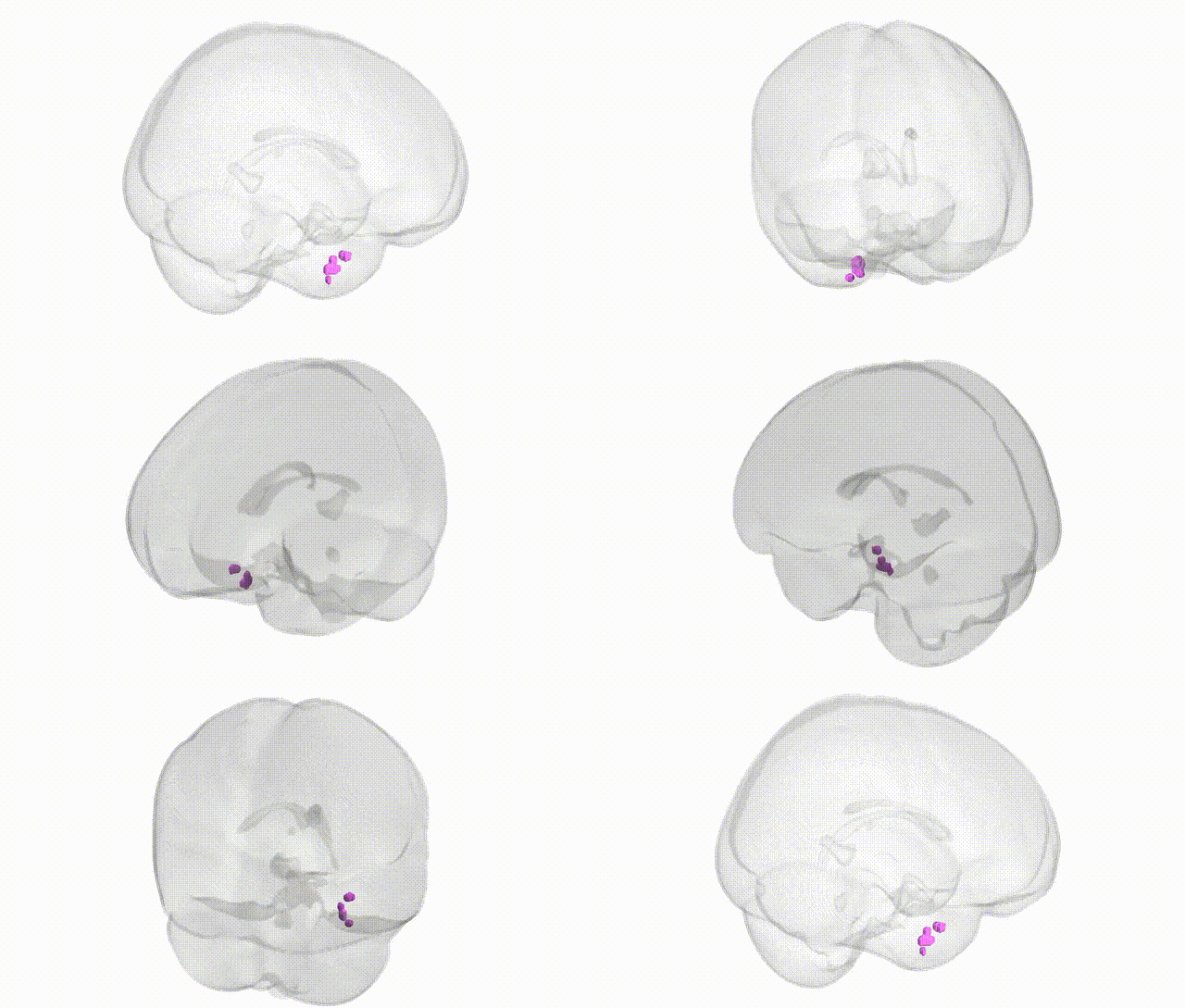
Full Quality Version: Download MP4
Wali Sidiqyar*, Gaurav Rudravaram*, Elyssa M. McMaster, Trent M. Schwartz, Adam M. Saunders, Kurt G. Schilling, Bennett A. Landman "Introducing SPINS: A Shared Public Visualization Library of Neuroanatomical Structures." Medical Imaging with Deep Learning- short paper
This resource is licensed under CC0 1.0 Universal (Public Domain).