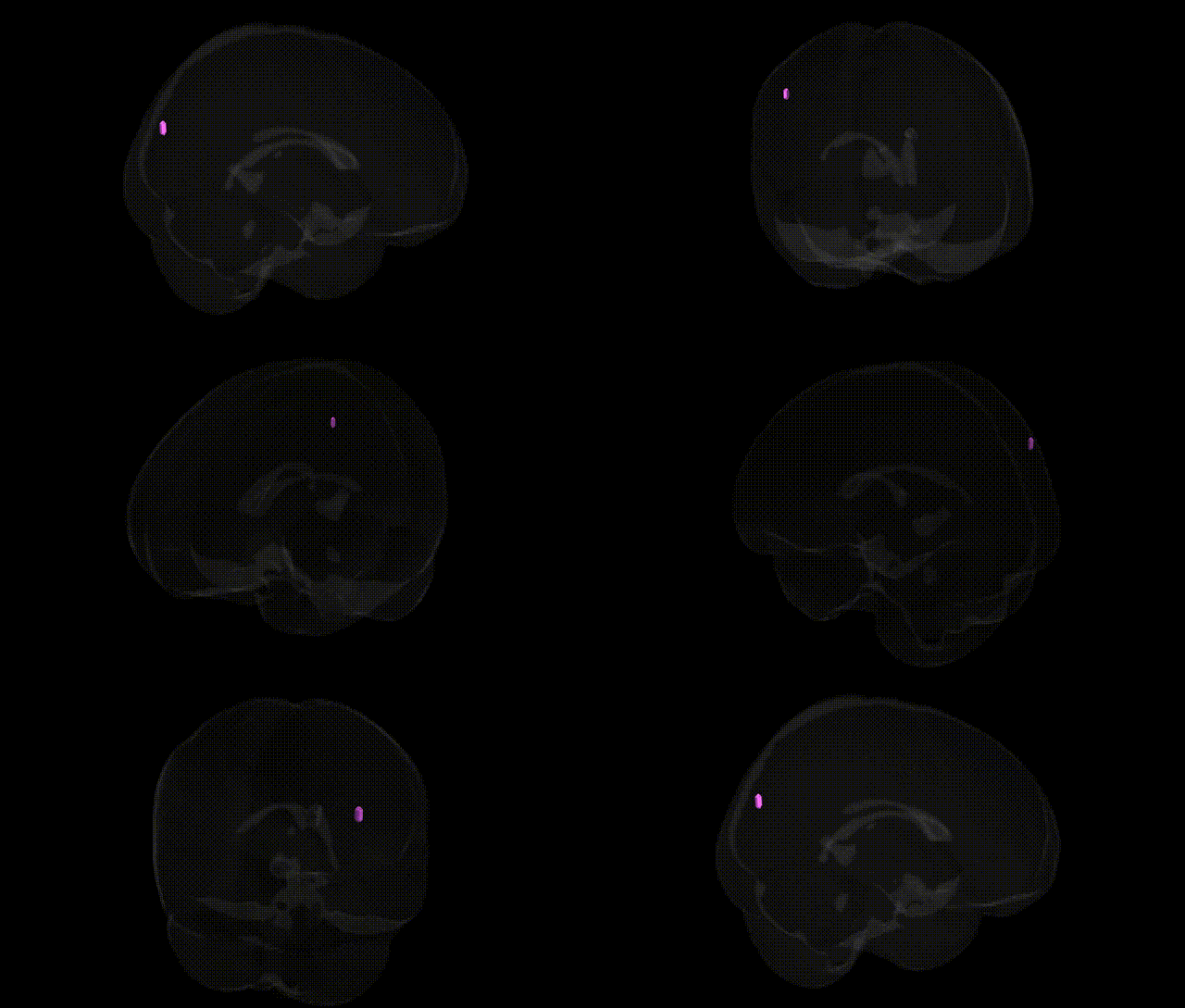
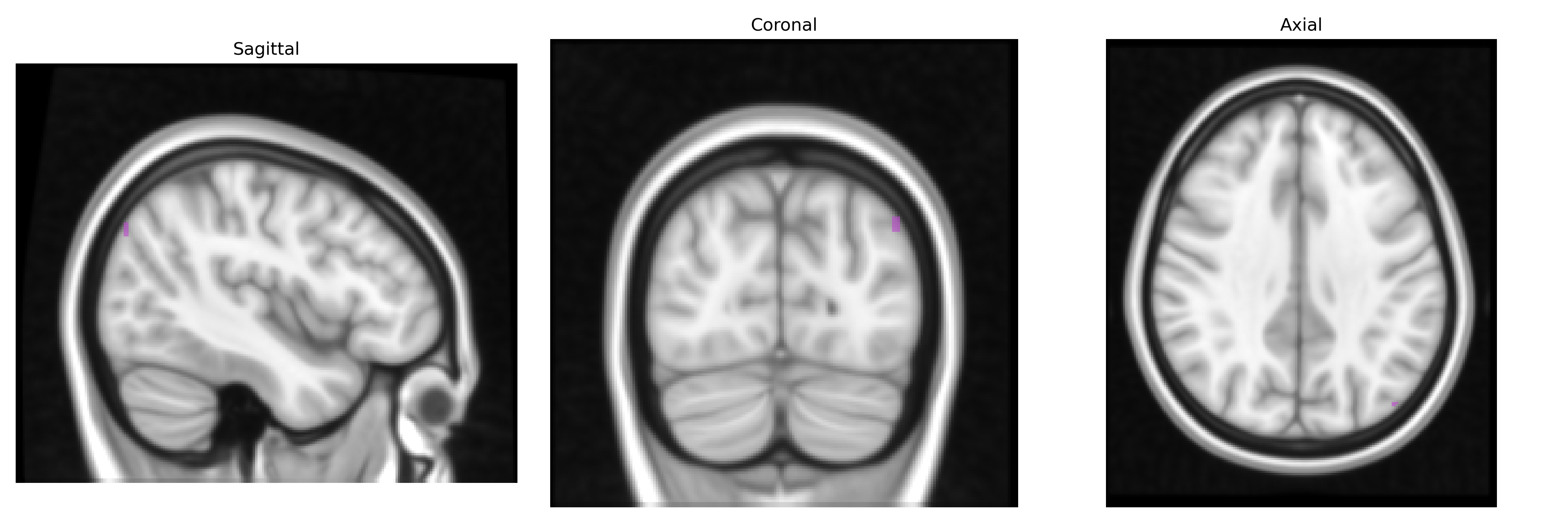
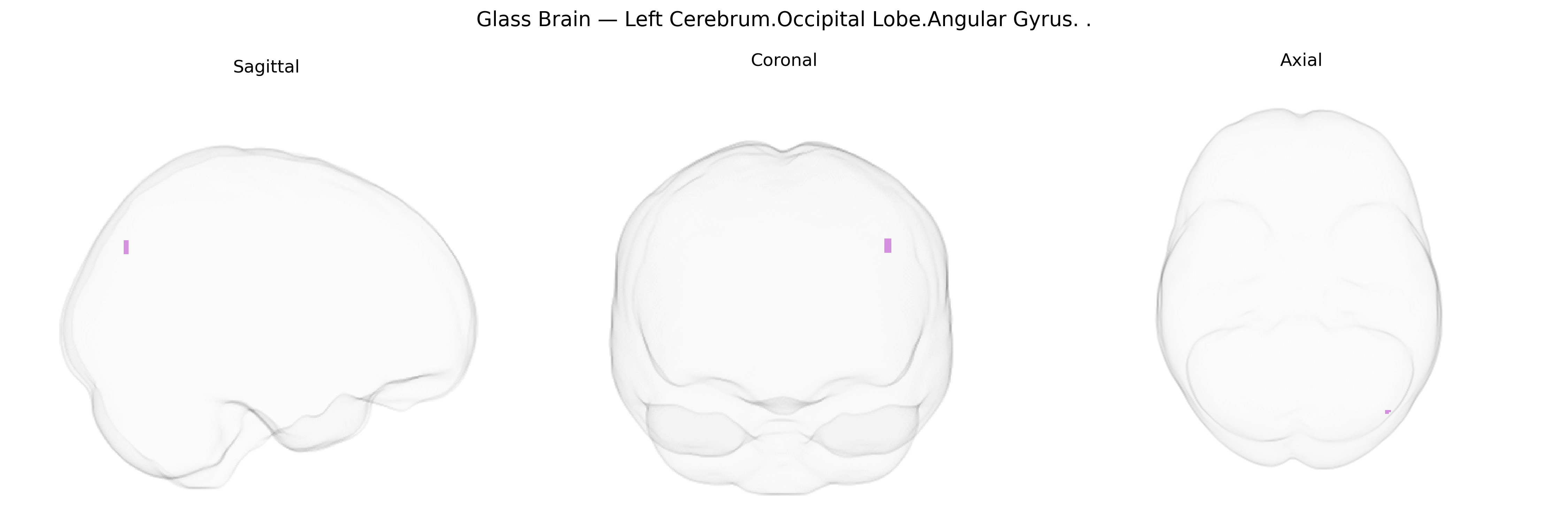
The bilateral Left Cerebrum.Occipital Lobe.Angular Gyrus, as defined in the Talairach 1 mm atlas, corresponds to the angular gyrus of the left hemisphere, a multimodal association region located at the junction of the temporal, parietal, and occipital lobes, typically around Brodmann area 39. This region integrates visual, auditory, and somatosensory information and is implicated in higher cognitive functions such as reading and writing, number processing, semantic processing, and aspects of spatial cognition and attention. It is also associated with language comprehension and theory of mind, and lesions in this area can lead to syndromes such as Gerstmann’s syndrome and various aphasic and alexic disturbances. No direct Wikipedia article exists for this exact Talairach label; a closely related structure is the Angular gyrus.
The bilateral left cerebrum occipital lobe angular gyrus (classically the left inferior parietal/angular region at the parietal–occipital junction) has been repeatedly implicated in genetic studies of higher cognitive function, language, and neuropsychiatric risk. GWAS and imaging–genetics work from consortia such as ENIGMA and UK Biobank show that common variants influencing cortical surface area and thickness in the angular gyrus overlap with loci involved in synaptic development, axon guidance, and neurodevelopmental regulation (for example, genes near MIR137, DCC, and MAPT in broader temporoparietal networks), and these same loci contribute to polygenic risk for schizophrenia, autism spectrum disorder, major depression, and Alzheimer’s disease. Variants associated with general cognitive ability, educational attainment, and reading and mathematical skills often show structural and functional associations with the angular gyrus and adjacent inferior parietal regions, suggesting a genetic contribution to the region’s role in semantic processing, number cognition, and default mode network function. In Alzheimer’s disease and related dementias, risk alleles in APOE and other AD GWAS loci predict greater atrophy and hypometabolism in temporoparietal regions including the angular gyrus, while schizophrenia risk variants are linked to altered cortical thickness and connectivity in this area. Overall, genetic findings converge on neurodevelopmental and synaptic pathways that modulate angular gyrus structure and connectivity and thereby influence vulnerability to psychiatric and neurodegenerative disorders as well as interindividual variation in cognition and language.
Overview generated by GPT-4o (2026).
Region ID: 955
Hemisphere: bilateral
Atlas: Talairach labels 1mm
Full Quality Version: Download MP4
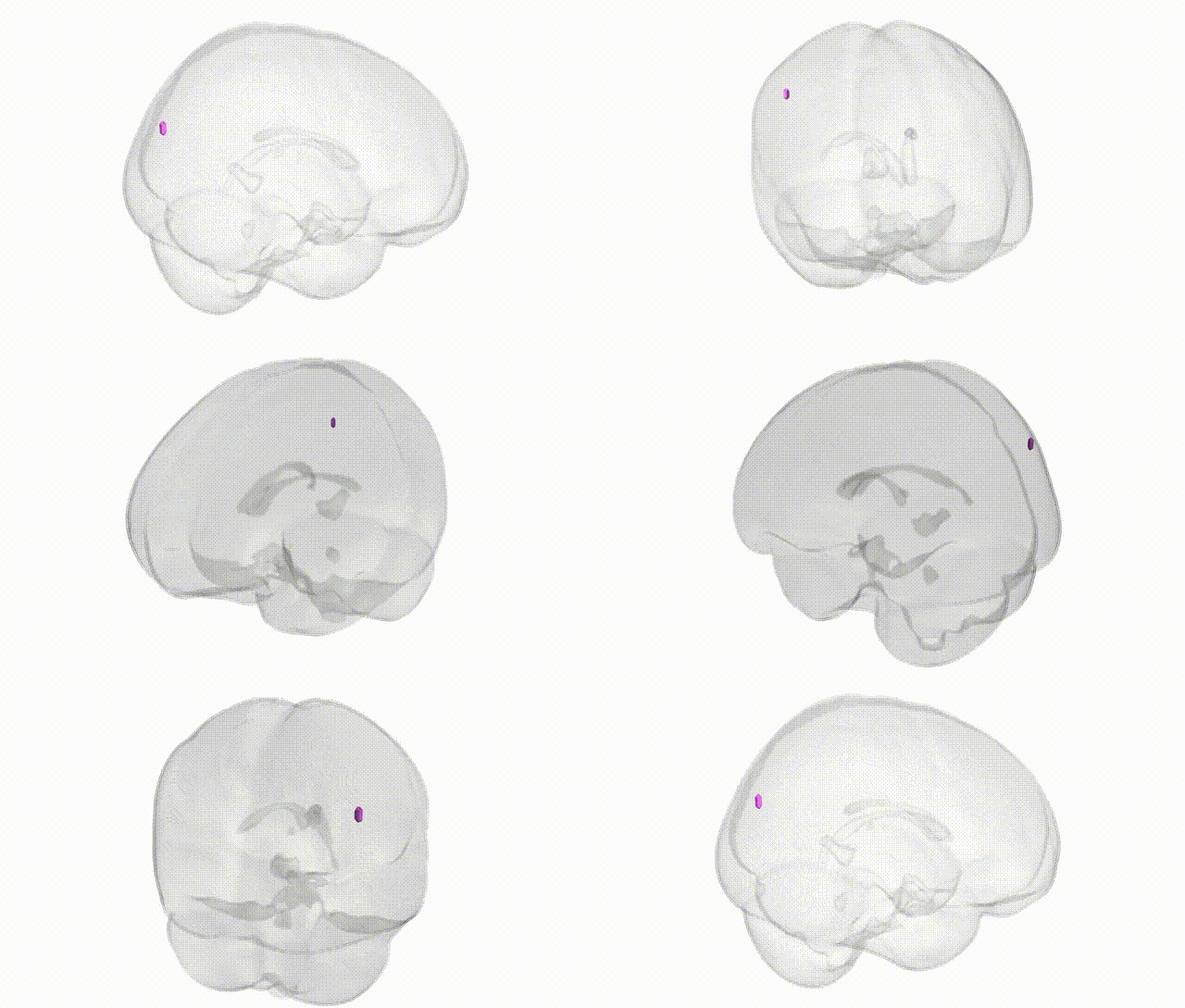
Full Quality Version: Download MP4
Wali Sidiqyar*, Gaurav Rudravaram*, Elyssa M. McMaster, Trent M. Schwartz, Adam M. Saunders, Kurt G. Schilling, Bennett A. Landman "Introducing SPINS: A Shared Public Visualization Library of Neuroanatomical Structures." Medical Imaging with Deep Learning- short paper
This resource is licensed under CC0 1.0 Universal (Public Domain).