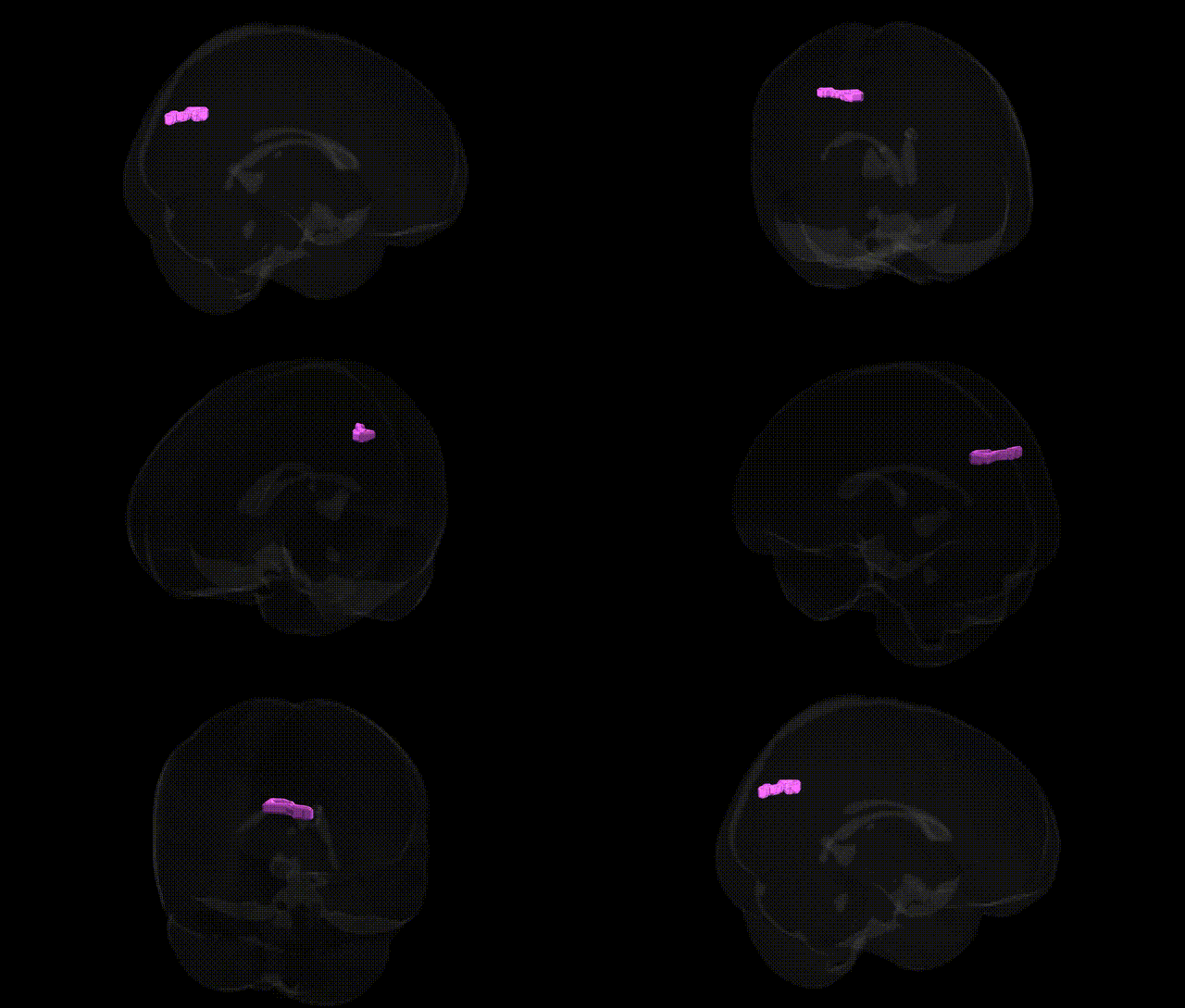
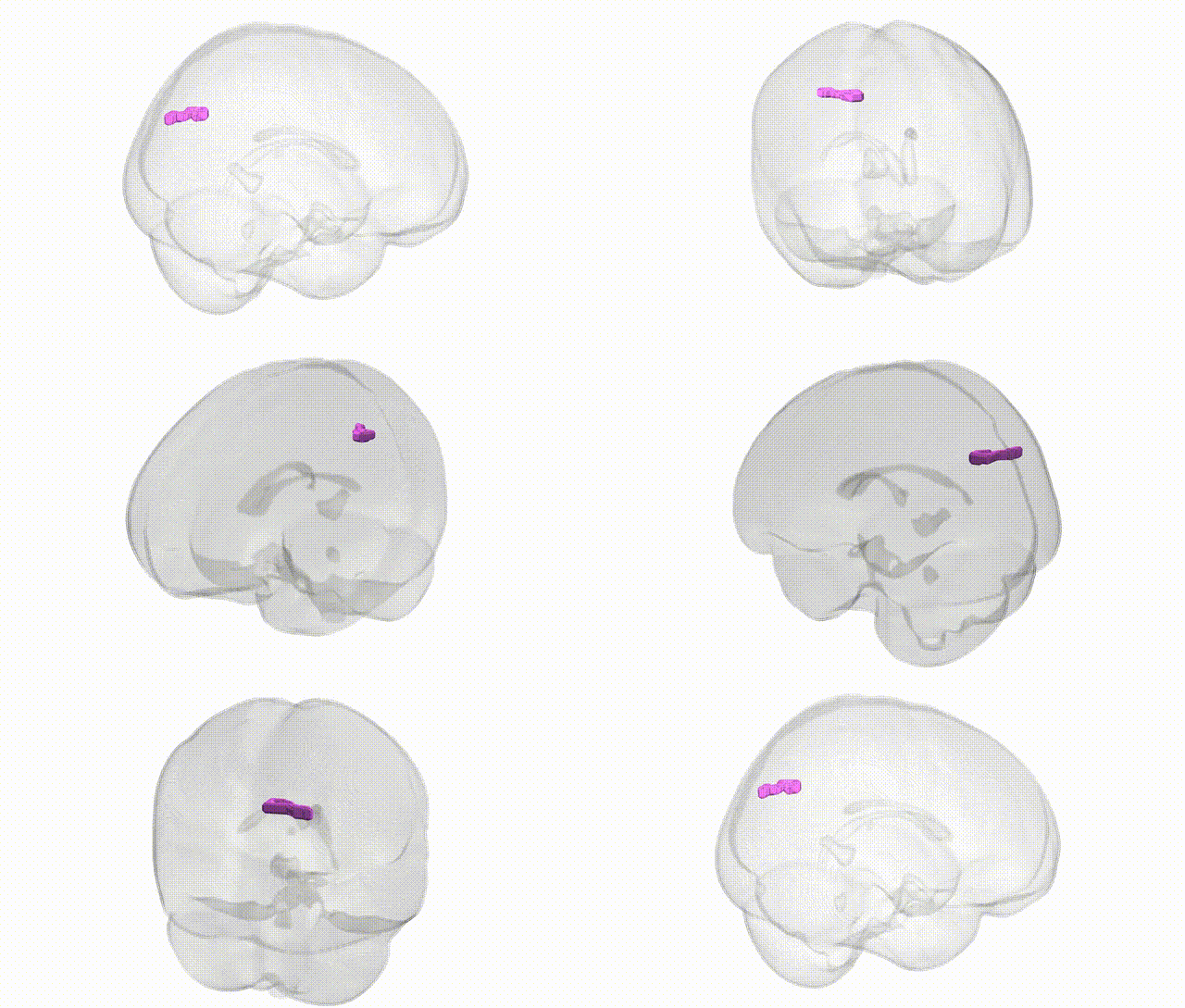
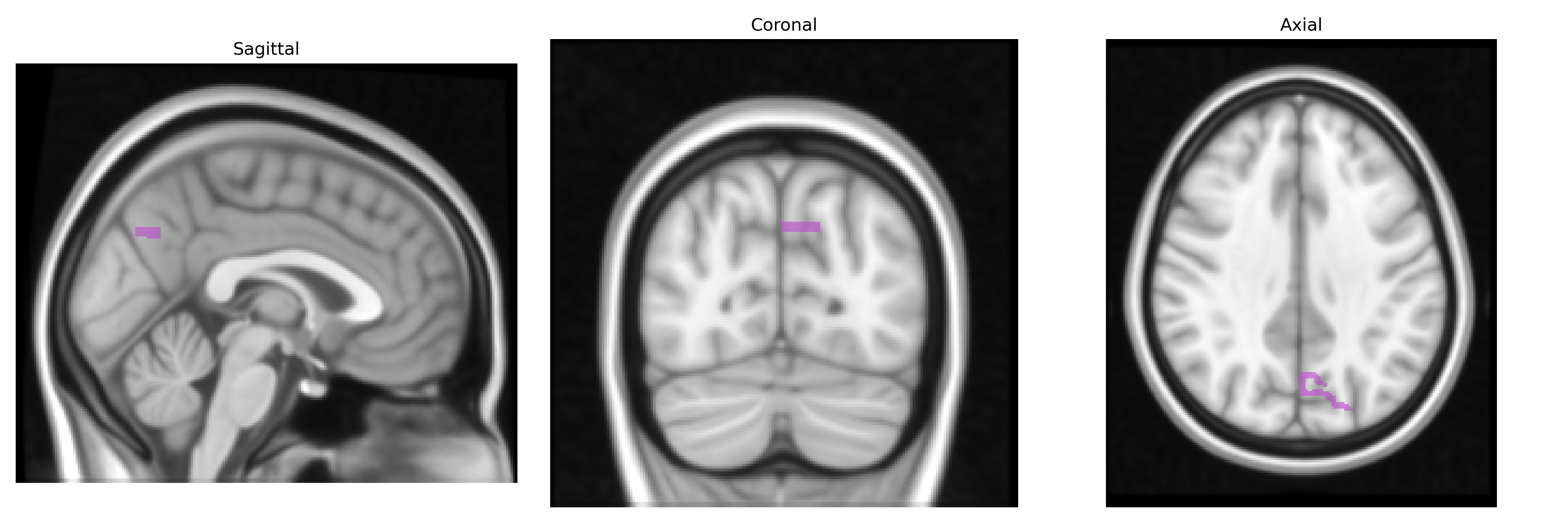
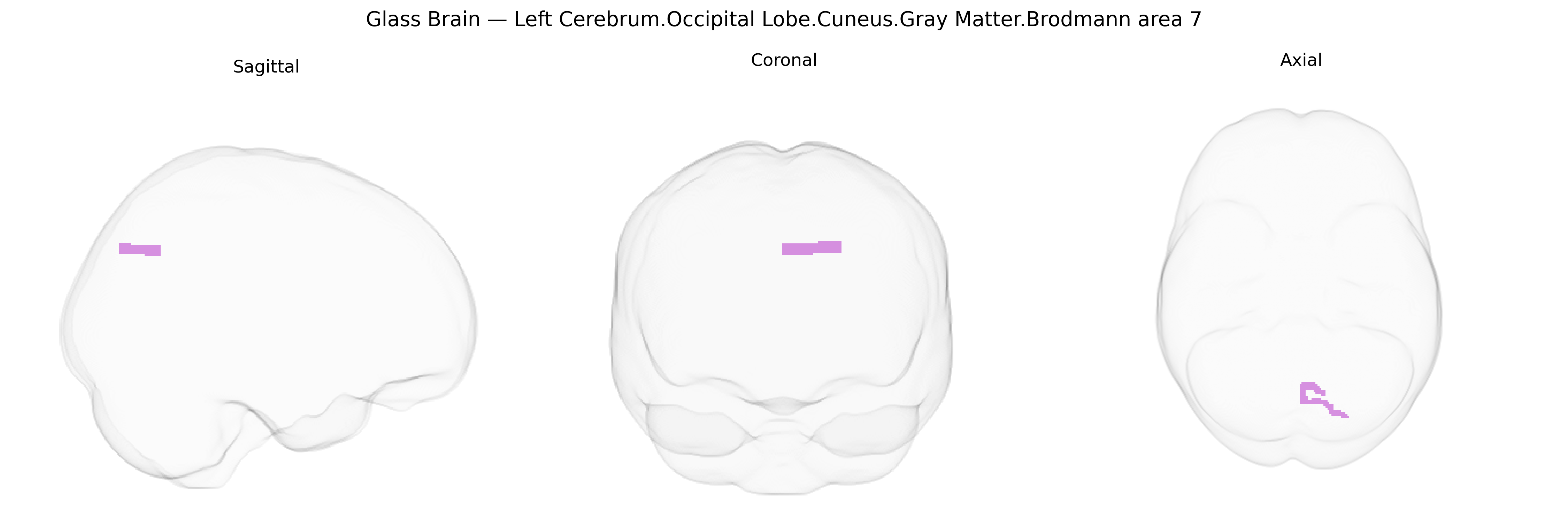
The bilateral Left Cerebrum.Occipital Lobe.Cuneus.Gray Matter.Brodmann area 7 region, as defined in the Talairach 1 mm atlas, refers to gray matter within the cuneus of the occipital lobe that falls within the cytoarchitectonic boundaries attributed to Brodmann area 7, a higher-order association area more classically located in the superior parietal lobule. Functionally, cortex in and around Brodmann area 7 participates in the integration of visual and somatosensory information, visuospatial processing, and the coordination of visually guided actions, contributing to spatial attention and the transformation of sensory input into motor-relevant representations. In the occipital cuneus, tissue labeled as BA7 likely reflects transitional or extended association cortex interfacing between primary and secondary visual areas and parietal visuomotor areas, supporting complex visual interpretation and spatial mapping. There is no direct Wikipedia article for this exact Talairach-defined region; a related structure is Brodmann area 7.
The bilateral left cuneus gray matter region in the occipital lobe, overlapping with posterior parietal/Brodmann area 7 territory in some Talairach-based atlases, has been implicated in several genetic and GWAS-based associations spanning visual processing, higher-order cognition, and neuropsychiatric risk. Imaging genetics studies and large-scale GWAS of cortical thickness and surface area have repeatedly linked variation in this region to common polymorphisms in genes involved in neurodevelopment, synaptic plasticity, and myelination, including loci near or within genes such as KIAA0586, MAPT, and POU3F2, although effect sizes are small and often distributed across many regions. Cuneus/BA7 structural and functional measures have been associated with polygenic risk scores for schizophrenia, major depressive disorder, and autism spectrum disorder, as well as with APOE-related risk in Alzheimer’s disease, reflecting the region’s participation in visuospatial, attentional, and default-mode–adjacent networks affected in these conditions. GWAS of brain imaging phenotypes from consortia such as ENIGMA and UK Biobank have identified genome-wide significant associations between occipital and superior parietal/cuneus metrics and loci implicated in cortical patterning (e.g., WNT and FGF pathway genes), visual cortex development, and general cognitive ability, suggesting that genetic influences on this region contribute to interindividual differences in visual attention, working memory, and intelligence. In addition, cuneus/BA7 activation and structure show heritable components tied to genes modulating glutamatergic and GABAergic signaling, with some studies linking these phenotypes to risk variants for migraine, attention-deficit/hyperactivity disorder, and anxiety traits, although these associations remain less robust and often require replication.
Overview generated by GPT-4o (2026).
Region ID: 952
Hemisphere: bilateral
Atlas: Talairach labels 1mm
Full Quality Version: Download MP4
Full Quality Version: Download MP4
Wali Sidiqyar*, Gaurav Rudravaram*, Elyssa M. McMaster, Trent M. Schwartz, Adam M. Saunders, Kurt G. Schilling, Bennett A. Landman "Introducing SPINS: A Shared Public Visualization Library of Neuroanatomical Structures." Medical Imaging with Deep Learning- short paper
This resource is licensed under CC0 1.0 Universal (Public Domain).