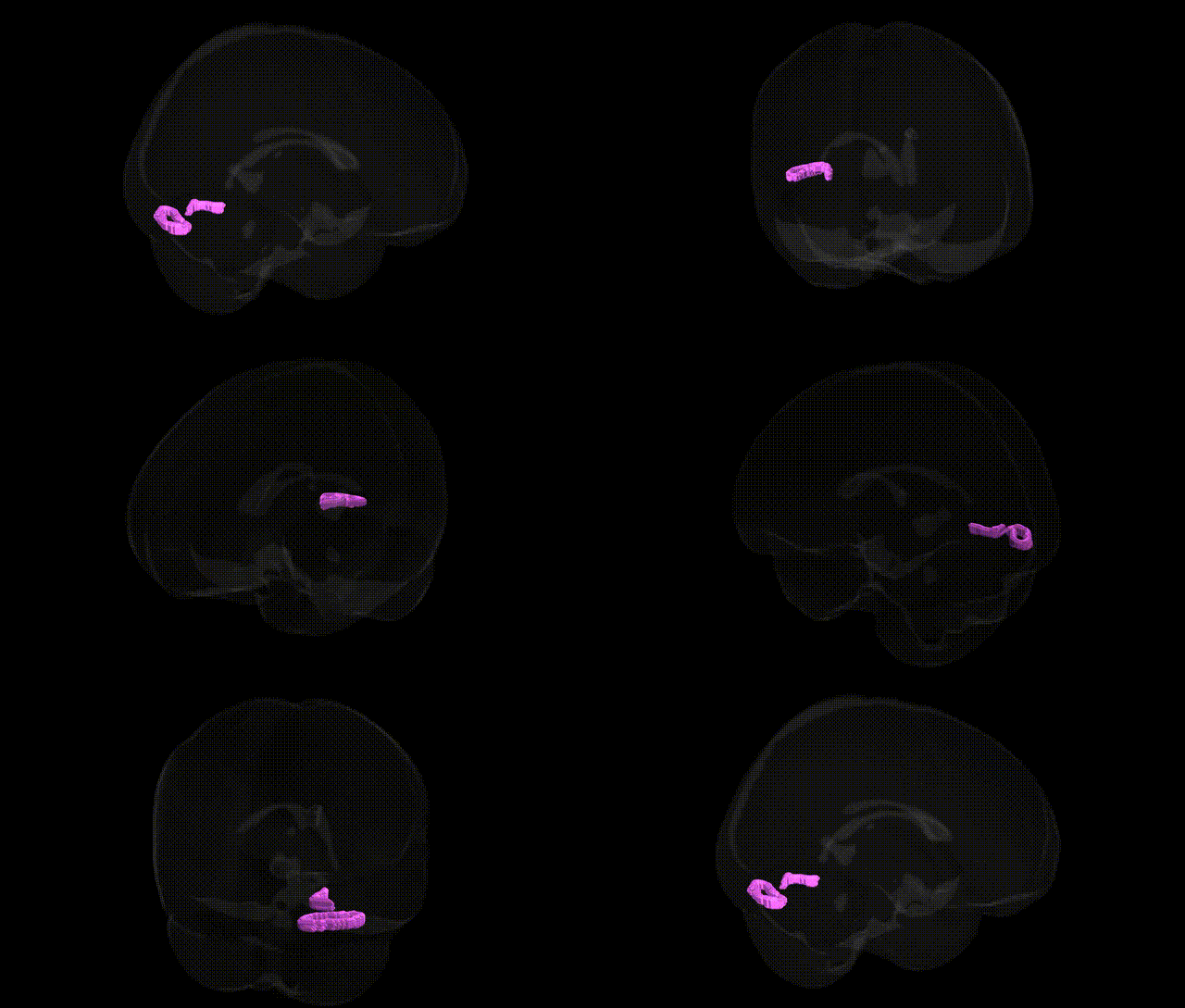
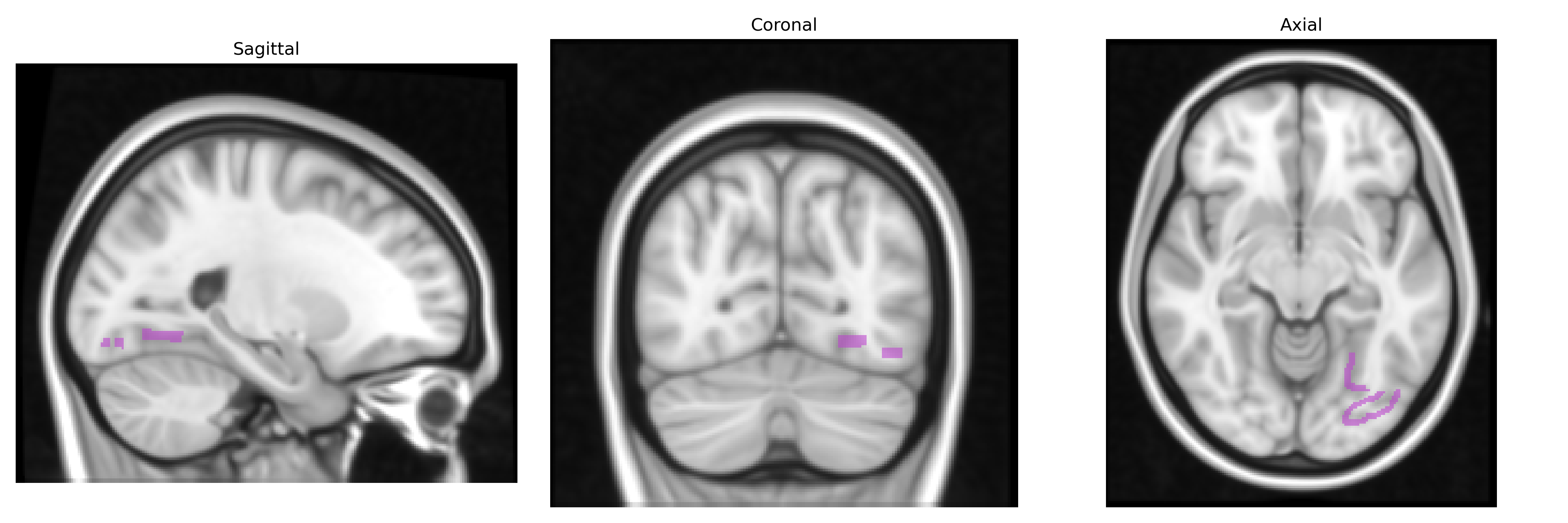
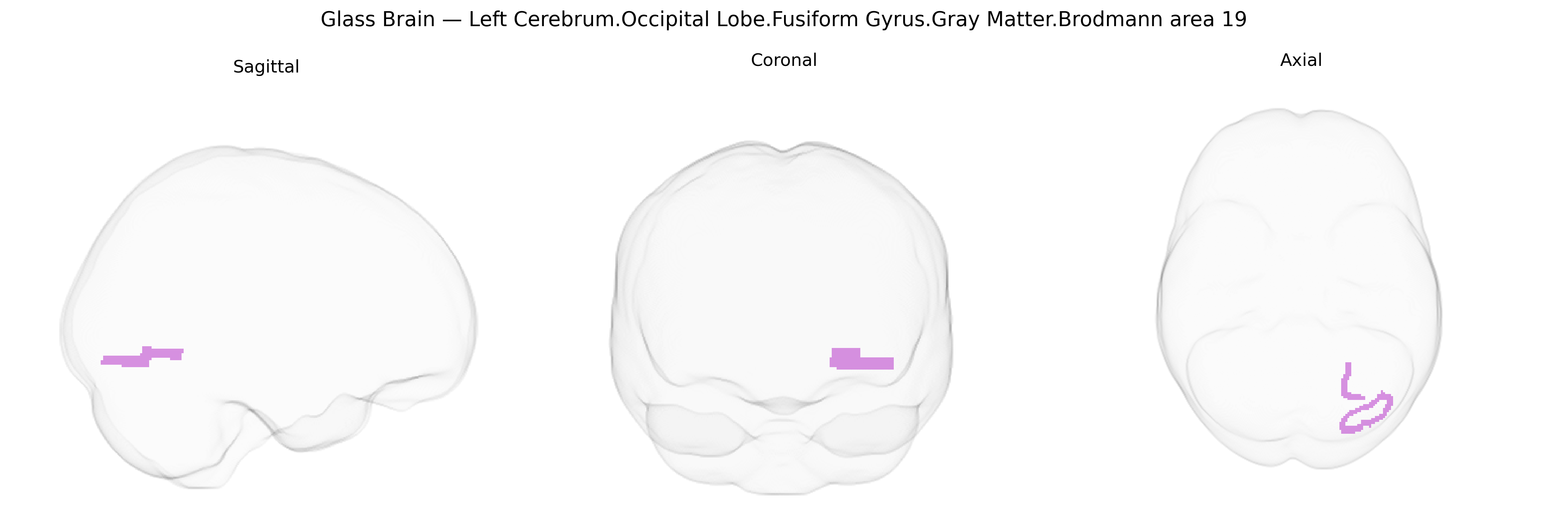
The bilateral Left Cerebrum.Occipital Lobe.Fusiform Gyrus.Gray Matter.Brodmann area 19 corresponds to a higher-order visual association region within the fusiform gyrus of the occipital lobe, occupying part of the medial-inferior occipitotemporal cortex. As a component of Brodmann area 19 (also known as a portion of the extrastriate visual cortex), this area participates in complex visual processing beyond primary and secondary visual areas, including integration of shape, color, and object-related information, and contributes to pathways involved in object recognition and visuospatial analysis. Its neurons receive convergent input from earlier visual areas (e.g., BA 17 and 18) and project to temporal and parietal association regions, supporting higher-level perceptual functions and visual memory. There is no direct link; a related structure is Brodmann area 19.
The bilateral Left Cerebrum Occipital Lobe Fusiform Gyrus Gray Matter Brodmann area 19 (Talairach 1 mm atlas) lies at the intersection of higher-order visual processing and occipitotemporal integration, and genetic associations with this region largely emerge from imaging‑genetics and GWAS studies of brain structure and function. Variants in and around genes such as TESC, DAAM1, HMGA2, and others identified in large MRI-based GWAS (e.g., ENIGMA) have been associated with occipital and fusiform cortical thickness or surface area, reflecting general neurodevelopmental influences rather than BA19-specific effects. Functional GWAS linking visual word form area and face‑processing networks implicate polygenic influences shared with neurodevelopmental and psychiatric disorders, including autism spectrum disorder, schizophrenia, dyslexia, and prosopagnosia, where altered fusiform and occipital activation or morphology is consistently reported; however, these studies typically map networks that encompass BA19 rather than isolating it. Genetic correlations between occipitotemporal structural measures and cognitive traits such as general intelligence, reading ability, and visual recognition memory have also been demonstrated, with polygenic scores for these traits predicting subtle variation in fusiform/occipital gray matter. Overall, current evidence supports a nonspecific, polygenic contribution to the structure and function of BA19 within the fusiform gyrus, embedded in broader occipitotemporal circuits, rather than discrete, well-characterized single-gene associations uniquely tied to this exact Talairach-defined region.
Overview generated by GPT-4o (2026).
Region ID: 258
Hemisphere: bilateral
Atlas: Talairach labels 1mm
Full Quality Version: Download MP4
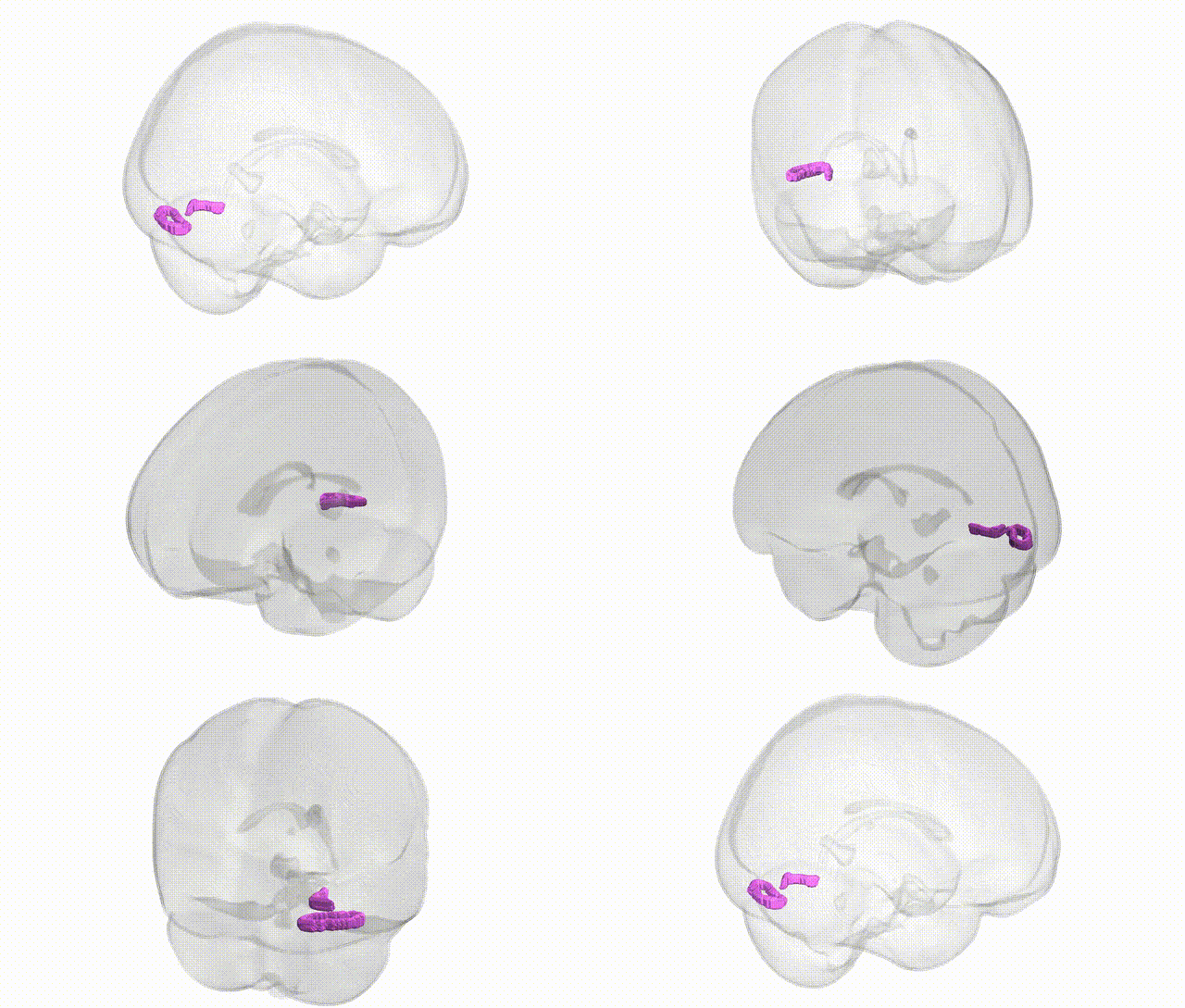
Full Quality Version: Download MP4
Wali Sidiqyar*, Gaurav Rudravaram*, Elyssa M. McMaster, Trent M. Schwartz, Adam M. Saunders, Kurt G. Schilling, Bennett A. Landman "Introducing SPINS: A Shared Public Visualization Library of Neuroanatomical Structures." Medical Imaging with Deep Learning- short paper
This resource is licensed under CC0 1.0 Universal (Public Domain).