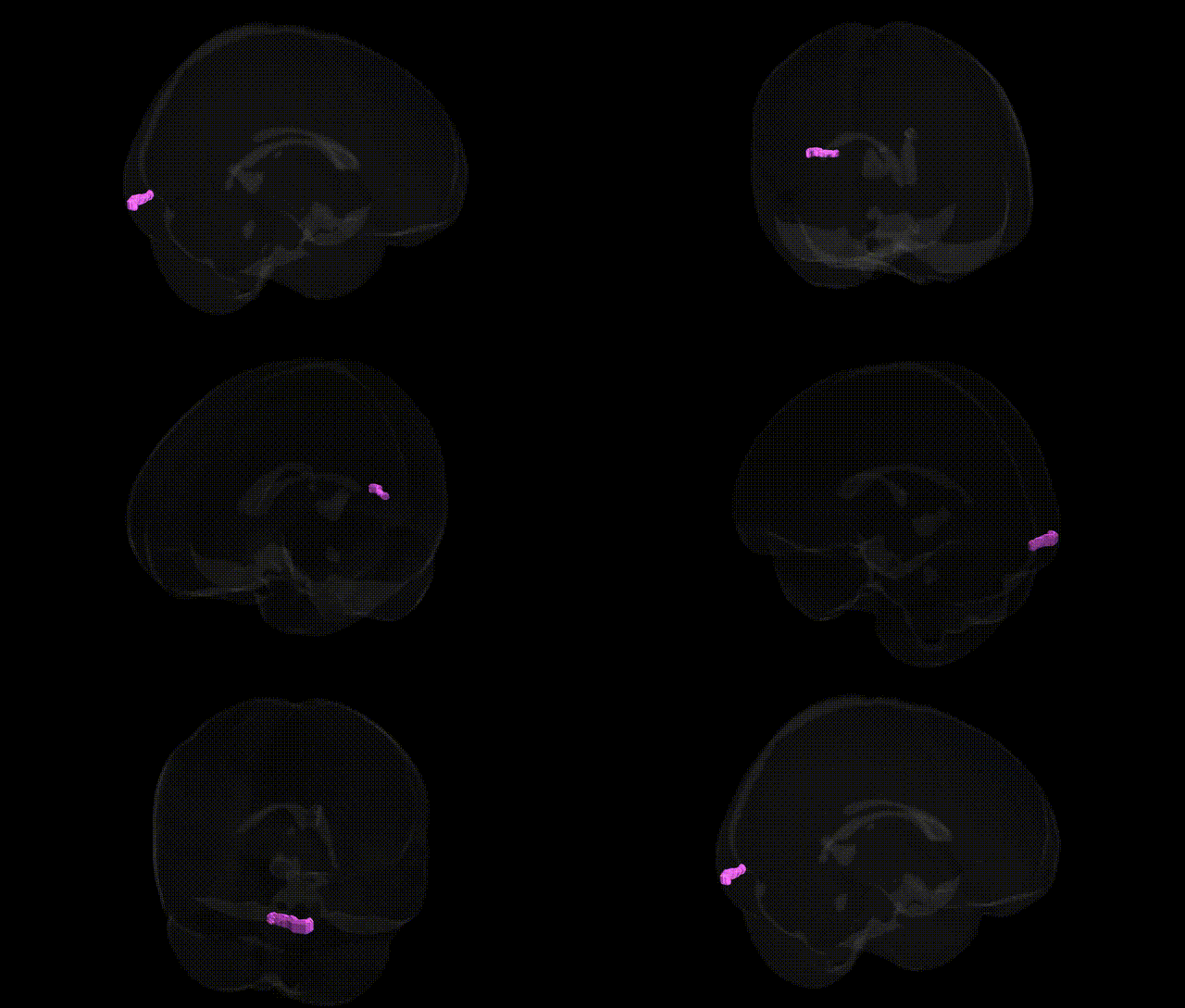
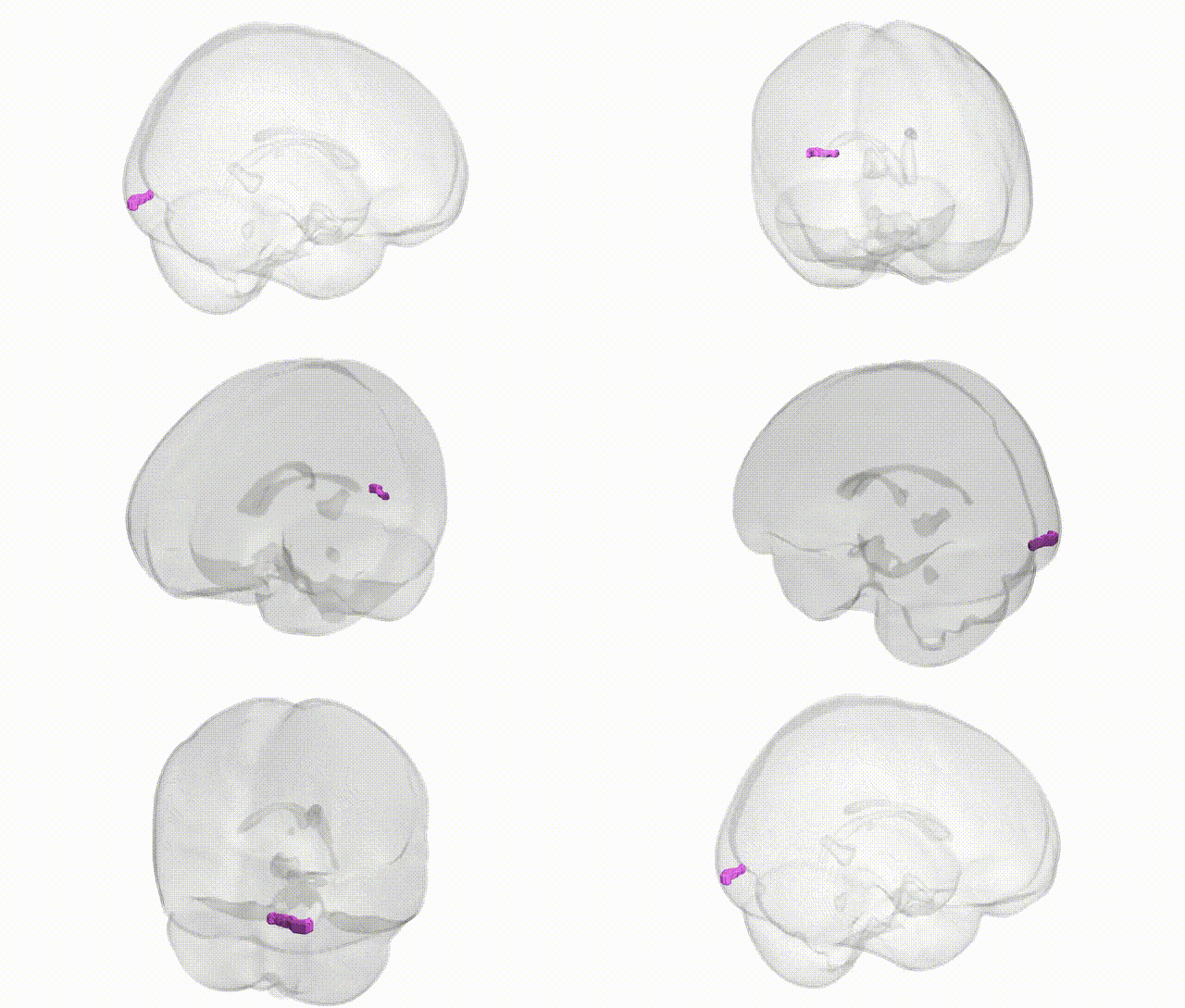
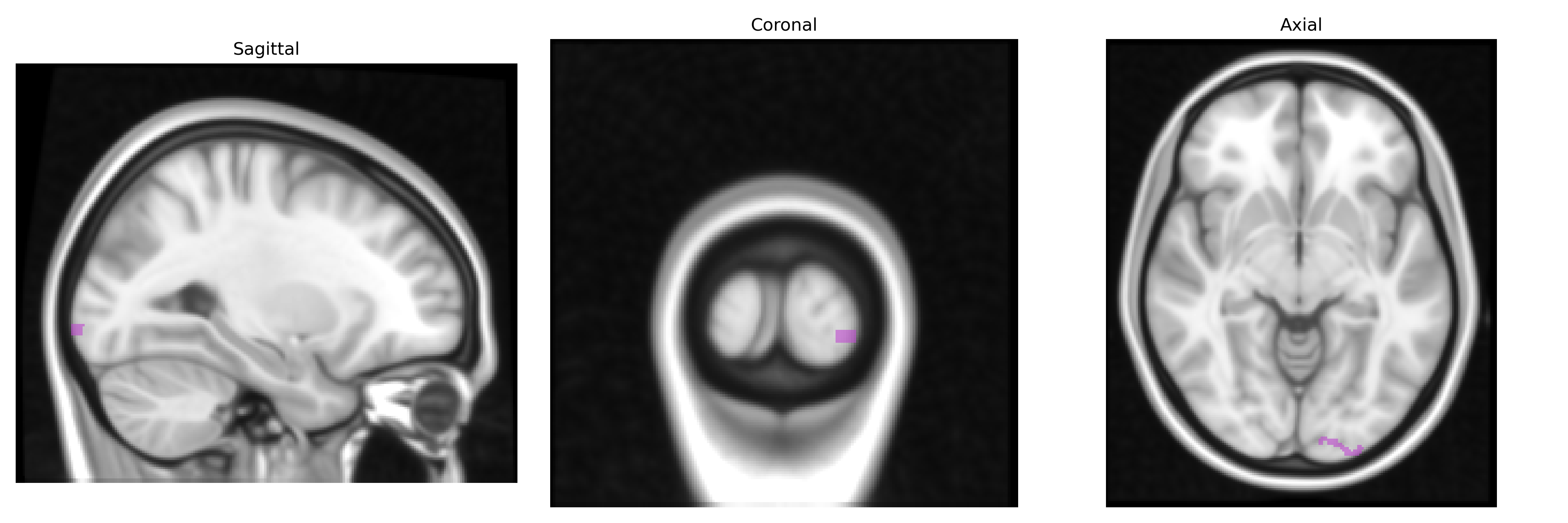
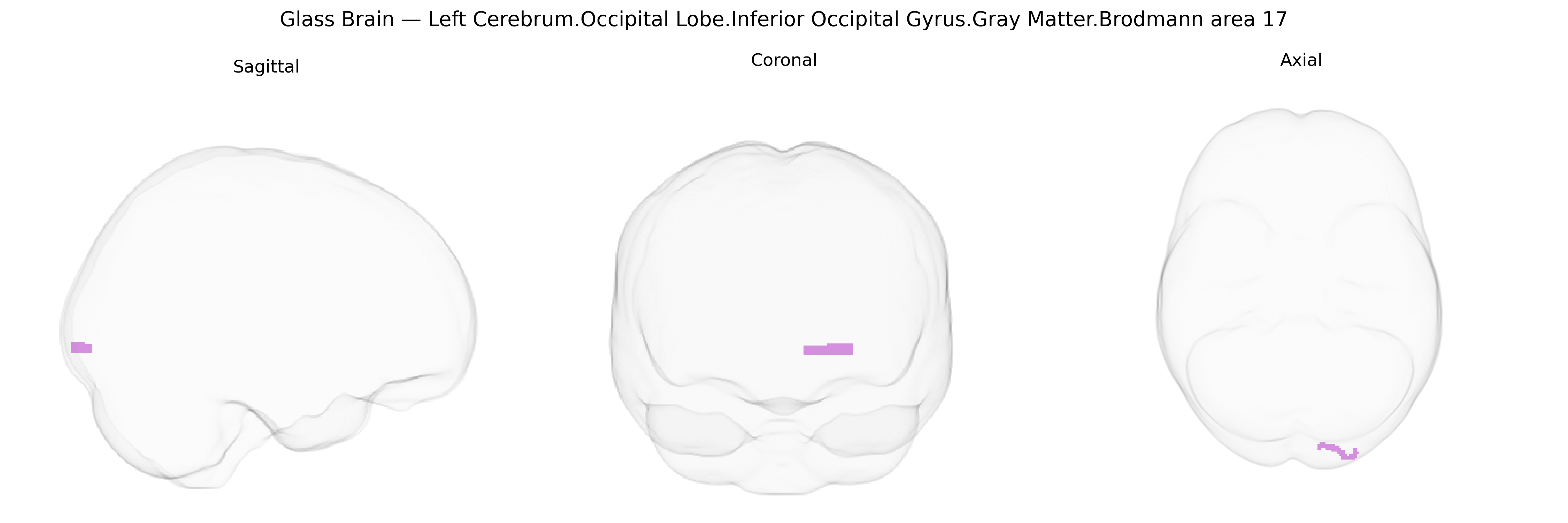
The bilateral Left Cerebrum.Occipital Lobe.Inferior Occipital Gyrus.Gray Matter.Brodmann area 17 corresponds to the primary visual cortex (V1) located in the occipital lobe, specifically within the gray matter of the inferior portions of the occipital cortex on the left hemisphere, and its contralateral homologue on the right. This region receives the majority of its afferent input from the lateral geniculate nucleus of the thalamus via the optic radiations and is responsible for the initial cortical processing of visual information, including edge detection, orientation, spatial frequency, and basic contrast features. Neuronal organization in this area exhibits a retinotopic map of the visual field, columnar architecture for orientation selectivity, and ocular dominance columns reflecting input from each eye, providing the foundation for higher-order visual processing in extrastriate visual areas. Primary visual cortex
The bilateral Left Cerebrum Occipital Lobe Inferior Occipital Gyrus Gray Matter Brodmann area 17 (primary visual cortex, V1) is a core node in genetically influenced visual and cognitive networks, and numerous imaging-genetics and GWAS studies implicate this region via structural and functional measures. Heritability analyses show high genetic contribution to occipital cortical thickness and surface area, with large-scale GWAS (e.g., ENIGMA-related cohorts and UK Biobank) identifying loci near genes involved in neurodevelopment and synaptic function (such as variants near PAX6, TBR1, and multiple chromatin-regulating genes) that modulate occipital gray matter morphology and visual cortex folding. Polygenic influences linked to educational attainment and general cognitive ability are associated with structural characteristics in BA17, while neurodevelopmental and psychiatric GWAS (schizophrenia, autism spectrum disorder, major depression) have reported genetic overlaps with occipital volume and connectivity, suggesting that visual processing circuitry contributes to broader brain-wide genetic risk architectures. Visual cortex measures in BA17 are influenced by genetic variants associated with myelination and axon guidance, and imaging-genetics work in disorders of vision (such as albinism or congenital blindness) demonstrates that specific genetic lesions are accompanied by characteristic structural reorganization of BA17, though these findings are based more on candidate gene and clinical cohorts than unbiased GWAS. Overall, BA17 appears as a genetically sensitive hub in visual and cognitive traits, with its structure and function reflecting polygenic effects that span neurodevelopmental, sensory, and higher-order cognitive domains rather than single, region-specific risk genes.
Overview generated by GPT-4o (2026).
Region ID: 303
Hemisphere: bilateral
Atlas: Talairach labels 1mm
Full Quality Version: Download MP4
Full Quality Version: Download MP4
Wali Sidiqyar*, Gaurav Rudravaram*, Elyssa M. McMaster, Trent M. Schwartz, Adam M. Saunders, Kurt G. Schilling, Bennett A. Landman "Introducing SPINS: A Shared Public Visualization Library of Neuroanatomical Structures." Medical Imaging with Deep Learning- short paper
This resource is licensed under CC0 1.0 Universal (Public Domain).