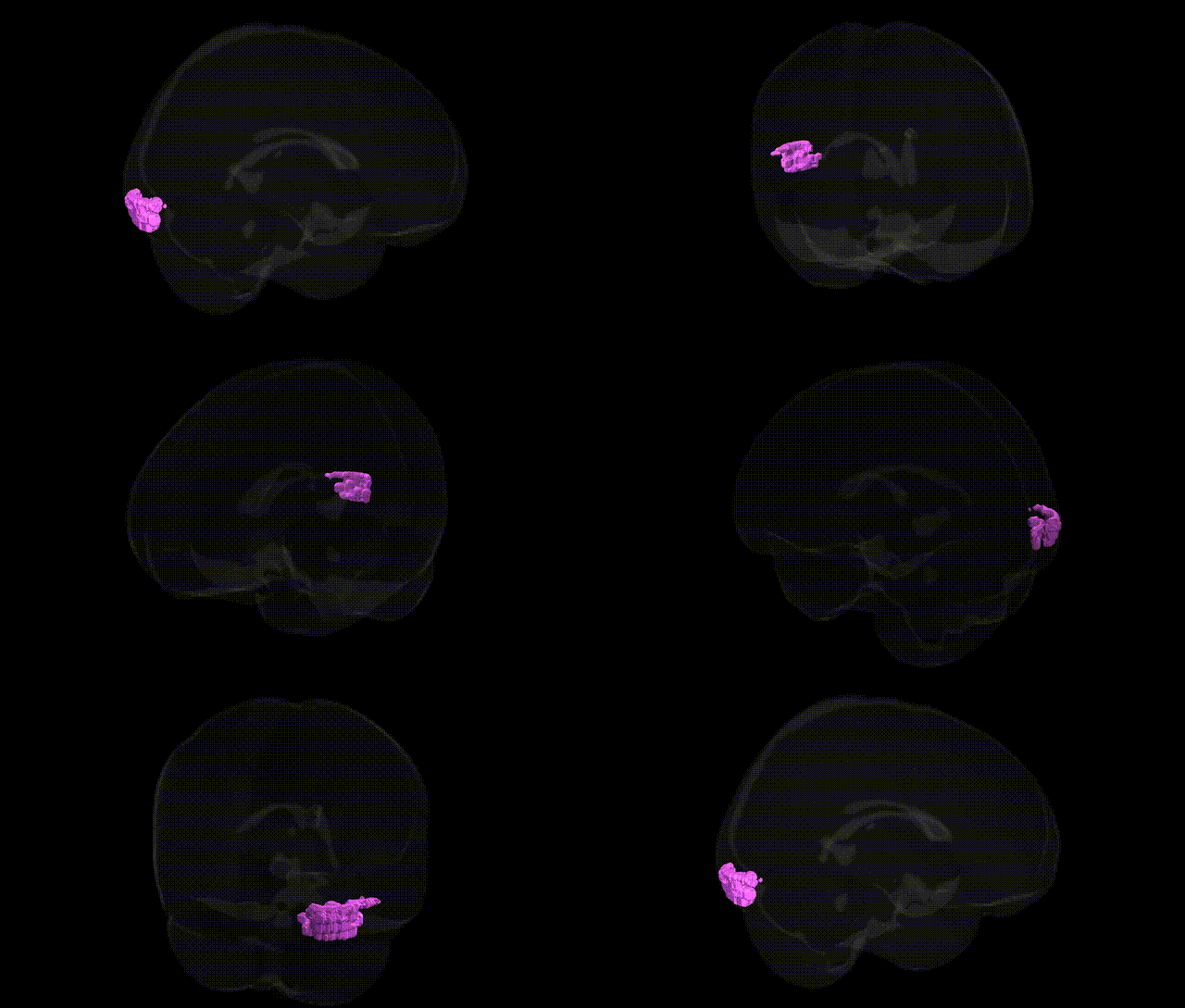
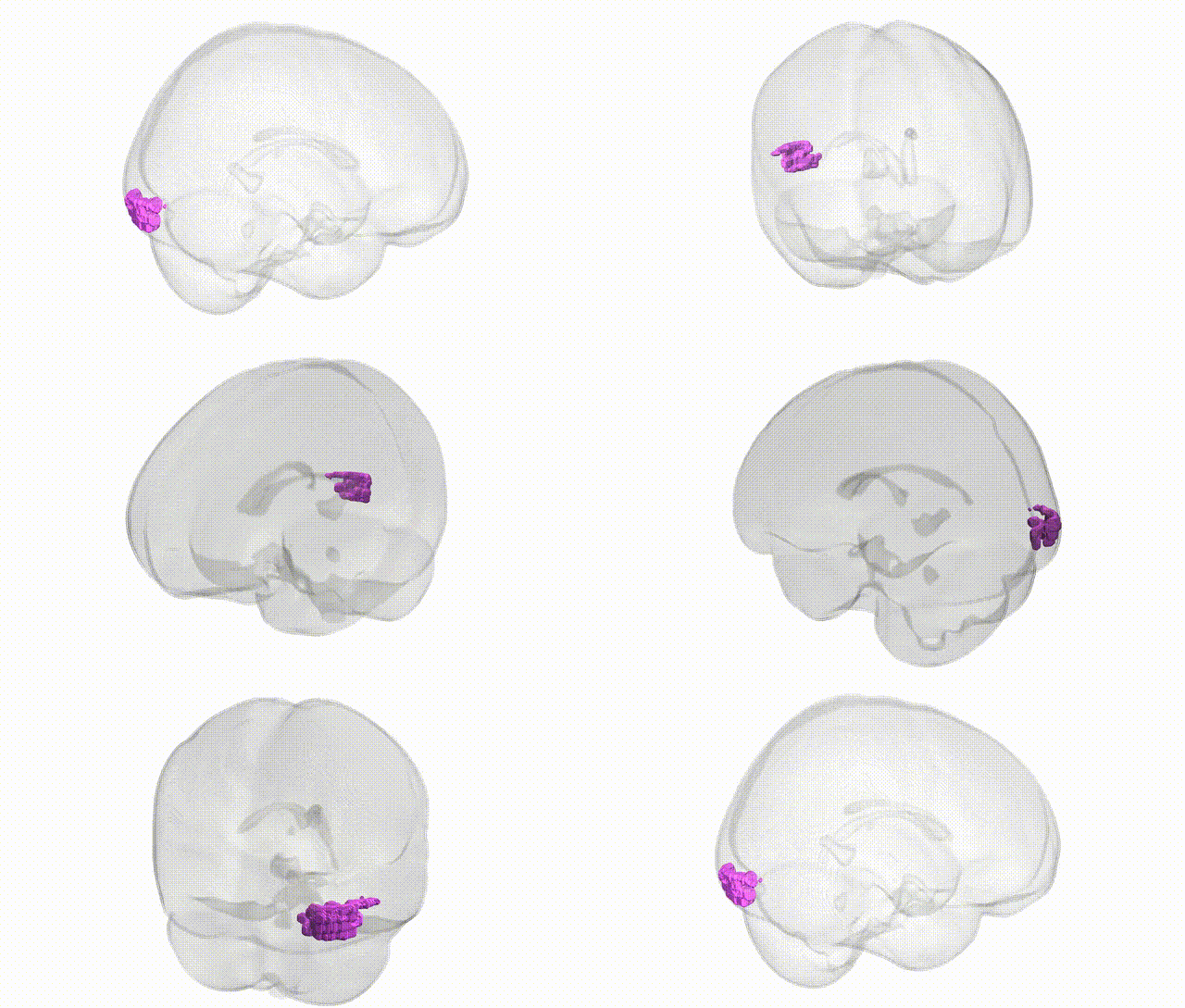
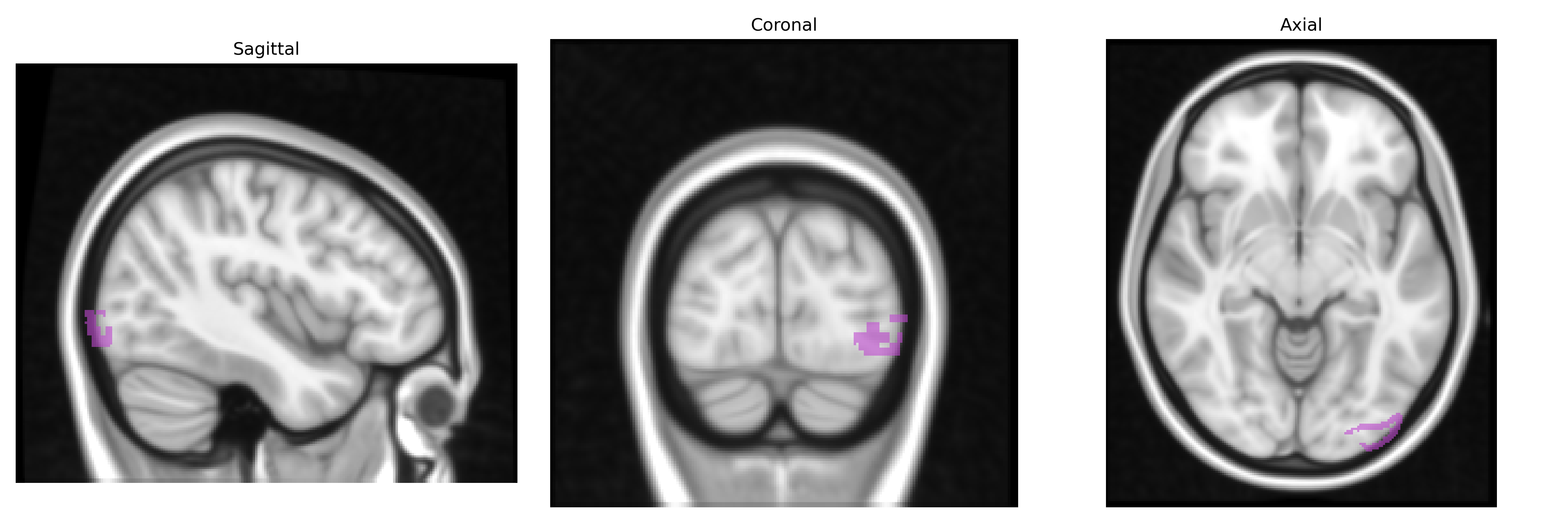
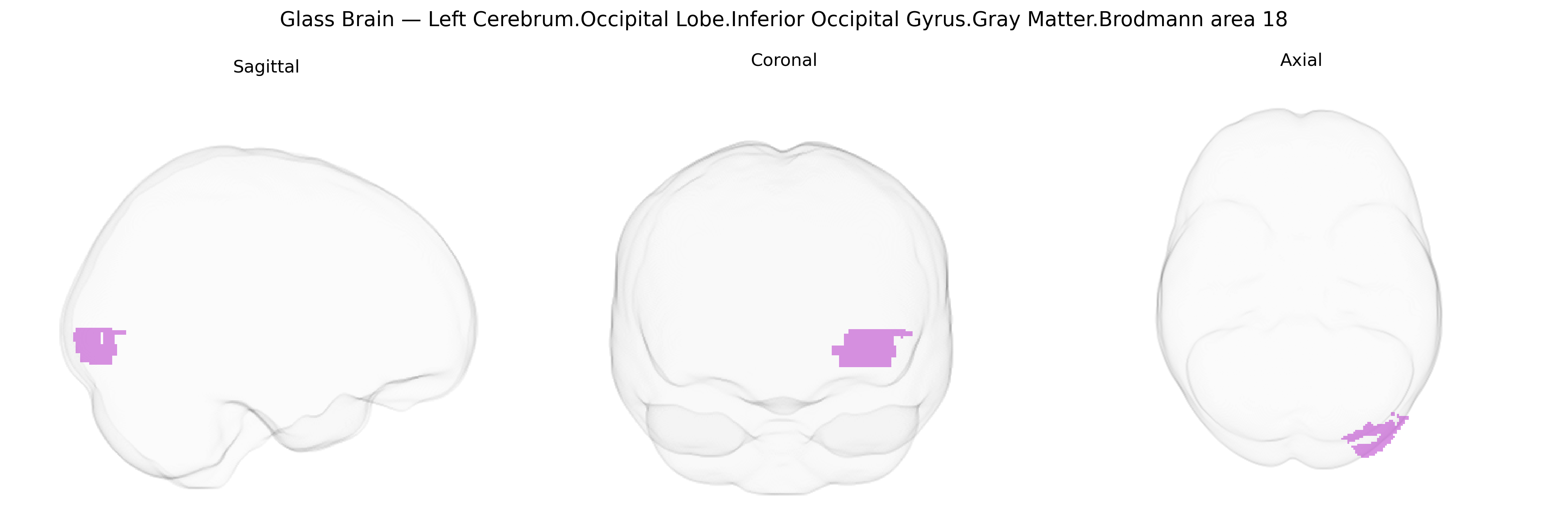
The bilateral Left Cerebrum.Occipital Lobe.Inferior Occipital Gyrus.Gray Matter.Brodmann area 18 corresponds to a portion of the secondary visual cortex (V2) located in the inferior aspect of the occipital lobe, adjacent to the primary visual cortex (Brodmann area 17). This region participates in early-stage visual processing beyond simple detection, including analysis of contours, orientation, spatial frequency, and more complex visual patterns, and contributes to pathways involved in object recognition and form perception. Neuronal populations within this area receive highly organized input from area 17 and project to higher-order visual areas in the occipital and temporal lobes, forming part of both dorsal and ventral visual streams. In the Talairach 1 mm atlas, its labeling emphasizes cytoarchitectonic features characteristic of area 18 and its position in the inferior occipital gyrus. There is no direct Wikipedia article for this exact composite region; a closely related structure is Brodmann area 18.
The bilateral inferior occipital gyrus gray matter in Brodmann area 18, a key component of the secondary visual cortex, has been implicated in genetic and GWAS-based studies primarily through its role in visual processing and structural brain variation. Large-scale imaging–genetics consortia (e.g., ENIGMA, UK Biobank) have identified polygenic influences on occipital cortical thickness and surface area, with associated loci including variants near genes involved in neurodevelopment, synaptic signaling, and axon guidance (such as HMGA2, MIR2113, and other widespread cortical-structure loci), though findings are typically not BA18-specific but rather part of distributed cortical patterns. GWAS of visual cortical thickness and volume have shown moderate heritability, with SNP-based heritability estimates indicating substantial genetic contribution to individual differences in BA17/18/19 regions. Functionally, alterations and volume changes in BA18/inferior occipital gyrus have been observed in genetic risk contexts for neuropsychiatric conditions—such as schizophrenia, bipolar disorder, and major depression—where polygenic risk scores correlate with occipital cortex morphology and activity, although single-gene or single-variant associations to BA18 are rarely isolated. In neurodevelopmental disorders, genetic variants associated with autism spectrum disorder and dyslexia have been linked to atypical activation or structure in ventral visual regions including the inferior occipital gyrus, particularly in tasks involving face and word recognition. Additionally, GWAS of visual acuity and refractive error (e.g., myopia) and of complex traits like educational attainment or general cognitive ability have reported genetic overlap with occipital cortical measures, suggesting shared genetic architecture between occipital structural variation and higher-order traits, but these associations reflect broad cortical networks rather than a unique, well-defined genetic signature confined specifically to BA18.
Overview generated by GPT-4o (2026).
Region ID: 250
Hemisphere: bilateral
Atlas: Talairach labels 1mm
Full Quality Version: Download MP4
Full Quality Version: Download MP4
Wali Sidiqyar*, Gaurav Rudravaram*, Elyssa M. McMaster, Trent M. Schwartz, Adam M. Saunders, Kurt G. Schilling, Bennett A. Landman "Introducing SPINS: A Shared Public Visualization Library of Neuroanatomical Structures." Medical Imaging with Deep Learning- short paper
This resource is licensed under CC0 1.0 Universal (Public Domain).