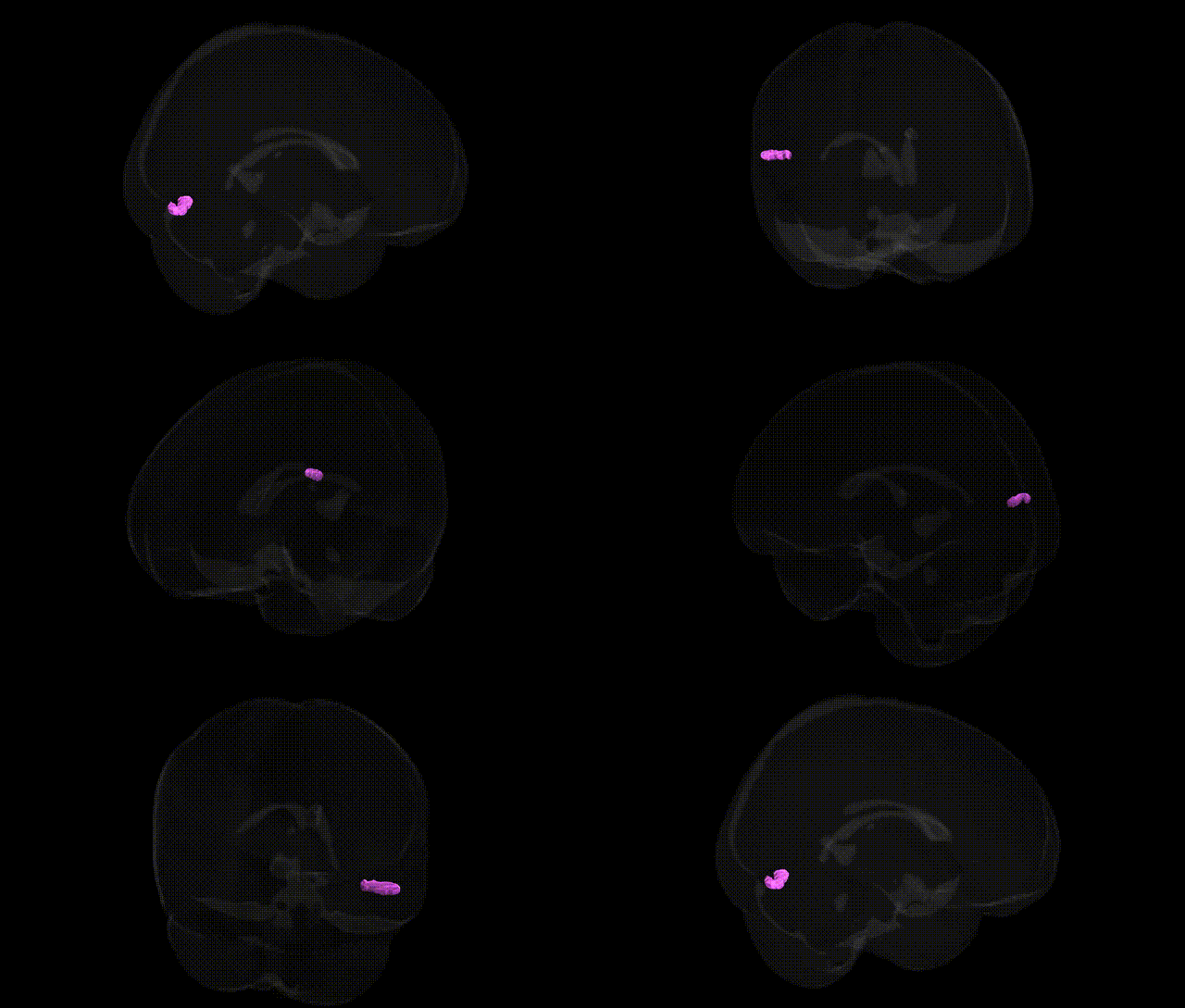
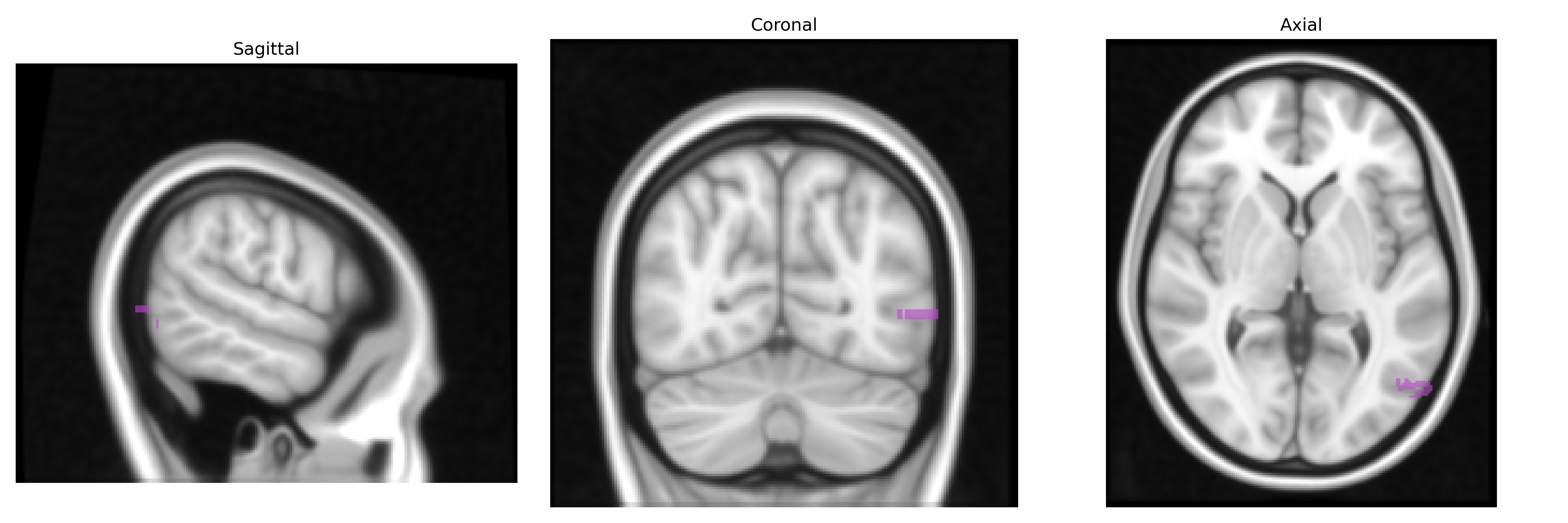
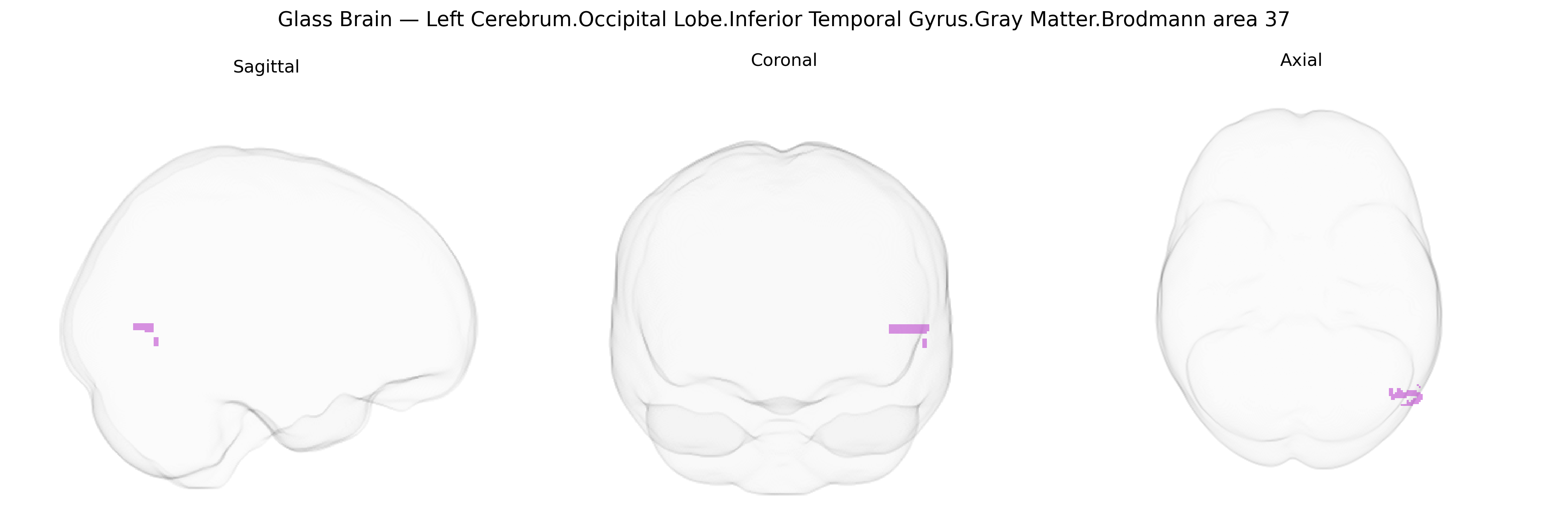
The bilateral Left Cerebrum.Occipital Lobe.Inferior Temporal Gyrus.Gray Matter.Brodmann area 37 corresponds to a cortical territory situated at the posterior portion of the inferior temporal gyrus extending into the occipitotemporal junction, commonly associated with the fusiform and adjacent inferior temporal cortices. Brodmann area 37 is implicated in high-order visual processing, including object recognition, complex form analysis, and aspects of visual word and face processing, integrating visual inputs from earlier occipital areas with semantic and linguistic systems. It participates in ventral visual stream (“what” pathway) functions and is interconnected with occipital, temporal, and parietal association cortices as well as limbic structures, supporting multimodal integration and memory-related processes. There is no direct link for Brodmann area 37; a closely related structure is the fusiform gyrus: Fusiform gyrus.
The bilateral left occipital–inferior temporal region corresponding to Brodmann area 37 (often encompassing the fusiform gyrus/occipitotemporal cortex and visual word form region) shows convergent genetic associations from imaging‑genetics and GWAS studies implicating neurodevelopmental, synaptic, and neurodegenerative pathways: common variants in KIAA0319, DCDC2, ROBO1, and CNTNAP2 have been linked to dyslexia and altered structure or activation of this area during reading and language tasks; FOXP2 and related language-network genes influence functional responses in BA37 during phonological and lexical processing; polygenic risk for autism spectrum disorder and schizophrenia associates with cortical thickness and surface area changes in inferior temporal and fusiform regions, with candidate loci including NRXN1, SHANK3, and other synaptic genes; Alzheimer’s disease and frontotemporal dementia GWAS loci (e.g., APOE, CLU, PICALM, MAPT) show downstream effects on atrophy patterns in BA37-related ventral visual and semantic networks, especially in early-onset or posterior cortical presentations; and large-scale ENIGMA and UK Biobank analyses indicate that common variants in genes involved in neuronal migration, axon guidance, and myelination (e.g., MAPT region, cell-adhesion and extracellular-matrix genes) contribute modest but significant heritability to gray-matter volume and surface area in inferior temporal/occipitotemporal cortex, with overlapping genetic architecture for traits such as reading ability, face recognition, general cognitive ability, and risk for neurodevelopmental and psychiatric disorders.
Overview generated by GPT-4o (2026).
Region ID: 420
Hemisphere: bilateral
Atlas: Talairach labels 1mm
Full Quality Version: Download MP4
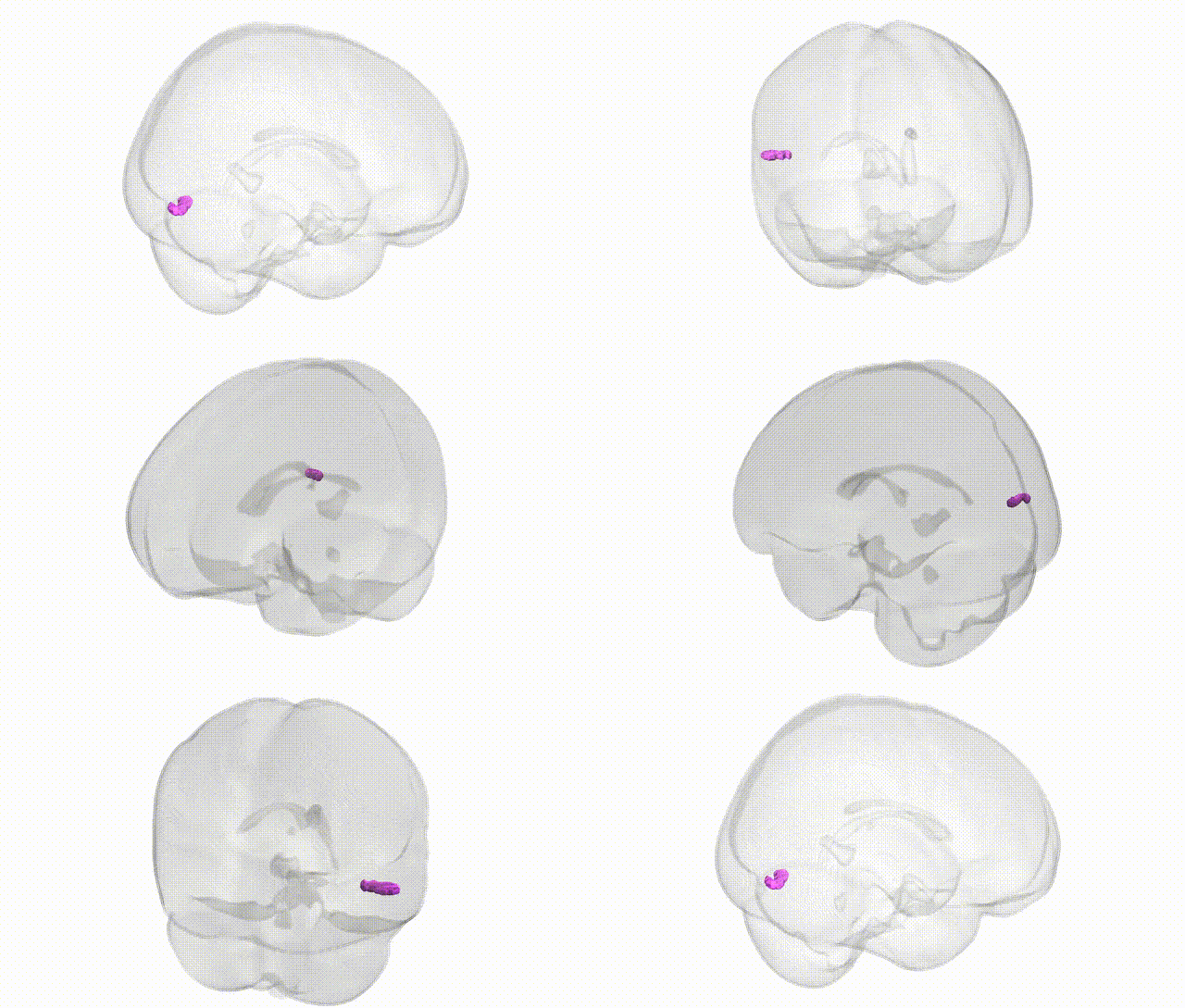
Full Quality Version: Download MP4
Wali Sidiqyar*, Gaurav Rudravaram*, Elyssa M. McMaster, Trent M. Schwartz, Adam M. Saunders, Kurt G. Schilling, Bennett A. Landman "Introducing SPINS: A Shared Public Visualization Library of Neuroanatomical Structures." Medical Imaging with Deep Learning- short paper
This resource is licensed under CC0 1.0 Universal (Public Domain).