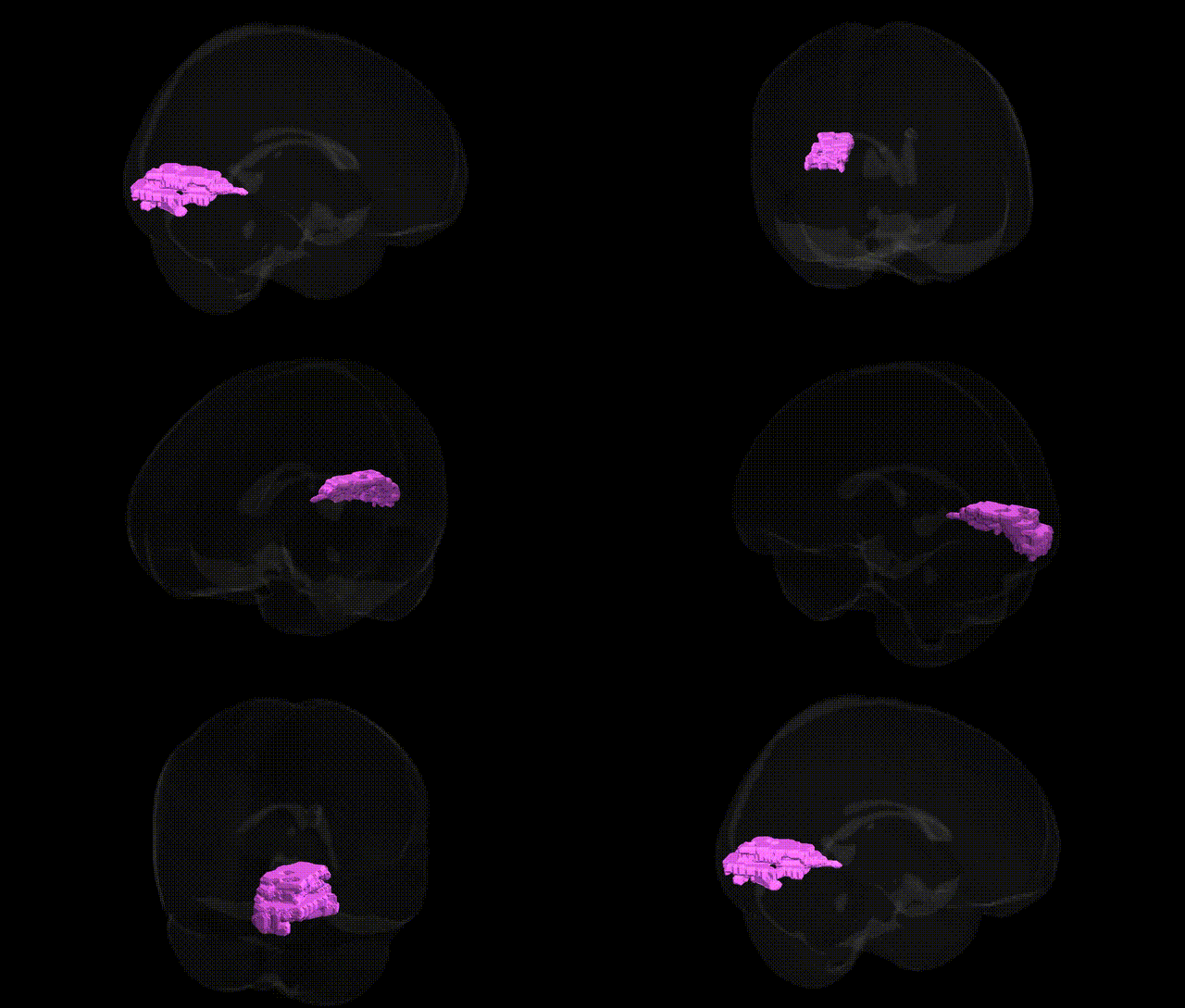
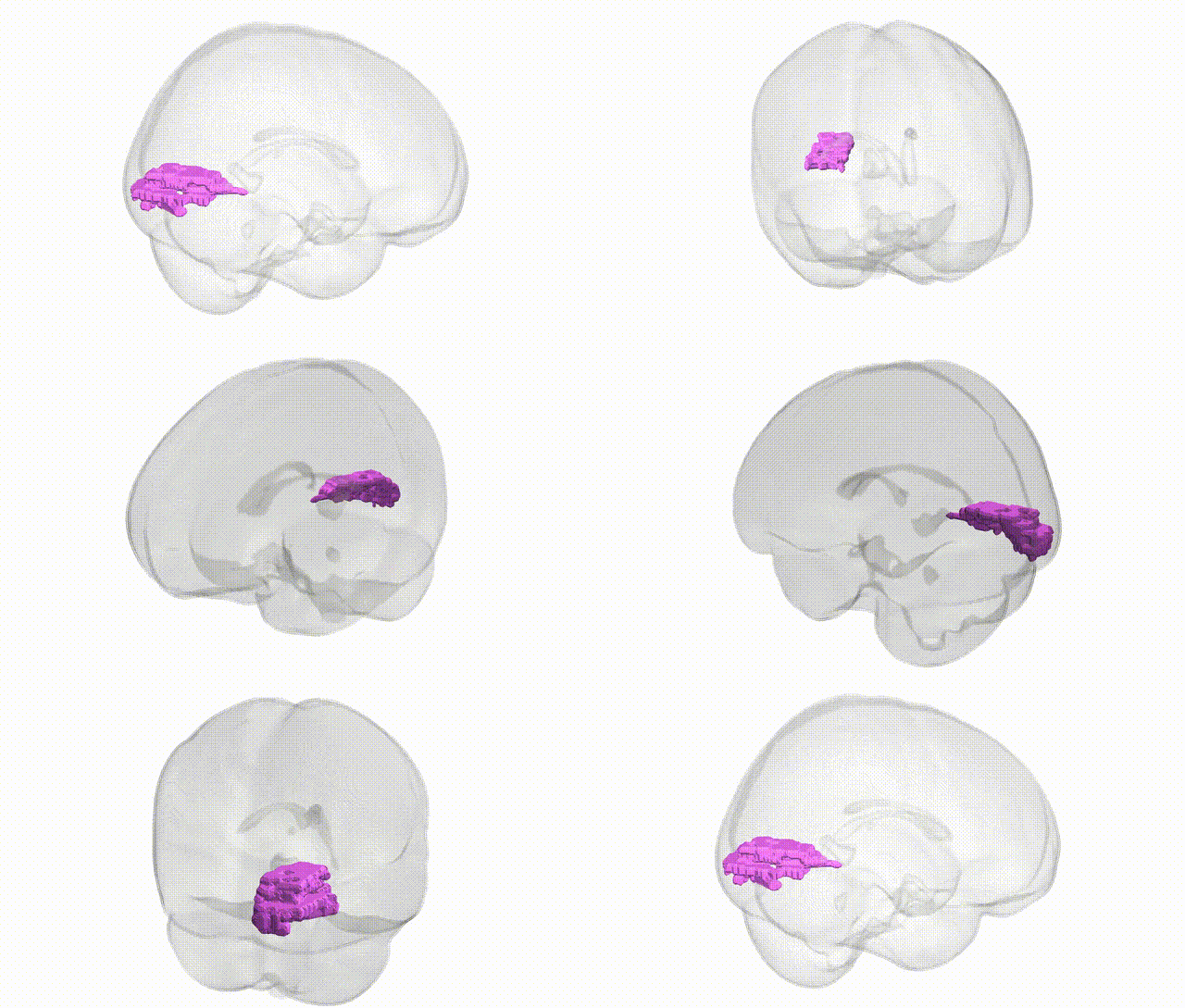
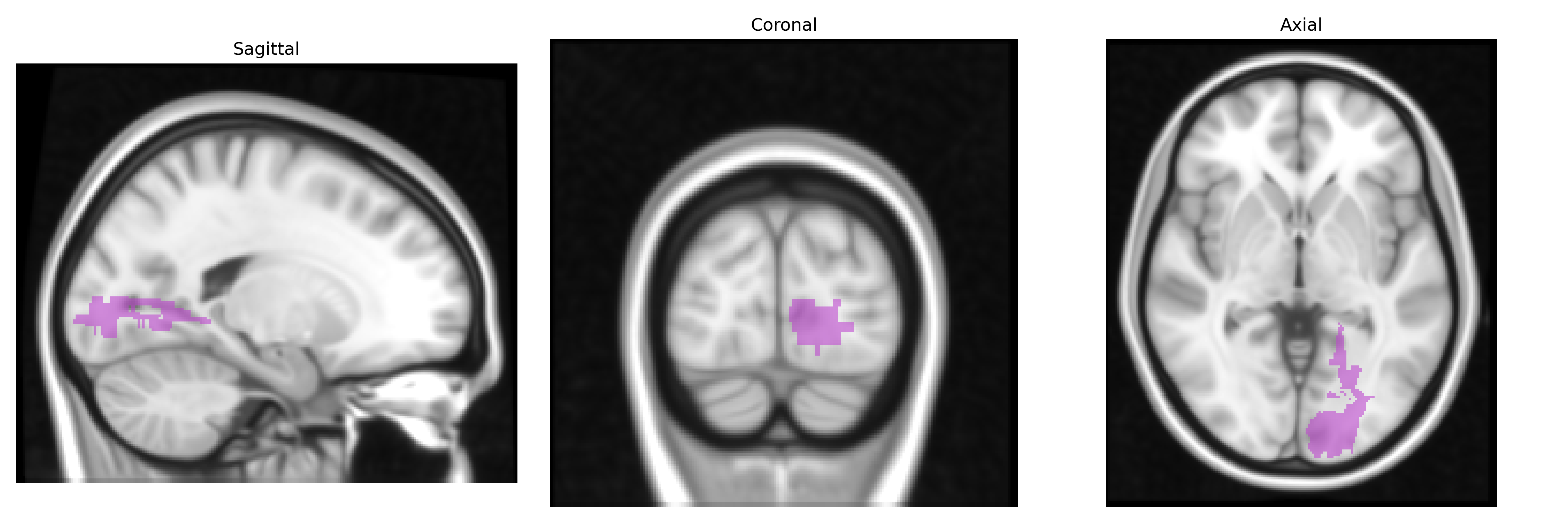
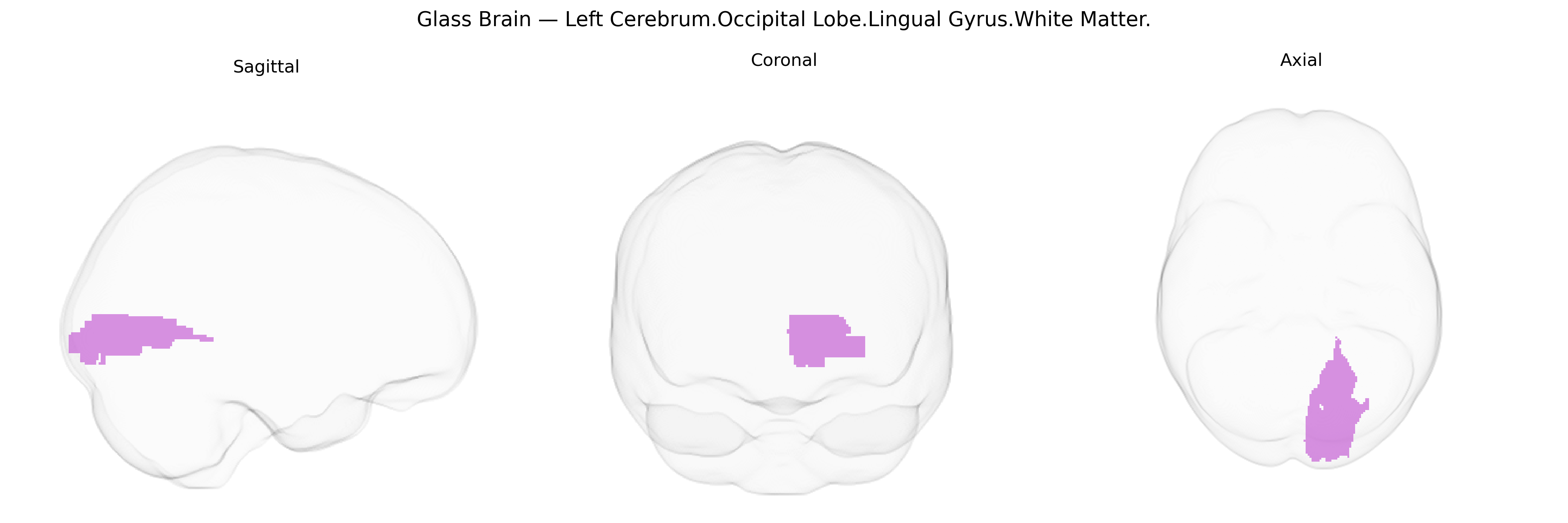
The bilateral Left Cerebrum.Occipital Lobe.Lingual Gyrus.White Matter corresponds to the subcortical myelinated fiber pathways underlying the lingual gyrus in the medial occipital lobe, extending along the ventral surface of the occipital cortex toward the posterior fusiform and parahippocampal regions. These fibers support communication between primary and secondary visual cortices and ventral visual association areas involved in processing complex visual features such as form, color, and aspects of scene and word recognition. The white matter here includes short U-fibers connecting adjacent gyri and portions of longer association tracts (e.g., components of the inferior longitudinal fasciculus) that link occipital visual regions with temporal lobe structures, thereby contributing to the ventral “what” visual pathway and integration of visual information with higher-order perceptual and mnemonic functions. There is no direct link; a related structure is the Lingual gyrus.
The bilateral left cerebrum occipital lobe lingual gyrus white matter, as defined in the Talairach 1 mm atlas, participates in visual processing and has been implicated indirectly in multiple genetic and genome‑wide association studies (GWAS) through imaging‑genetics and neurodevelopmental research, although explicit GWAS targeting this exact subregion’s white matter are limited. Variants in genes associated with myelination and axonal integrity (e.g., MAG, MBP, PLP1, and other oligodendrocyte‑related loci) have been linked to global and occipital white matter microstructure in diffusion MRI GWAS, with downstream effects on fractional anisotropy and mean diffusivity that encompass occipital and lingual gyrus tracts. Large consortia such as ENIGMA and UK Biobank have identified polygenic influences on occipital white matter volumes and diffusion metrics, with enriched heritability in pathways related to neurodevelopment, axon guidance (e.g., ROBO/SLIT signaling), and synaptic organization, and these traits show modest genetic correlations with educational attainment, general cognitive ability, and neuropsychiatric conditions. Occipital and lingual gyrus white matter alterations are repeatedly observed in schizophrenia, bipolar disorder, major depression, autism spectrum disorder, and multiple sclerosis, and risk variants in genes such as ZNF804A, NRG1, and DISC1, as well as HLA and other immune‑related loci in MS, have been associated with widespread white matter abnormalities that include posterior/occipital pathways. Additionally, genetic variants influencing susceptibility to migraine with visual aura, albinism, and congenital visual disorders can affect development and integrity of occipital/lingual white matter tracts, though these effects are typically characterized at the system or pathway level rather than being specific to the Talairach‑defined lingual gyrus white matter region.
Overview generated by GPT-4o (2026).
Region ID: 252
Hemisphere: bilateral
Atlas: Talairach labels 1mm
Full Quality Version: Download MP4
Full Quality Version: Download MP4
Wali Sidiqyar*, Gaurav Rudravaram*, Elyssa M. McMaster, Trent M. Schwartz, Adam M. Saunders, Kurt G. Schilling, Bennett A. Landman "Introducing SPINS: A Shared Public Visualization Library of Neuroanatomical Structures." Medical Imaging with Deep Learning- short paper
This resource is licensed under CC0 1.0 Universal (Public Domain).