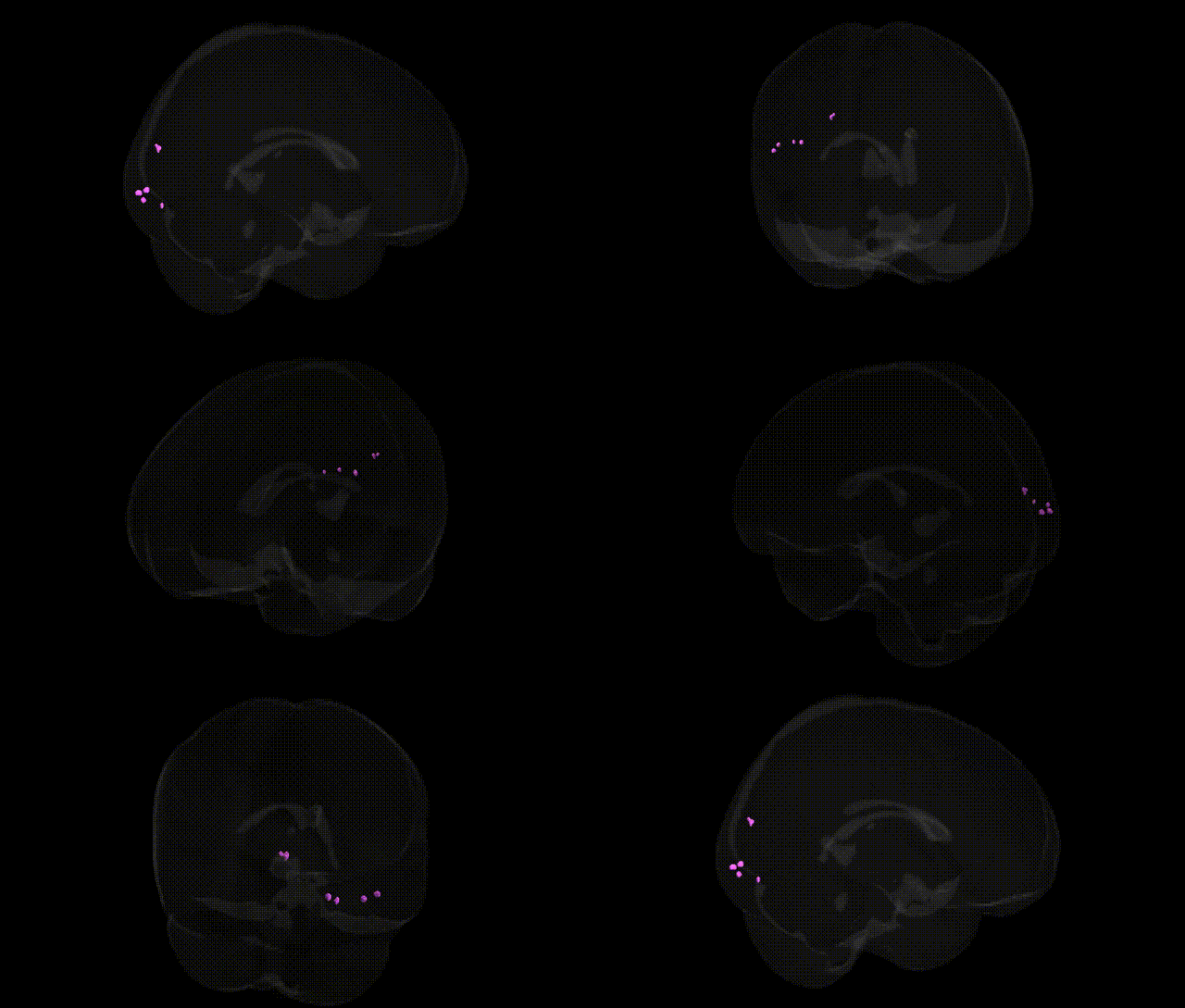
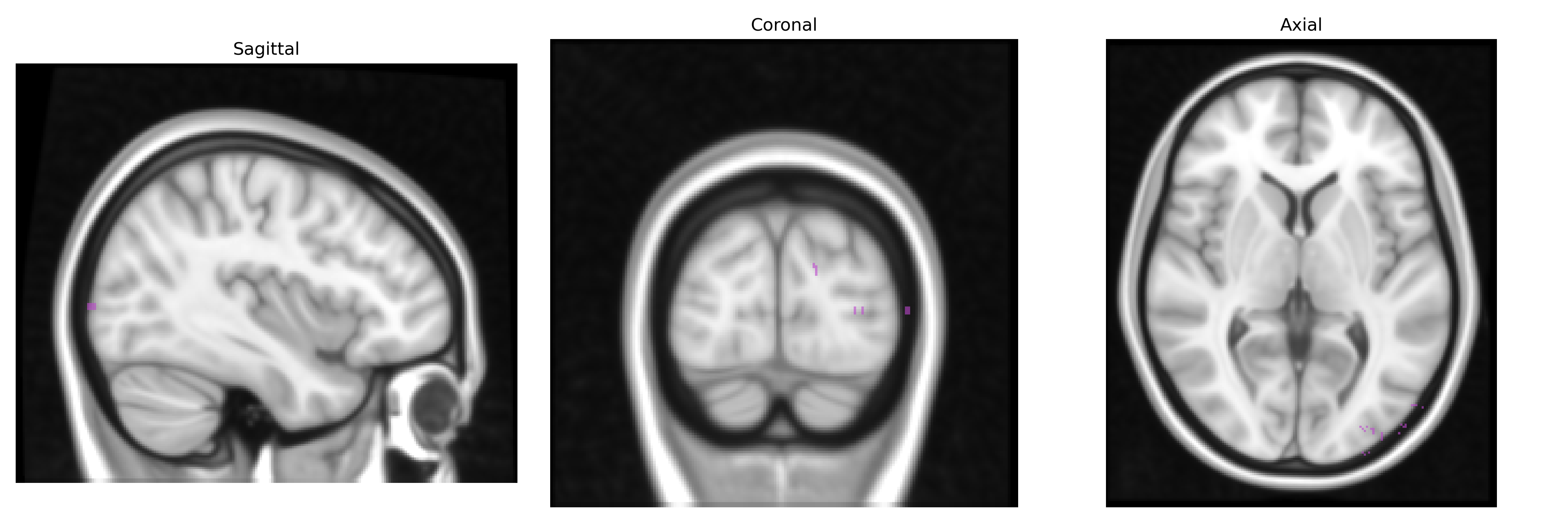
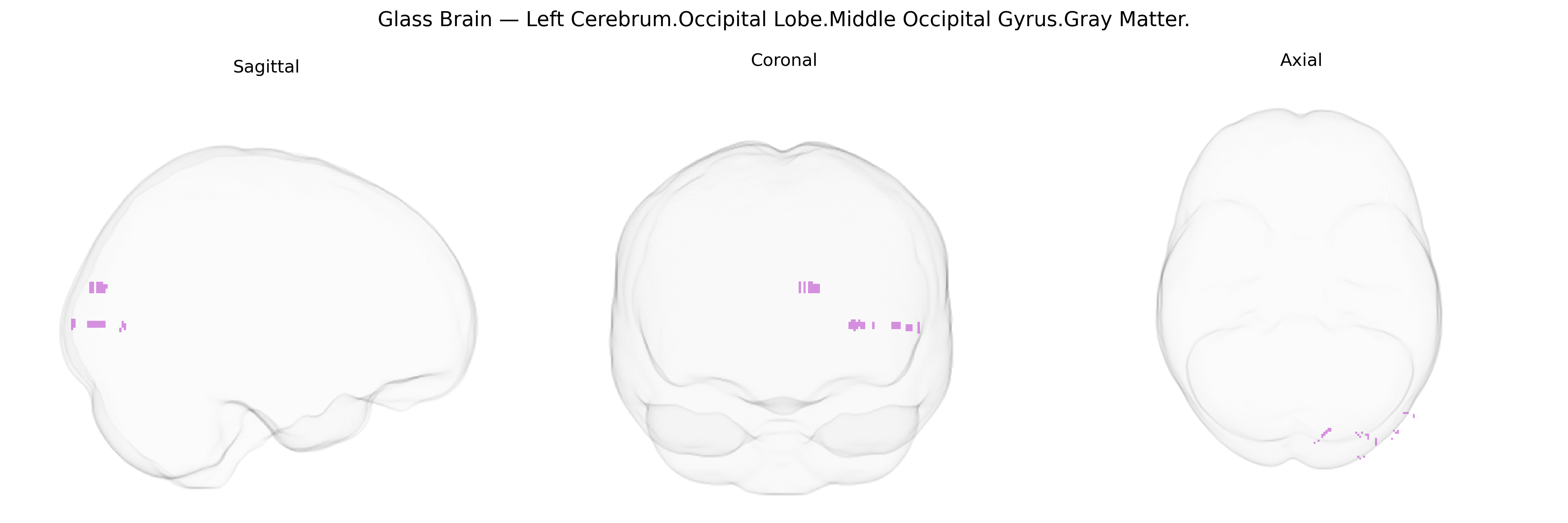
The bilateral Left Cerebrum Occipital Lobe Middle Occipital Gyrus Gray Matter corresponds to the cortical ribbon of the middle occipital gyrus within the occipital lobe, a region primarily involved in intermediate stages of visual processing. This gyrus lies between the superior and inferior occipital gyri and participates in the analysis of visual motion, spatial relationships, object form, and aspects of visuospatial attention via its connections with primary visual cortex, dorsal and ventral visual streams, and parietal and temporal association areas. Neuronal populations in this gray matter region integrate inputs from earlier visual areas and contribute to constructing coherent representations of the visual environment, supporting functions such as object localization, orientation, and the guidance of visually driven behavior. There is no direct link for this exact Talairach label; see the related structure Occipital lobe.
The bilateral middle occipital gyrus (MOG) gray matter in the left cerebrum, as defined in the Talairach 1 mm atlas, has been repeatedly implicated in genetic and genomic studies of visual processing, psychiatric illness, and neurodevelopmental traits, although few variants are specific solely to this subregion. Twin and SNP-heritability studies of cortical thickness and surface area (e.g., ENIGMA, UK Biobank) report moderate to high heritability in occipital association cortex, including MOG, with polygenic influences distributed across the genome rather than single large-effect loci. GWAS of brain structure and functional connectivity have linked common variants in genes related to synaptic plasticity, axon guidance, and neurodevelopment (such as BDNF, DISC1, and various glutamatergic and GABAergic genes) to occipital gray matter measures that encompass the MOG, often in the context of visual network or dorsal stream morphology. Structural and functional abnormalities in the middle occipital gyrus have been associated, via imaging–genetics or polygenic risk analyses, with schizophrenia, major depressive disorder, bipolar disorder, autism spectrum disorder, and attention-deficit/hyperactivity disorder, in which disease-related polygenic scores correlate with altered occipital gray matter volume or thickness. In addition, GWAS of visual acuity, refractive error, and reading-related traits (including dyslexia) have identified risk loci and polygenic effects that show downstream associations with occipital cortical structure and activity, implicating genes involved in visual pathway development and myelination, though these associations are usually reported at the level of broader occipital regions rather than the MOG alone. Overall, genetic findings indicate that the middle occipital gyrus is a heritable visual association area whose structure and function are modulated by distributed polygenic architectures contributing to visual, cognitive, and psychiatric phenotypes, but no single gene or variant has been uniquely and robustly tied specifically to the bilateral left middle occipital gyrus gray matter in the Talairach atlas.
Overview generated by GPT-4o (2026).
Region ID: 520
Hemisphere: bilateral
Atlas: Talairach labels 1mm
Full Quality Version: Download MP4
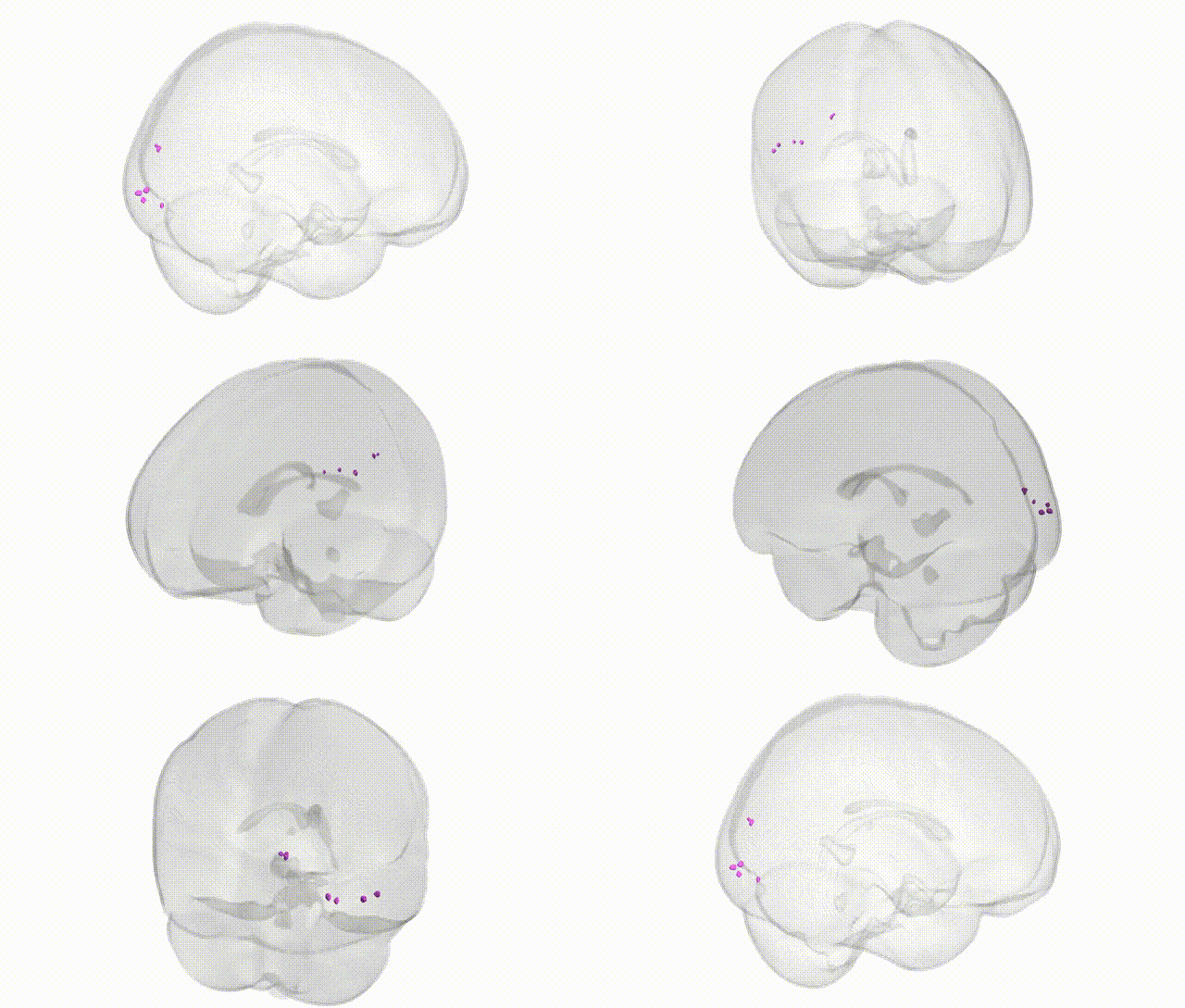
Full Quality Version: Download MP4
Wali Sidiqyar*, Gaurav Rudravaram*, Elyssa M. McMaster, Trent M. Schwartz, Adam M. Saunders, Kurt G. Schilling, Bennett A. Landman "Introducing SPINS: A Shared Public Visualization Library of Neuroanatomical Structures." Medical Imaging with Deep Learning- short paper
This resource is licensed under CC0 1.0 Universal (Public Domain).