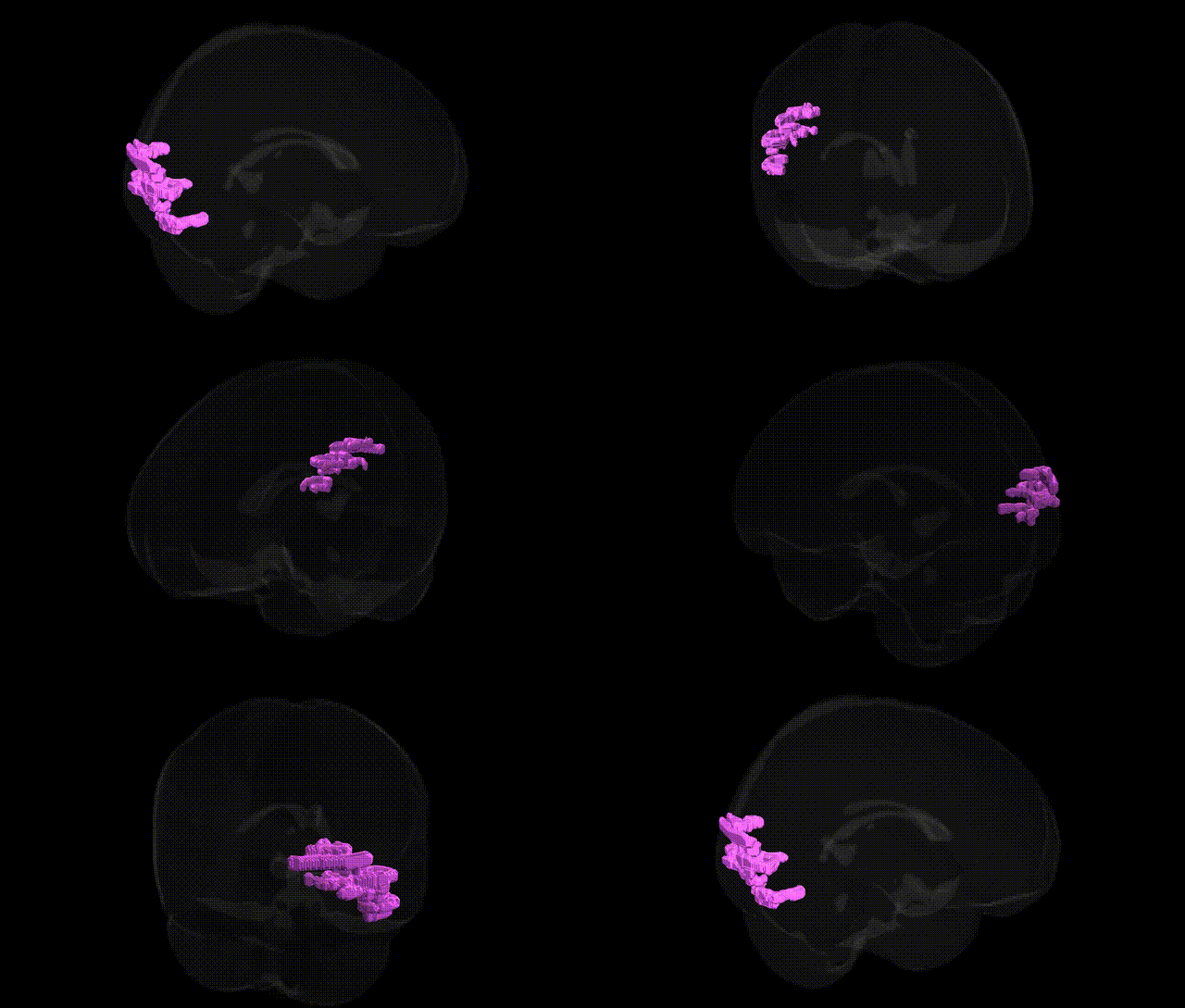
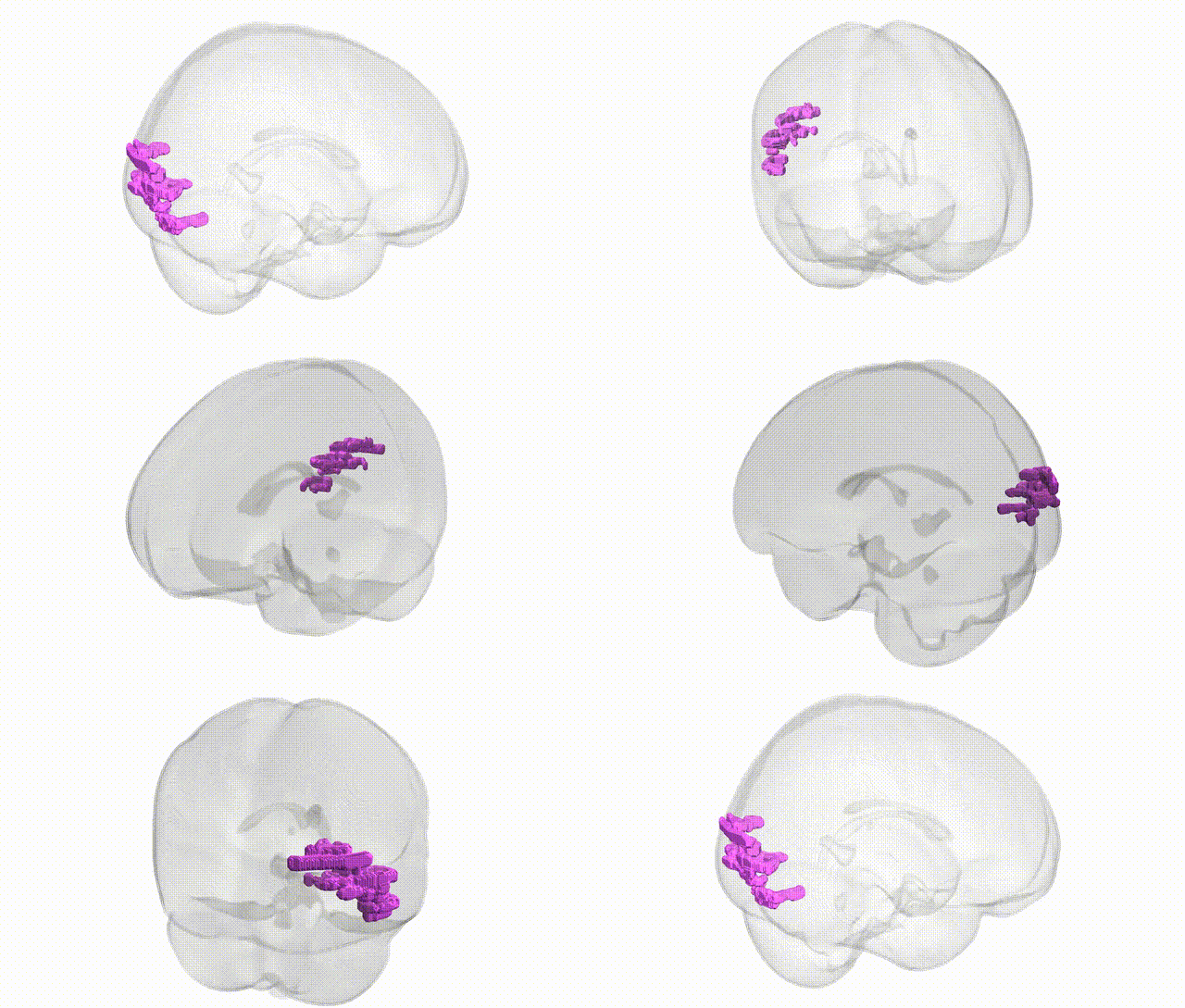
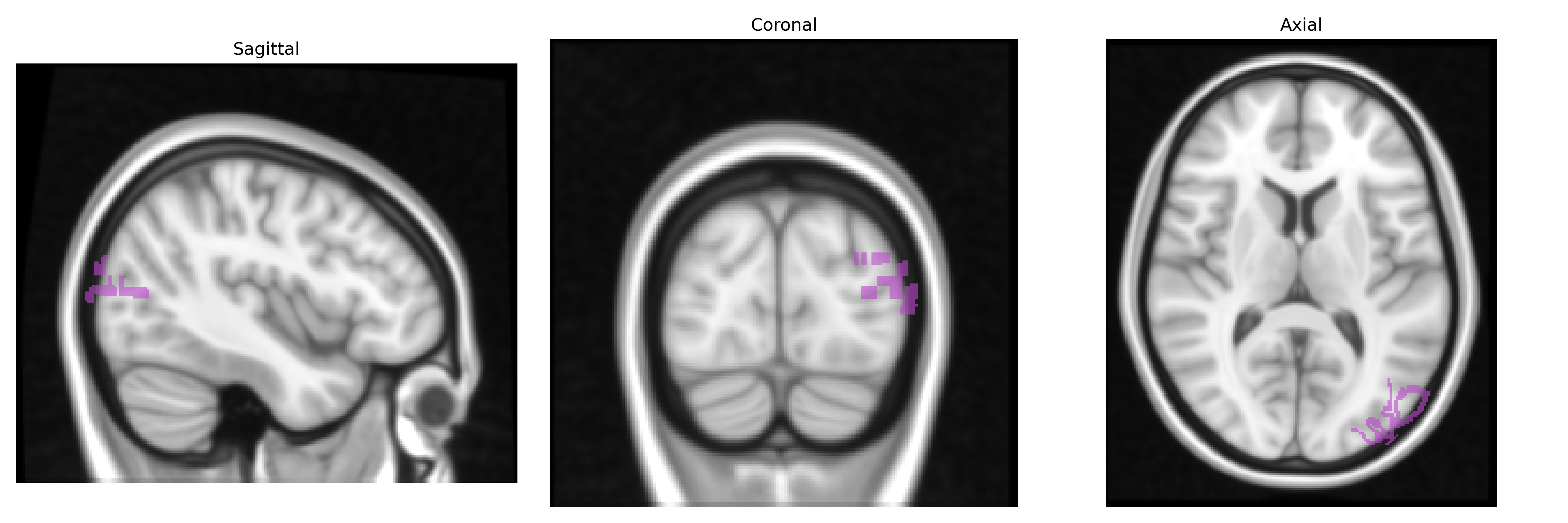
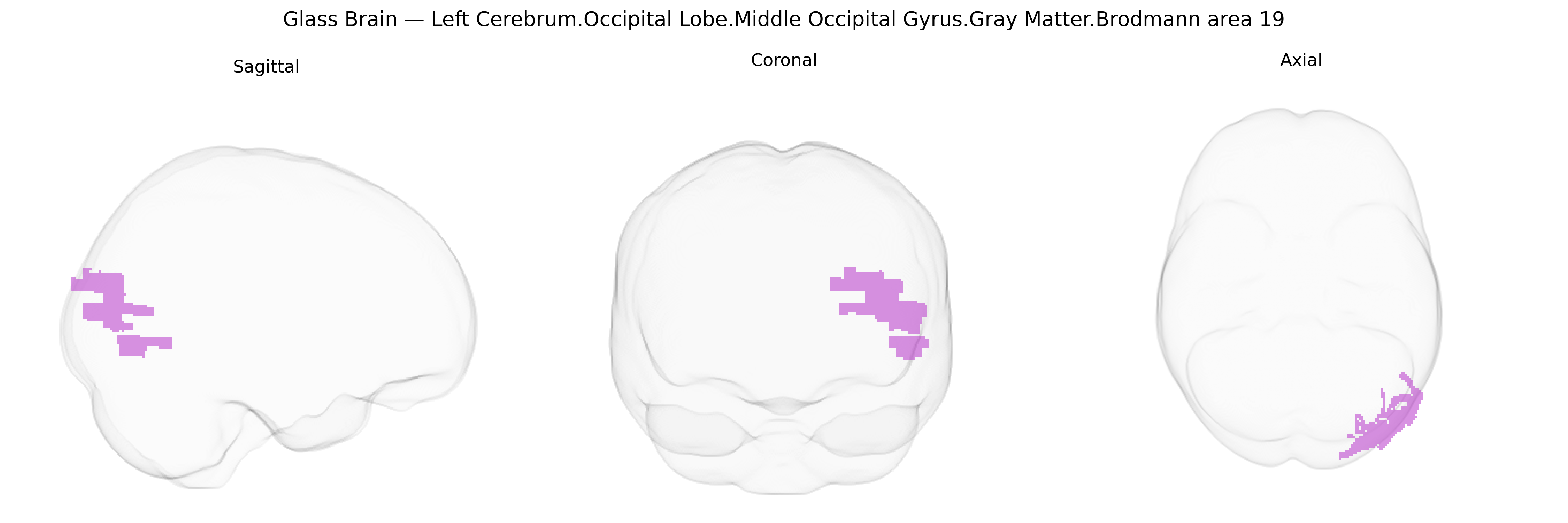
The bilateral Left Cerebrum.Occipital Lobe.Middle Occipital Gyrus.Gray Matter.Brodmann area 19 corresponds to higher-order visual association cortex located in the middle portion of the occipital lobe, lateral to the calcarine fissure and extending into the lateral occipital surface. This region integrates complex visual information beyond primary (BA17) and secondary (BA18) visual areas, contributing to form, motion, and spatial processing, as well as aspects of object and scene recognition. Cytoarchitectonically, Brodmann area 19 exhibits a well-developed granular layer IV and dense myelination consistent with advanced visual processing, and functionally it participates in distributed networks supporting visual attention and visuospatial analysis. There is no direct link for Brodmann area 19 in the middle occipital gyrus; a related structure is Brodmann area 19.
The bilateral left middle occipital gyrus (Brodmann area 19), a higher-order visual association region in the occipital lobe, has been implicated in genetic studies primarily through imaging–genetics and GWAS of brain structure, visual processing, and neuropsychiatric disorders. Twin and SNP-based heritability studies show substantial genetic influence on gray-matter volume, cortical thickness, and surface area in BA19, with common variants near or within genes such as HMGA2, IGF1, MAPT, and microtubule- or synaptic-related genes repeatedly associated with occipital or visual-association cortex morphology in large consortia (e.g., ENIGMA, UK Biobank). GWAS and candidate-gene studies in schizophrenia, bipolar disorder, major depression, autism spectrum disorder, and ADHD have reported case–control or polygenic-risk associations with altered gray matter or activation in BA19, although effects are typically small and distributed across many regions. Variants in genes involved in axon guidance and synaptic plasticity (e.g., NRG1/ERBB signaling, glutamatergic and GABAergic pathways) have been statistically linked to differences in activation of BA19 during visual tasks, and BA19 structural/functional changes mediate part of the genetic risk for visual hallucinations in psychosis and Lewy body disease. Additional associations include genetic contributions to dyslexia and other reading-related traits, where polymorphisms in candidate genes such as DCDC2, KIAA0319, and ROBO1 have been related to altered activation or structure in occipito-temporal/BA19 regions, as well as GWAS signals for migraine and visual aura involving loci that modulate cortical excitability in occipital association cortex. Overall, current evidence points to BA19 as a genetically influenced hub for visual association processing, with polygenic effects spanning neurodevelopmental, psychiatric, and visual-migraine phenotypes rather than strong region-specific single-gene associations.
Overview generated by GPT-4o (2026).
Region ID: 315
Hemisphere: bilateral
Atlas: Talairach labels 1mm
Full Quality Version: Download MP4
Full Quality Version: Download MP4
Wali Sidiqyar*, Gaurav Rudravaram*, Elyssa M. McMaster, Trent M. Schwartz, Adam M. Saunders, Kurt G. Schilling, Bennett A. Landman "Introducing SPINS: A Shared Public Visualization Library of Neuroanatomical Structures." Medical Imaging with Deep Learning- short paper
This resource is licensed under CC0 1.0 Universal (Public Domain).