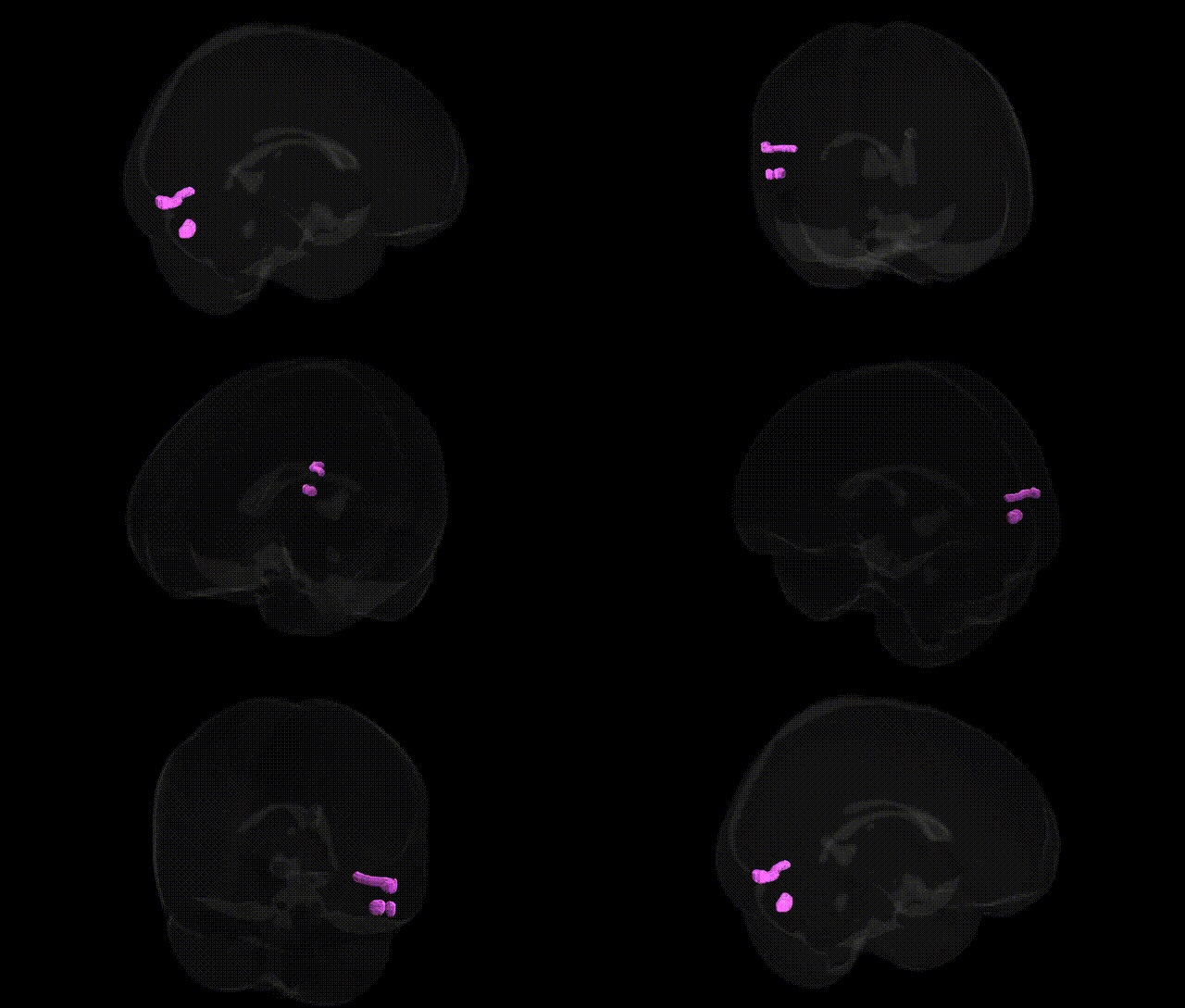
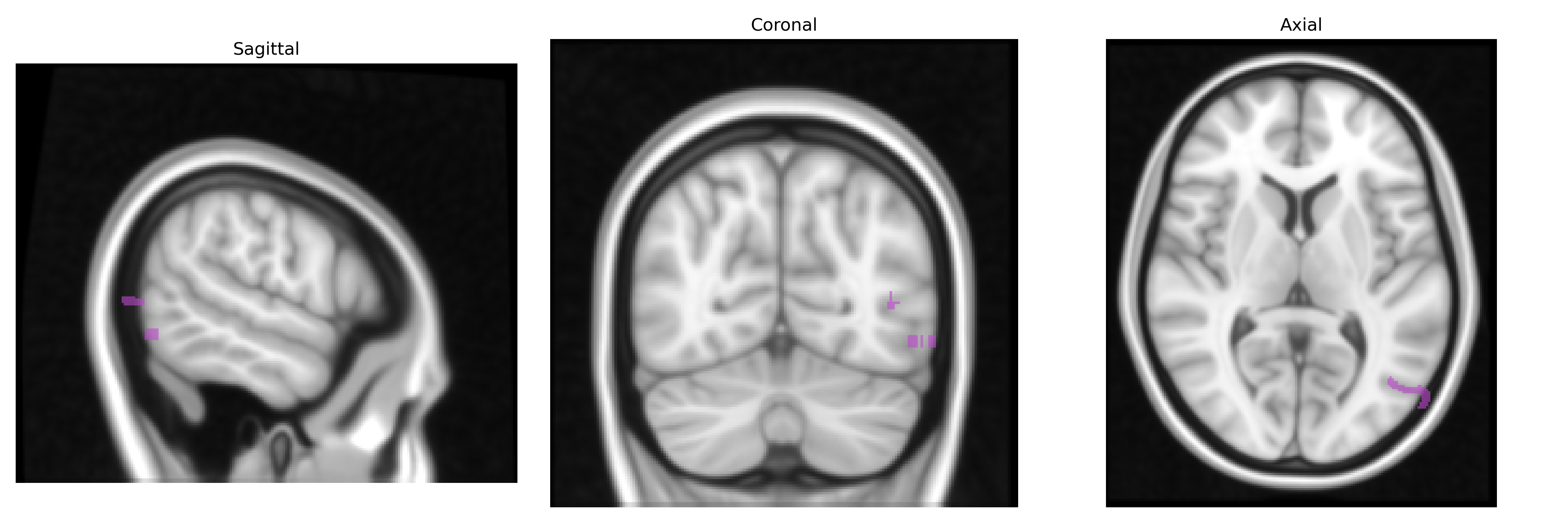
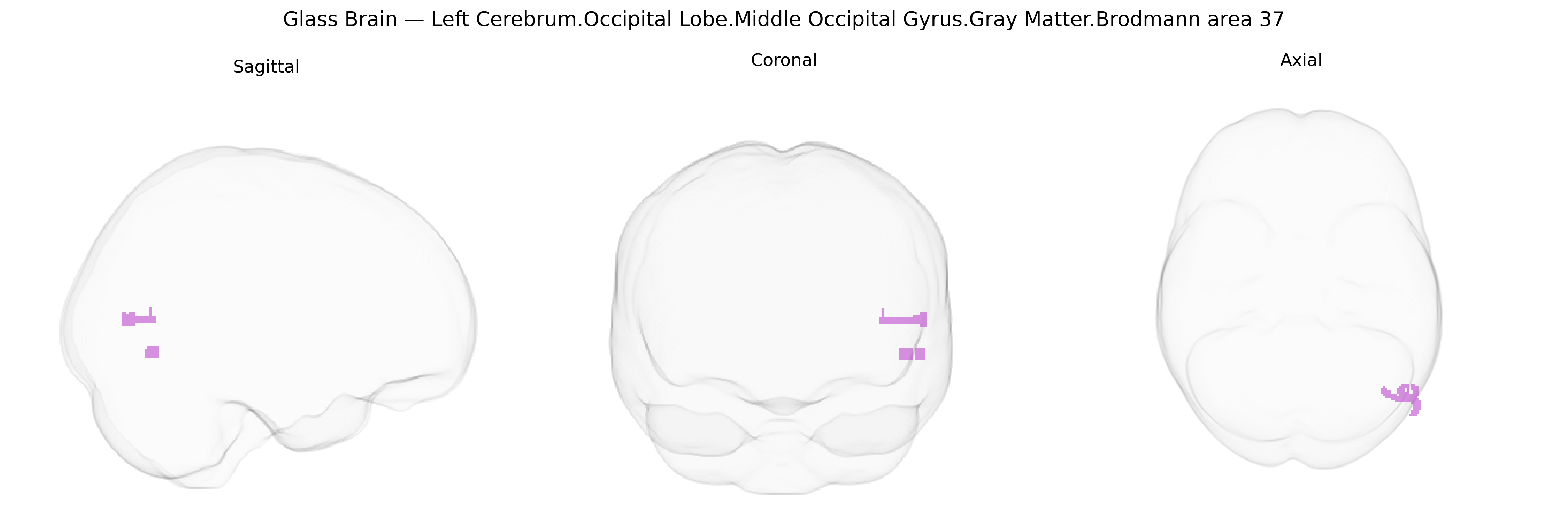
The bilateral Left Cerebrum.Occipital Lobe.Middle Occipital Gyrus.Gray Matter.Brodmann area 37 corresponds primarily to the lateral occipitotemporal cortex, encompassing parts of the fusiform and adjacent inferior/middle occipital gyri, and is classically associated with high-level visual processing, including object, face, and word recognition. Histologically, BA37 exhibits a well-developed granular layer IV and distinct pyramidal layers III and V, consistent with association cortex in the ventral visual stream. Functionally, this region integrates complex visual features into coherent percepts and contributes to semantic processing of visually presented stimuli, with strong connectivity to temporal and parietal association areas as well as prefrontal regions. Lesions in BA37 can result in category-specific agnosias, such as prosopagnosia or difficulties with reading and object identification, reflecting its role in linking visual form representations with stored knowledge. Brodmann area 37
The bilateral left occipitotemporal region corresponding to the Middle Occipital Gyrus/Brodmann area 37 (often overlapping the lateral fusiform and posterior inferior temporal cortex) has been implicated in multiple genetically influenced traits, primarily through imaging–genetics and GWAS of brain structure and function rather than direct region-specific association studies. Large-scale cortical GWAS (e.g., ENIGMA, UK Biobank) show that gray-matter thickness and surface area in occipitotemporal and fusiform territories are moderately heritable and associated with common variants in genes involved in neurodevelopment (such as those in axon guidance, synaptic formation, and cortical patterning pathways), though the associations are typically reported at the level of “occipital” or “temporal” cortex rather than a discrete BA37 label. Functionally, this region is strongly involved in visual word and object processing, and genetic studies of dyslexia and reading ability (e.g., involving KIAA0319, DCDC2, and ROBO1) repeatedly implicate structural and functional differences in left occipitotemporal cortex, including the visual word form area, which partially overlaps BA37. Similarly, genetic risk for autism spectrum disorder and schizophrenia—especially variants in synaptic and neurodevelopmental genes such as CNTNAP2, NRGN, and others identified in large psychiatric GWAS—has been associated with altered activation or morphology in occipitotemporal regions during face and object recognition tasks, processes for which BA37 is critical. GWAS of face recognition ability and prosopagnosia suggest polygenic influences on fusiform/occipitotemporal circuitry, again overlapping this territory. Overall, genetic associations are indirect and mediated through broader occipitotemporal networks, with most evidence linking BA37’s structure and function to polygenic risk for language and reading disorders, visual object and face processing variability, and major psychiatric conditions rather than to single, region-specific genetic variants.
Overview generated by GPT-4o (2026).
Region ID: 323
Hemisphere: bilateral
Atlas: Talairach labels 1mm
Full Quality Version: Download MP4
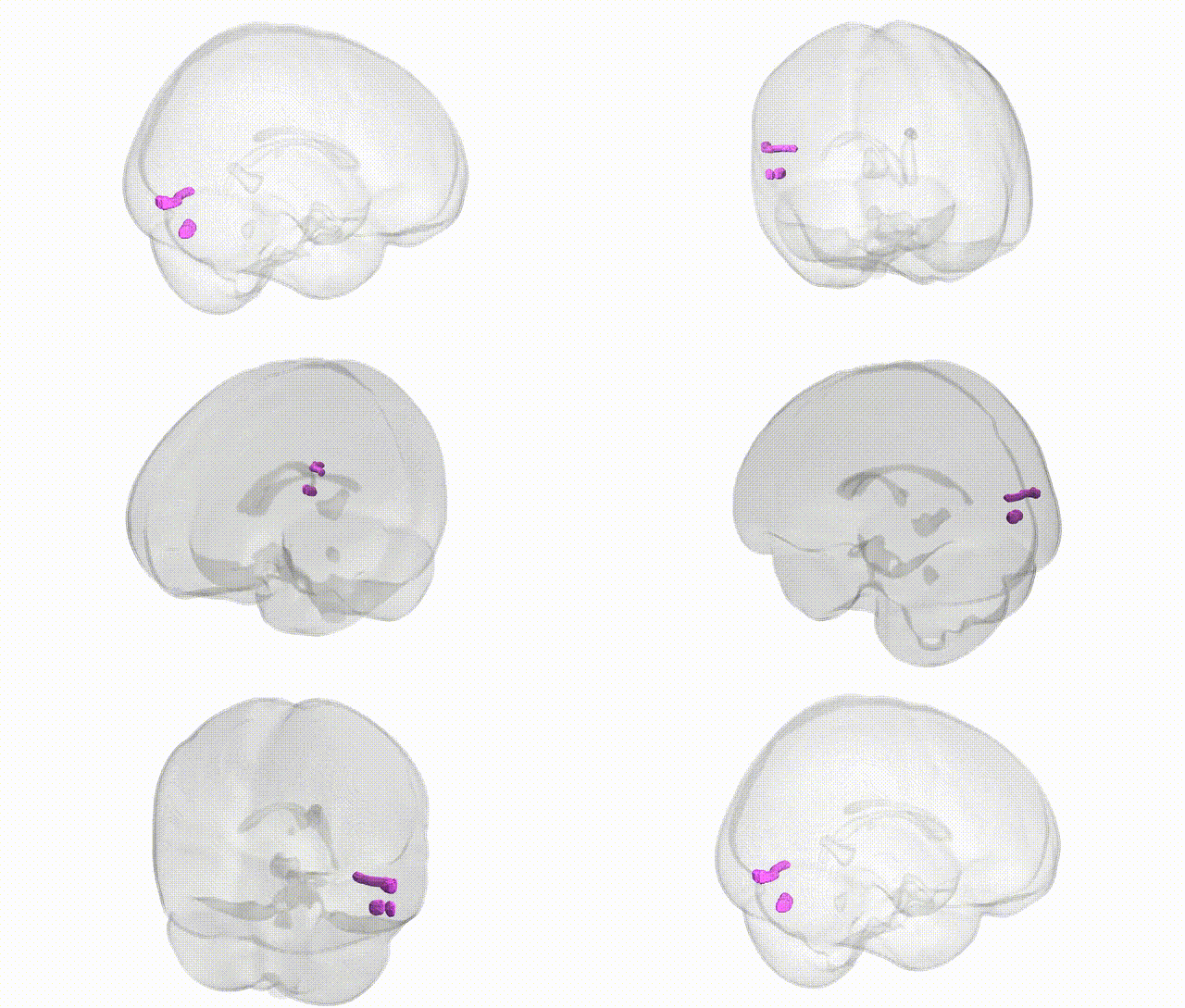
Full Quality Version: Download MP4
Wali Sidiqyar*, Gaurav Rudravaram*, Elyssa M. McMaster, Trent M. Schwartz, Adam M. Saunders, Kurt G. Schilling, Bennett A. Landman "Introducing SPINS: A Shared Public Visualization Library of Neuroanatomical Structures." Medical Imaging with Deep Learning- short paper
This resource is licensed under CC0 1.0 Universal (Public Domain).