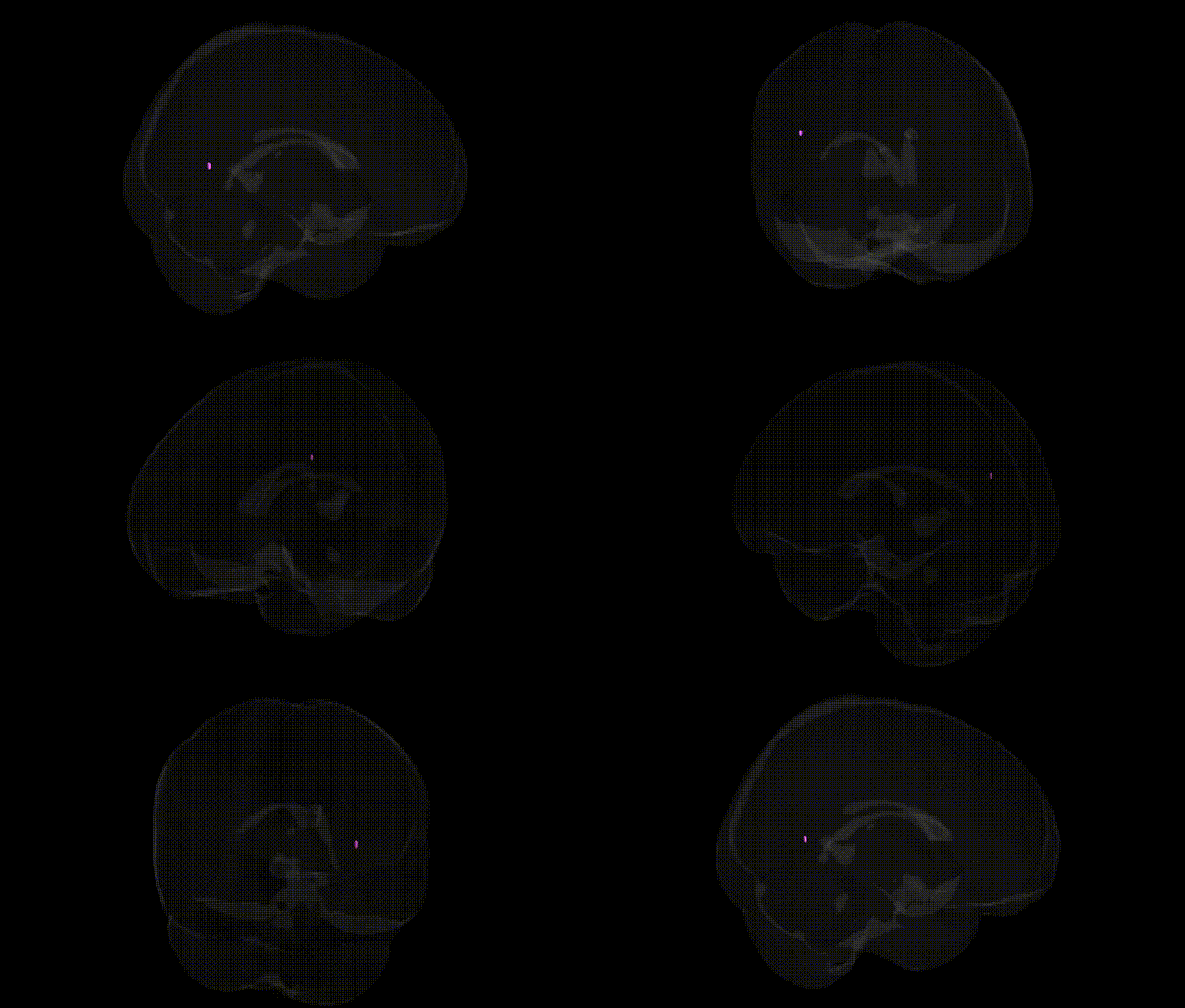
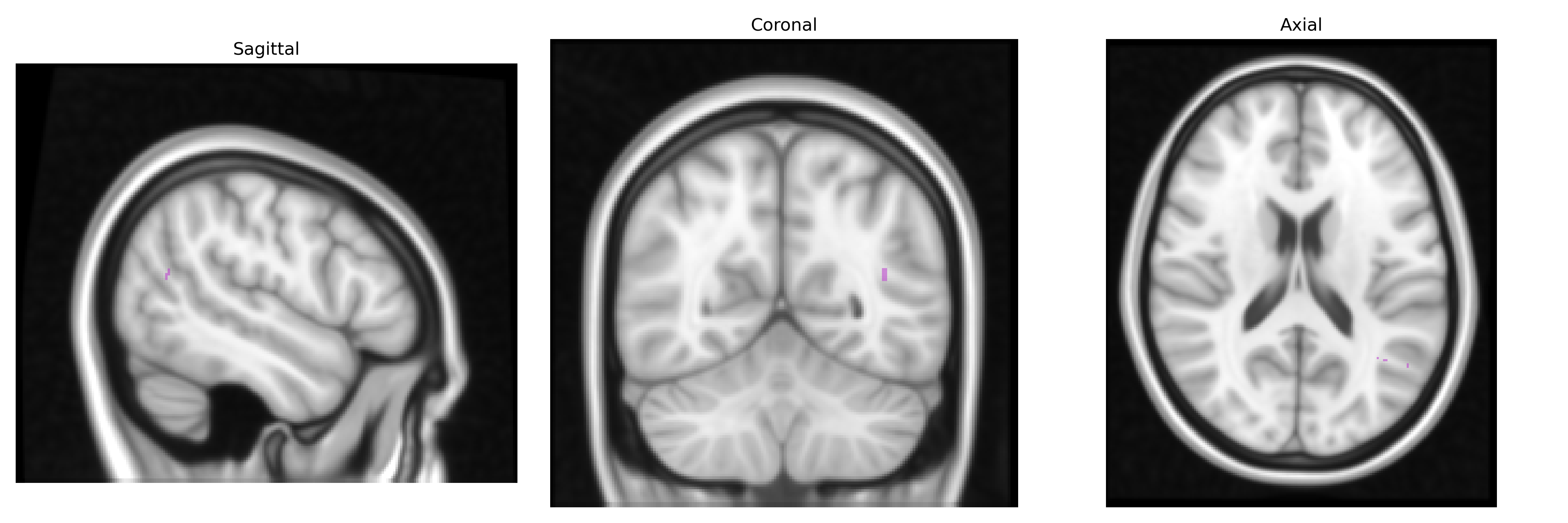
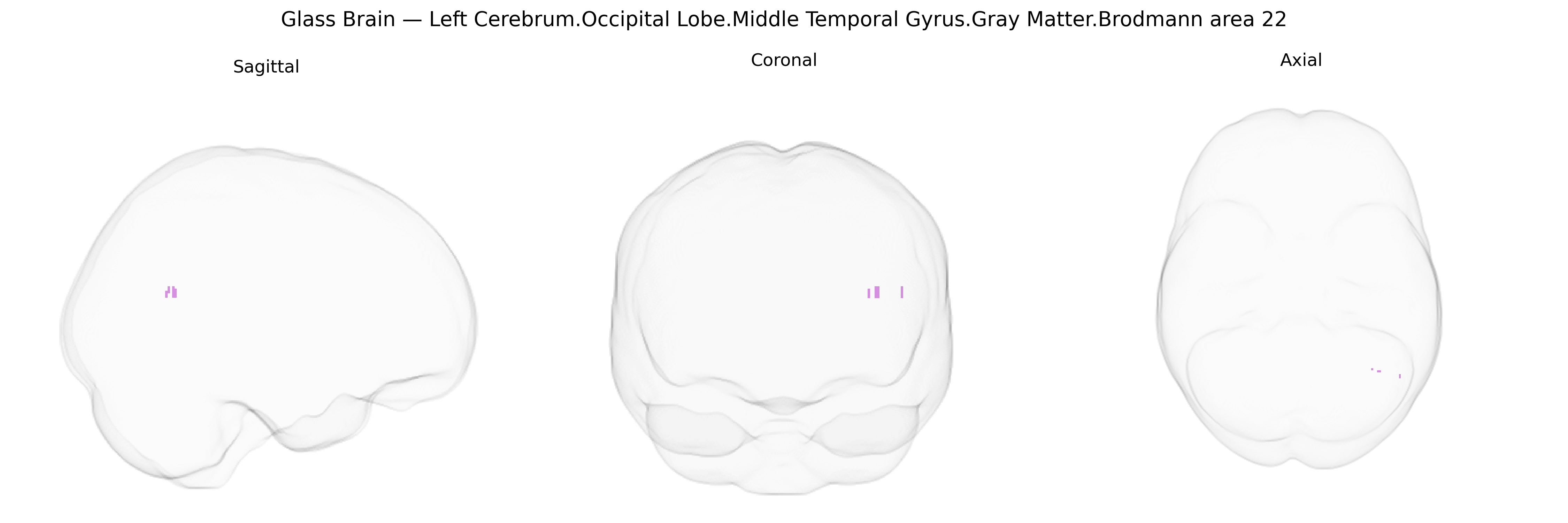
The bilateral Left Cerebrum.Occipital Lobe.Middle Temporal Gyrus.Gray Matter.Brodmann area 22, as labeled in the Talairach 1 mm atlas, corresponds primarily to the posterior segment of the middle temporal gyrus within the occipital–temporal transition zone, encompassing cytoarchitectonic territory associated with Brodmann area 22, a region classically linked to higher-order auditory and language processing (notably Wernicke’s area in the dominant hemisphere). In this atlas context, the label emphasizes its gray matter localization and its position at the intersection of visual association cortex and temporal association cortex, suggesting a role in integrating complex visual inputs with auditory and linguistic representations, as well as contributing to multimodal semantic processing. There is no direct Wikipedia article for this exact composite region; a closely related structure is Brodmann area 22.
The Middle Temporal Gyrus in Brodmann area 22 of the occipitotemporal cortex has been implicated in several genetic and genomic studies, particularly those examining language, auditory processing, social cognition, and neuropsychiatric disorders. GWAS and imaging‑genetics studies have linked variation in genes involved in synaptic function, neuronal migration, and cortical development—such as CNTNAP2, FOXP2, GRIN2B, and DCDC2—to structural and functional differences in temporal language regions that encompass BA22, with associations to speech and language impairments, dyslexia, autism spectrum disorder, and schizophrenia. Large-scale neuroimaging GWAS (e.g., ENIGMA consortium) have shown that common variants influencing cortical thickness and surface area in lateral temporal cortex overlap with genetic architectures for cognitive performance, educational attainment, and risk for major psychiatric disorders. BA22, particularly in the left hemisphere, is consistently reported in studies of genetic risk for schizophrenia and auditory hallucinations, where variants in glutamatergic, GABAergic, and dopaminergic pathway genes correlate with altered activation and connectivity of this region. Additionally, polygenic risk scores for Alzheimer’s disease and frontotemporal dementia have been associated with atrophy and hypometabolism in temporal association cortices including BA22, supporting a broader role for this area as a convergence zone where genetic variation affecting language, memory, and social behavior manifests through region-specific structural and functional alterations.
Overview generated by GPT-4o (2026).
Region ID: 764
Hemisphere: bilateral
Atlas: Talairach labels 1mm
Full Quality Version: Download MP4
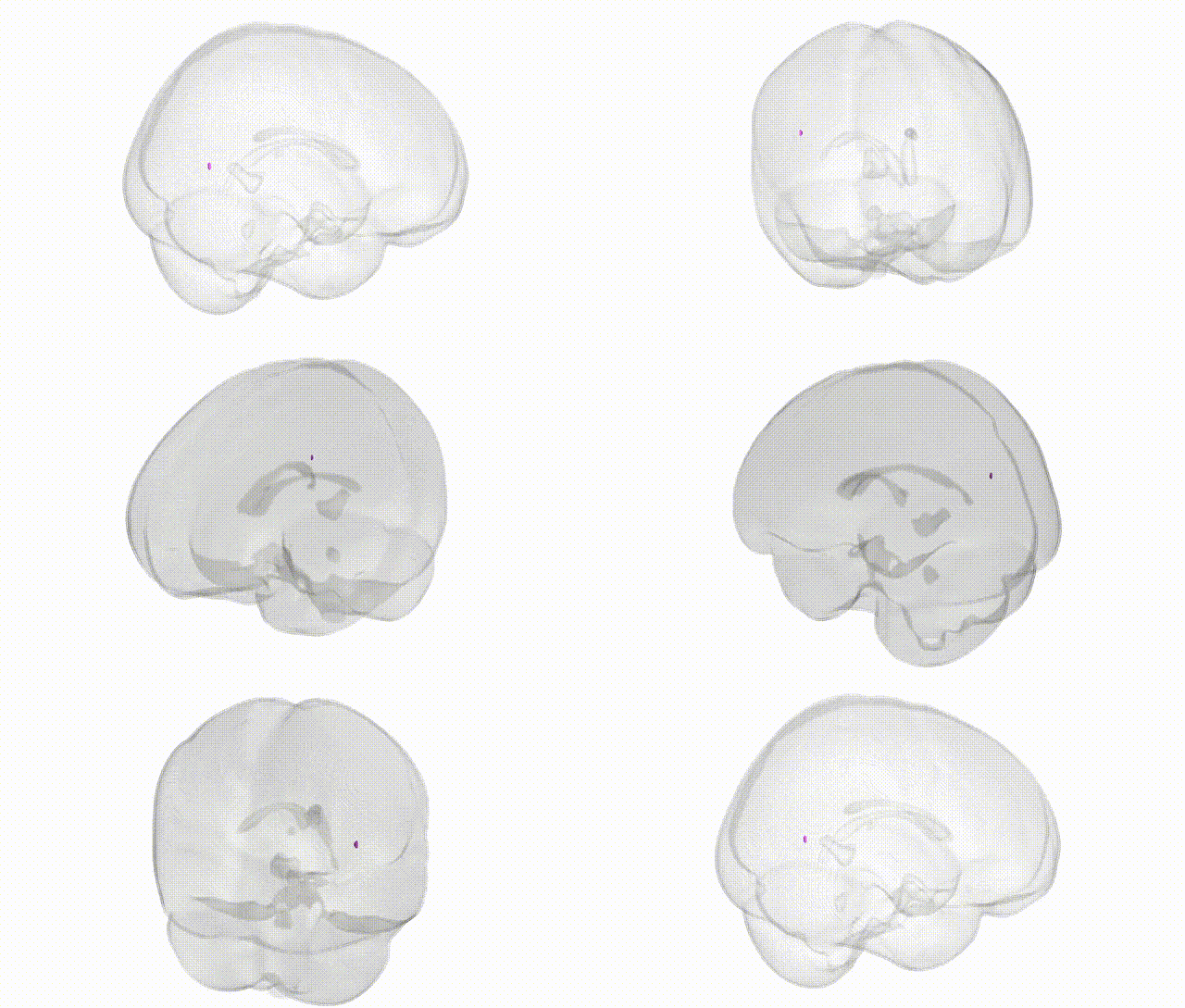
Full Quality Version: Download MP4
Wali Sidiqyar*, Gaurav Rudravaram*, Elyssa M. McMaster, Trent M. Schwartz, Adam M. Saunders, Kurt G. Schilling, Bennett A. Landman "Introducing SPINS: A Shared Public Visualization Library of Neuroanatomical Structures." Medical Imaging with Deep Learning- short paper
This resource is licensed under CC0 1.0 Universal (Public Domain).