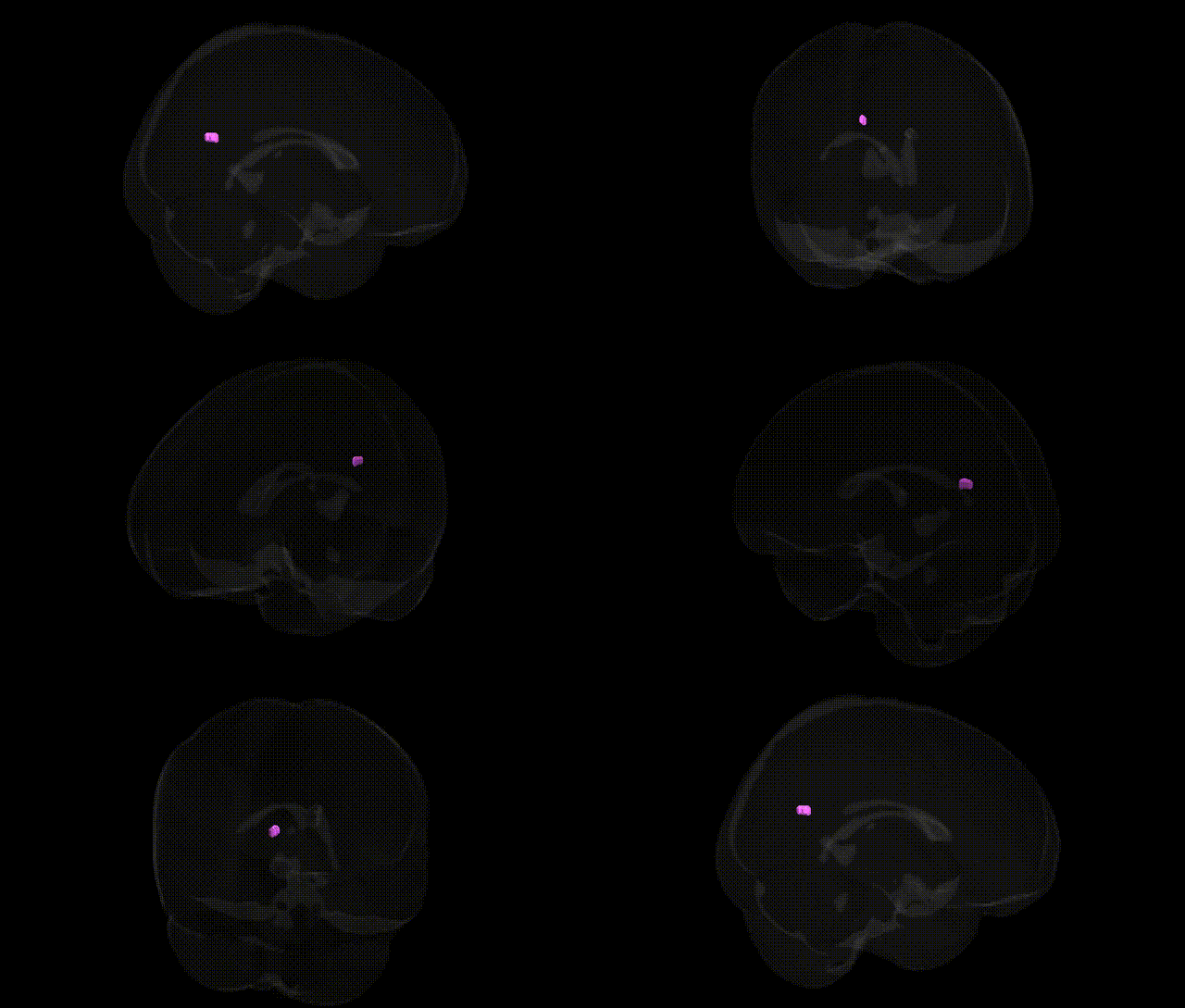
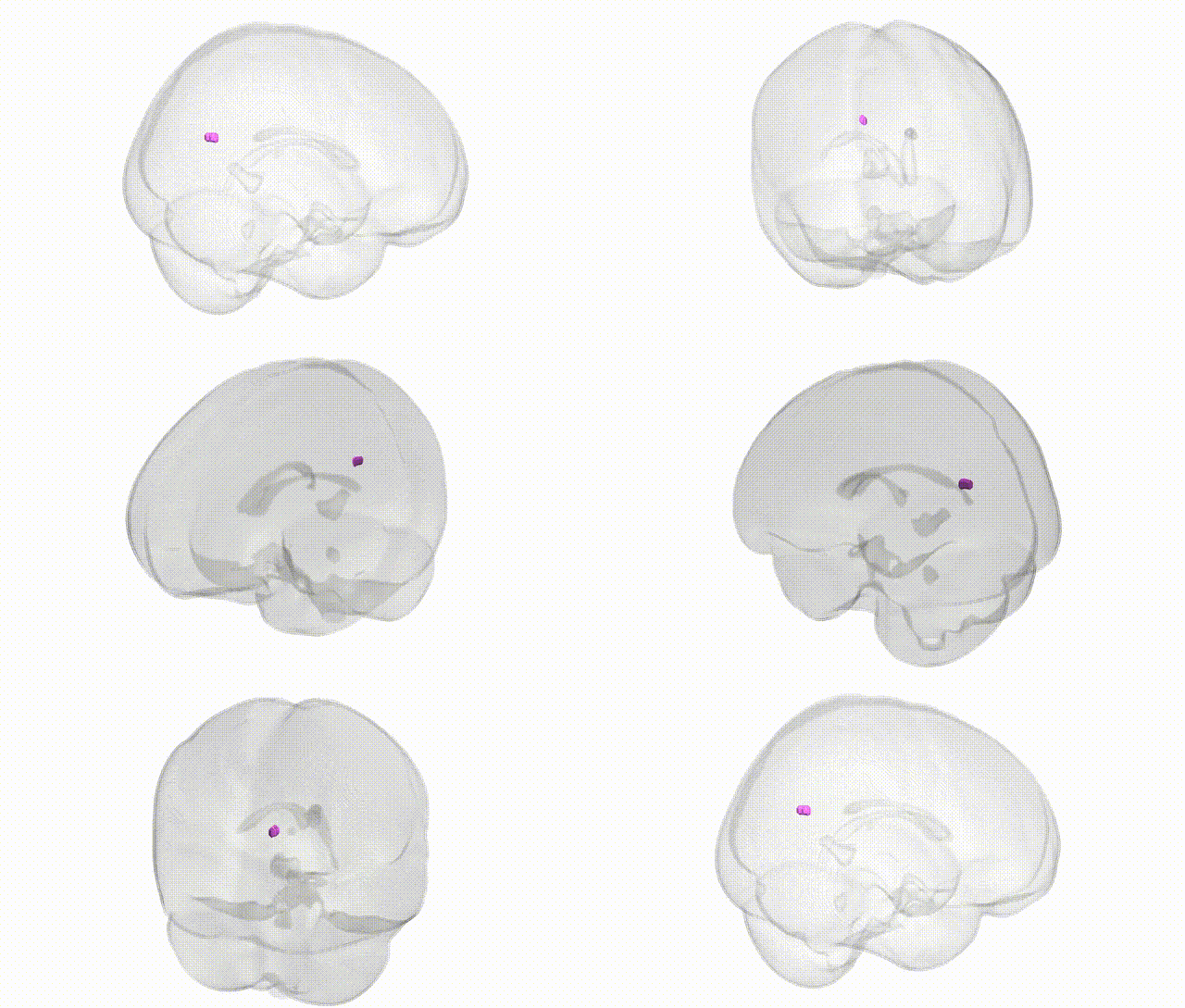
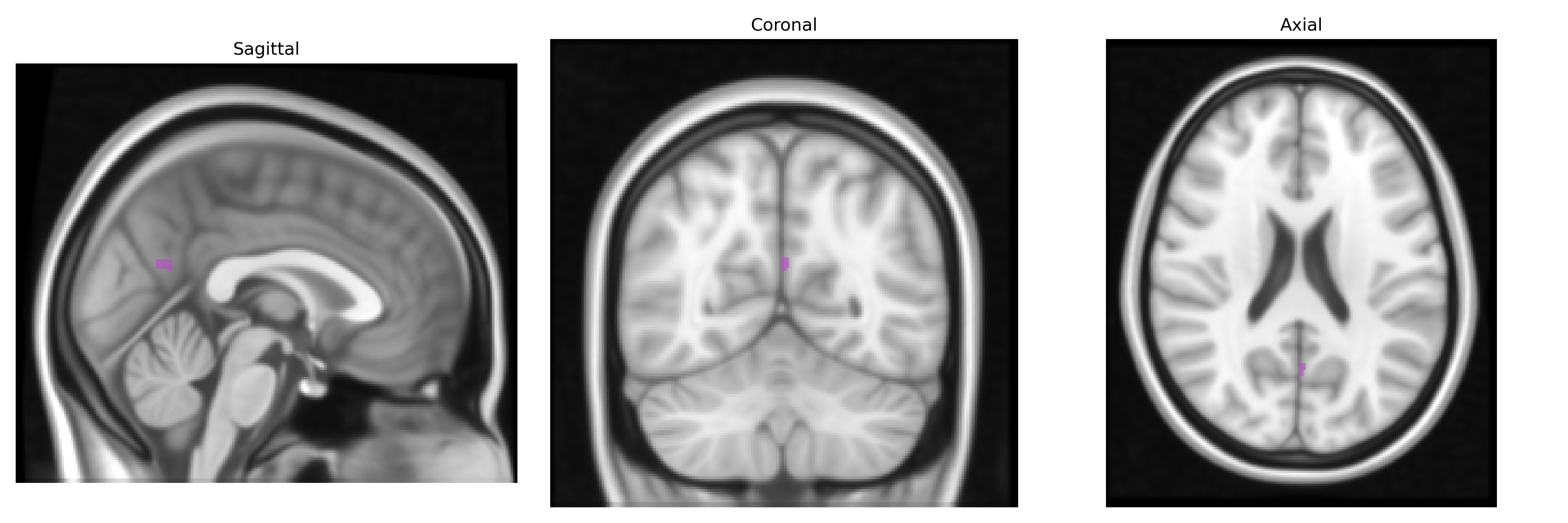
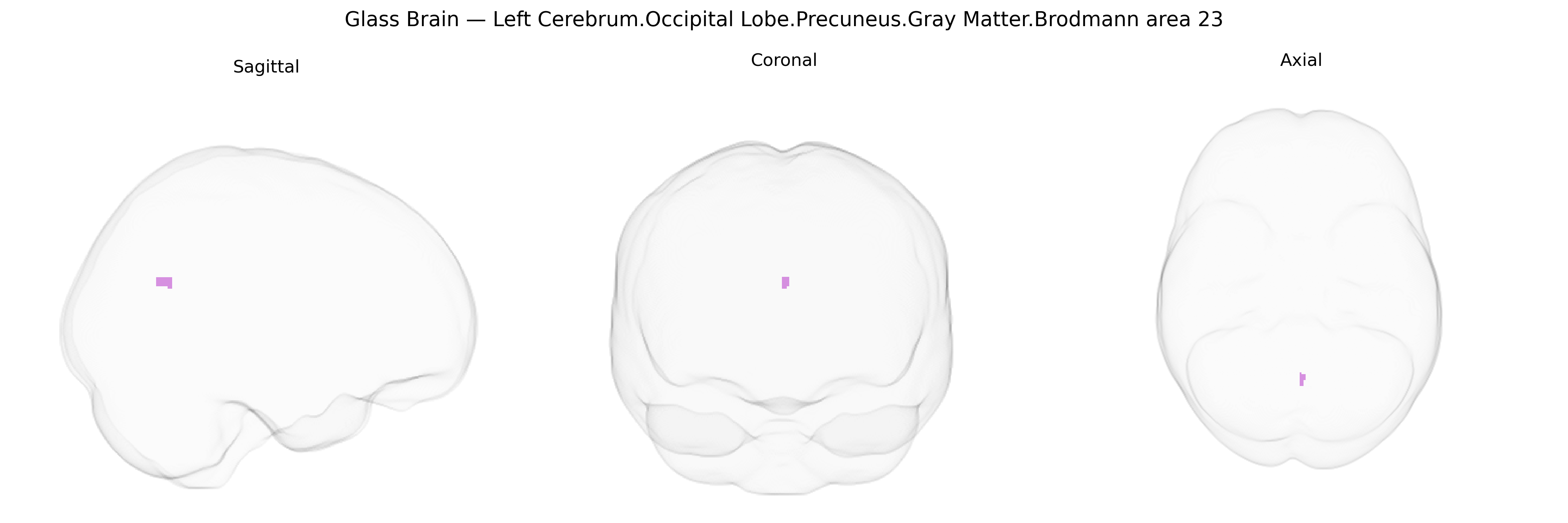
The bilateral Left Cerebrum.Occipital Lobe.Precuneus.Gray Matter.Brodmann area 23 region, as defined in the Talairach 1 mm atlas, corresponds primarily to posteromedial cortical gray matter in the caudal portion of the precuneus and adjacent posterior cingulate cortex, within Brodmann area 23. This area lies along the medial wall of the cerebral hemisphere near the parietal–occipital junction and is part of the limbic and default mode networks, contributing to functions such as visuospatial imagery, self-referential processing, episodic memory retrieval, and integration of multimodal sensory information. Cytoarchitectonically, BA23 is characterized by its granular cortex and distinct laminar organization typical of isocortex, and it maintains dense reciprocal connections with the hippocampal formation, retrosplenial cortex, and association areas in parietal and frontal lobes, supporting its role in higher-order cognitive and mnemonic processes. No direct link exists for this exact composite Talairach label; a closely related structure is the Posterior cingulate cortex.
The bilateral precuneus gray matter in Brodmann area 23 (posterior medial cortex within the occipital–parietal transition) has been implicated in multiple genetic and GWAS-based associations through its roles in default mode network function, self-referential processing, and visuospatial integration. Imaging genetics studies repeatedly link common variants in APOE (especially ε4) and CLU to altered precuneus structure, metabolism, and connectivity, particularly in Alzheimer’s disease and age-related cognitive decline, with stronger atrophy and hypometabolism in risk-allele carriers. Large-scale ENIGMA and UK Biobank–based GWAS of cortical thickness and surface area identify polygenic influences on precuneus morphology, including loci near genes involved in neuronal development and synaptic function (e.g., MAPT region, microtubule and axon-guidance pathways), and show moderate heritability of regional volume and thickness. Polygenic risk scores for schizophrenia, major depressive disorder, autism spectrum disorder, and attention-deficit/hyperactivity disorder have been associated with structural and functional alterations in this region, consistent with broader default mode network dysconnectivity in these conditions. Additional associations include links between precuneus gray matter measures and genetic liability for traits such as general cognitive ability, educational attainment, neuroticism, and insomnia, suggesting that variation in this region serves as an intermediate neural phenotype through which pleiotropic neuropsychiatric and cognitive genetics exert effects.
Overview generated by GPT-4o (2026).
Region ID: 829
Hemisphere: bilateral
Atlas: Talairach labels 1mm
Full Quality Version: Download MP4
Full Quality Version: Download MP4
Wali Sidiqyar*, Gaurav Rudravaram*, Elyssa M. McMaster, Trent M. Schwartz, Adam M. Saunders, Kurt G. Schilling, Bennett A. Landman "Introducing SPINS: A Shared Public Visualization Library of Neuroanatomical Structures." Medical Imaging with Deep Learning- short paper
This resource is licensed under CC0 1.0 Universal (Public Domain).