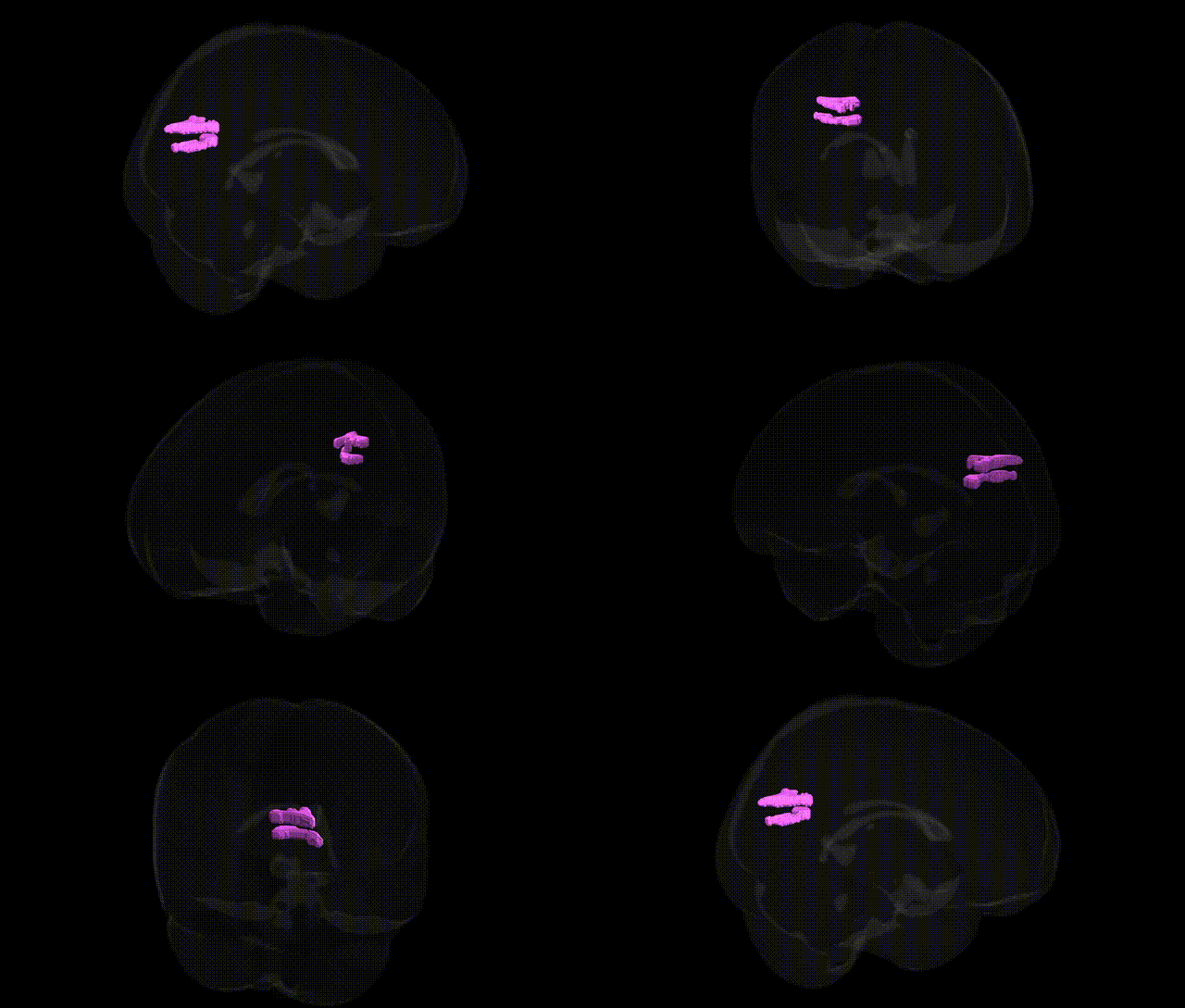
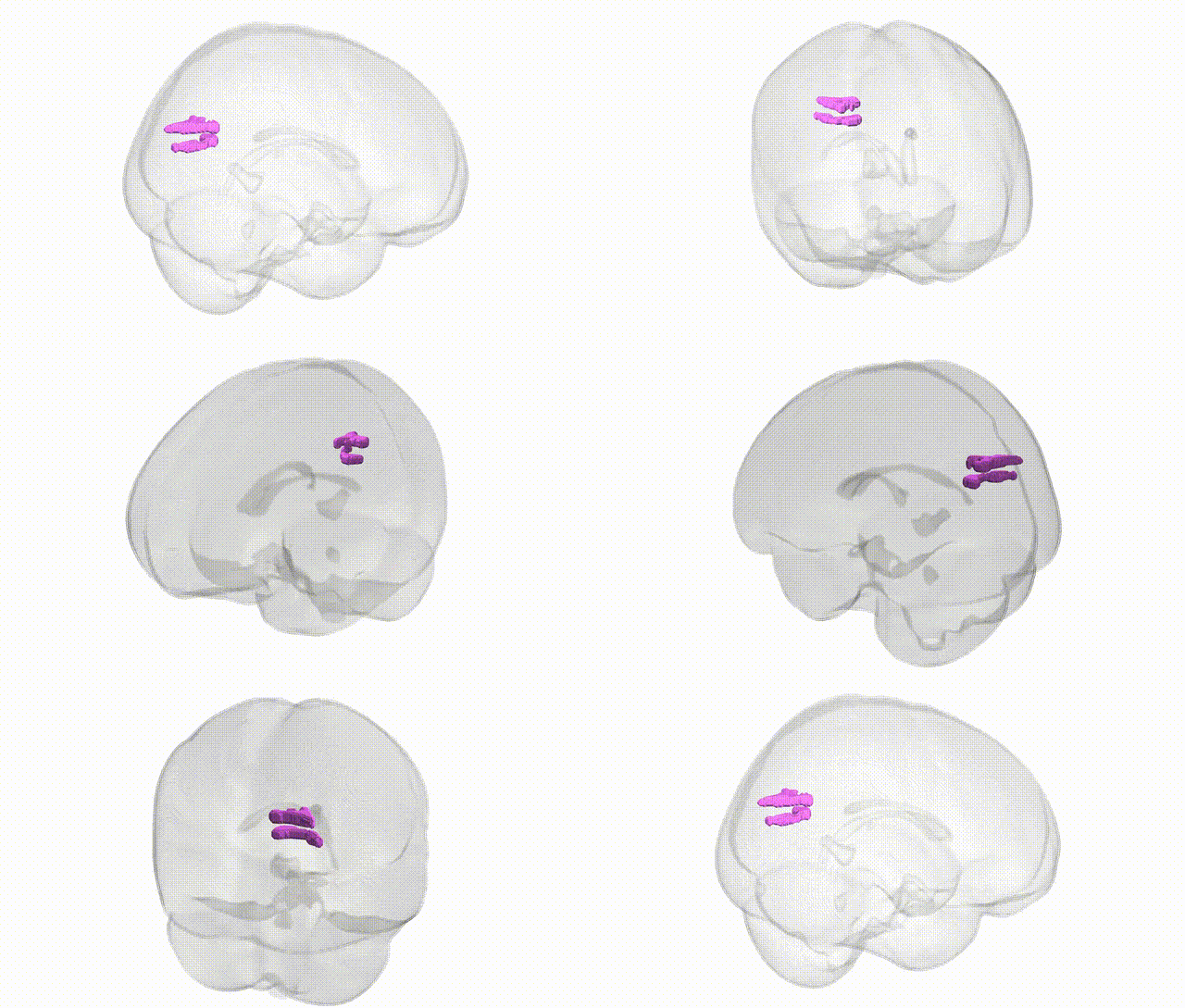
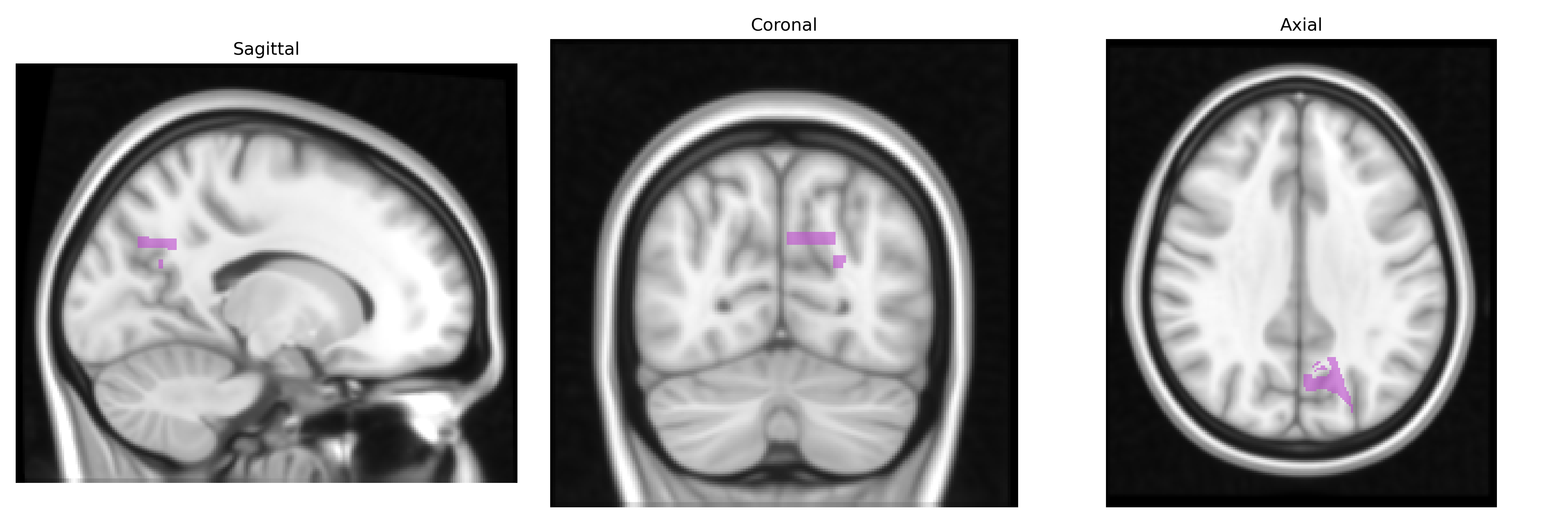
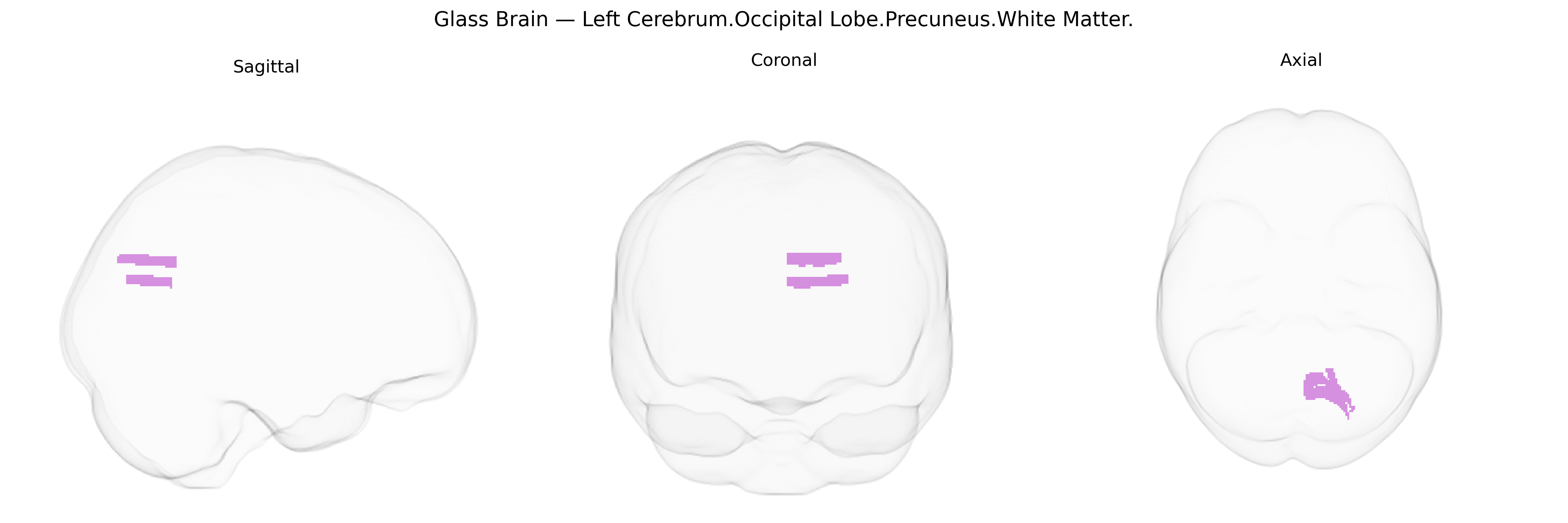
The bilateral Left Cerebrum.Occipital Lobe.Precuneus.White Matter corresponds to subcortical myelinated fiber pathways underlying the precuneus region, a medial parietal cortical area that extends posteriorly toward the occipital lobe. These white matter tracts participate in long-range connectivity linking the precuneus with occipital visual areas, posterior cingulate cortex, parietal association cortex, and medial frontal regions, contributing to visuospatial integration, self-referential processing, and default mode network activity. As this label is defined in the Talairach 1 mm atlas, the exact boundaries reflect atlas-based parcellation rather than a distinct anatomical fascicle, but it broadly encompasses association fibers and short U-fibers supporting communication between the occipital and medial parietal cortices. There is no direct Wikipedia article for this precise atlas-defined white matter region; a closely related cortical region is the Precuneus.
The bilateral Left Cerebrum.Occipital Lobe.Precuneus.White Matter region, as defined in the Talairach 1 mm atlas, corresponds broadly to posterior medial parietal/occipital white matter underlying the precuneus, a hub of the default mode network that has been implicated in diverse genetic influences on brain structure and function. Large-scale GWAS of neuroimaging phenotypes (e.g., ENIGMA, UK Biobank) have identified multiple loci associated with white matter microstructure (FA, MD) and cortical thickness in precuneus-adjacent regions, including variants in genes involved in axon guidance, myelination, and synaptic plasticity such as MAG, CNTN4, PLP1, and several oligodendrocyte-related genes, though associations are typically reported at the tract or regional level (e.g., superior longitudinal fasciculus, posterior cingulum, posterior callosal fibers) rather than this exact Talairach label. GWAS of resting-state connectivity and default mode network strength have implicated common variants near genes such as APOE, TOMM40, and other Alzheimer’s disease–related loci that show early microstructural and connectivity alterations in precuneus white matter. Genetic risk for late-onset Alzheimer’s disease, schizophrenia, major depression, and autism spectrum disorder has been associated with abnormal structure or connectivity of precuneus and neighboring posterior midline white matter, with polygenic risk scores correlating with diffusion metrics or functional connectivity in this region across several cohorts. Additional GWAS of cognitive traits (general intelligence, memory, mind-wandering, self-referential processing) have highlighted the precuneus as a key intermediate phenotype linking common genetic variation to behavior, although specific SNP-to-region mappings for the exact “Left Cerebrum.Occipital Lobe.Precuneus.White Matter” label are not typically reported, and findings should be interpreted as reflecting broader posterior default-mode and association white matter networks rather than a uniquely defined Talairach parcel.
Overview generated by GPT-4o (2026).
Region ID: 821
Hemisphere: bilateral
Atlas: Talairach labels 1mm
Full Quality Version: Download MP4
Full Quality Version: Download MP4
Wali Sidiqyar*, Gaurav Rudravaram*, Elyssa M. McMaster, Trent M. Schwartz, Adam M. Saunders, Kurt G. Schilling, Bennett A. Landman "Introducing SPINS: A Shared Public Visualization Library of Neuroanatomical Structures." Medical Imaging with Deep Learning- short paper
This resource is licensed under CC0 1.0 Universal (Public Domain).