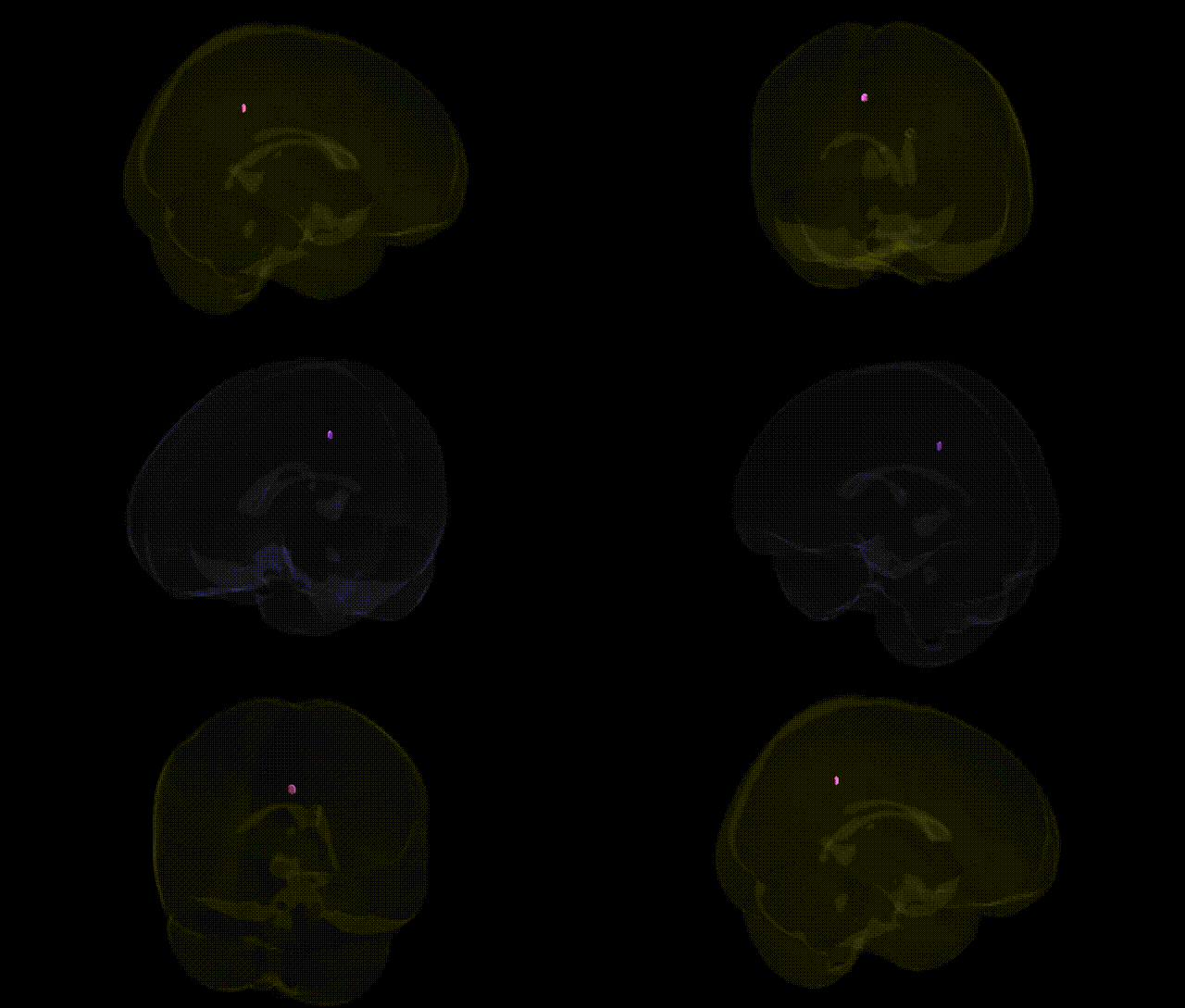
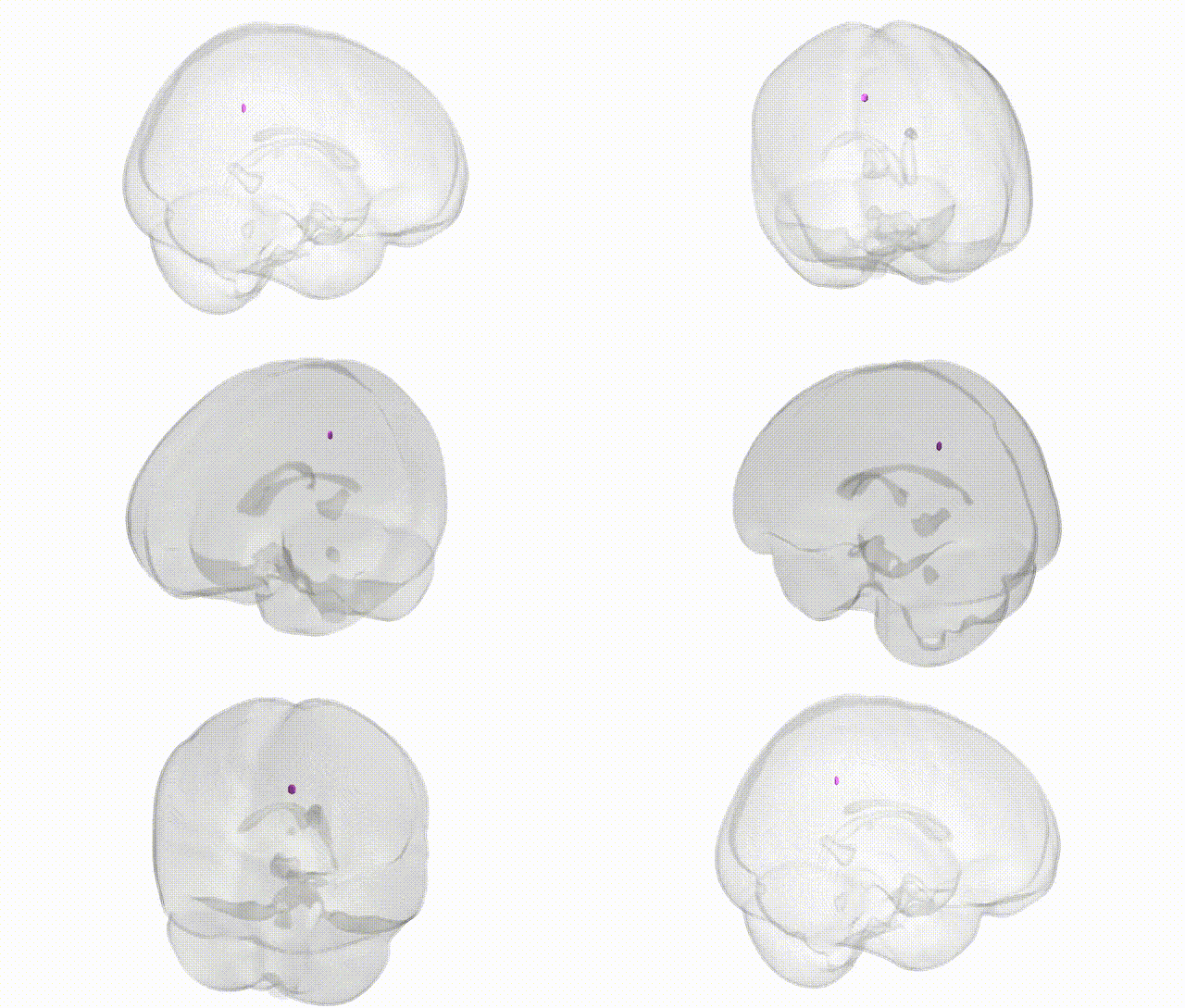
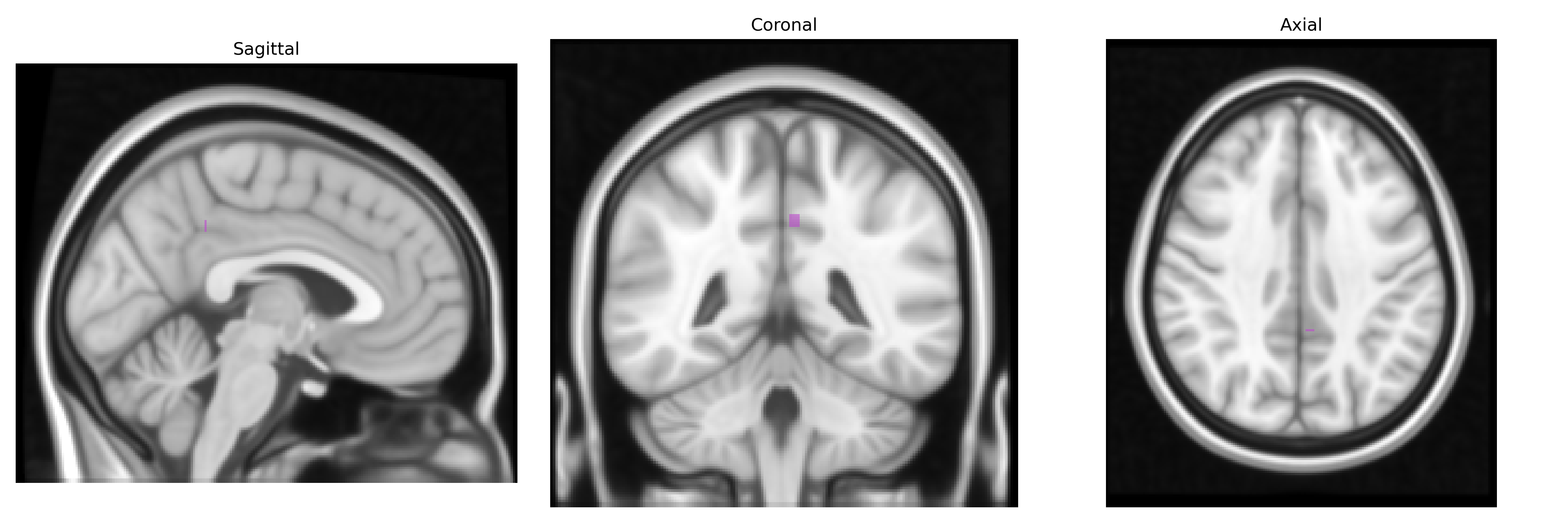
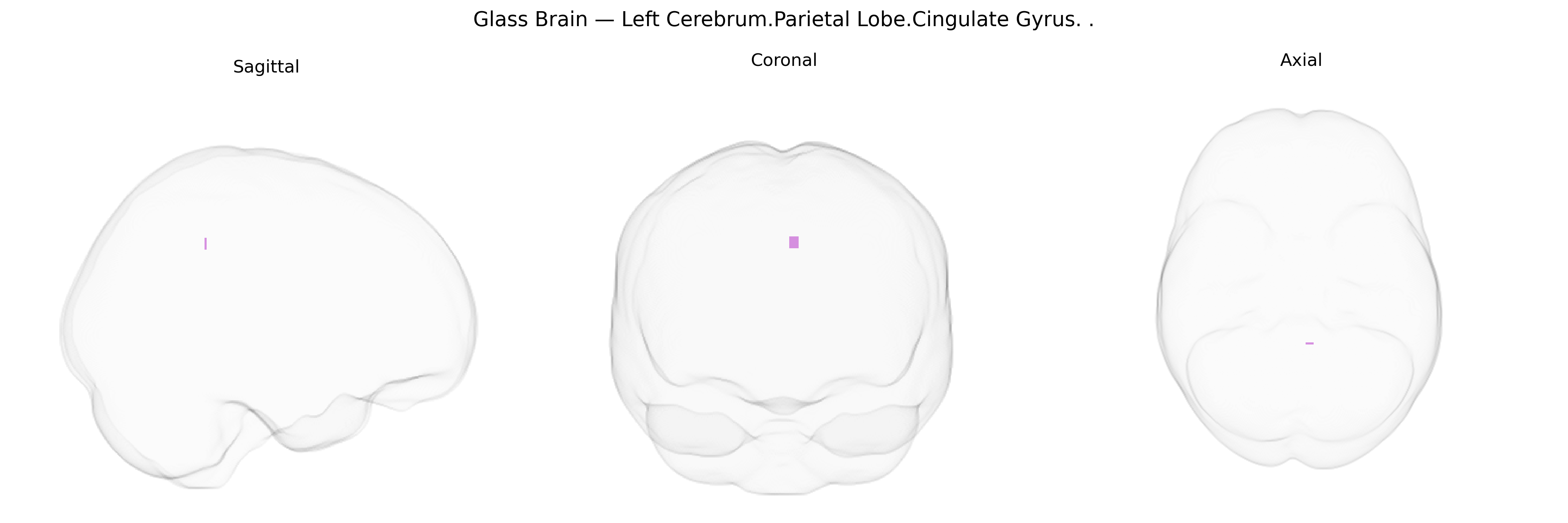
The bilateral Left Cerebrum.Parietal Lobe.Cingulate Gyrus, as labeled in the Talairach 1 mm atlas, corresponds primarily to the posterior portion of the cingulate gyrus that borders the medial aspect of the parietal lobe, forming part of the limbic cortex on the medial surface of the cerebral hemispheres. This region participates in networks subserving attention, visuospatial processing, memory retrieval, and aspects of internally directed cognition, and is a key node in the default mode network, integrating information about self-referential thought and environmental context. Anatomically, it lies superior to the corpus callosum and extends toward the precuneus and adjacent medial parietal cortex, with extensive connections to frontal, parietal, and limbic regions that support its role in cognitive control and affective processing. Cingulate gyrus
The bilateral left parietal lobe–cingulate gyrus region (as defined in the Talairach 1 mm atlas) is implicated in genetic studies of cognition, emotion, and psychiatric risk, although most findings reference functional networks rather than this exact anatomical label. GWAS and imaging-genetics studies have linked common variants in genes involved in synaptic function and neuronal development—such as those in the major histocompatibility complex (MHC) region, CACNA1C, ZNF804A, and genes regulating glutamatergic and GABAergic signaling—to altered structure or connectivity of cingulate and adjacent parietal areas, particularly within the default mode and frontoparietal control networks. These associations appear in large consortia datasets (e.g., ENIGMA, UK Biobank) that relate polygenic risk scores for schizophrenia, major depressive disorder, bipolar disorder, attention-deficit/hyperactivity disorder, and autism spectrum disorder to cortical thickness, surface area, and functional connectivity in the cingulate–parietal midline cortex. Additional genetic influences have been reported for traits such as general intelligence, working memory, chronic pain, and emotion regulation, in which cingulate and parietal midline activation is a key intermediate phenotype. However, no major GWAS to date has isolated a single gene uniquely specific to the “Left Cerebrum.Parietal Lobe.Cingulate Gyrus” region; rather, its genetic associations are distributed and partially shared across broader corticolimbic networks involved in cognitive control, self-referential processing, and affective regulation.
Overview generated by GPT-4o (2026).
Region ID: 996
Hemisphere: bilateral
Atlas: Talairach labels 1mm
Full Quality Version: Download MP4
Full Quality Version: Download MP4
Wali Sidiqyar*, Gaurav Rudravaram*, Elyssa M. McMaster, Trent M. Schwartz, Adam M. Saunders, Kurt G. Schilling, Bennett A. Landman "Introducing SPINS: A Shared Public Visualization Library of Neuroanatomical Structures." Medical Imaging with Deep Learning- short paper
This resource is licensed under CC0 1.0 Universal (Public Domain).