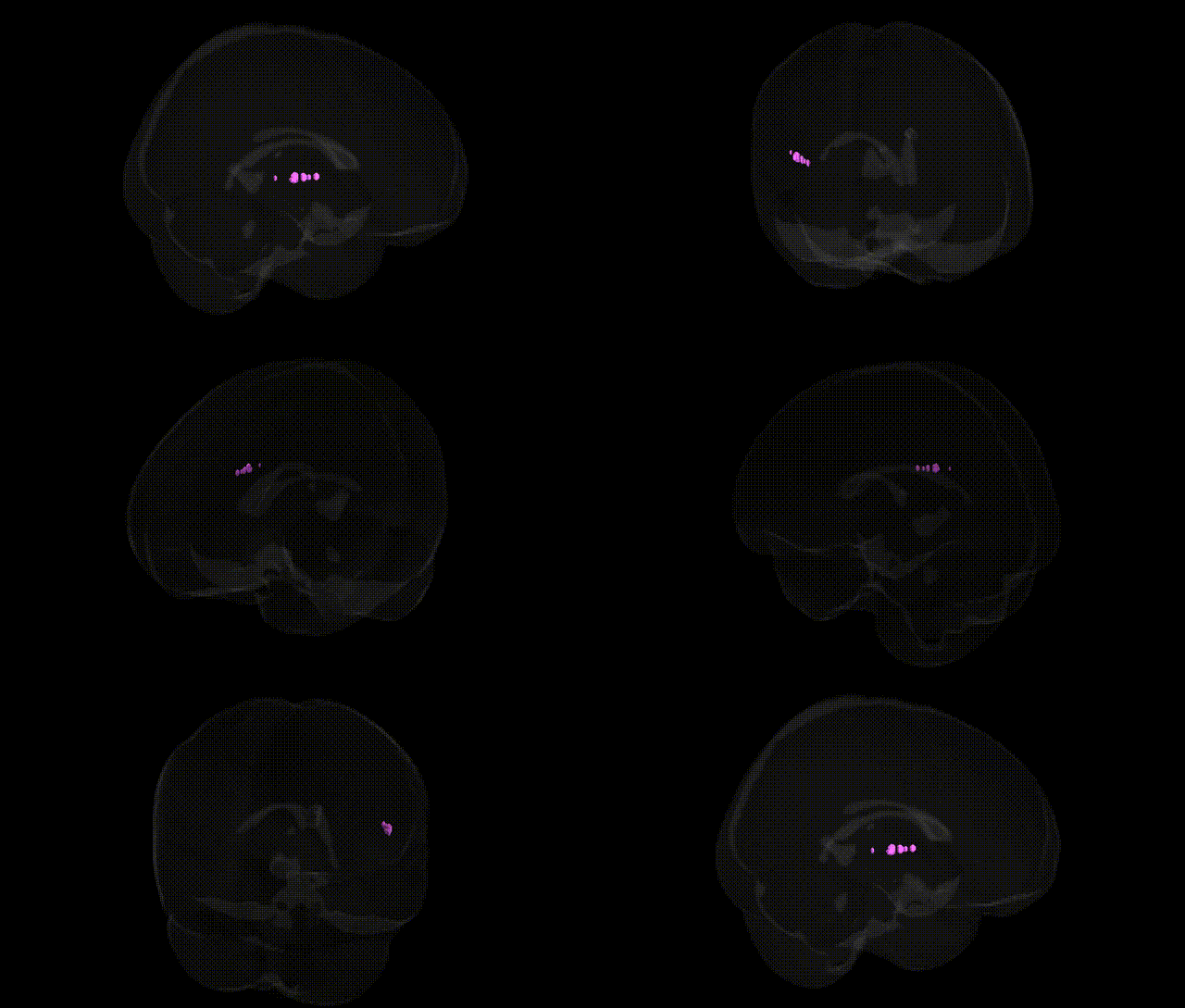
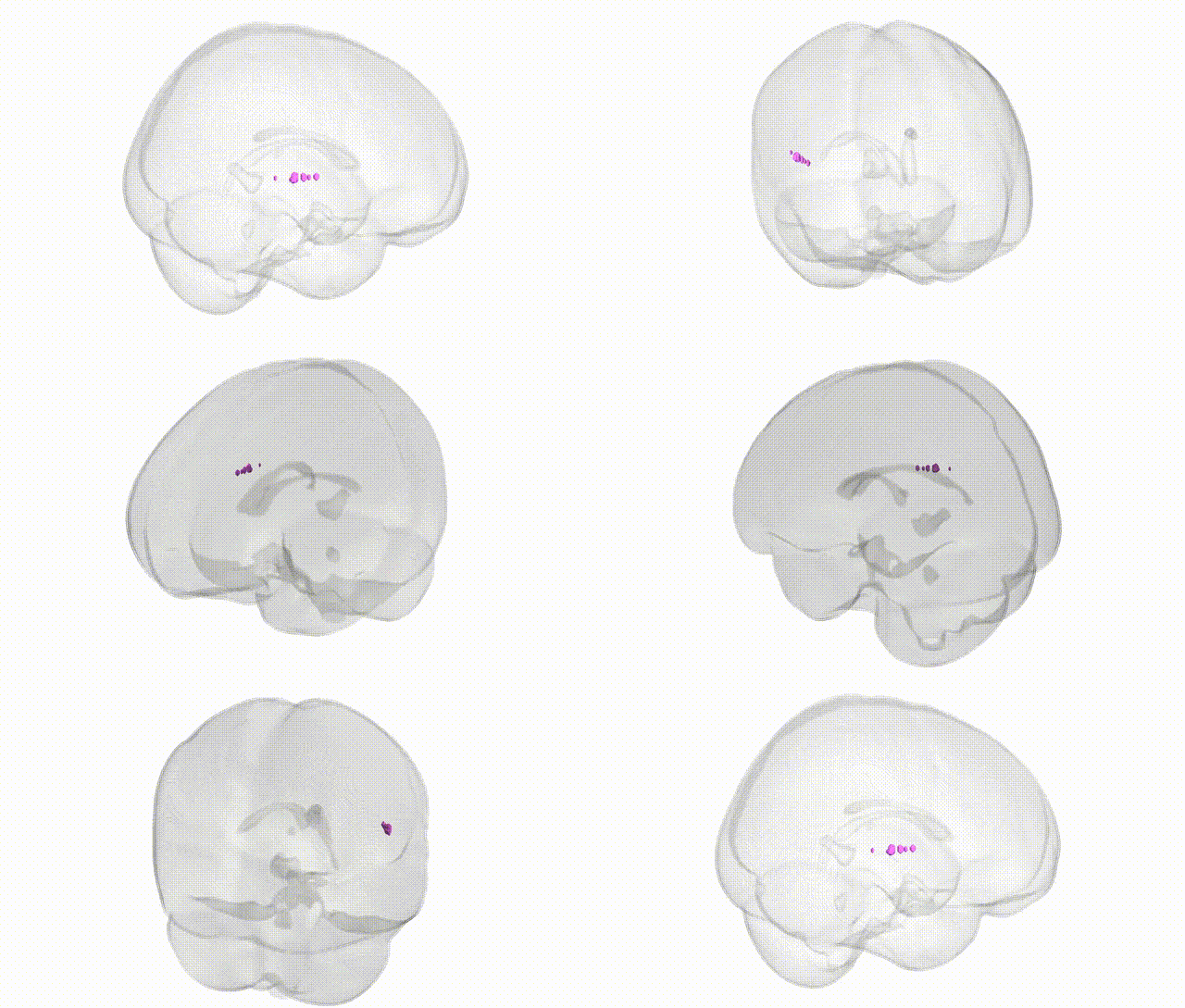
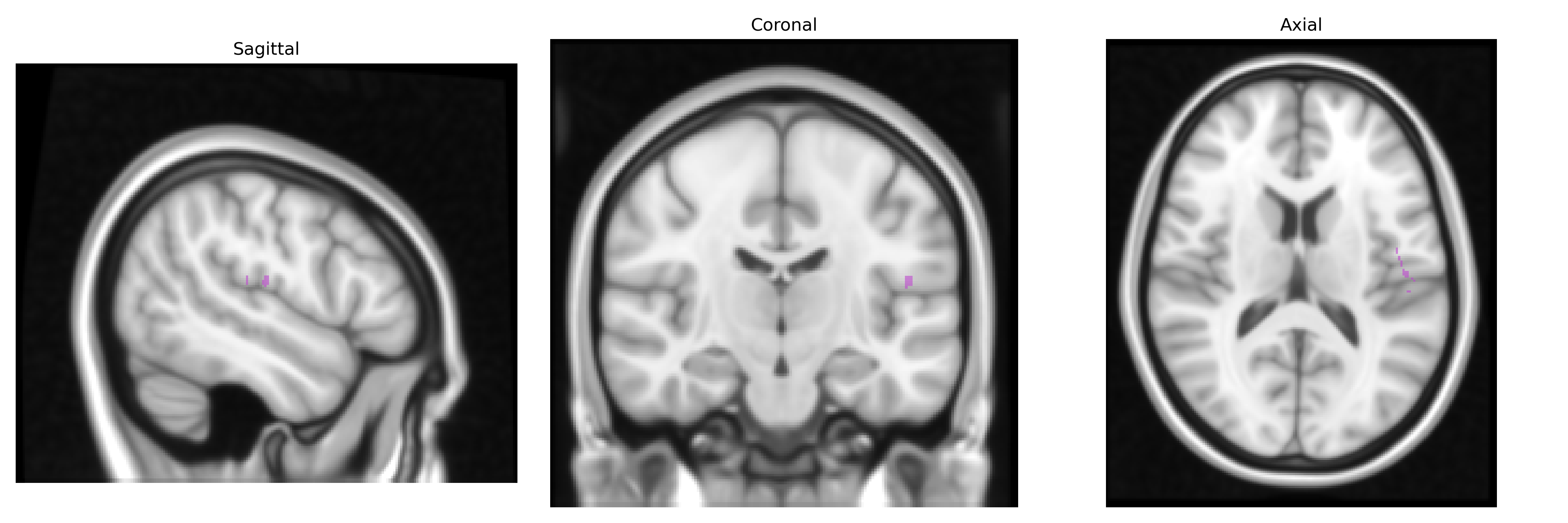
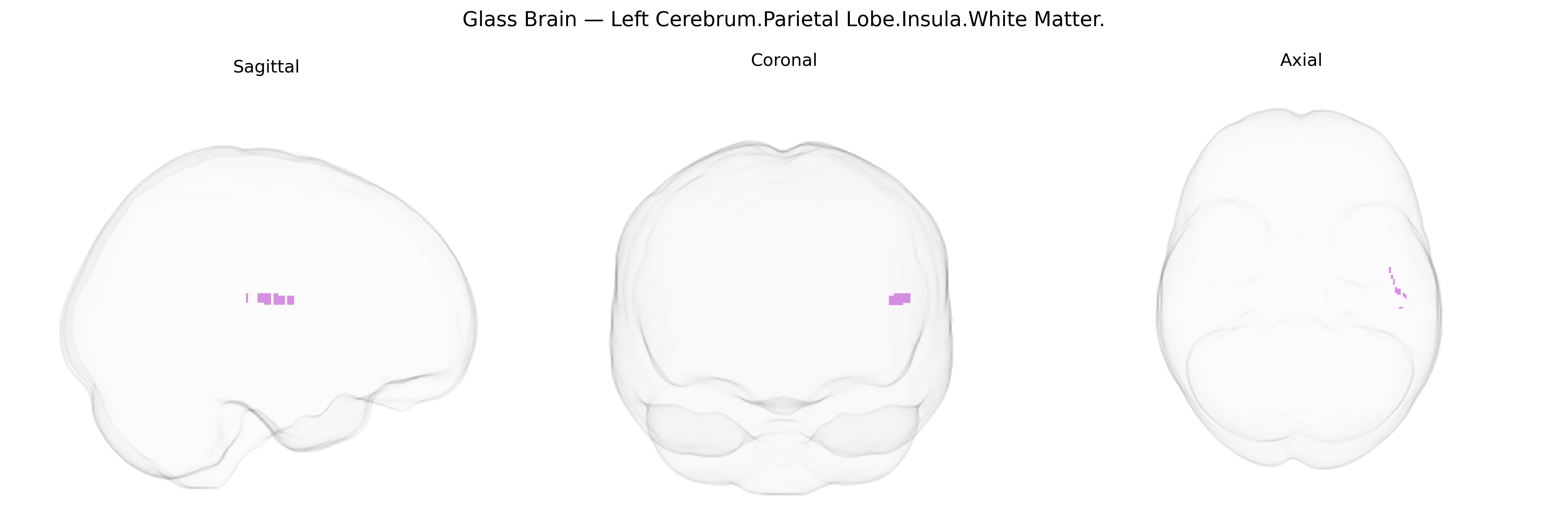
The bilateral Left Cerebrum.Parietal Lobe.Insula.White Matter refers to the subcortical myelinated fiber pathways underlying the insular cortex located deep within the lateral sulcus, at the junction of the parietal, frontal, and temporal lobes on the left side of the cerebrum. This white matter region contains association fibers connecting the insular cortex with parietal, frontal, and limbic areas, supporting integration of somatosensory, visceral, and affective information, as well as participation in networks related to interoception, pain, language, and multimodal sensory processing. In the Talairach 1 mm Atlas, this label identifies the deep white matter beneath the insular cortex rather than a distinct nucleus, and it is typically considered part of broader parietal–insular and fronto–insular connectivity systems. There is no direct Wikipedia page for this exact white matter label; a related article is the Insular cortex.
The bilateral Left Cerebrum Parietal Lobe Insula white matter, as defined in the Talairach 1 mm atlas, lies at the interface of insular and parietal cortices and participates in interoception, salience processing, sensorimotor integration, and higher-order cognitive control, and genetic influences on structure and connectivity in this region have been implicated in several complex traits and disorders. Large-scale brain imaging GWAS (e.g., ENIGMA, UK Biobank) have identified common variants in genes related to neurodevelopment, axon guidance, and myelination—such as CNTNAP2, DISC1, NTRK3, and various cell-adhesion and synaptic genes—as contributing to individual differences in insular and parietal white matter microstructure and volume, often via polygenic effects rather than single strong loci. Altered insula–parietal white matter and connectivity have been repeatedly reported in psychiatric and neurological conditions, including schizophrenia, bipolar disorder, major depressive disorder, autism spectrum disorder, attention-deficit/hyperactivity disorder, obsessive–compulsive disorder, and anxiety disorders, many of which show convergent genetic risk in synaptic, glutamatergic, and calcium-channel pathways that modulate cortico-subcortical networks involving the insula and parietal cortex. GWAS of pain sensitivity, addiction and substance use, risk-taking, eating behavior, and cardiometabolic traits have also linked polygenic risk scores to structural and functional variation in insulo-parietal networks, suggesting that genetic factors influencing this white matter region contribute to vulnerability for disorders of salience processing, interoception, and cognitive control, even though no single gene or locus is uniquely or specifically associated with the “Left Cerebrum.Parietal Lobe.Insula.White Matter” label itself.
Overview generated by GPT-4o (2026).
Region ID: 775
Hemisphere: bilateral
Atlas: Talairach labels 1mm
Full Quality Version: Download MP4
Full Quality Version: Download MP4
Wali Sidiqyar*, Gaurav Rudravaram*, Elyssa M. McMaster, Trent M. Schwartz, Adam M. Saunders, Kurt G. Schilling, Bennett A. Landman "Introducing SPINS: A Shared Public Visualization Library of Neuroanatomical Structures." Medical Imaging with Deep Learning- short paper
This resource is licensed under CC0 1.0 Universal (Public Domain).