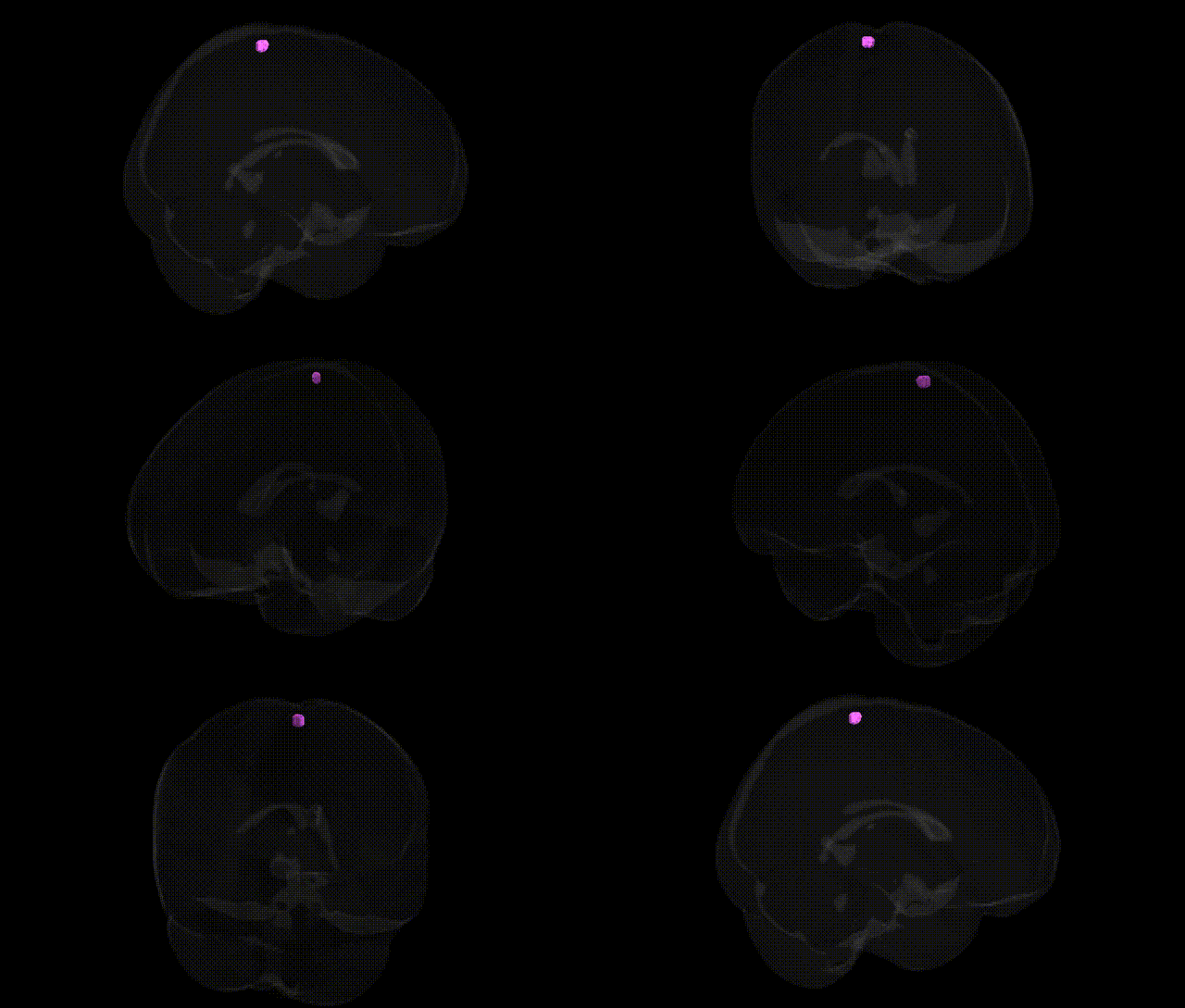
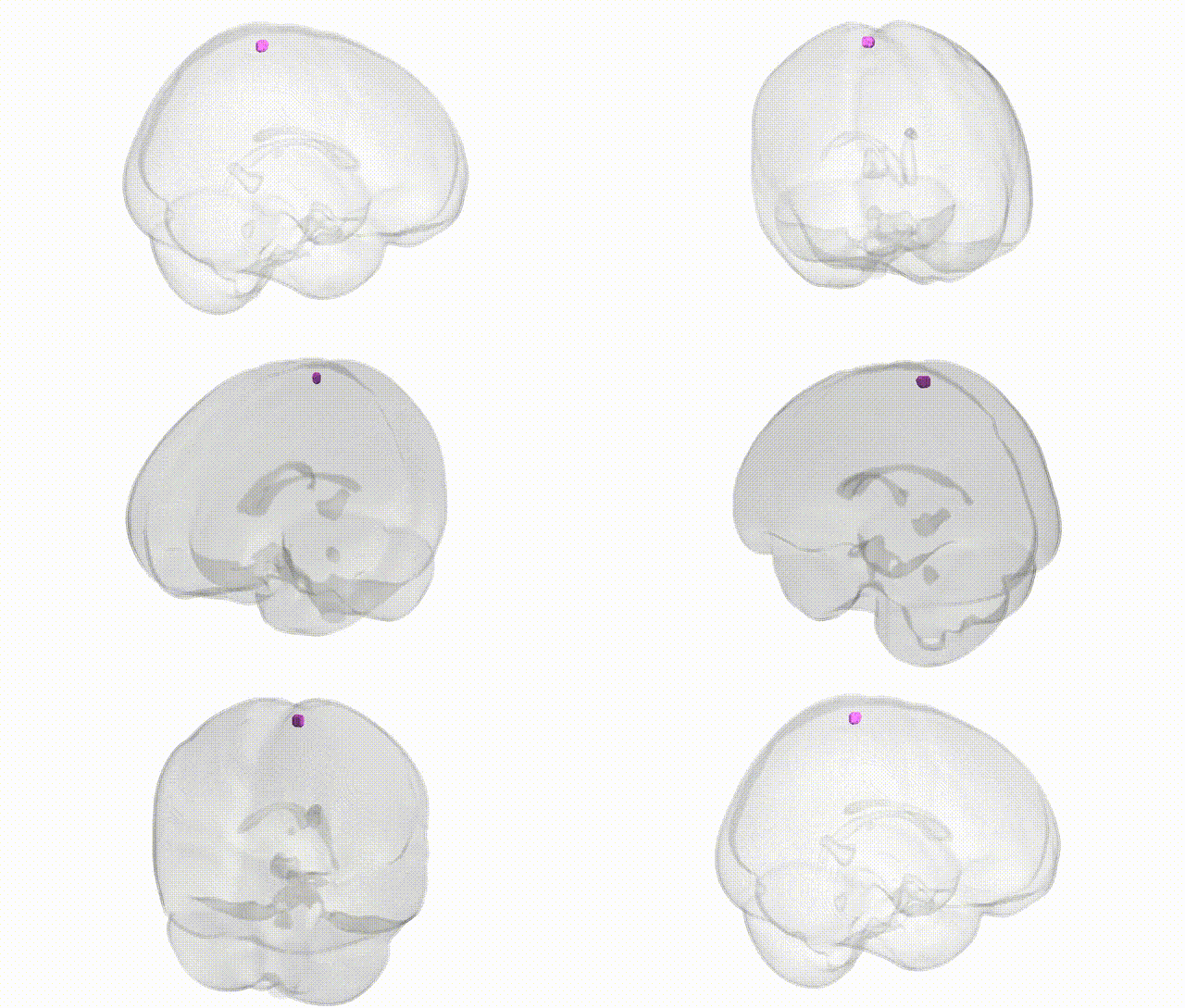
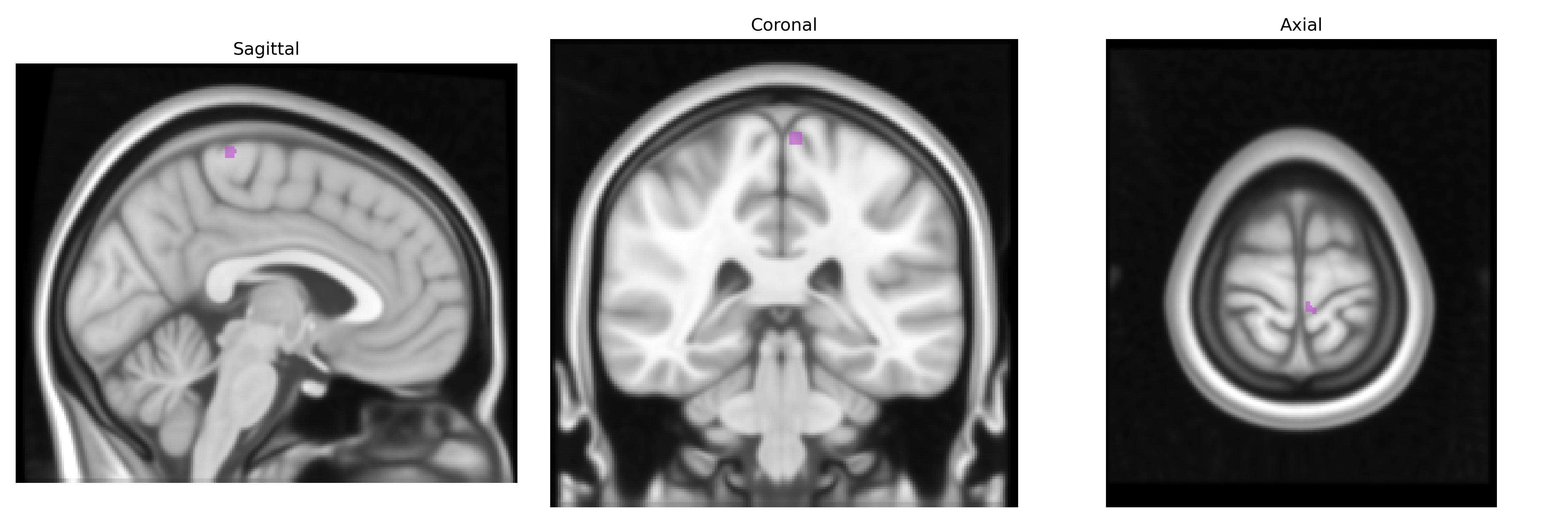
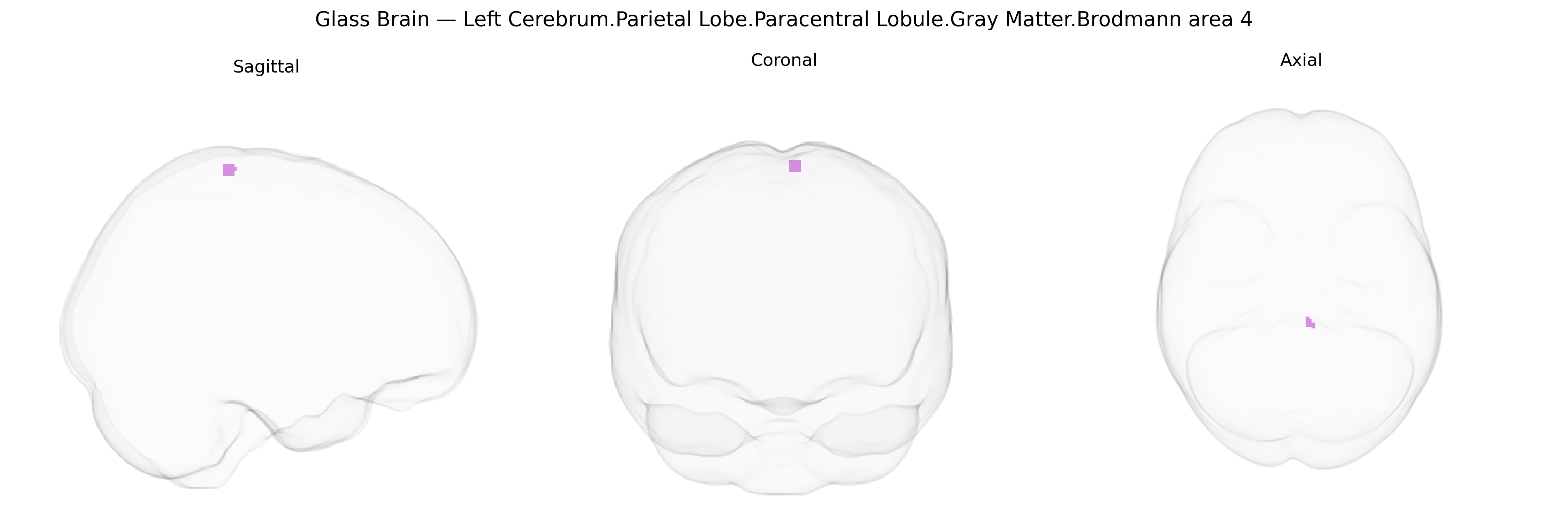
The bilateral Left Cerebrum.Parietal Lobe.Paracentral Lobule.Gray Matter.Brodmann area 4 corresponds to primary motor cortex (M1) located along the medial extension of the precentral gyrus into the paracentral lobule, near the boundary of the frontal and parietal lobes on the medial surface of the hemisphere. In the Talairach 1 mm atlas, this region encompasses agranular cortical gray matter specialized for the execution of voluntary motor commands, particularly involving lower limb and pelvic musculature represented in the medial motor homunculus. Neurons in this area give rise to a substantial portion of the corticospinal (pyramidal) tract, exhibit somatotopic organization, and are critical for fine control of contralateral movement, muscle tone regulation, and reflex modulation. There is no direct Wikipedia article for this exact composite label; a closely related structure is the primary motor cortex: Primary motor cortex.
The paracentral lobule (BA4) in the left parietal lobe, encompassing primary motor cortex for lower limbs and aspects of sensorimotor integration, has been implicated in genetic studies largely through imaging genetics and GWAS of brain structure and function rather than region-specific single-gene associations. Variants in genes involved in synaptic function, neurodevelopment, and myelination—such as BDNF (e.g., Val66Met), COMT, and several glutamatergic and GABAergic pathway genes—have been associated with differences in cortical thickness, gray matter volume, or motor-evoked responses in primary motor areas, sometimes including paracentral lobule regions. Large-scale GWAS using MRI-derived measures of cortical surface area and thickness (e.g., ENIGMA, UK Biobank) have identified multiple loci (including variants near genes like HMGA2, POU3F2, and others involved in neurodevelopment) that influence global and regional motor cortex morphology, though these findings are often reported at the level of broader motor or sensorimotor cortices rather than the precise Talairach BA4 paracentral label. In disorders, polygenic risk for amyotrophic lateral sclerosis, multiple sclerosis, and hereditary spastic paraplegia has been linked to structural and functional changes in the paracentral lobule, consistent with its role in lower-limb motor control, while schizophrenia, bipolar disorder, and major depression GWAS signals—spread across many neurodevelopmental and synaptic genes—have been associated with motor and sensorimotor cortical alterations that may encompass this region. Additionally, GWAS of motor performance, gait, and physical activity traits show enrichment in neurodevelopmental and motor pathway genes whose imaging-correlates frequently involve primary motor cortex, including paracentral lobule, but current evidence remains largely indirect, with genetic effects mapped to broader motor networks rather than uniquely or specifically to the bilateral left BA4 paracentral lobule gray matter defined by the Talairach 1 mm atlas.
Overview generated by GPT-4o (2026).
Region ID: 1104
Hemisphere: bilateral
Atlas: Talairach labels 1mm
Full Quality Version: Download MP4
Full Quality Version: Download MP4
Wali Sidiqyar*, Gaurav Rudravaram*, Elyssa M. McMaster, Trent M. Schwartz, Adam M. Saunders, Kurt G. Schilling, Bennett A. Landman "Introducing SPINS: A Shared Public Visualization Library of Neuroanatomical Structures." Medical Imaging with Deep Learning- short paper
This resource is licensed under CC0 1.0 Universal (Public Domain).