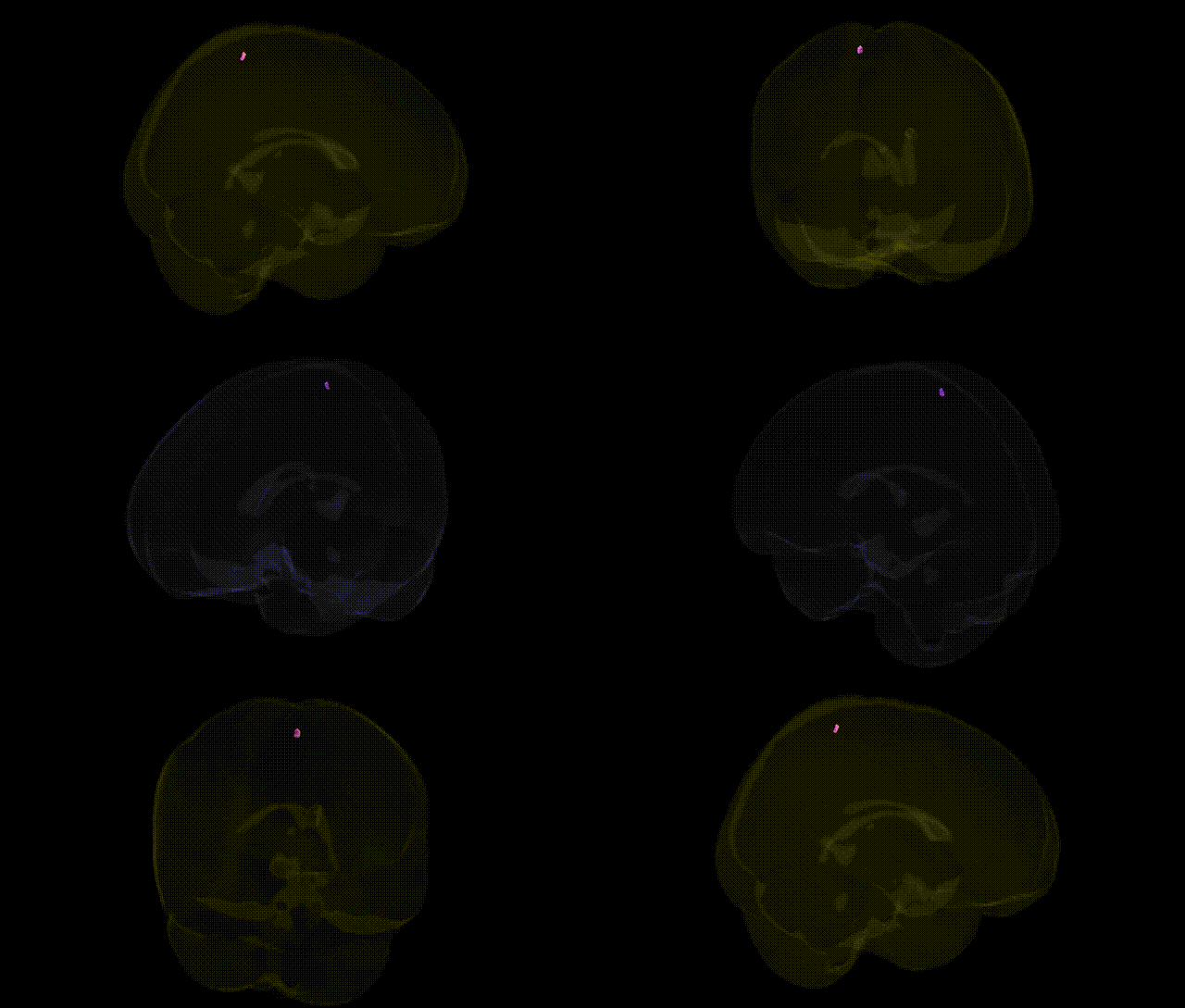
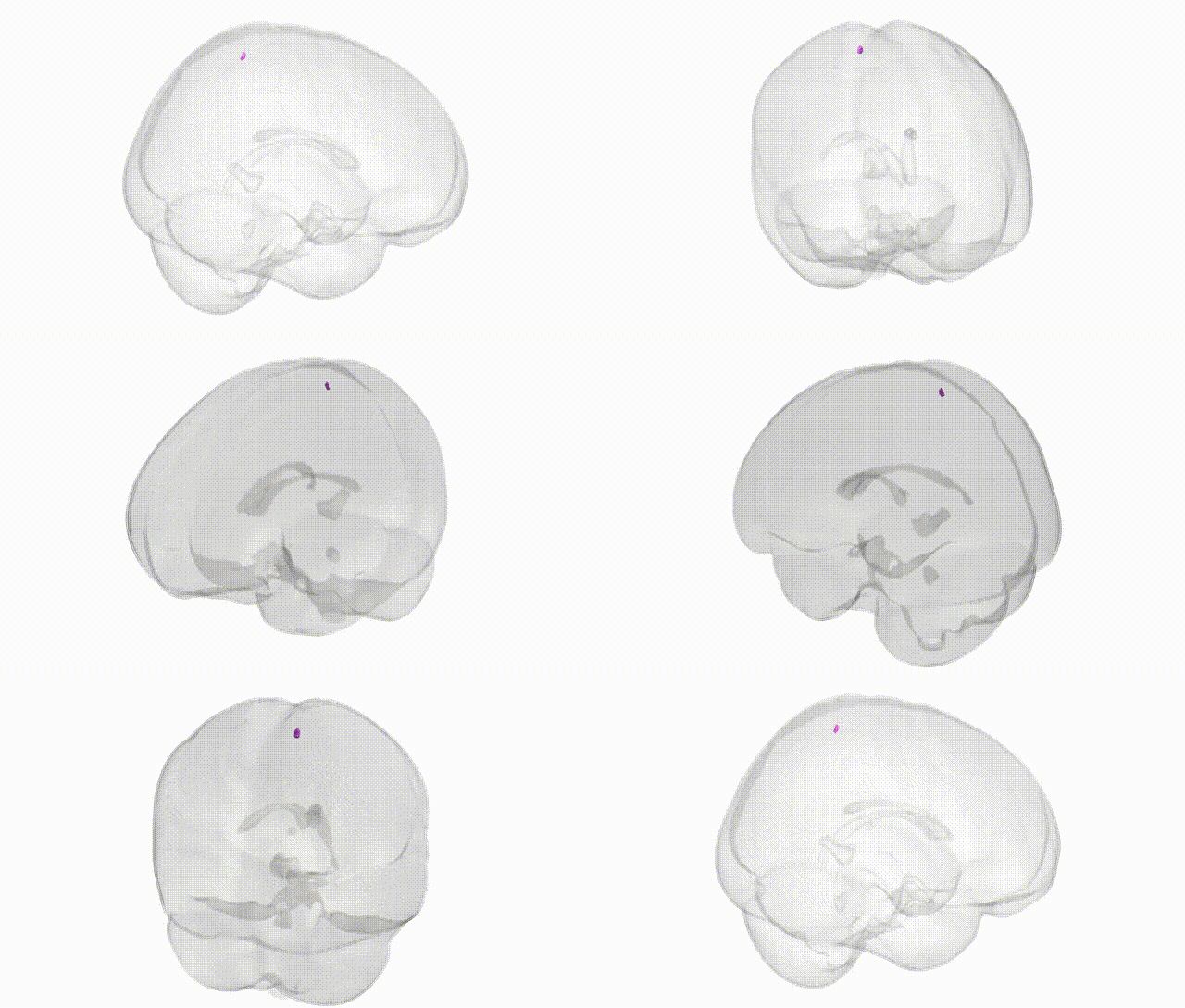
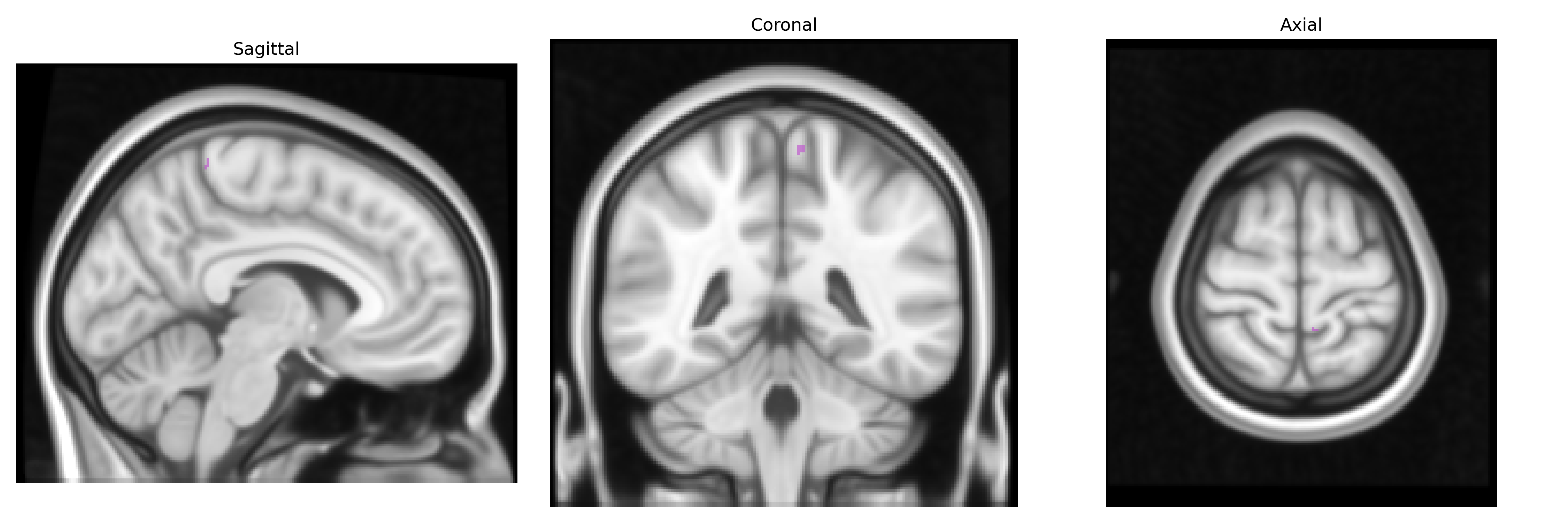
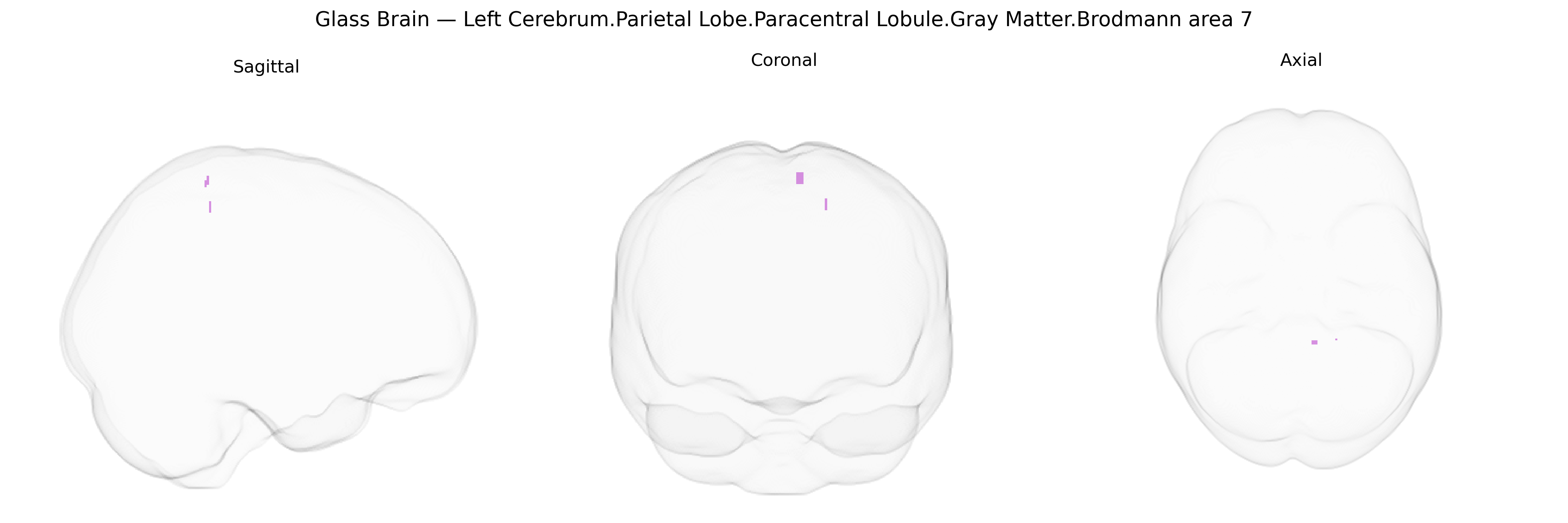
The bilateral Left Cerebrum.Parietal Lobe.Paracentral Lobule.Gray Matter.Brodmann area 7 corresponds to a dorsal parietal association region located near the medial portion of the superior parietal lobule, extending into the paracentral lobule and bordering sensorimotor territories around the medial central sulcus. Cytoarchitectonically defined as part of Brodmann area 7, this region participates in higher-order visuospatial processing, integration of somatosensory input with visual information, and coordination of goal-directed movements, including aspects of sensorimotor transformation for reaching and posture control. It forms part of the posterior parietal cortex and is interconnected with premotor, motor, and visual association areas, supporting spatial attention, body schema representation, and complex motor planning. There is no direct link; a related article is Brodmann area 7.
The bilateral left paracentral lobule within the parietal lobe (Talairach 1 mm, Brodmann area 7–adjacent territory) is part of a broader parietal/motor network whose genetic associations are typically inferred from imaging genetics and GWAS of brain structure and function rather than from region-specific analyses of BA7 alone. Large-scale MRI–GWAS studies (e.g., ENIGMA, UK Biobank) have identified multiple loci influencing cortical thickness and surface area in parietal regions proximal to the paracentral lobule, with robust signals in and near genes such as HMGA2, IGF1, CENPW, and KIAA0586, implicated in general brain and body growth, neuronal development, and cortical patterning. Variants in genes affecting sensorimotor and somatosensory processing—such as those involved in glutamatergic and GABAergic signaling—have been associated with functional activation patterns in superior and posterior parietal cortex in tasks involving attention, visuospatial integration, and motor control, indirectly implicating the paracentral territory. In neuropsychiatric GWAS, polygenic risk for schizophrenia, ADHD, autism spectrum disorder, and major depressive disorder shows consistent associations with altered parietal and paracentral gray matter volume and connectivity, suggesting that widely distributed risk alleles (e.g., in CACNA1C, GRIN2A, DRD2, among others) contribute to structural and functional variation in this region as part of large-scale networks rather than acting specifically on BA7. Similarly, GWAS of cognitive traits such as general intelligence, working memory, and educational attainment have linked parietal cortical morphology and activation—including regions near the paracentral lobule—to polygenic profiles involving neurodevelopmental and synaptic genes, but no single gene–region association uniquely targets the bilateral left paracentral lobule gray matter. Overall, genetic findings support a polygenic, network-level influence on this parietal/motor area, with associations emerging through distributed effects on cortical development, cognition, and neuropsychiatric vulnerability rather than through region-specific GWAS signals.
Overview generated by GPT-4o (2026).
Region ID: 1065
Hemisphere: bilateral
Atlas: Talairach labels 1mm
Full Quality Version: Download MP4
Full Quality Version: Download MP4
Wali Sidiqyar*, Gaurav Rudravaram*, Elyssa M. McMaster, Trent M. Schwartz, Adam M. Saunders, Kurt G. Schilling, Bennett A. Landman "Introducing SPINS: A Shared Public Visualization Library of Neuroanatomical Structures." Medical Imaging with Deep Learning- short paper
This resource is licensed under CC0 1.0 Universal (Public Domain).