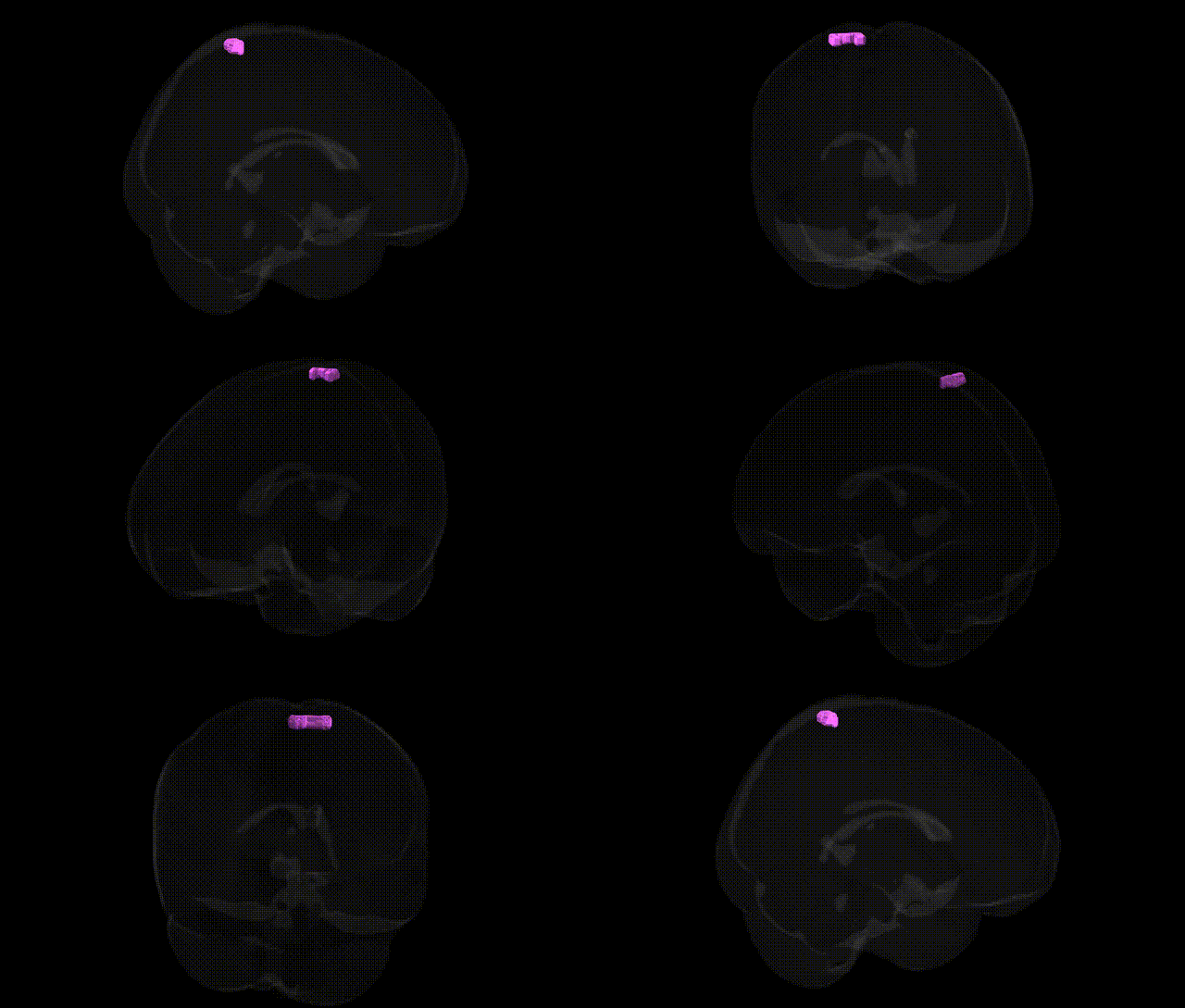
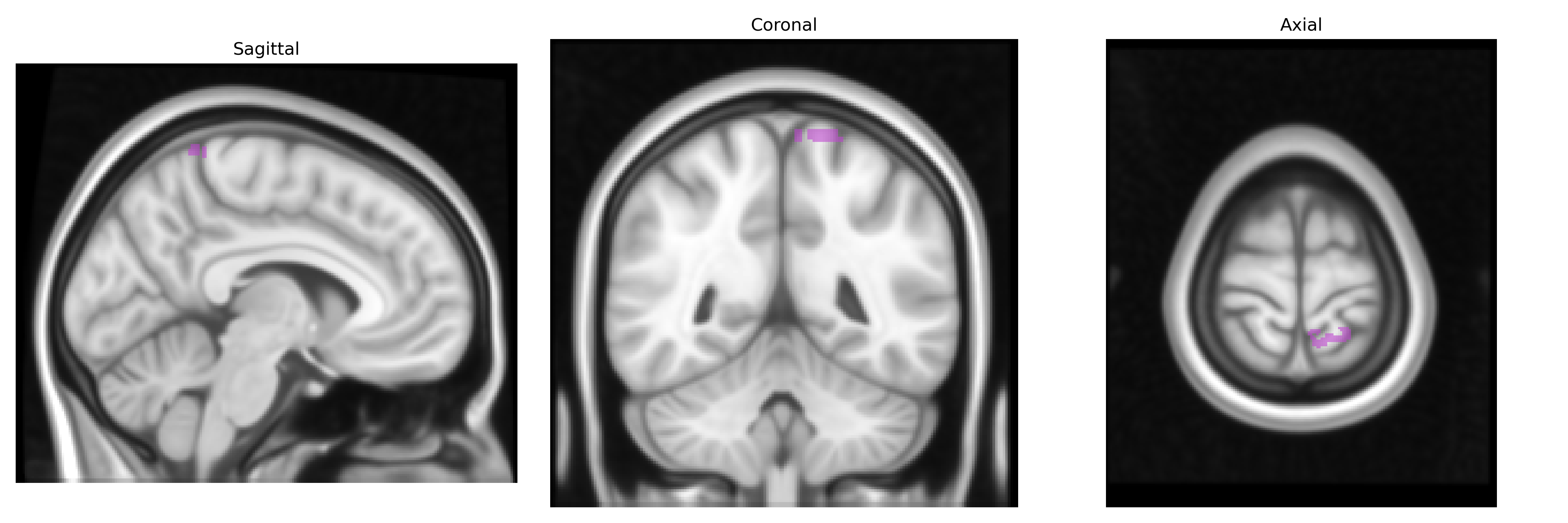
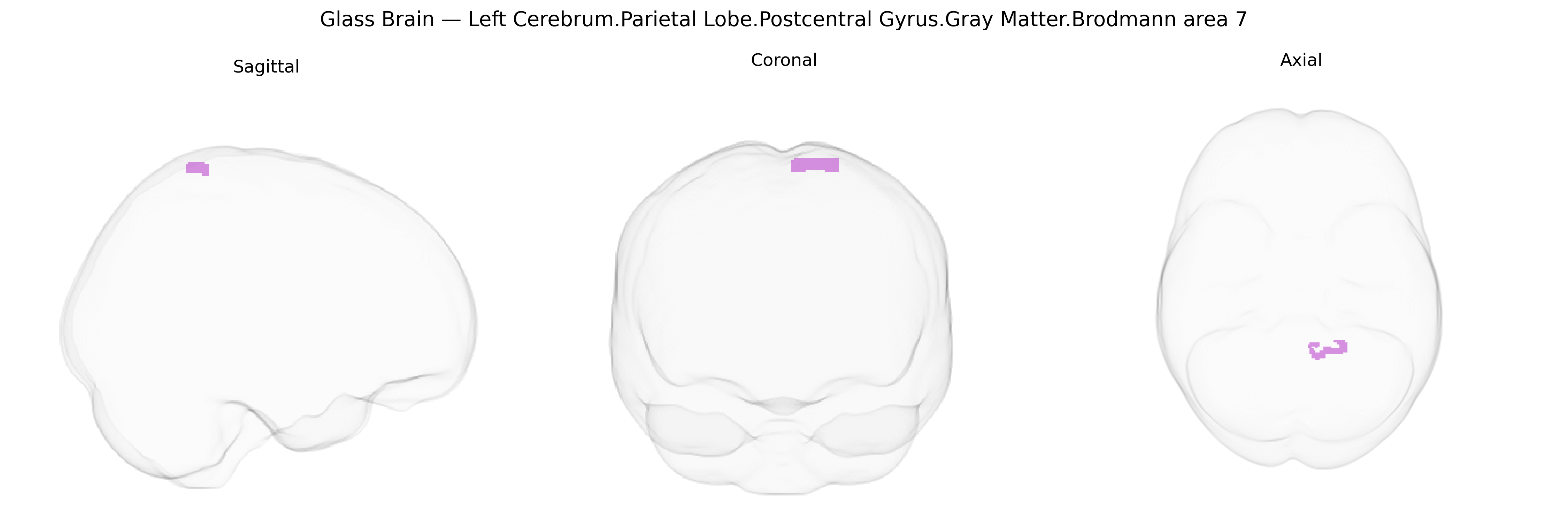
The bilateral Left Cerebrum.Parietal Lobe.Postcentral Gyrus.Gray Matter.Brodmann area 7 corresponds primarily to the superior parietal lobule and adjacent portions of the postcentral gyrus, a higher-order somatosensory association cortex located posterior to primary somatosensory cortex (Brodmann areas 3, 1, and 2). This region integrates multimodal sensory input, including tactile, proprioceptive, and visual information, to support spatial perception, visuomotor coordination, and body schema representation. Neurons in Brodmann area 7 contribute to functions such as reaching and grasping, spatial attention, and the transformation of sensory coordinates into motor commands, playing a key role in sensorimotor integration and the guidance of goal-directed movements. There is no direct link for this exact Talairach label; a closely related structure is Brodmann area 7.
The bilateral Left Cerebrum Parietal Lobe Postcentral Gyrus gray matter corresponding to Brodmann area 7 is part of the superior parietal cortex, a multimodal association region implicated in visuospatial processing, attention, sensorimotor integration, and aspects of body awareness, and has been repeatedly highlighted in imaging genetics and GWAS of brain structure and function. Large-scale neuroimaging GWAS (e.g., ENIGMA, UK Biobank) have identified common variants near genes such as KIAA0319, DCDC2, ROBO1, and other neurodevelopmental loci associated with parietal cortical thickness, surface area, and gyrification, although these findings typically map to broader parietal or superior parietal regions rather than BA7 voxels specifically. Genetic variants in dopaminergic (DRD2, COMT) and glutamatergic (GRIN2B) pathways have been linked to individual differences in parietal activation during working memory and attentional tasks, supporting a role for neurotransmission-related genes in BA7 functional variation. In clinical genetics, postcentral/superior parietal regions including BA7 show structural or functional alterations associated with polygenic risk for schizophrenia, bipolar disorder, major depressive disorder, autism spectrum disorder, ADHD, and dyslexia, as well as with GWAS-identified risk loci for Alzheimer’s disease and frontotemporal dementia, although the associations are generally at the level of distributed networks rather than region-specific causation. GWAS of cognitive and behavioral traits—such as general intelligence, educational attainment, and visuospatial abilities—have linked polygenic scores to parietal cortical metrics, suggesting that many cognition-related loci exert part of their effect via development and maintenance of superior parietal areas, including BA7. Overall, genetic associations to this Talairach-defined BA7 region are indirect and coarse-grained, emerging from polygenic influences on parietal morphometry and network function rather than from single, region-exclusive variants.
Overview generated by GPT-4o (2026).
Region ID: 1101
Hemisphere: bilateral
Atlas: Talairach labels 1mm
Full Quality Version: Download MP4
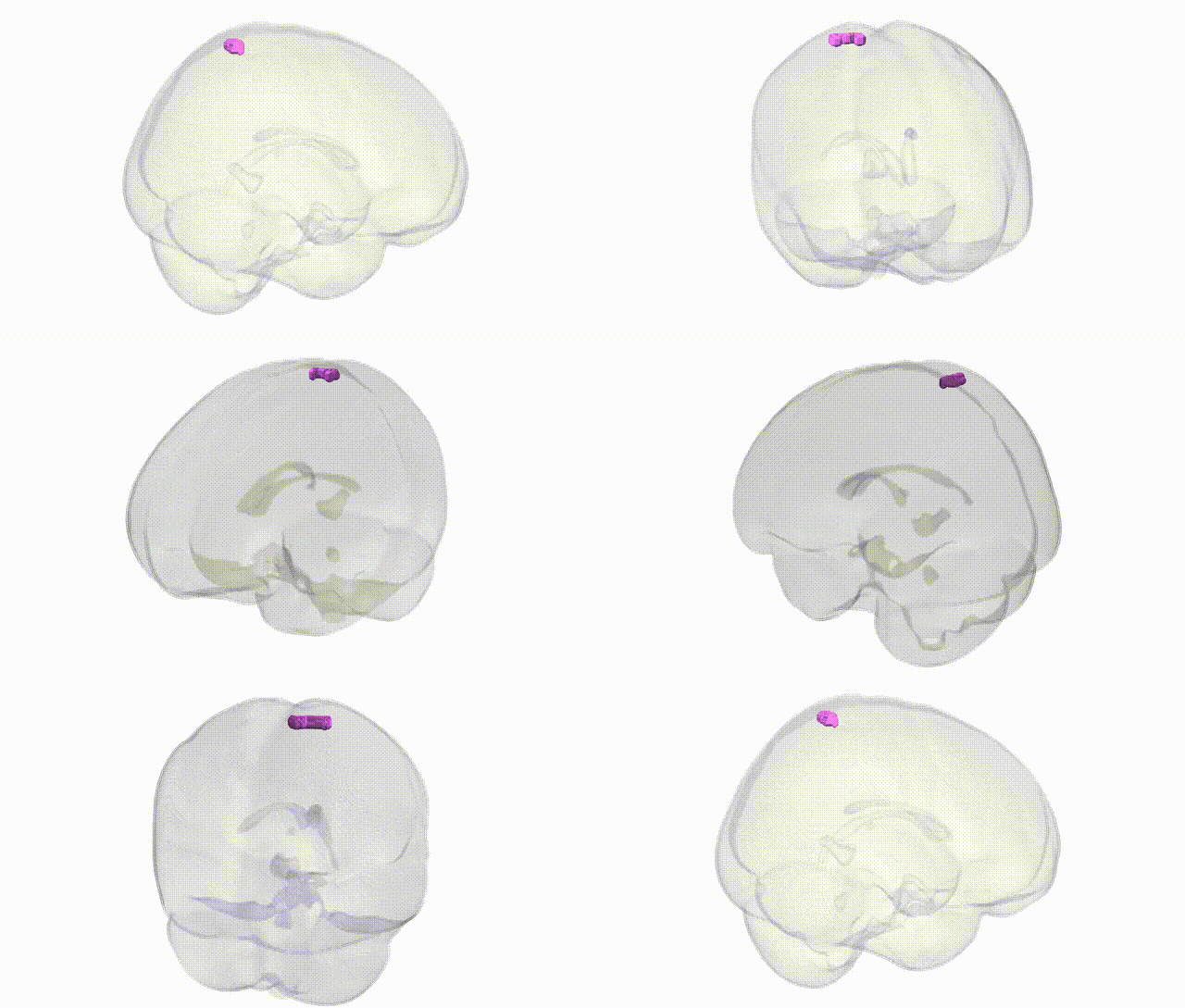
Full Quality Version: Download MP4
Wali Sidiqyar*, Gaurav Rudravaram*, Elyssa M. McMaster, Trent M. Schwartz, Adam M. Saunders, Kurt G. Schilling, Bennett A. Landman "Introducing SPINS: A Shared Public Visualization Library of Neuroanatomical Structures." Medical Imaging with Deep Learning- short paper
This resource is licensed under CC0 1.0 Universal (Public Domain).