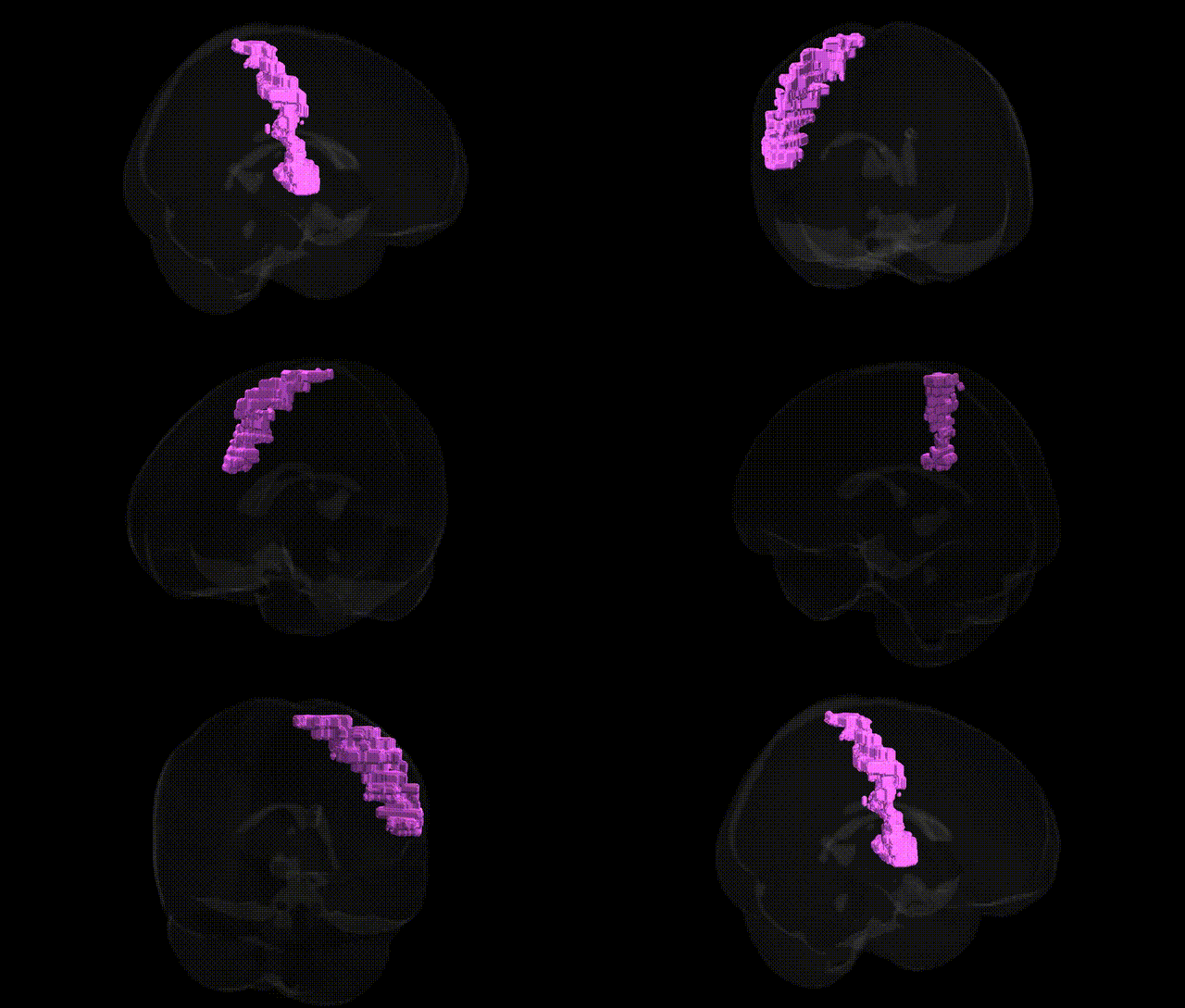
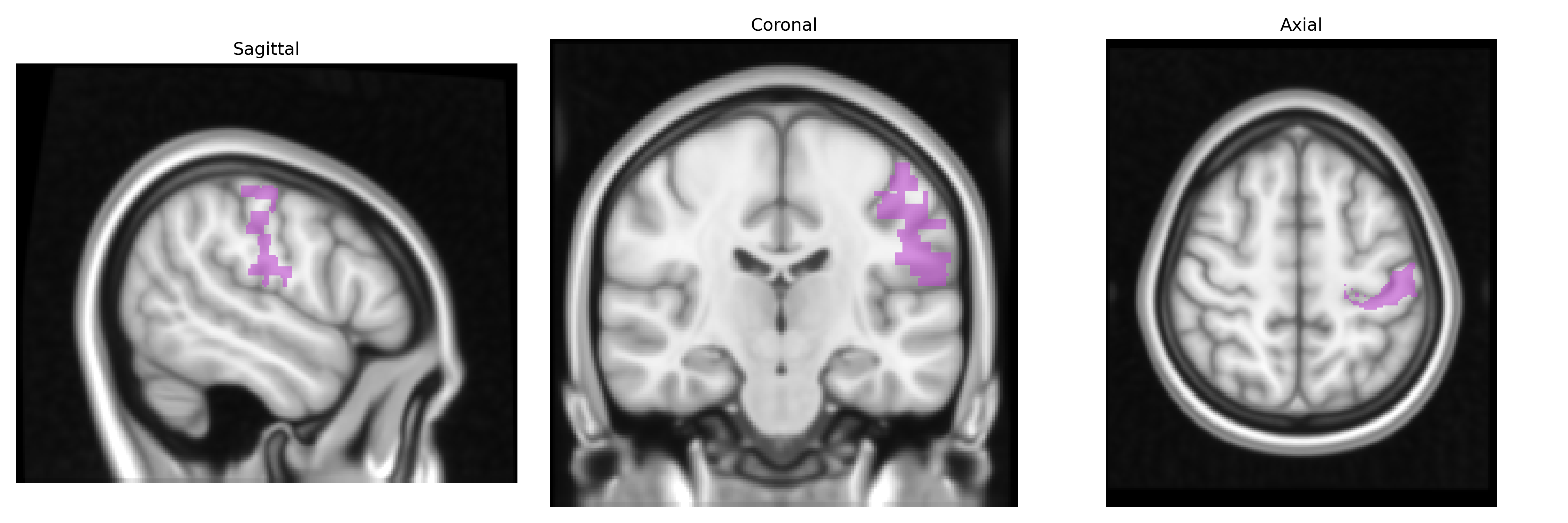
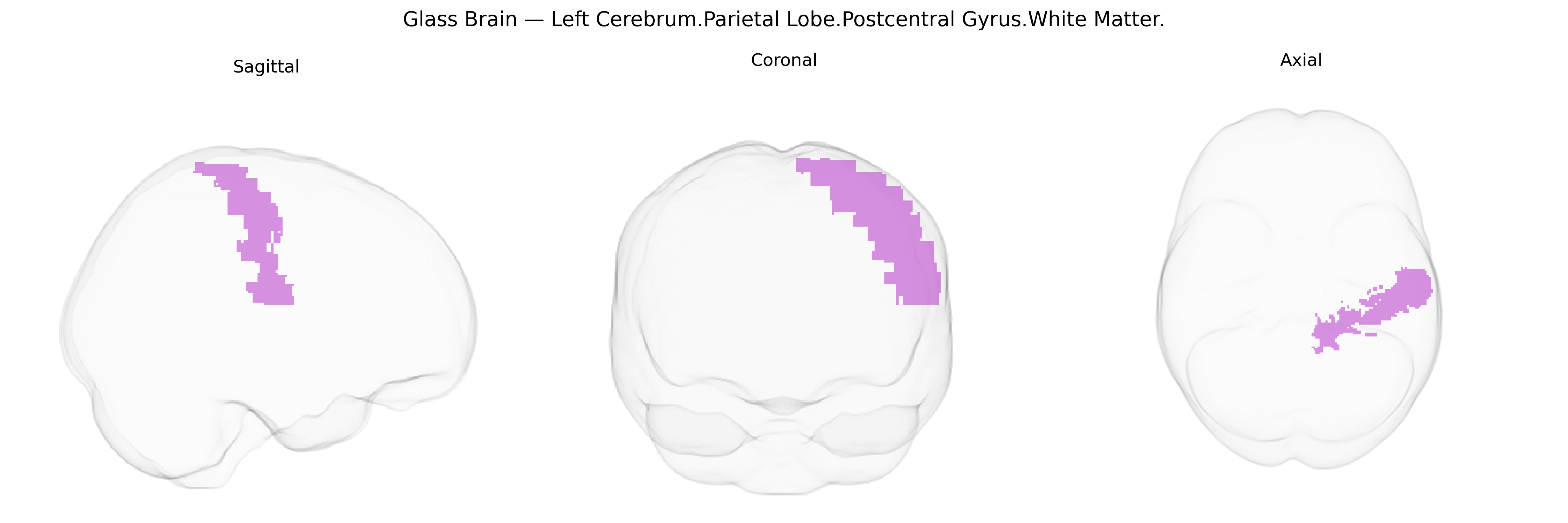
The bilateral Left Cerebrum.Parietal Lobe.Postcentral Gyrus.White Matter corresponds to the subcortical myelinated fiber tracts underlying the postcentral gyrus of the parietal lobe, which contains the primary somatosensory cortex (Brodmann areas 3, 1, and 2). These white matter pathways carry afferent somatosensory information—such as touch, proprioception, vibration, and temperature—from thalamic relay nuclei and other subcortical structures to the cortical somatosensory fields, and also mediate short- and long-range cortico-cortical communication with adjacent parietal, frontal, and multimodal association areas. Functionally, this region is critical for the rapid transmission and integration of somatic sensory signals necessary for body schema, tactile discrimination, and sensorimotor coordination, forming part of the dorsal stream pathways that support spatial perception and guided action. Postcentral gyrus
The bilateral left Parietal Lobe Postcentral Gyrus white matter—corresponding primarily to primary somatosensory pathways—has been implicated indirectly by numerous imaging‑genetics and GWAS-based neuroimaging studies rather than by region-specific GWAS focused solely on this Talairach-defined area. Large consortia such as ENIGMA and UK Biobank have identified common variants in genes involved in axonal growth, myelination, and neurodevelopment (for example, variants near or in genes such as NRG1, MAG, CNTNAP2, and microtubule- or oligodendrocyte-related genes) that associate with white matter microstructure (e.g., fractional anisotropy and mean diffusivity) in parietal and sensorimotor tracts encompassing postcentral gyrus white matter. Polygenic risk scores for schizophrenia, bipolar disorder, major depressive disorder, autism spectrum disorder, and ADHD have been associated with altered parietal and somatosensory white matter integrity, while risk loci for neurodevelopmental disorders (e.g., 16p11.2 CNVs, FOXP1/FOXP2 pathway genes) and epilepsy show convergent effects on sensorimotor/parietal connectivity. GWAS of pain sensitivity, tactile perception, and motor function, though rarely mapping uniquely to postcentral gyrus white matter, frequently highlight genes involved in synaptic plasticity and neuroinflammation (such as BDNF, GRIN family genes, and HLA-region variants) that modulate structural and functional measures in somatosensory networks. Collectively, current genetic evidence links this region’s white matter to polygenic architectures influencing neurodevelopment, myelination, psychiatric and neurodevelopmental disorder risk, and individual variability in somatosensory and motor-related traits, but precise locus-to-region specificity for the Talairach “Left Cerebrum.Parietal Lobe.Postcentral Gyrus.White Matter” label remains largely inferred from broader parietal/sensorimotor white matter findings rather than from region-exclusive GWAS hits.
Overview generated by GPT-4o (2026).
Region ID: 784
Hemisphere: bilateral
Atlas: Talairach labels 1mm
Full Quality Version: Download MP4
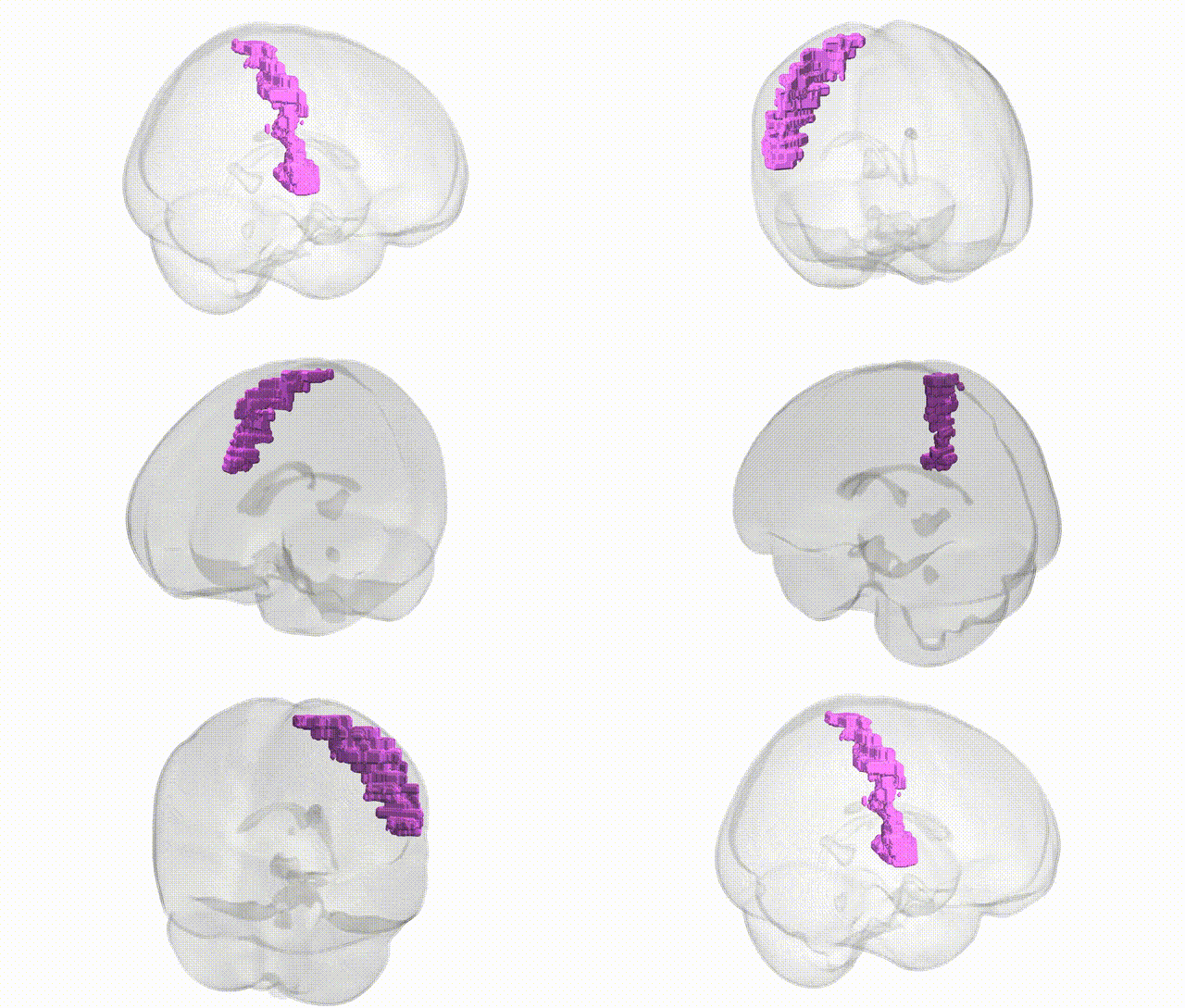
Full Quality Version: Download MP4
Wali Sidiqyar*, Gaurav Rudravaram*, Elyssa M. McMaster, Trent M. Schwartz, Adam M. Saunders, Kurt G. Schilling, Bennett A. Landman "Introducing SPINS: A Shared Public Visualization Library of Neuroanatomical Structures." Medical Imaging with Deep Learning- short paper
This resource is licensed under CC0 1.0 Universal (Public Domain).