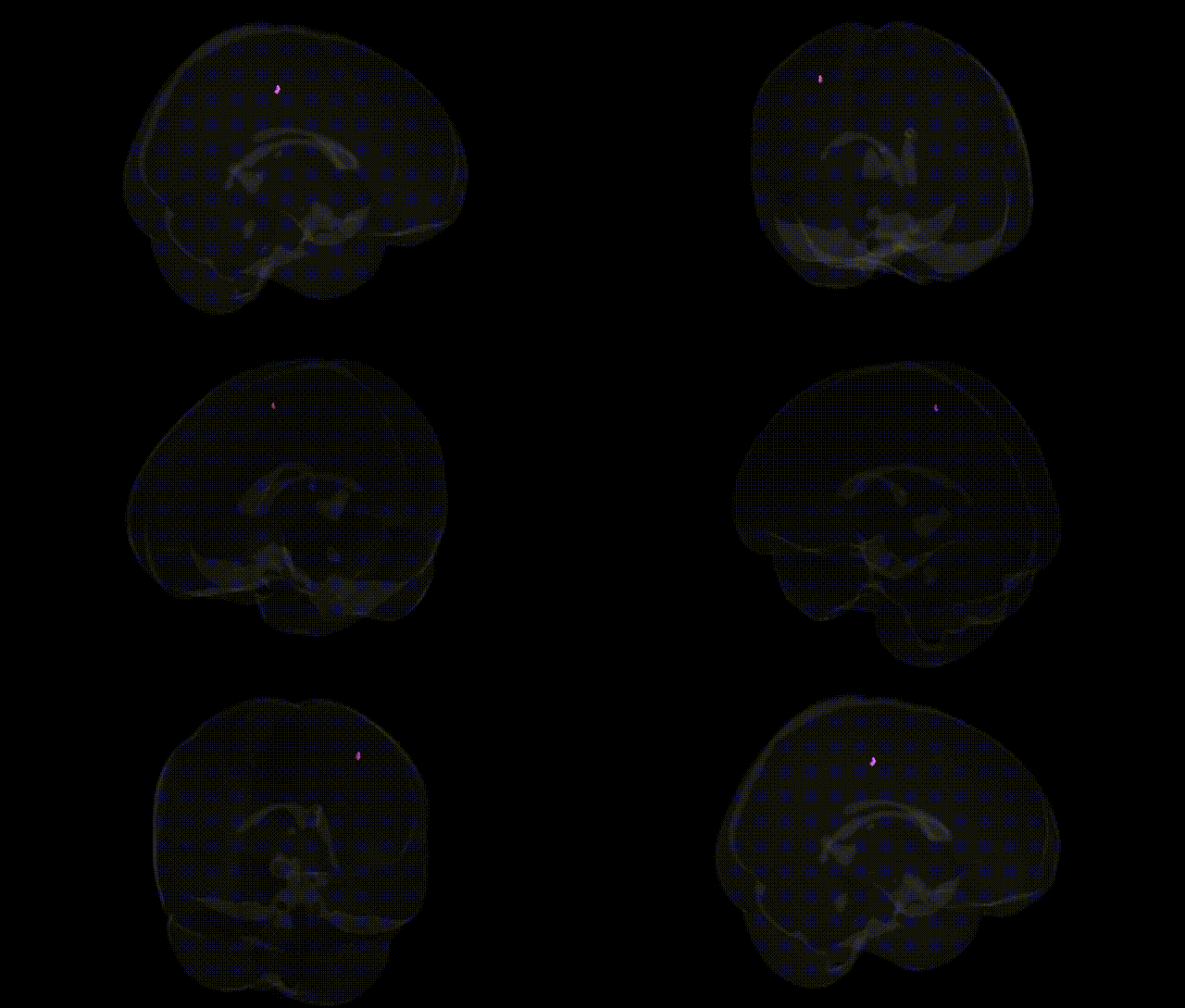
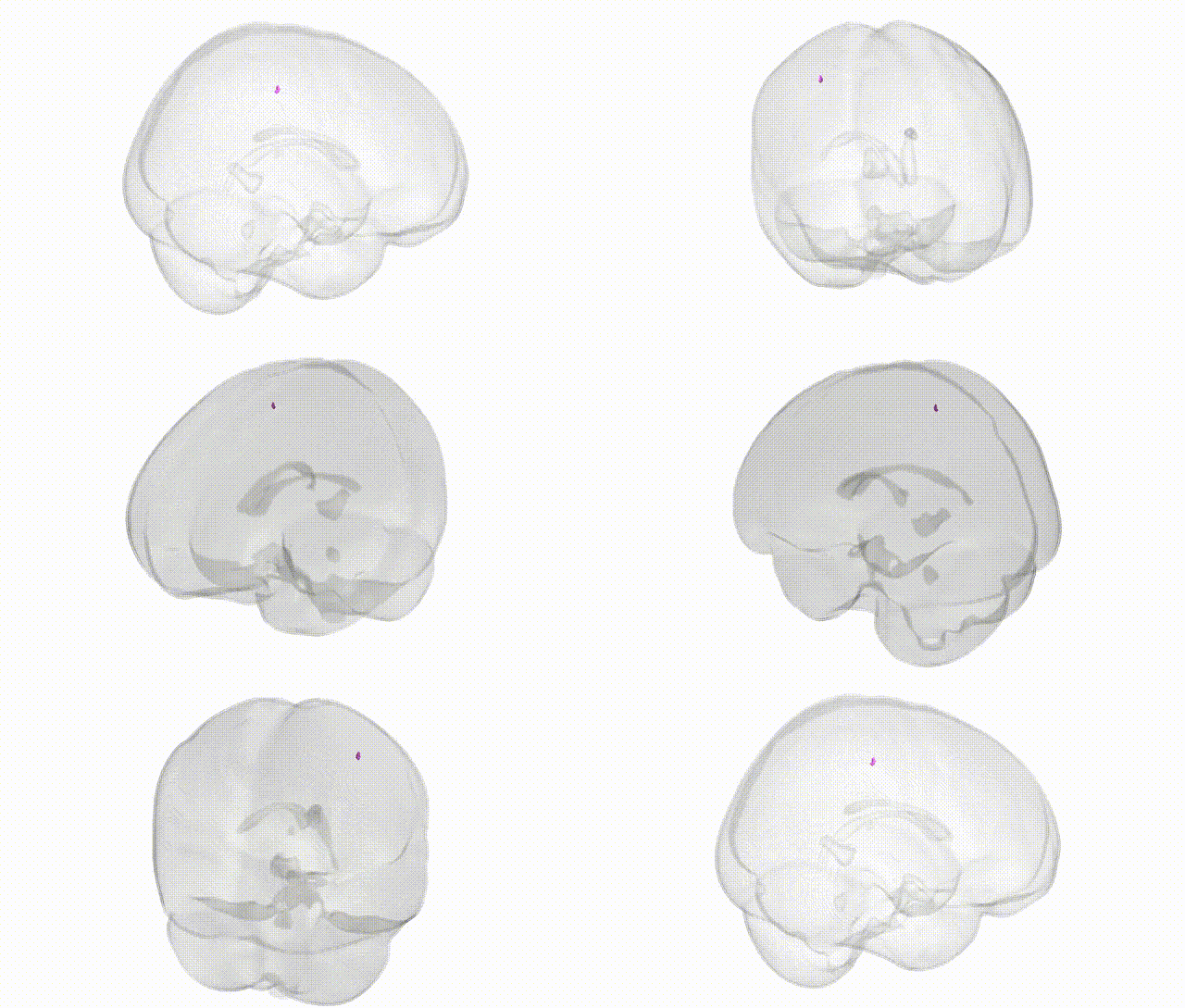
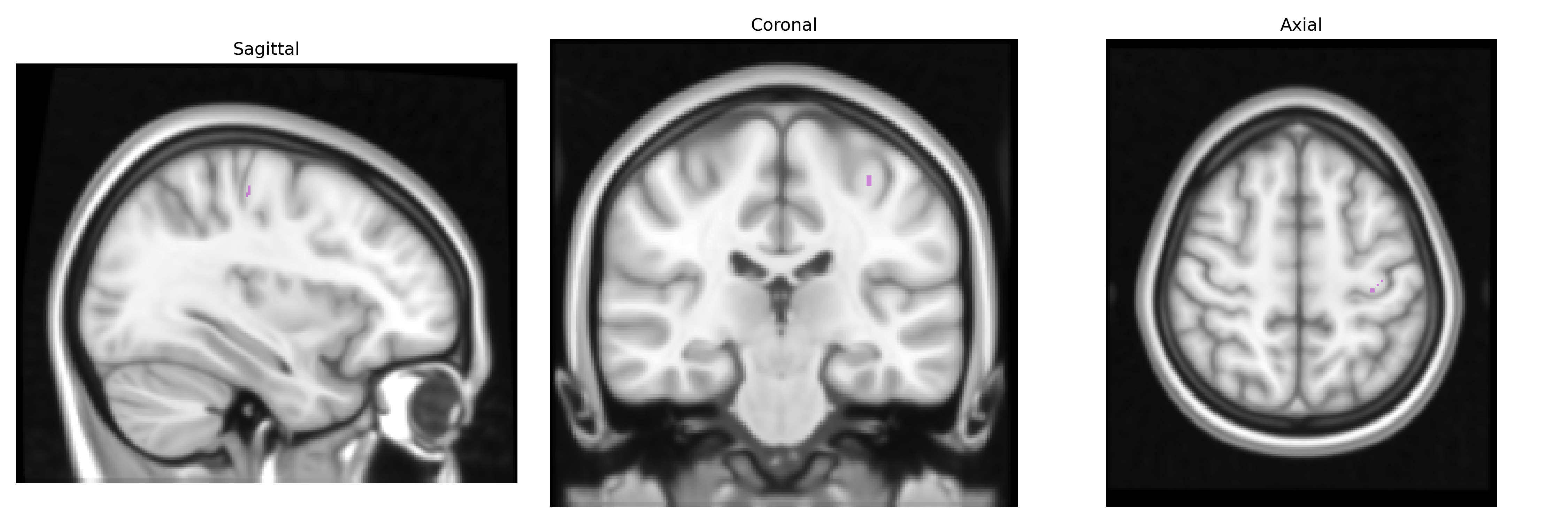
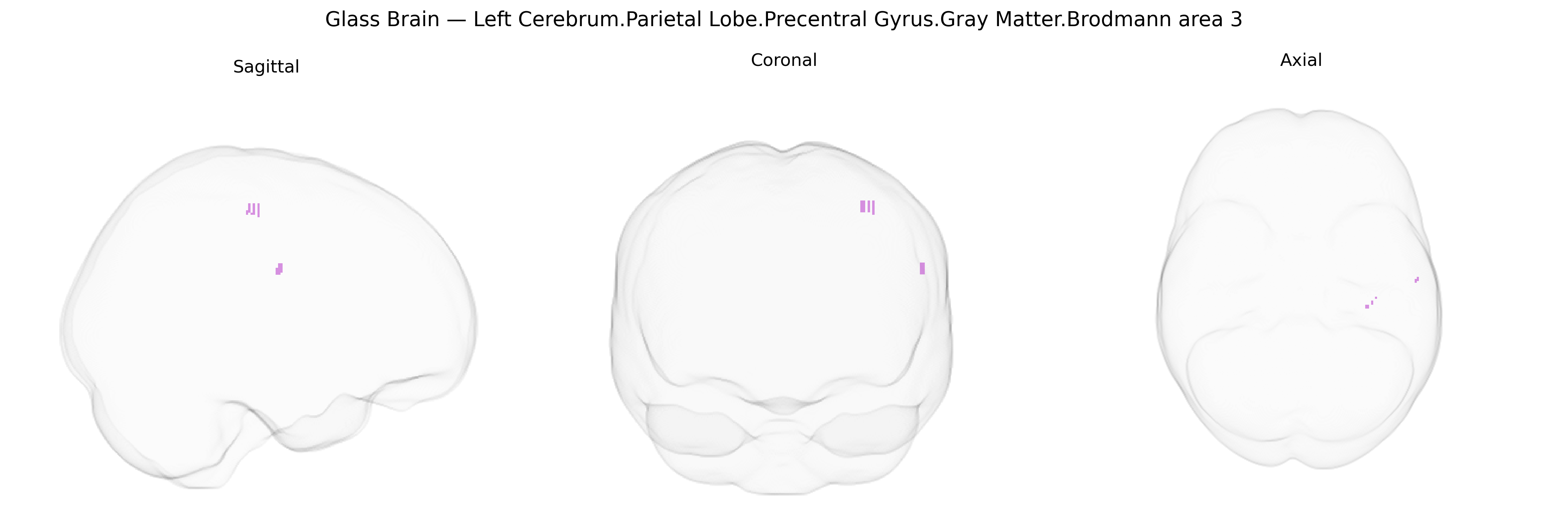
The bilateral Left Cerebrum.Parietal Lobe.Precentral Gyrus.Gray Matter.Brodmann area 3, as defined in the Talairach 1 mm atlas, corresponds primarily to the primary somatosensory cortex (S1), specifically the granular cortical field receiving dense thalamocortical input from the ventral posterior nucleus of the thalamus. It is located along the postcentral region bordering the central sulcus, at the interface of parietal and frontal territories, and is involved in high-resolution processing of tactile, proprioceptive, and nociceptive information from the contralateral body surface, with a somatotopic (homuncular) organization emphasizing the hand and face regions. Neurons in this region exhibit small receptive fields and are critical for fine touch discrimination, stimulus localization, and the early cortical stages of conscious somatic sensation, forming part of a broader sensorimotor network with adjacent Brodmann areas 1, 2, and 4. Primary somatosensory cortex
The bilateral left precentral/postcentral gyrus gray matter corresponding to Brodmann area 3 (primary somatosensory cortex) has been implicated in several genetic and GWAS-based associations, largely via imaging-genetics and disorder-risk studies rather than direct locus-specific mapping. Common variants influencing cortical thickness, surface area, and gyrification in the precentral and adjacent postcentral/parietal regions have been identified by large consortia such as ENIGMA and UK Biobank, with significant contributions from genes involved in neurodevelopment, cortical patterning, and synaptic function (for example, loci near MCPH1, MIR2113, HMGA2, and other neurodevelopmental regulators), though most effects are shared across broader sensorimotor cortices rather than uniquely confined to Brodmann area 3. Polygenic risk for neurodevelopmental and psychiatric conditions—autism spectrum disorder, ADHD, schizophrenia, and major depression—has been associated with altered morphology or activity in primary sensorimotor regions, including parietal-precentral cortex, while rare or high-impact variants in genes affecting neuronal migration and cortical lamination (such as those implicated in polymicrogyria or focal cortical dysplasia) can produce structural abnormalities encompassing BA3 and adjacent areas, sometimes linked to epilepsy or sensorimotor deficits. GWAS of motor and somatosensory phenotypes (e.g., handedness, fine motor skills, pain sensitivity) have also shown distributed polygenic effects that include changes in primary somatosensory and motor cortices, suggesting that genetic architecture influencing sensorimotor function partially converges on the bilateral BA3 region, although current evidence emphasizes broad network-level and global cortical measures rather than region-exclusive genetic determinants.
Overview generated by GPT-4o (2026).
Region ID: 938
Hemisphere: bilateral
Atlas: Talairach labels 1mm
Full Quality Version: Download MP4
Full Quality Version: Download MP4
Wali Sidiqyar*, Gaurav Rudravaram*, Elyssa M. McMaster, Trent M. Schwartz, Adam M. Saunders, Kurt G. Schilling, Bennett A. Landman "Introducing SPINS: A Shared Public Visualization Library of Neuroanatomical Structures." Medical Imaging with Deep Learning- short paper
This resource is licensed under CC0 1.0 Universal (Public Domain).