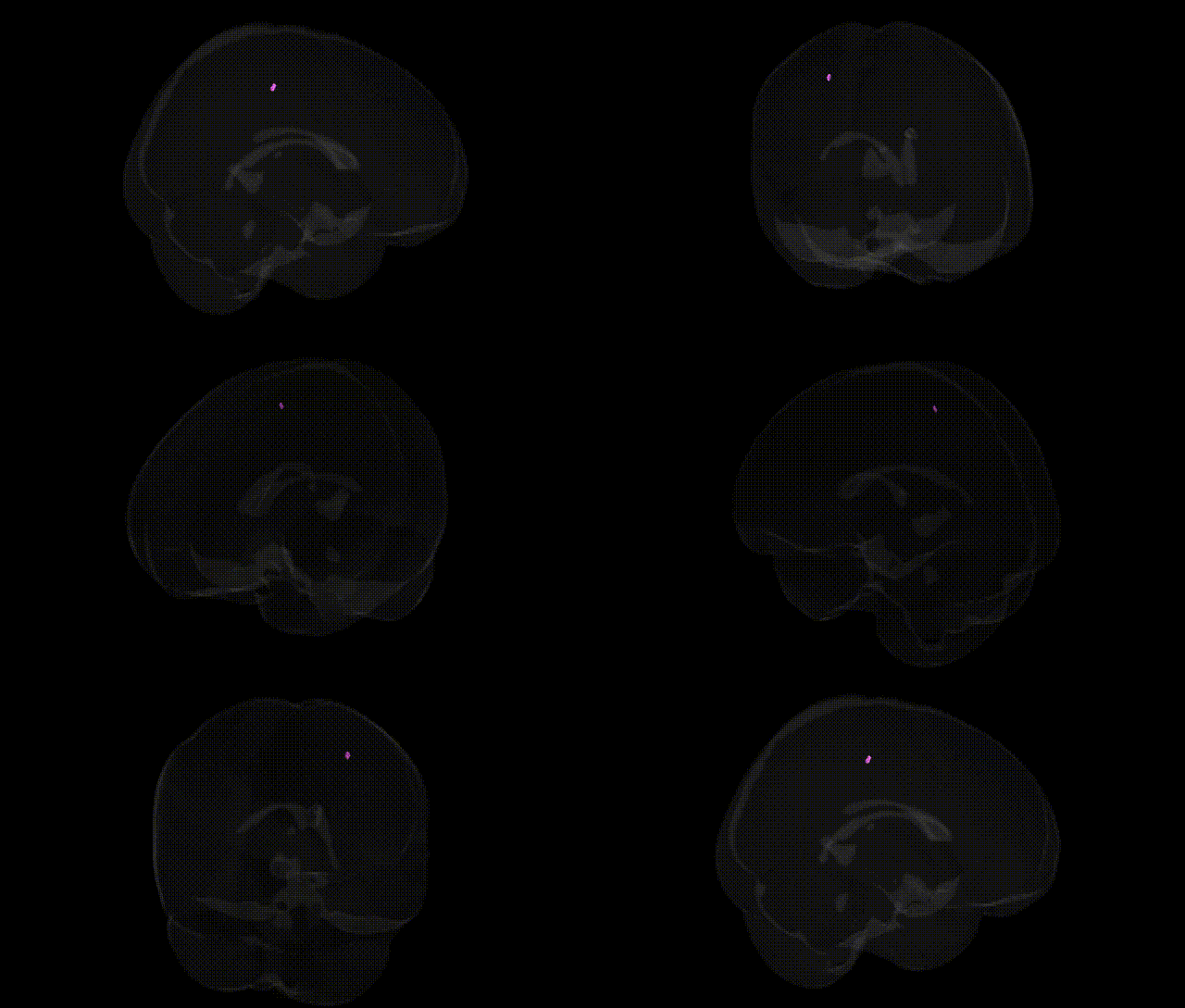
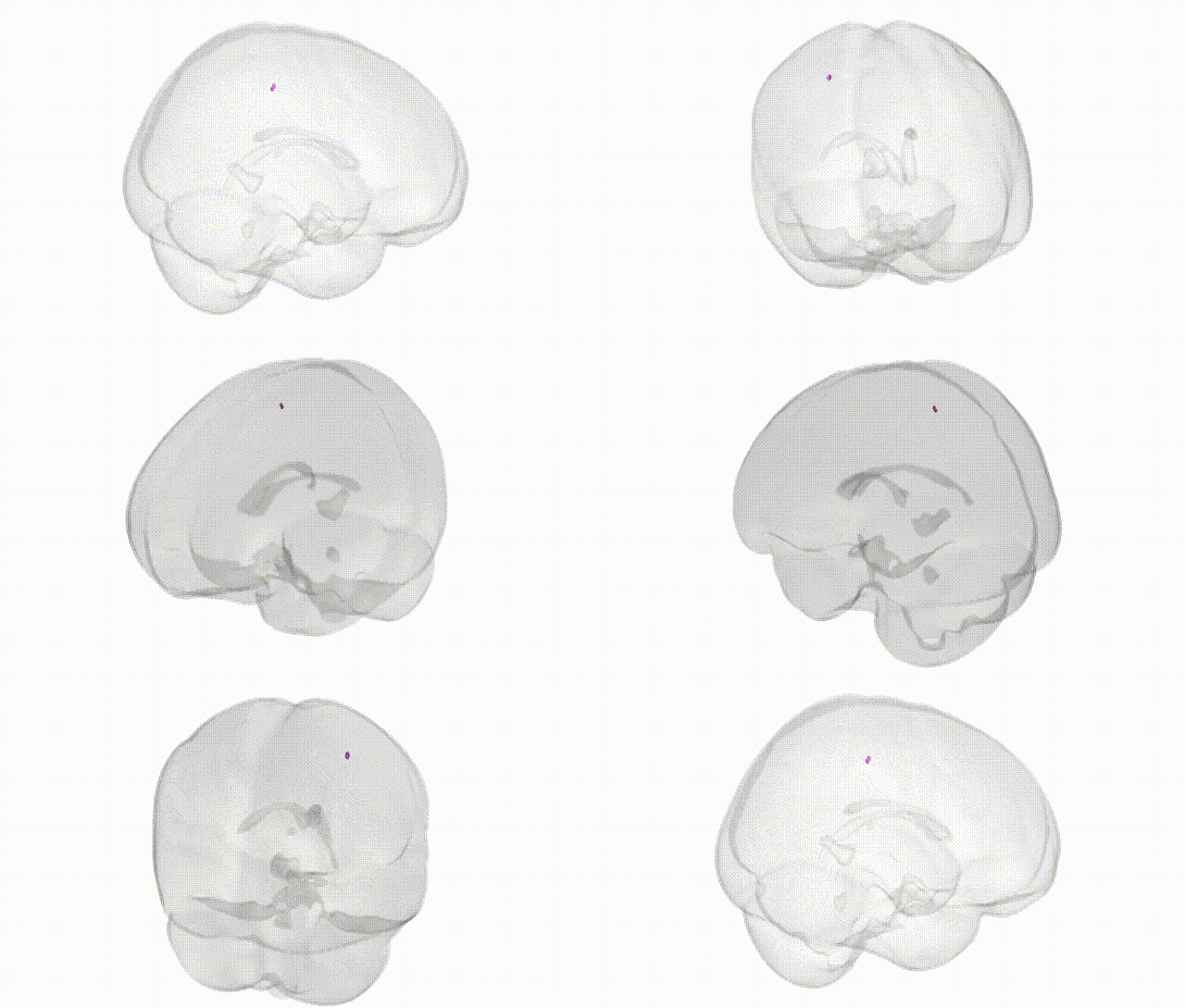
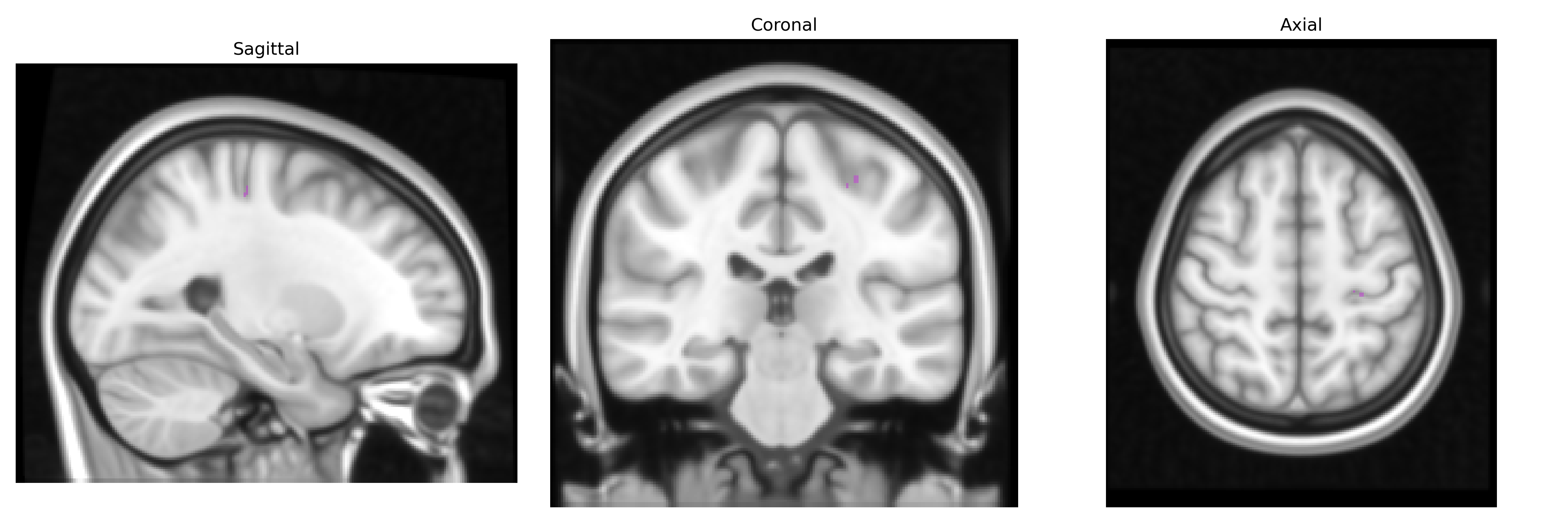
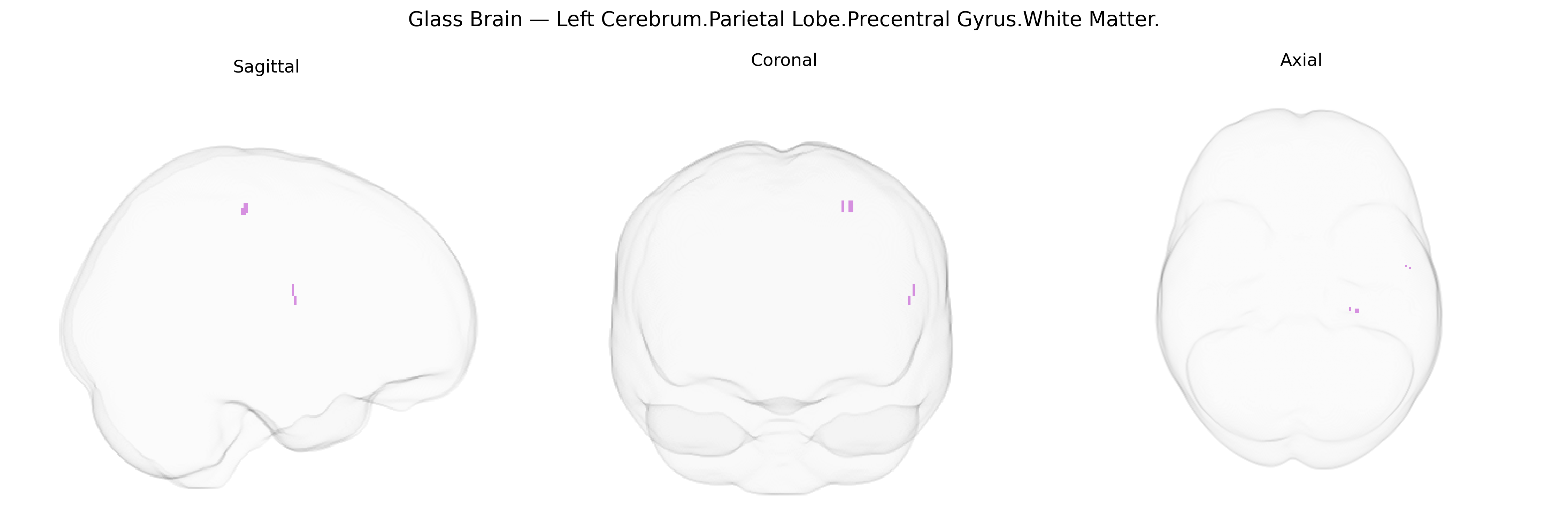
The bilateral Left Cerebrum.Parietal Lobe.Precentral Gyrus.White Matter corresponds to subcortical white matter tracts underlying the precentral gyrus near the parietal–frontal boundary, carrying efferent and afferent fibers that connect primary motor and premotor cortices with other cortical and subcortical regions. These fibers include portions of corticospinal, corticobulbar, and association pathways that are crucial for voluntary motor control, sensorimotor integration, and coordination of complex movements. Damage in this area can lead to motor deficits such as weakness, impaired fine motor skills, or disruption of motor planning, reflecting its role as a conduit between cortical motor areas and downstream motor systems. There is no direct link for this exact atlas label; a related structure is the Precentral gyrus.
The bilateral Left Cerebrum Parietal/Precentral white matter (as defined in the Talairach 1 mm atlas, overlapping premotor–sensorimotor and posterior frontal–parietal pathways) has been implicated in multiple imaging-genetics and GWAS-derived associations, primarily through studies of white matter microstructure (e.g., fractional anisotropy) and structural connectivity rather than region-specific candidate genes. Large consortia such as ENIGMA-DTI and UK Biobank have identified common variants in genes involved in axonal guidance, myelination, and neurodevelopment (for example, NCAN, NTRK3, PLCL1, AKT3, and several loci near oligodendrocyte and neuronal differentiation genes) that influence integrity of corticospinal and superior longitudinal fasciculus fibers traversing precentral and parietal white matter. Polygenic scores for schizophrenia, bipolar disorder, major depression, ADHD, autism spectrum disorder, and epilepsy have been associated with altered white matter in fronto-parietal and motor-related tracts in this region, while risk variants in genes such as CACNA1C, ZNF804A, and others have been linked to reduced integrity in nearby motor and association pathways. GWAS of motor function, reaction time, and general cognitive ability have further shown overlap between loci affecting white matter in precentral/parietal regions and those influencing traits such as processing speed and coordination. Rare monogenic leukodystrophies and hereditary spastic paraplegias (e.g., involving PLP1, SPAST, and ATL1) also prominently affect corticospinal and parietal white matter passing through these Talairach-defined coordinates, supporting a broader genetic architecture in which both common and rare variants converge on white matter development, myelin maintenance, and long-range motor–parietal network integrity.
Overview generated by GPT-4o (2026).
Region ID: 800
Hemisphere: bilateral
Atlas: Talairach labels 1mm
Full Quality Version: Download MP4
Full Quality Version: Download MP4
Wali Sidiqyar*, Gaurav Rudravaram*, Elyssa M. McMaster, Trent M. Schwartz, Adam M. Saunders, Kurt G. Schilling, Bennett A. Landman "Introducing SPINS: A Shared Public Visualization Library of Neuroanatomical Structures." Medical Imaging with Deep Learning- short paper
This resource is licensed under CC0 1.0 Universal (Public Domain).