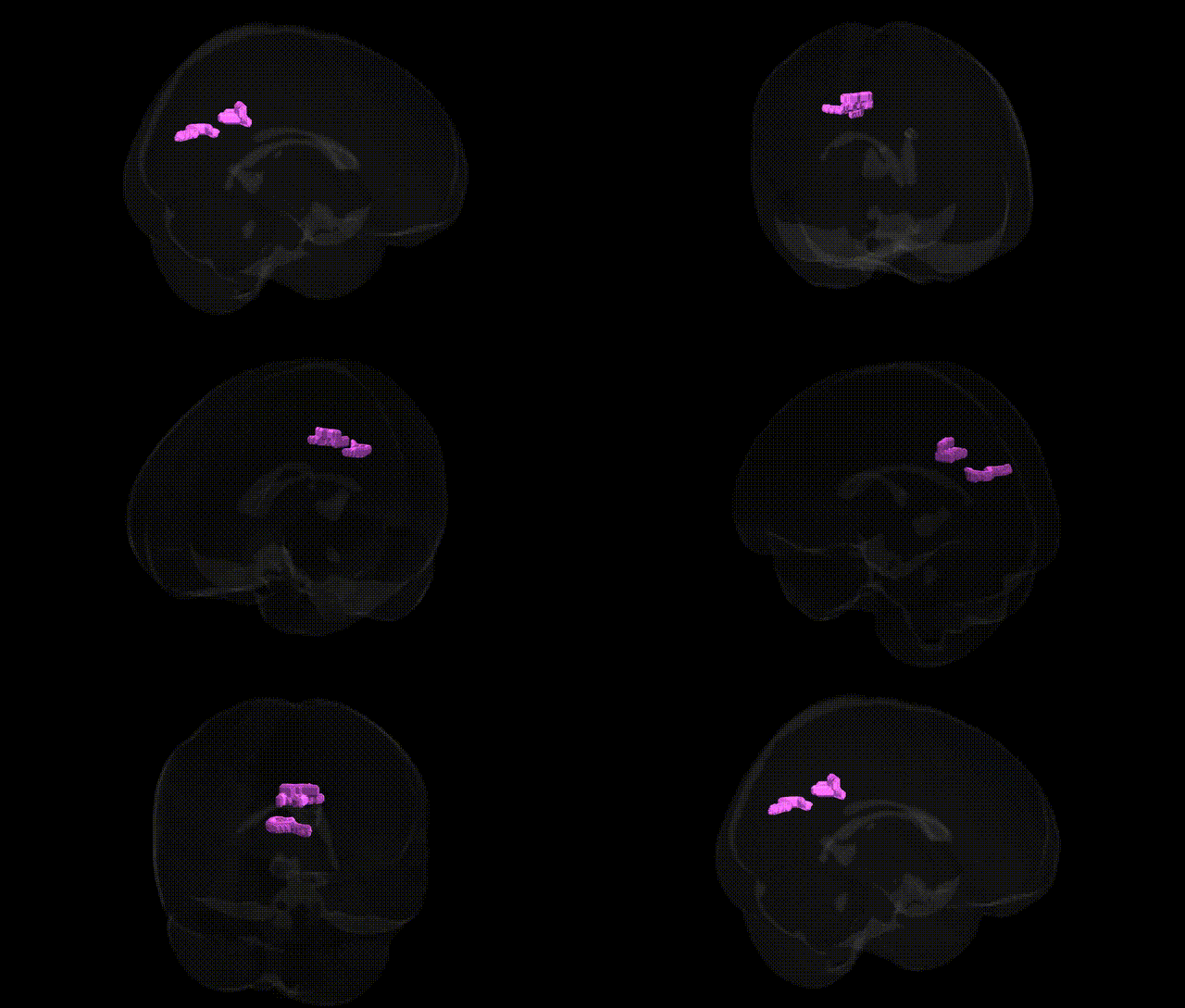
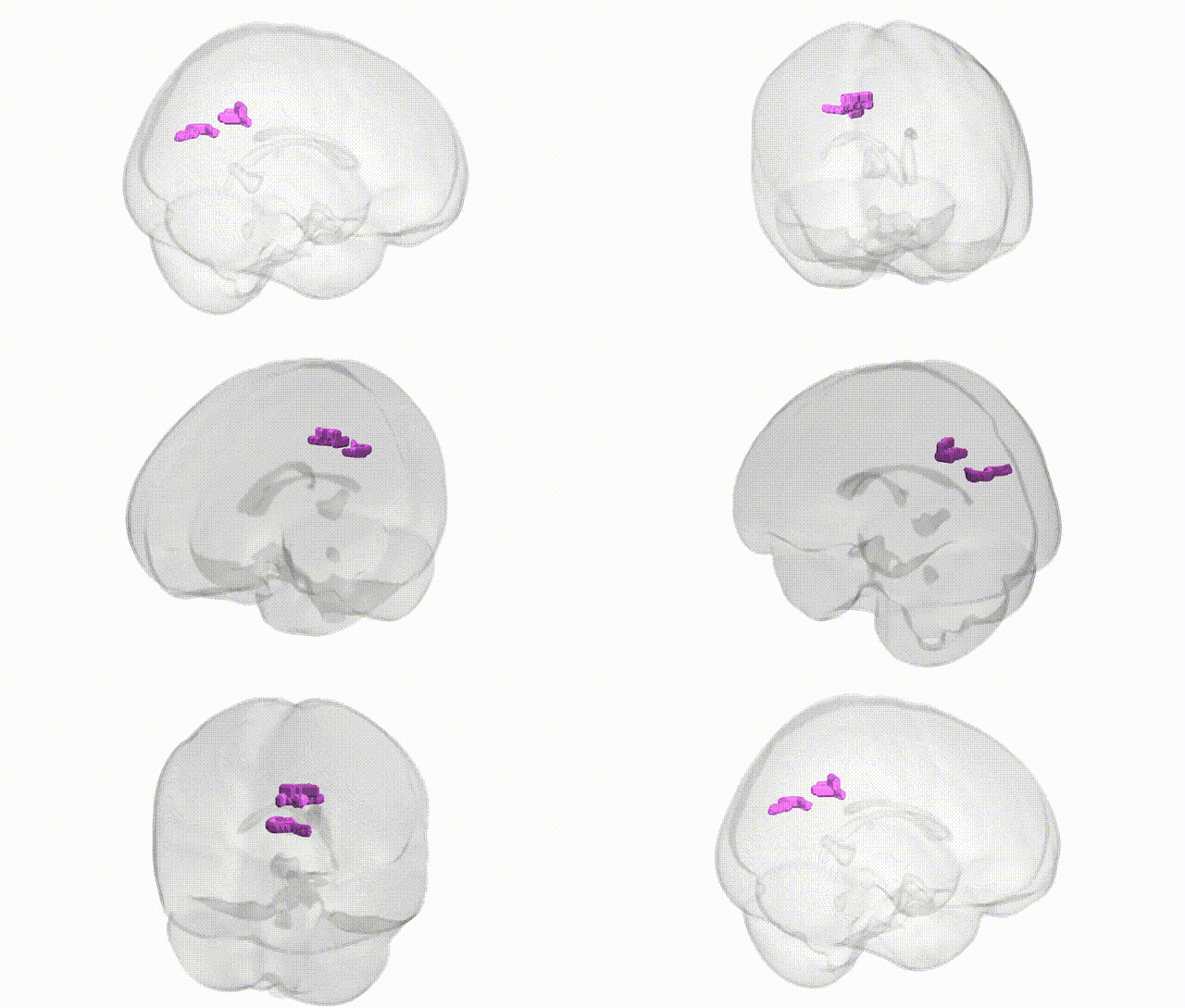
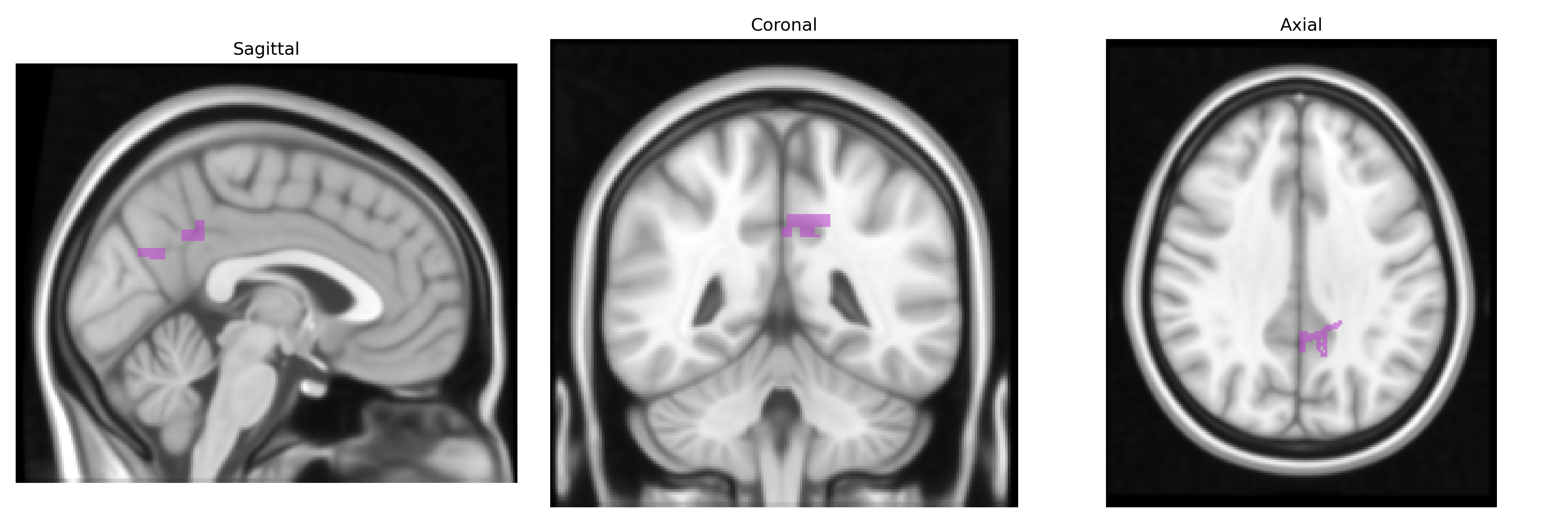
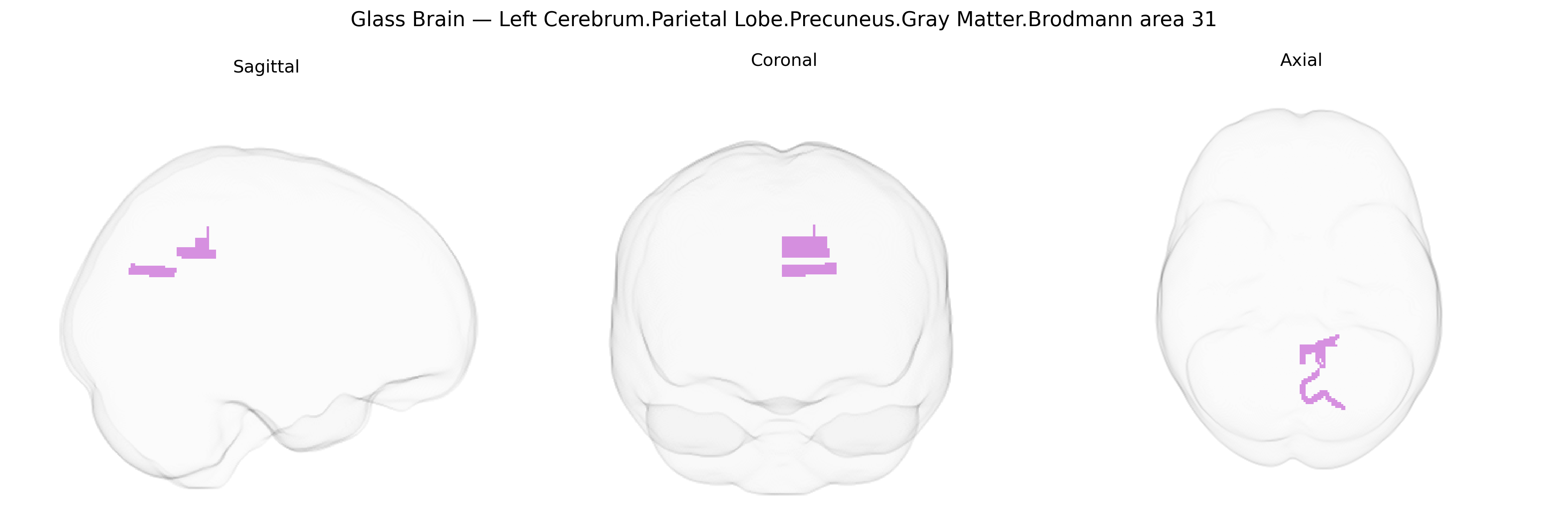
The bilateral Left Cerebrum.Parietal Lobe.Precuneus.Gray Matter.Brodmann area 31 corresponds to a medial parietal cortical territory situated within the posterior cingulate–precuneus region, typically bordering the parieto-occipital sulcus and extending into the retrosplenial cortex. Brodmann area 31 is implicated in higher-order associative functions, including episodic memory retrieval, self-referential processing, visuospatial integration, and components of the default mode network activity. Cytoarchitectonically, it is a heteromodal association cortex with relatively dense corticocortical connections to adjacent parietal, cingulate, and frontal areas, as well as to hippocampal and other limbic structures. Functionally, this region contributes to internally directed cognition, environmental contextualization, and integration of multimodal sensory information with autobiographical and emotional content. Brodmann area 31
The bilateral left precuneus gray matter in Brodmann area 31, as defined by the Talairach 1 mm atlas, has been implicated in multiple genetic and GWAS findings primarily through imaging-genetics and neuropsychiatric studies rather than gene–region mapping in isolation. Variants in genes related to synaptic plasticity, myelination, and neurodevelopment (for example, BDNF, APOE, and genes within the major histocompatibility complex) have been associated with structural and functional differences in the precuneus, including gray matter volume, cortical thickness, and connectivity within the default mode network. Large-scale GWAS of brain morphometry (e.g., ENIGMA and UK Biobank–based studies) have identified polygenic influences on parietal and precuneus measures, linking common variants in loci such as 17q21.31 and 3p24–p25 to regional cortical thickness or surface area, though specific effects on BA31 are typically reported at the parietal/precuneus cluster level rather than at fine-grained Brodmann areas. Genetic risk scores for Alzheimer’s disease, schizophrenia, major depression, and autism spectrum disorder show associations with structural or functional alterations in the precuneus, consistent with its role in episodic memory, self-referential processing, and default mode activity; APOE ε4 and other AD risk variants have been repeatedly linked to precuneus atrophy and hypometabolism. Additional GWAS linking this region to traits such as intelligence, educational attainment, and measures of consciousness or mind-wandering emerge via polygenic effects on default mode network organization, but current evidence remains largely correlational and distributed, without a single dominant gene specific to left BA31.
Overview generated by GPT-4o (2026).
Region ID: 856
Hemisphere: bilateral
Atlas: Talairach labels 1mm
Full Quality Version: Download MP4
Full Quality Version: Download MP4
Wali Sidiqyar*, Gaurav Rudravaram*, Elyssa M. McMaster, Trent M. Schwartz, Adam M. Saunders, Kurt G. Schilling, Bennett A. Landman "Introducing SPINS: A Shared Public Visualization Library of Neuroanatomical Structures." Medical Imaging with Deep Learning- short paper
This resource is licensed under CC0 1.0 Universal (Public Domain).