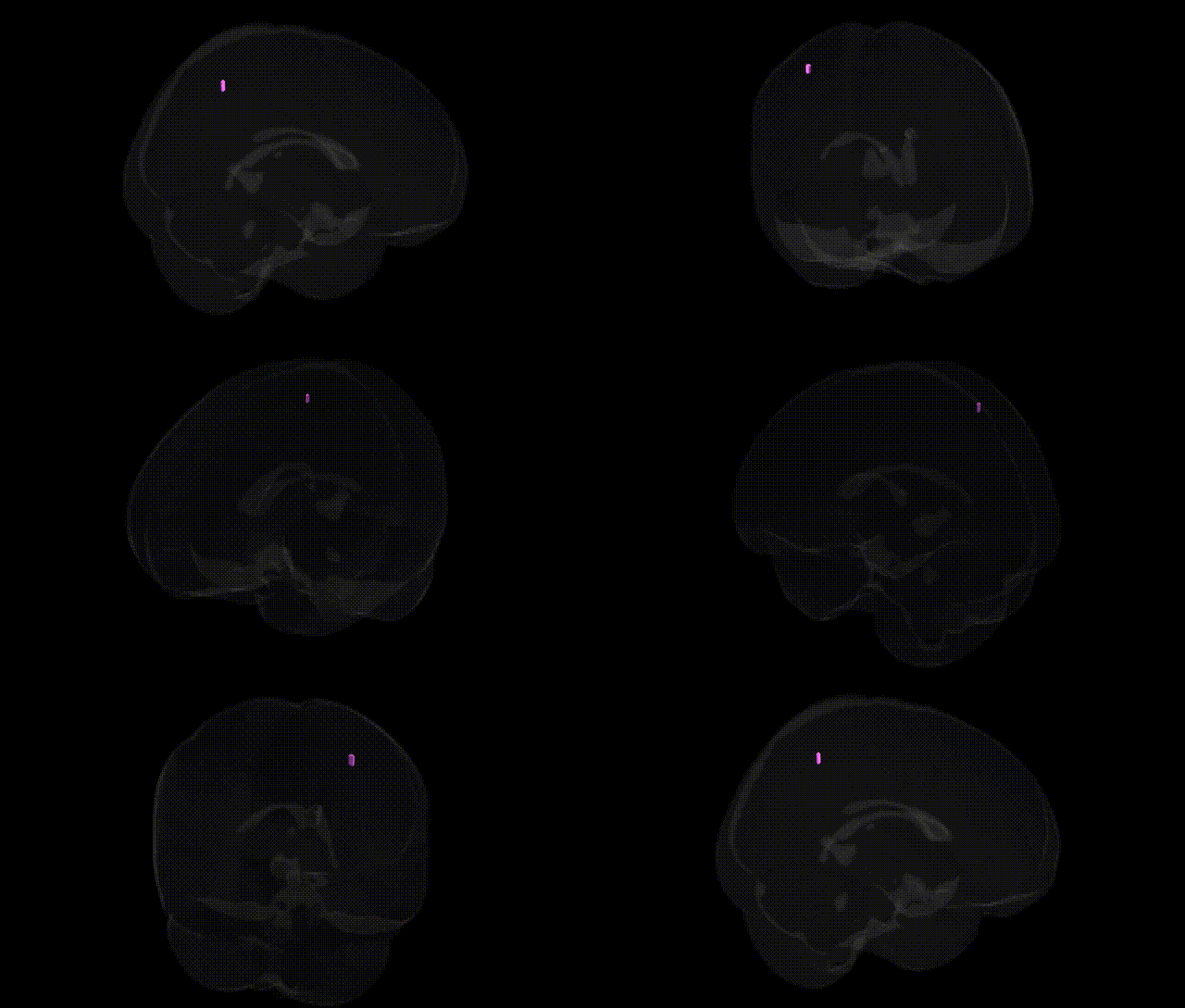
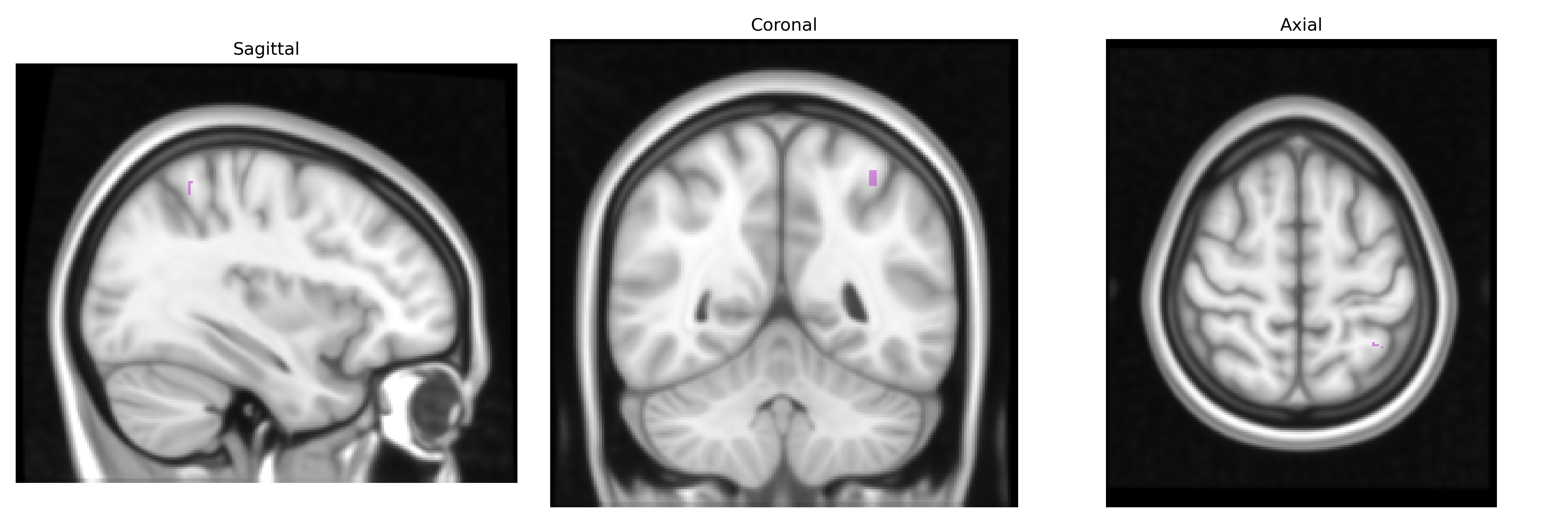
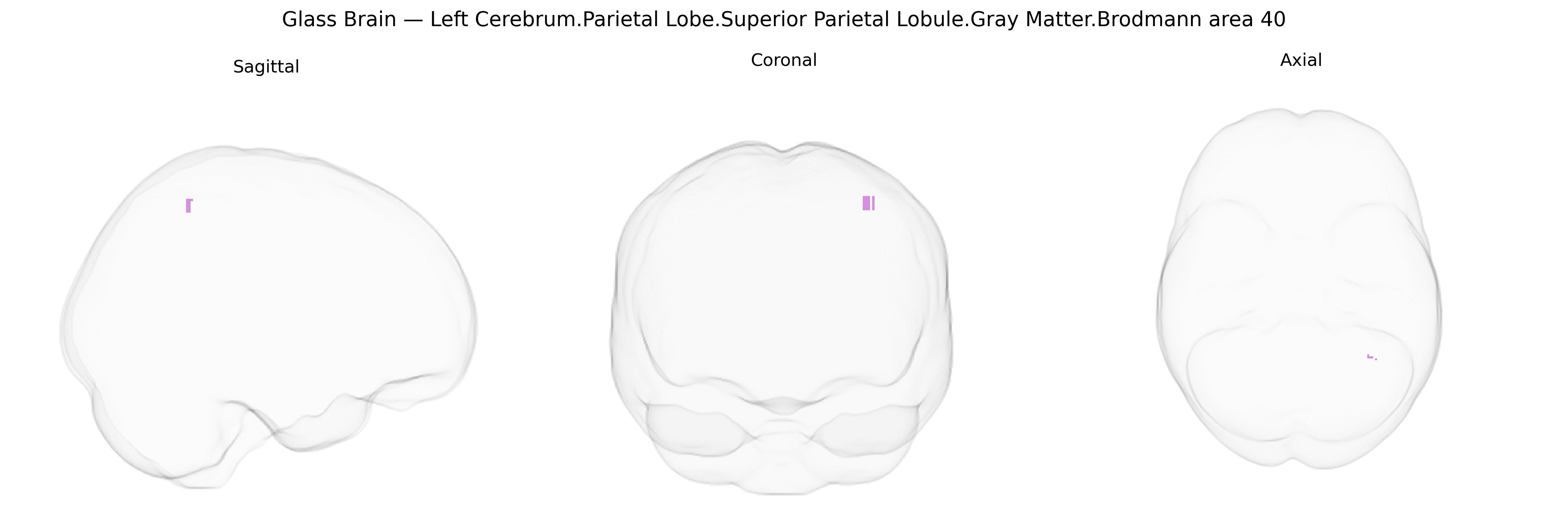
The bilateral Left Cerebrum.Parietal Lobe.Superior Parietal Lobule.Gray Matter.Brodmann area 40, as designated in the Talairach 1 mm Atlas, corresponds largely to the supramarginal gyrus, a component of the inferior parietal lobule that often extends into superior parietal territories depending on parcellation schemes. Functionally, this region participates in multimodal sensory integration, phonological processing, and aspects of language comprehension, as well as visuospatial attention and the transformation of sensory input into motor commands. It is implicated in praxis (the planning and execution of skilled movements), working memory for spatial and linguistic information, and higher-order somatosensory processing, often showing lateralization of function with the left hemisphere more strongly associated with language-related tasks. No direct Wikipedia article exists for this exact Talairach label; a closely related structure encompassing most of this territory is the Supramarginal gyrus.
Genetic associations involving the bilateral Left Cerebrum.Parietal Lobe.Superior Parietal Lobule.Gray Matter.Brodmann area 40 (classically overlapping the inferior parietal/supramarginal region in many modern parcellations) have emerged primarily from large-scale GWAS and imaging-genetics studies linking variation in this region’s cortical thickness, surface area, or activation patterns to diverse traits and disorders. Common variants in genes involved in synaptic plasticity, neuronal migration, axon guidance, and cortical patterning (for example, MAPT, BDNF, GRIN2B, DCC, and several loci near WNT and FGF signaling genes) have been repeatedly associated with parietal lobe morphometry or connectivity, including in the superior and inferior parietal lobules and adjoining BA40. GWAS of general cognitive ability, educational attainment, and working memory consistently highlight parietal cortex—especially left-hemisphere language- and number-related parietal areas—as a structural and functional mediator of polygenic influences on intelligence and scholastic performance, with polygenic scores for cognitive traits correlating with BA40-adjacent thickness and activation during arithmetic, visuospatial, and phonological tasks. In neurodevelopmental disorders, risk alleles for autism spectrum disorder, ADHD, and dyslexia show downstream associations with altered parietal gray matter, atypical lateralization, and disrupted parietal–frontal networks encompassing BA40, consistent with its role in attention and language. Psychiatric risk variants for schizophrenia and bipolar disorder are also linked through imaging-genetics to reduced cortical thickness, gyrification, or functional dysconnectivity in parietal regions that include BA40, supporting a convergence of polygenic liability on large-scale association networks. Finally, GWAS for neurodegenerative and cerebrovascular traits (Alzheimer’s disease, small-vessel disease, and white-matter hyperintensities) implicate loci in APP/Aβ processing, lipid metabolism (e.g., APOE), and vascular integrity that correspond to patterns of atrophy and perfusion changes involving the posterior parietal cortex and BA40, underscoring this region as a key anatomical substrate through which distributed genetic risks influence cognition, language, and higher-order association functions.
Overview generated by GPT-4o (2026).
Region ID: 1061
Hemisphere: bilateral
Atlas: Talairach labels 1mm
Full Quality Version: Download MP4
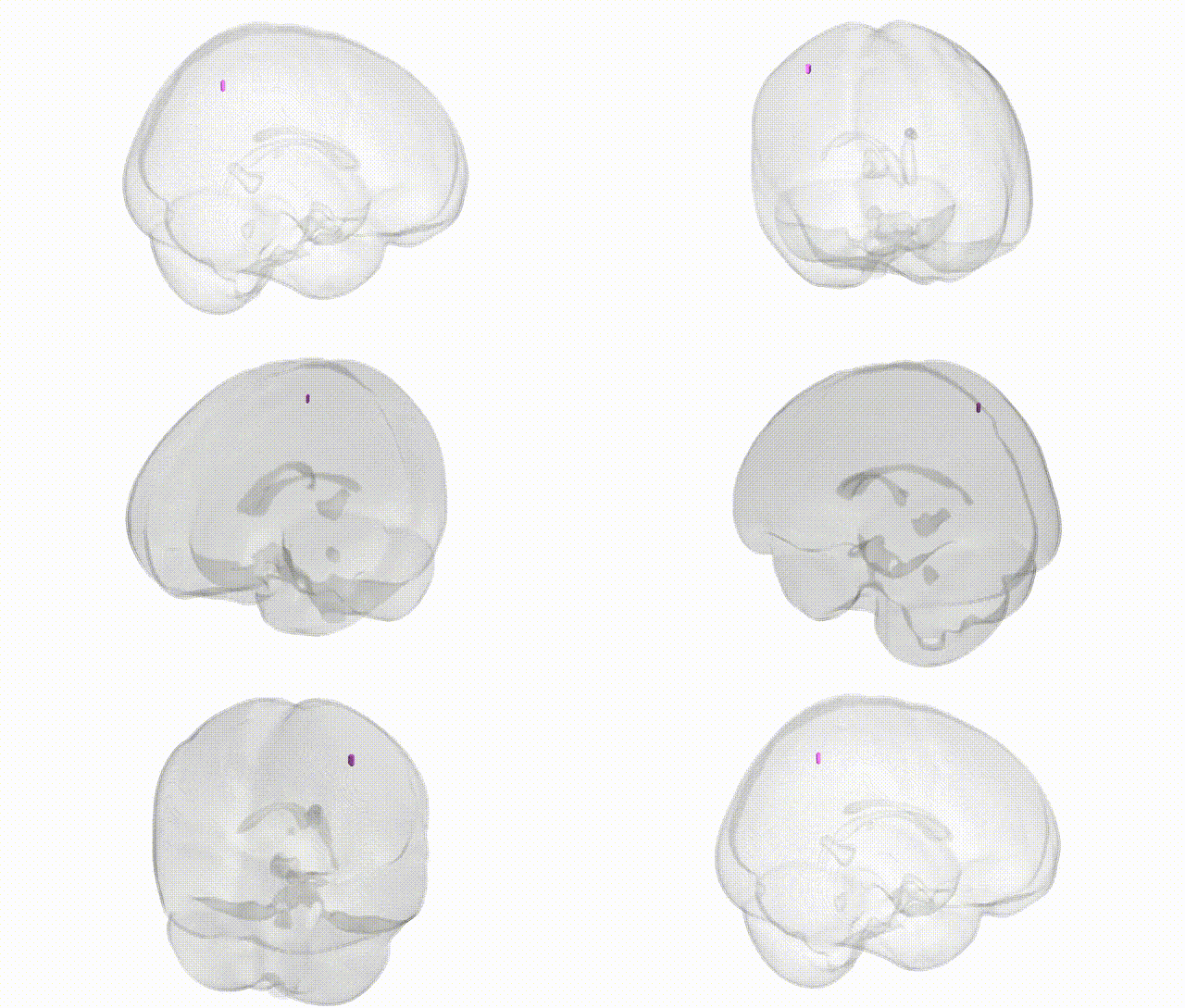
Full Quality Version: Download MP4
Wali Sidiqyar*, Gaurav Rudravaram*, Elyssa M. McMaster, Trent M. Schwartz, Adam M. Saunders, Kurt G. Schilling, Bennett A. Landman "Introducing SPINS: A Shared Public Visualization Library of Neuroanatomical Structures." Medical Imaging with Deep Learning- short paper
This resource is licensed under CC0 1.0 Universal (Public Domain).