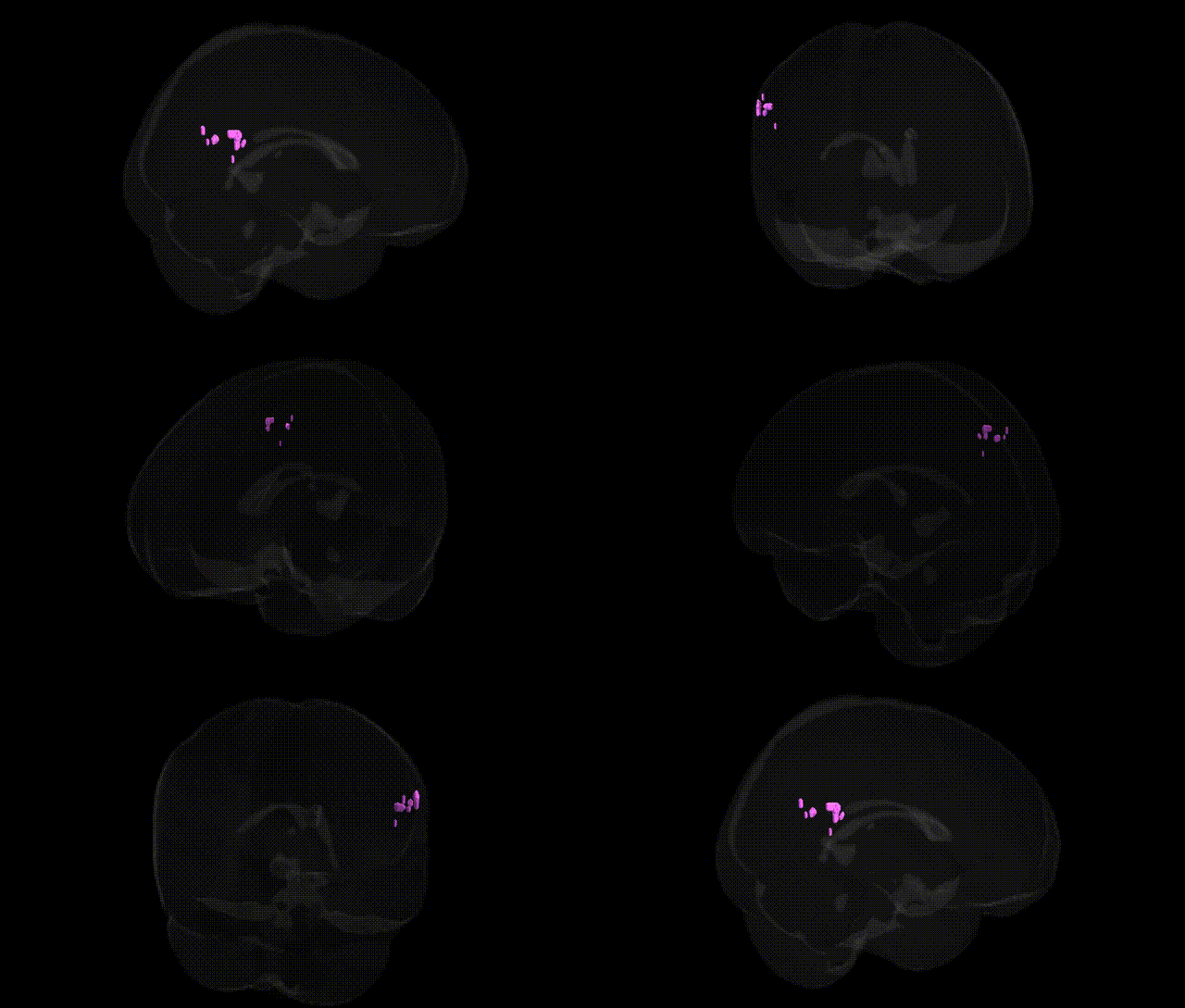
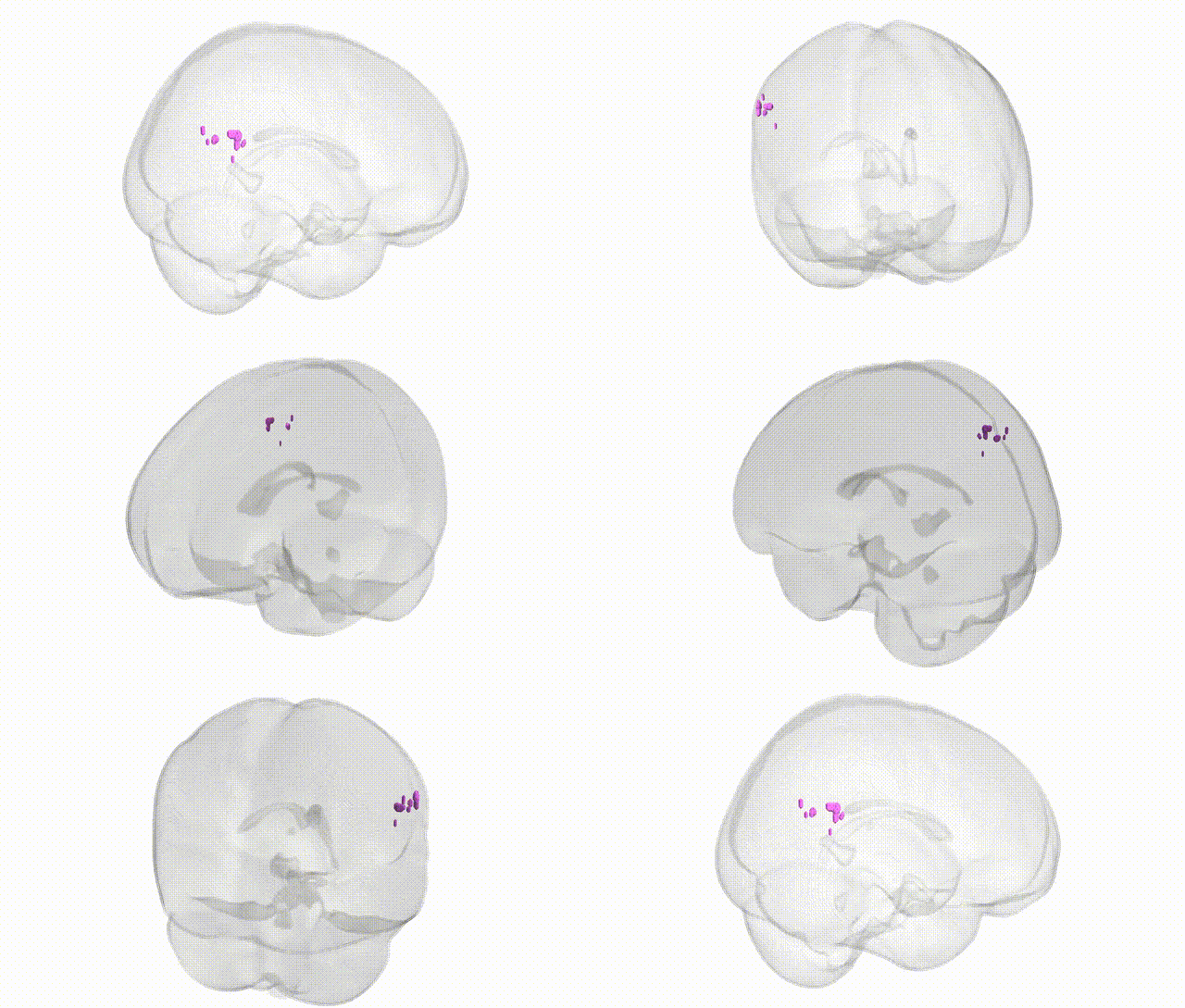
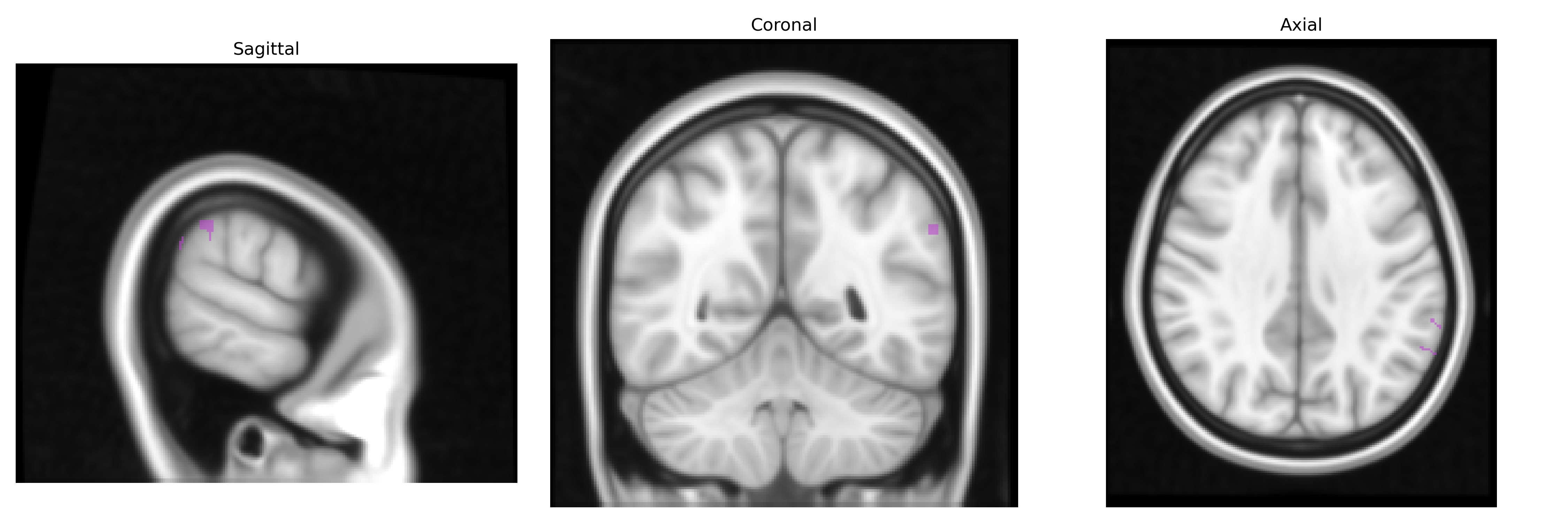
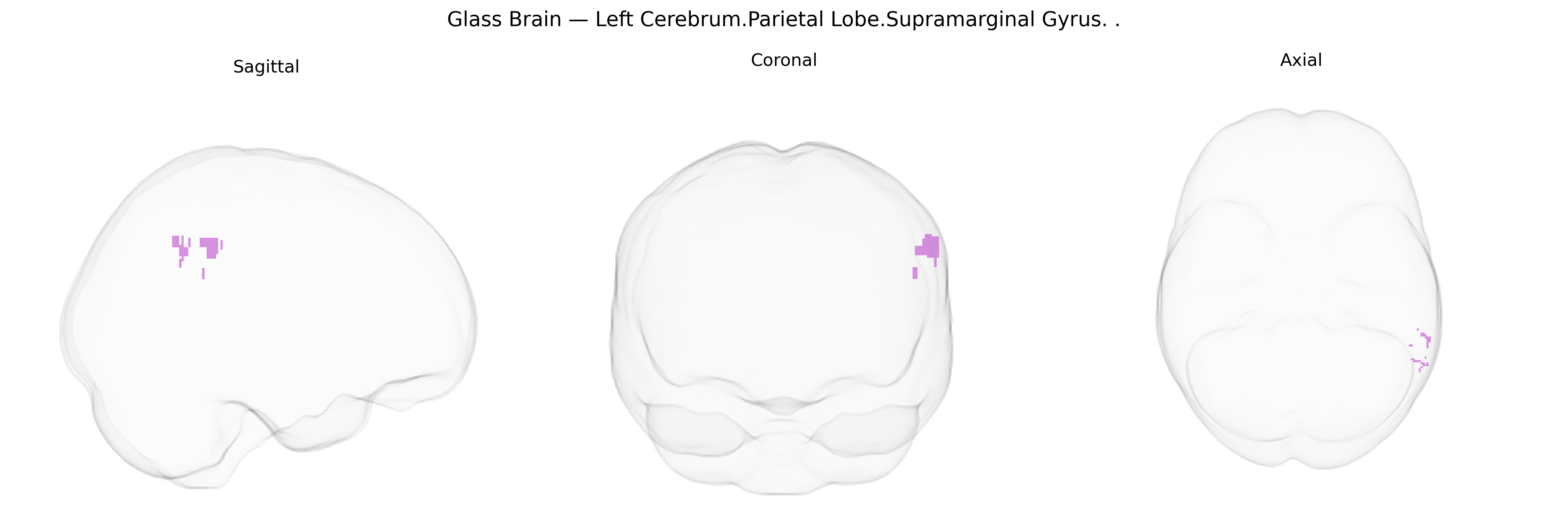
The bilateral Left Cerebrum.Parietal Lobe.Supramarginal Gyrus corresponds to cortex in the inferior parietal lobule that arches around the posterior end of the lateral (Sylvian) fissure, forming part of the supralateral border of the temporal lobe. Cytoarchitectonically, it overlaps mainly with Brodmann area 40 and participates in multimodal integration of somatosensory, auditory, and visual inputs. Functionally, this gyrus is implicated in phonological processing, reading and writing, working memory for verbal material, praxis and tool use, as well as aspects of social cognition such as empathy and theory of mind; in the dominant (typically left) hemisphere, it contributes critically to language comprehension, while the contralateral homologue supports spatial attention and body schema. Supramarginal gyrus
The bilateral supramarginal gyrus of the parietal lobe, as defined in the Talairach 1 mm atlas, has been implicated in multiple genetically influenced traits and disorders, primarily through imaging-genetics and GWAS of brain structure and function rather than region-specific single-gene associations. Large-scale consortia such as ENIGMA and UK Biobank have linked common variants in genes involved in neurodevelopment, synaptic function, and cortical patterning (for example, within or near MIR137, MAPT, and loci on chromosomes 3p, 6q, and 17q) to interindividual differences in supramarginal cortical thickness, surface area, and gyrification, often in the broader inferior parietal or temporo-parietal regions that encompass this area. Polygenic risk scores for schizophrenia, bipolar disorder, major depressive disorder, and autism spectrum disorder have been associated with structural and functional alterations in the supramarginal gyrus, aligning with its role in language, social cognition, and multisensory integration; similar polygenic influences have been reported for dyslexia and reading-related traits, where genes such as KIAA0319 and DCDC2 show associations with parietal and temporo-parietal activation patterns. GWAS of cognitive traits, including general intelligence, working memory, and mathematical ability, have identified loci whose cortical-expression patterns and downstream imaging associations disproportionately involve the supramarginal and adjacent inferior parietal cortex, while studies of pain sensitivity, empathy, and social-emotional traits have linked polygenic variation to functional activation in this region. Overall, current genetic evidence indicates that the supramarginal gyrus is a convergent hub where highly polygenic influences on neurodevelopment, psychiatric risk, language, and higher-order cognition manifest as structural and functional variability, rather than a region defined by a small number of specific “supramarginal” genes.
Overview generated by GPT-4o (2026).
Region ID: 882
Hemisphere: bilateral
Atlas: Talairach labels 1mm
Full Quality Version: Download MP4
Full Quality Version: Download MP4
Wali Sidiqyar*, Gaurav Rudravaram*, Elyssa M. McMaster, Trent M. Schwartz, Adam M. Saunders, Kurt G. Schilling, Bennett A. Landman "Introducing SPINS: A Shared Public Visualization Library of Neuroanatomical Structures." Medical Imaging with Deep Learning- short paper
This resource is licensed under CC0 1.0 Universal (Public Domain).