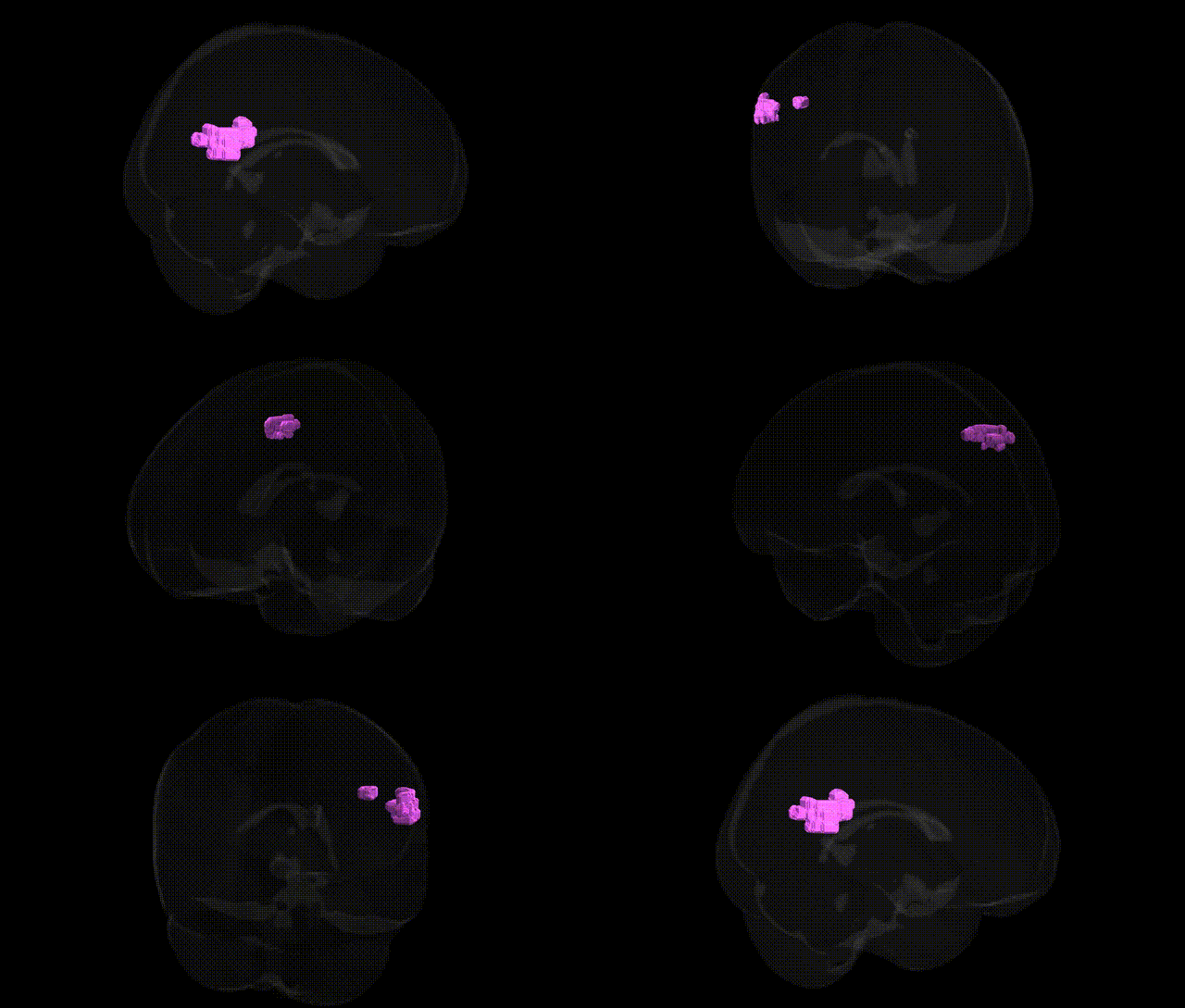
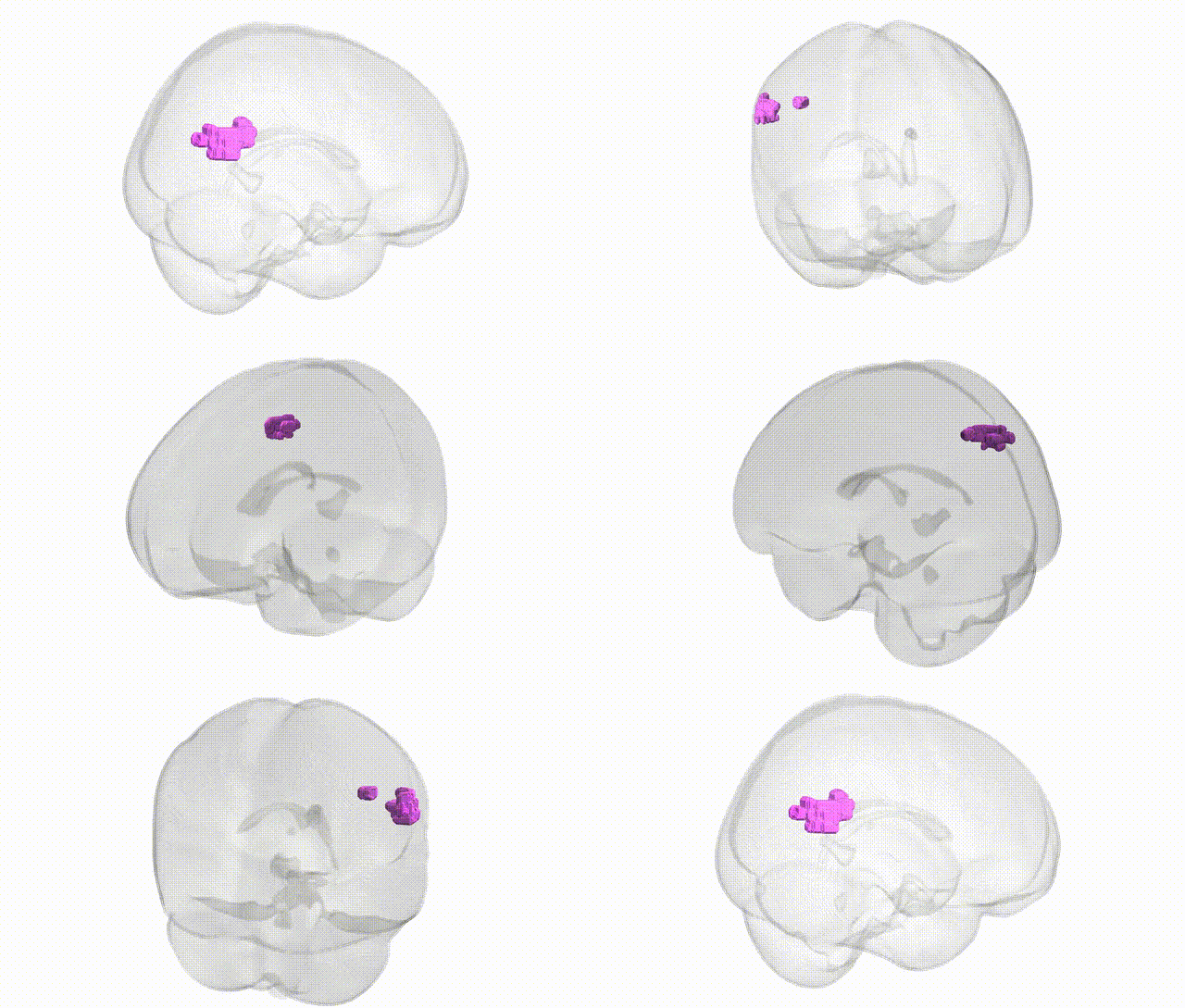
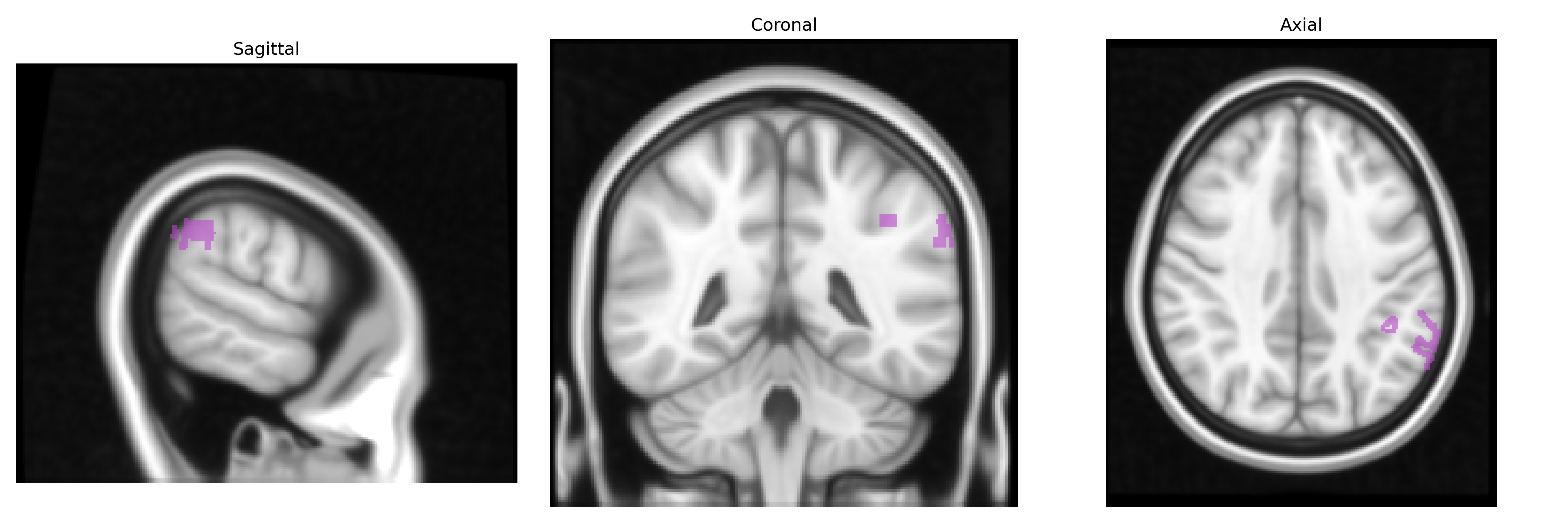
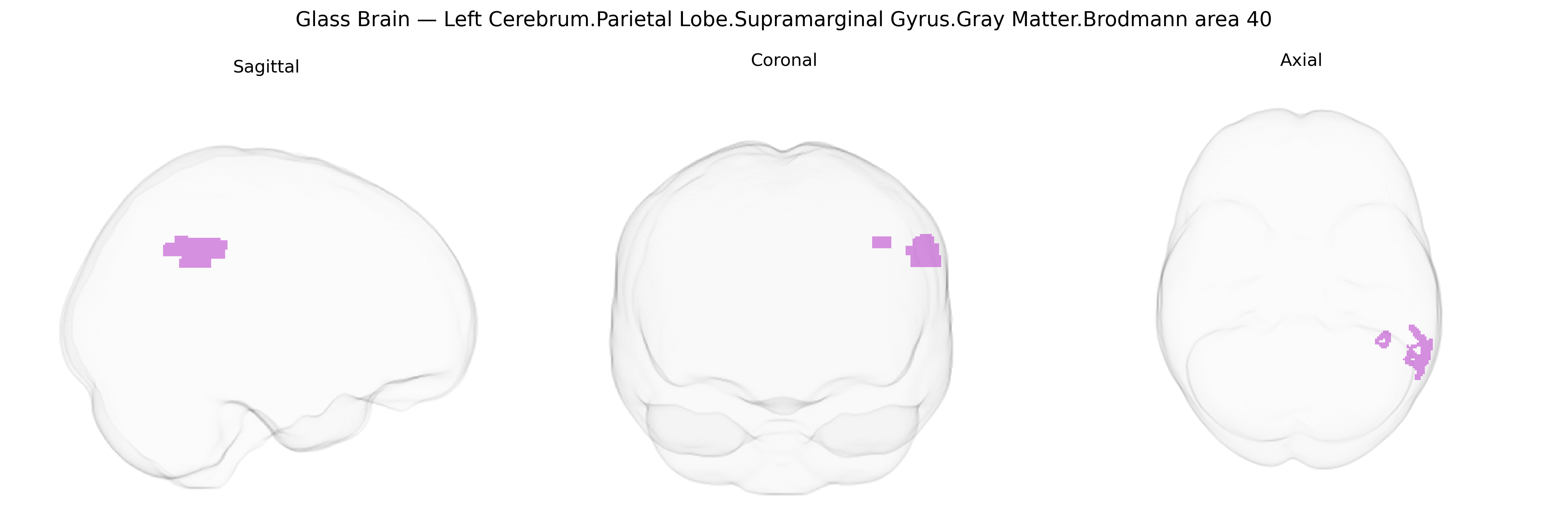
The bilateral Left Cerebrum.Parietal Lobe.Supramarginal Gyrus.Gray Matter.Brodmann area 40 corresponds to a cortical region in the inferior parietal lobule that caps the posterior end of the lateral sulcus and forms part of the supramarginal gyrus, cytoarchitectonically defined as Brodmann area 40. This region participates in multimodal integration of somatosensory, auditory, and visual information and plays key roles in language processing (particularly phonological and lexical aspects), praxis, spatial attention, and working memory. Functionally, it is implicated in the dorsal language stream and in sensorimotor transformations for speech and tool use, and damage may lead to syndromes such as conduction aphasia, ideomotor apraxia, and components of Gerstmann or neglect syndromes. There is no direct Wikipedia article for this exact compound label; a closely related structure is the Supramarginal gyrus.
The bilateral left supramarginal gyrus (parietal lobe, Brodmann area 40) has been implicated in multiple genetic and GWAS findings, particularly involving language, reading, and higher-order cognitive traits. Variants in FOXP2, DCDC2, KIAA0319, CNTNAP2, and ROBO1 have been repeatedly associated with structural and functional alterations in this region, especially in the context of developmental dyslexia, specific language impairment, and speech–language phenotypes; imaging–genetics studies have linked risk alleles in these genes to reduced gray matter volume or altered activation in left BA40 during phonological and reading tasks. Large-scale GWAS of educational attainment, general cognitive ability, and brain morphometry (e.g., ENIGMA and UK Biobank–based analyses) have identified polygenic influences on parietal and supramarginal gyrus thickness and surface area, with implicated loci enriched for neurodevelopmental and synaptic pathways. Schizophrenia, autism spectrum disorder, and ADHD risk variants—particularly in genes affecting synaptic plasticity, glutamatergic signaling, and corticocortical connectivity—have been linked to structural and connectivity abnormalities that include the left supramarginal gyrus within frontoparietal and language networks, while Alzheimer’s disease and frontotemporal dementia genetics (e.g., APOE, MAPT, GRN) have been associated with atrophy patterns that often encompass this region. Overall, genetic associations with this area converge on neurodevelopmental, language/cognitive, and psychiatric traits, mediated by distributed polygenic effects on cortical development and network organization rather than single-region, single-gene specificity.
Overview generated by GPT-4o (2026).
Region ID: 927
Hemisphere: bilateral
Atlas: Talairach labels 1mm
Full Quality Version: Download MP4
Full Quality Version: Download MP4
Wali Sidiqyar*, Gaurav Rudravaram*, Elyssa M. McMaster, Trent M. Schwartz, Adam M. Saunders, Kurt G. Schilling, Bennett A. Landman "Introducing SPINS: A Shared Public Visualization Library of Neuroanatomical Structures." Medical Imaging with Deep Learning- short paper
This resource is licensed under CC0 1.0 Universal (Public Domain).