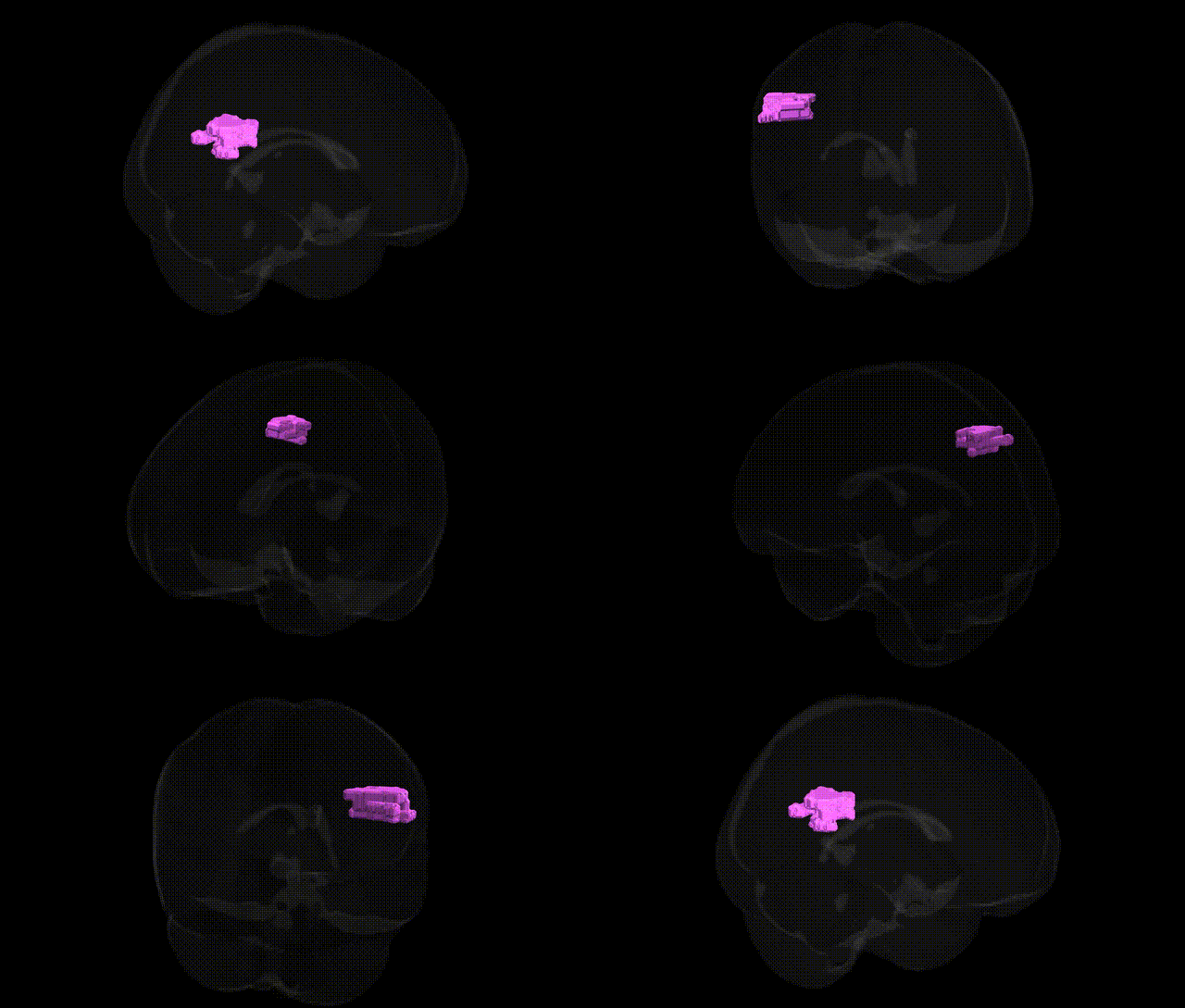
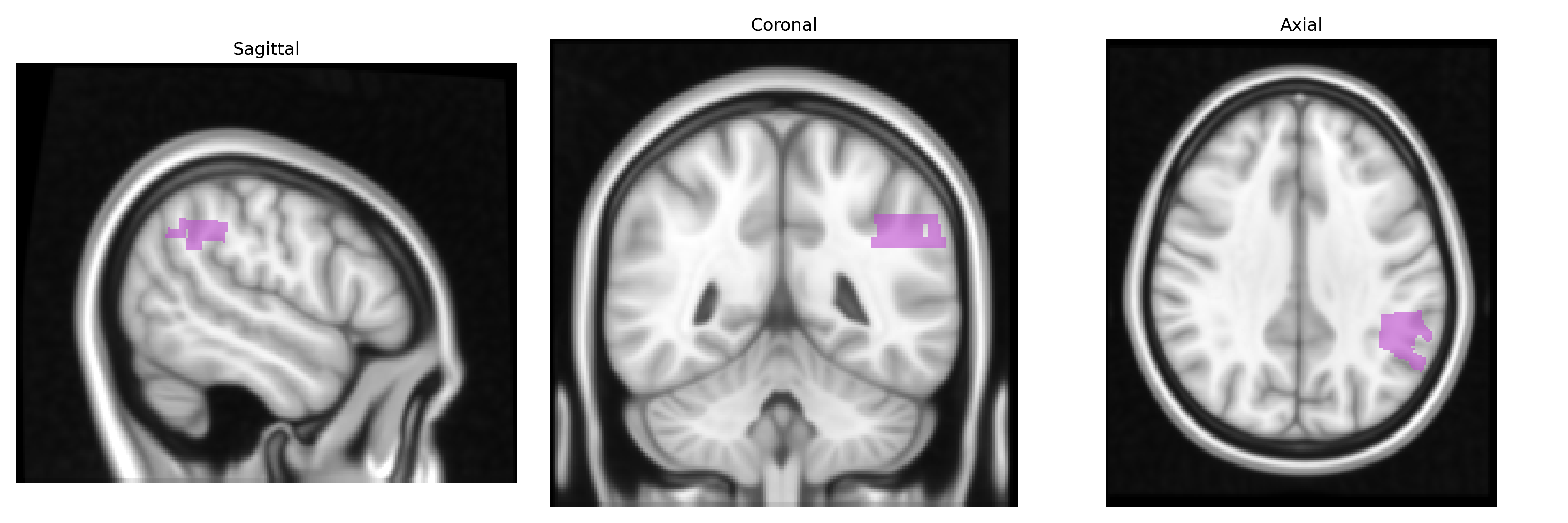
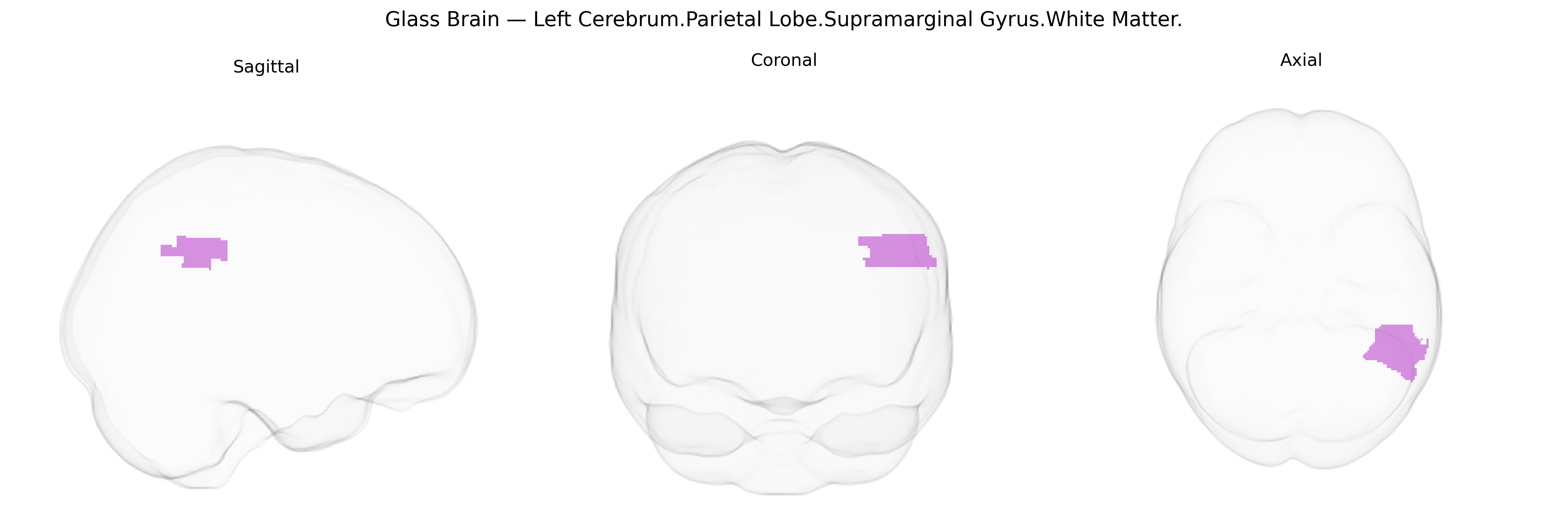
The bilateral Left Cerebrum.Parietal Lobe.Supramarginal Gyrus.White Matter corresponds to subcortical myelinated fiber pathways underlying the supramarginal gyrus in the inferior parietal lobule, a multimodal association region involved in language, phonological processing, spatial attention, and sensorimotor integration. These white matter tracts include short U-fibers connecting adjacent gyri and longer association fibers that link the supramarginal gyrus with frontal, temporal, and other parietal regions, supporting networks for speech perception and production, praxis, and body schema representation. Lesions in this area are associated with deficits such as conduction aphasia, ideomotor apraxia, and disturbances in spatial awareness, depending on the extent and specific tracts affected. There is no direct Wikipedia article for the white matter of the supramarginal gyrus; the most relevant cortical structure is the Supramarginal gyrus.
The supramarginal gyrus white matter in the left parietal lobe has been implicated in a range of genetically influenced traits and disorders, largely via GWAS and imaging‑genetics studies that examine diffusion metrics or structural connectivity in this region and its homologous right‑hemisphere counterpart. Common variants near and within genes involved in axon guidance, myelination, and synaptic plasticity—such as NRG1, CNTNAP2, and various oligodendrocyte-related loci—have been associated with white‑matter microstructure in parietal association pathways that traverse or connect with the supramarginal gyrus, including superior longitudinal and arcuate fasciculi that underlie language and working memory networks. Large-scale GWAS of brain imaging phenotypes (for example, UK Biobank–based studies) have reported heritable variation in parietal white matter anisotropy and volume linked to polygenic scores for cognitive ability, educational attainment, and reading-related traits, which converge on this region’s role in phonological processing and visuo-spatial integration. Genetic risk variants for neurodevelopmental and psychiatric conditions—such as schizophrenia, autism spectrum disorder, and ADHD—have also been associated with altered parietal white matter integrity and supramarginal connectivity, often through pleiotropic loci in calcium-channel genes (e.g., CACNA1C) and synaptic regulators identified in cross-disorder GWAS. In neurodegenerative and cerebrovascular genetics, risk alleles for Alzheimer’s disease (notably APOE ε4) and small-vessel disease polygenic scores show associations with reduced white-matter integrity in parietal association tracts, consistent with this region’s vulnerability to age-related demyelination and microvascular burden. Collectively, these findings indicate that genetic influences on cognition, language, and psychiatric risk are partly mediated through effects on the microstructure and connectivity of the left supramarginal gyrus white matter and its bilateral parietal networks.
Overview generated by GPT-4o (2026).
Region ID: 929
Hemisphere: bilateral
Atlas: Talairach labels 1mm
Full Quality Version: Download MP4
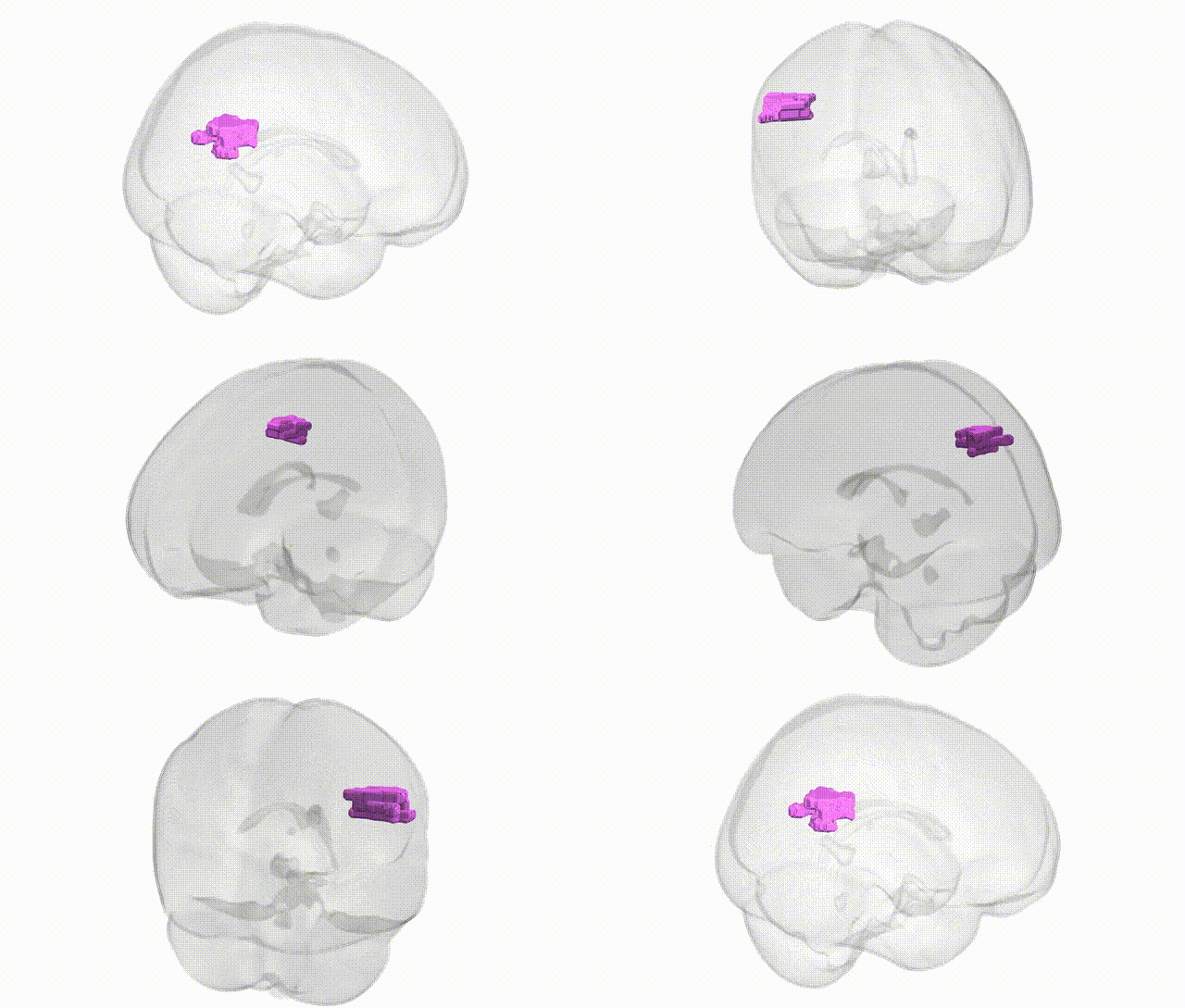
Full Quality Version: Download MP4
Wali Sidiqyar*, Gaurav Rudravaram*, Elyssa M. McMaster, Trent M. Schwartz, Adam M. Saunders, Kurt G. Schilling, Bennett A. Landman "Introducing SPINS: A Shared Public Visualization Library of Neuroanatomical Structures." Medical Imaging with Deep Learning- short paper
This resource is licensed under CC0 1.0 Universal (Public Domain).