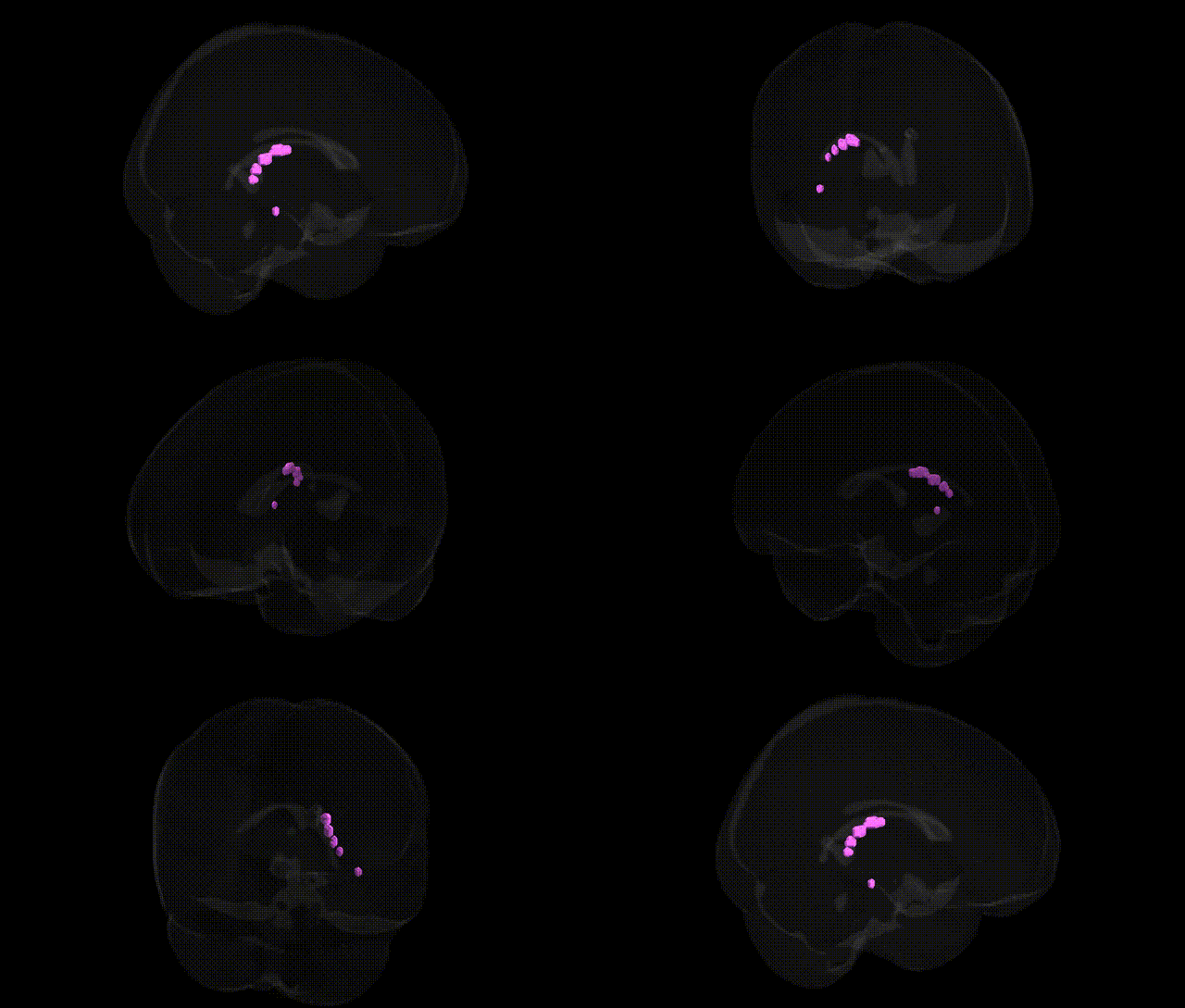
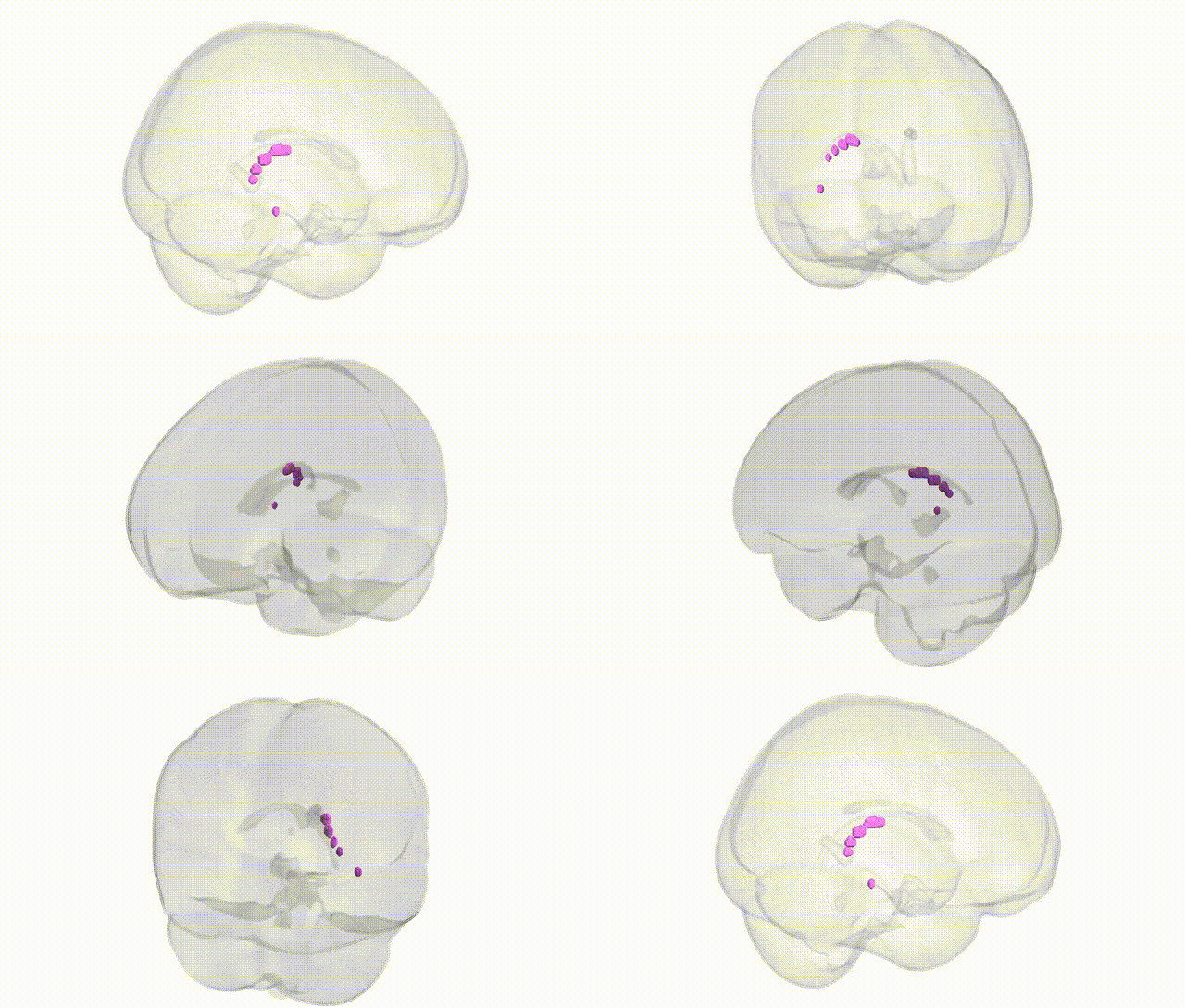
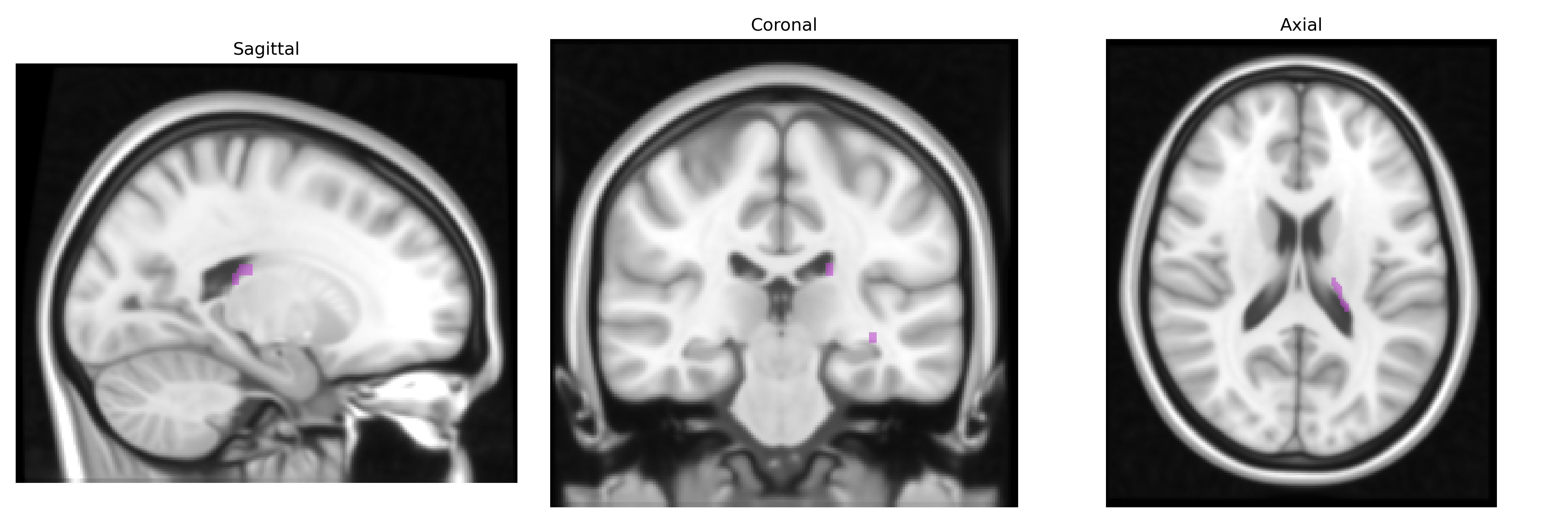
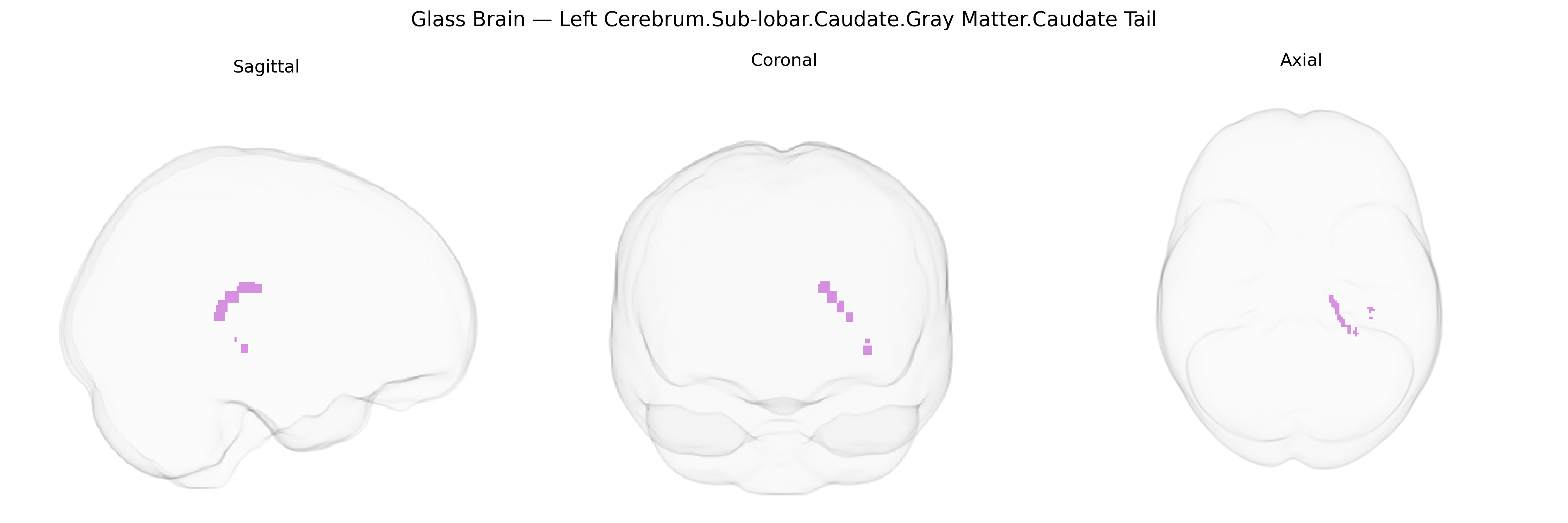
The bilateral Left Cerebrum.Sub-lobar.Caudate.Gray Matter.Caudate Tail corresponds to the posterior portion of the caudate nucleus, a C-shaped gray matter structure within the dorsal striatum of the basal ganglia. Extending into the temporal lobe and curving around the lateral ventricle, the caudate tail is primarily composed of medium spiny neurons receiving glutamatergic inputs from cortical association areas and thalamus, and dopaminergic projections from the substantia nigra pars compacta. It participates in cortico-striato-thalamo-cortical loops involved in motor control, habit formation, associative learning, and aspects of cognitive and emotional processing, although its specific functional contributions are less well characterized than those of the caudate head and body. There is no direct link for the caudate tail; a related structure is the Caudate nucleus.
The caudate tail, part of the sub-lobar gray matter of the left cerebrum, has been implicated in multiple genetic associations largely inferred from GWAS of caudate volume and related subcortical measures rather than from studies specifically isolating the tail subregion; nevertheless, these findings provide convergent evidence for genetic influence on this structure. Large-scale imaging-genetics consortia (e.g., ENIGMA, UK Biobank) have identified common variants in and near genes such as HMGA2, FAT3, PTCH1, KTN1, WDR73, and FAM109B that associate with caudate nucleus volume, some of which show pleiotropic links to neurodevelopmental traits and cognitive performance. Polygenic architectures involving schizophrenia, bipolar disorder, autism spectrum disorder, ADHD, and major depressive disorder show significant genetic correlations with caudate morphology, suggesting shared risk alleles that influence both psychiatric liability and caudate structure. Additional associations connect caudate-related genetic variants to Parkinson’s disease, Huntington’s disease modifiers, and movement-related traits, consistent with the basal ganglia’s role in motor control and habit learning; however, these typically pertain to the caudate as a whole and do not yet provide tail-specific GWAS signals at Talairach 1 mm resolution.
Overview generated by GPT-4o (2026).
Region ID: 435
Hemisphere: bilateral
Atlas: Talairach labels 1mm
Full Quality Version: Download MP4
Full Quality Version: Download MP4
Wali Sidiqyar*, Gaurav Rudravaram*, Elyssa M. McMaster, Trent M. Schwartz, Adam M. Saunders, Kurt G. Schilling, Bennett A. Landman "Introducing SPINS: A Shared Public Visualization Library of Neuroanatomical Structures." Medical Imaging with Deep Learning- short paper
This resource is licensed under CC0 1.0 Universal (Public Domain).