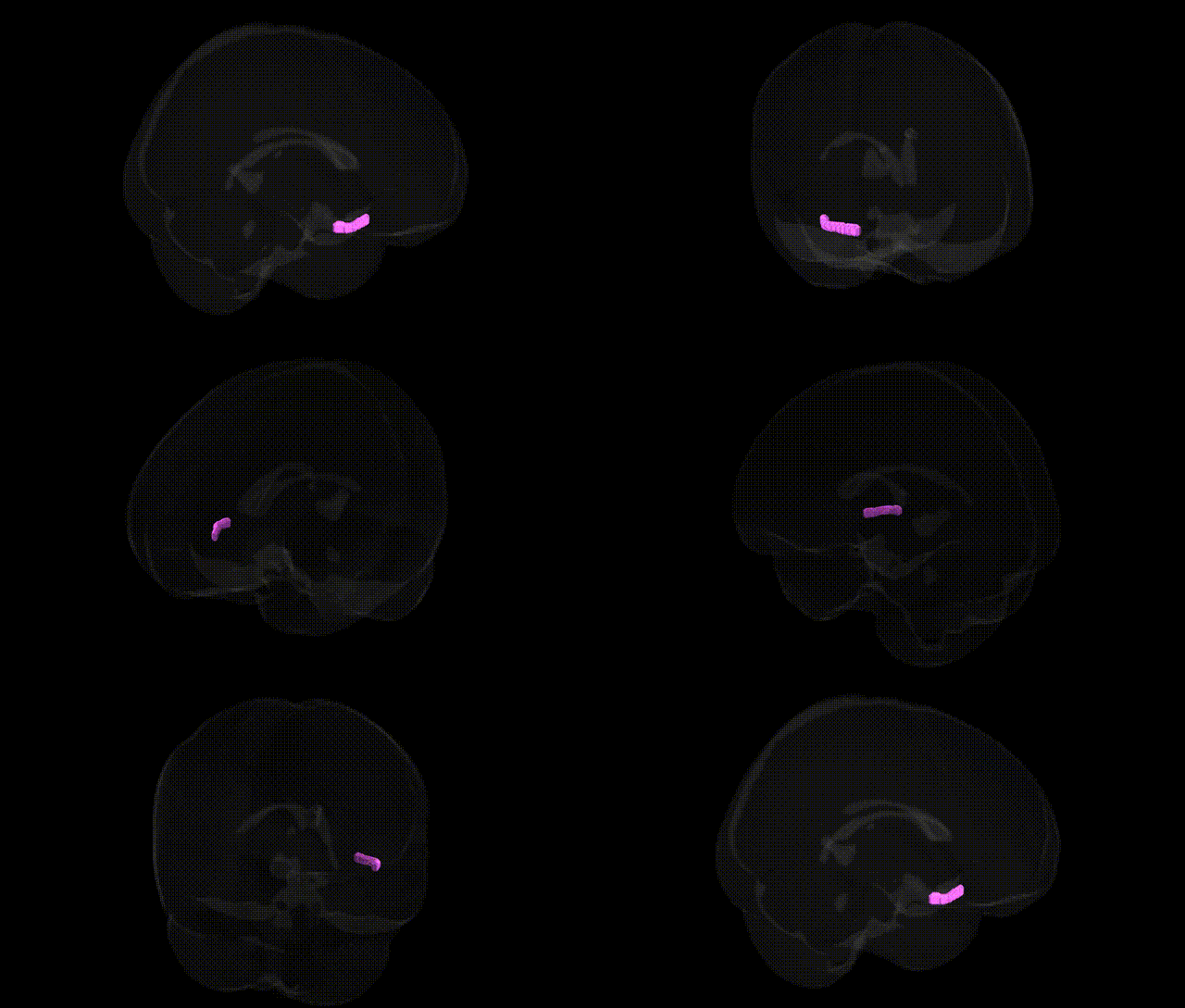
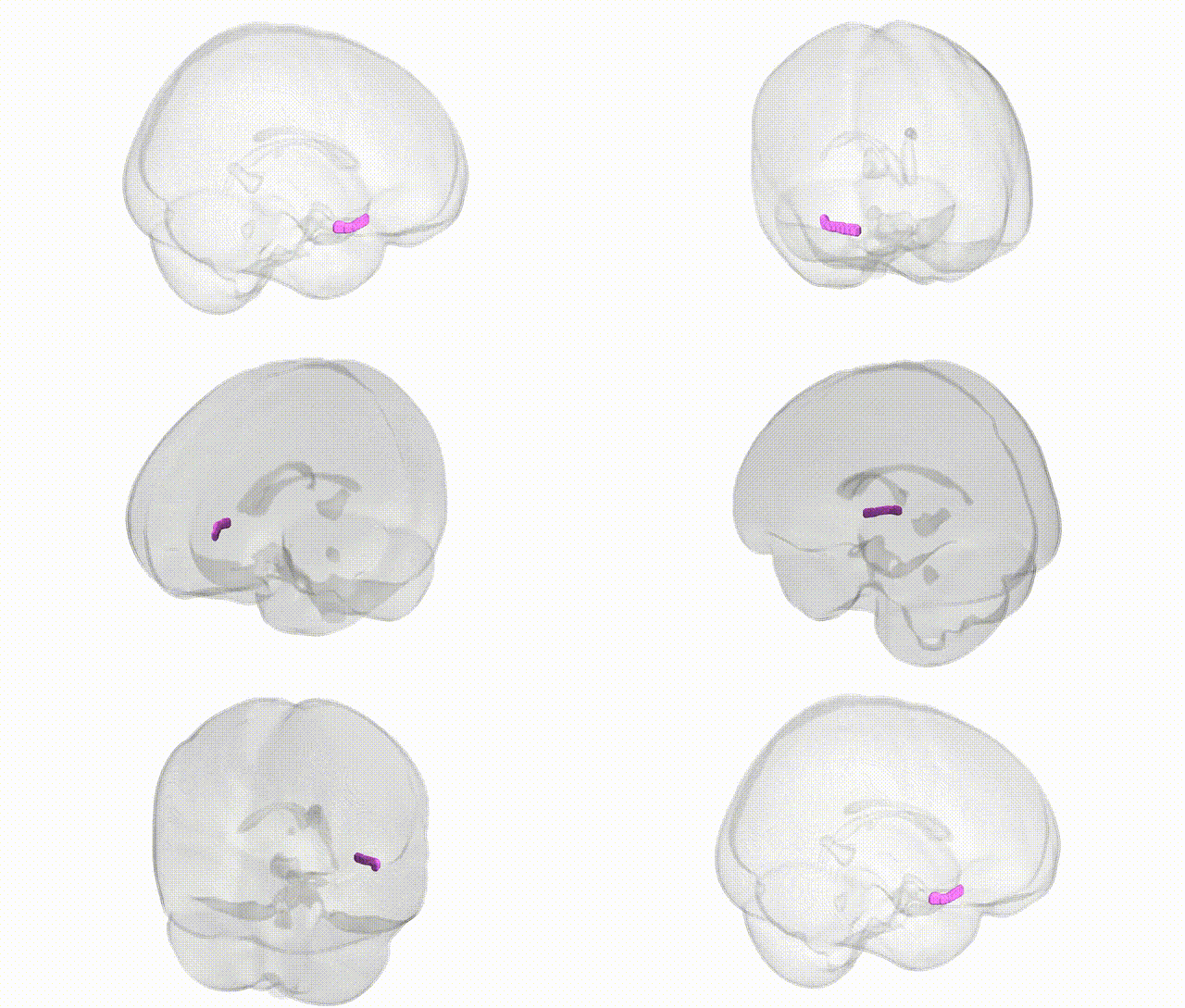
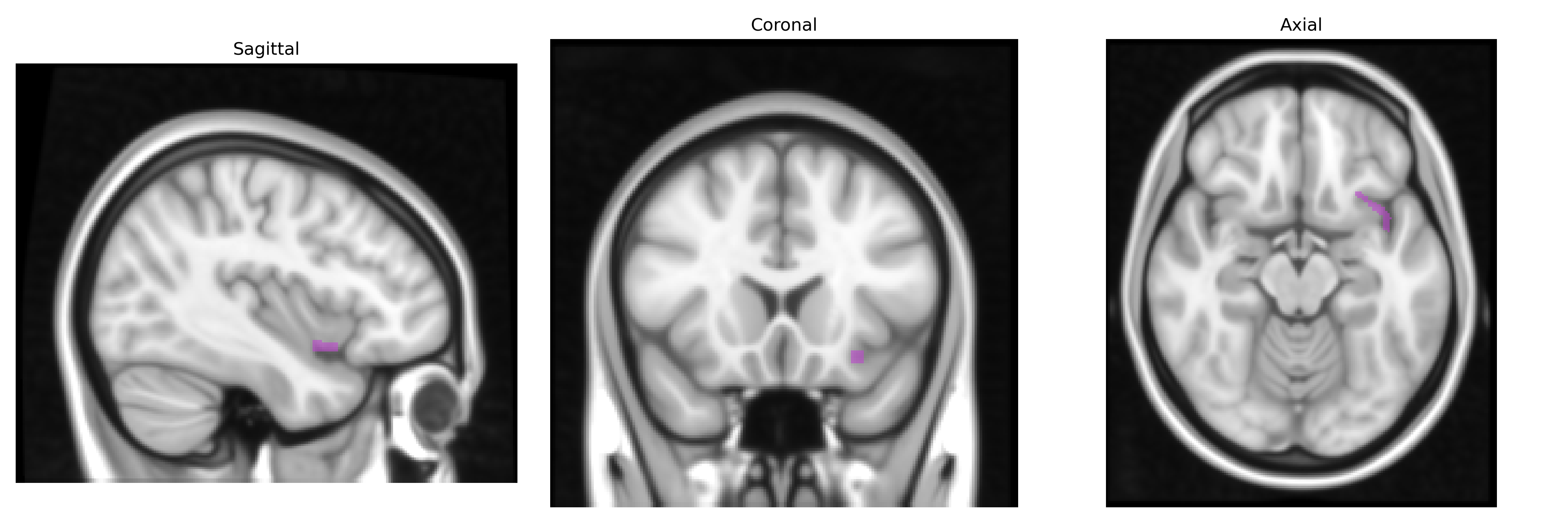
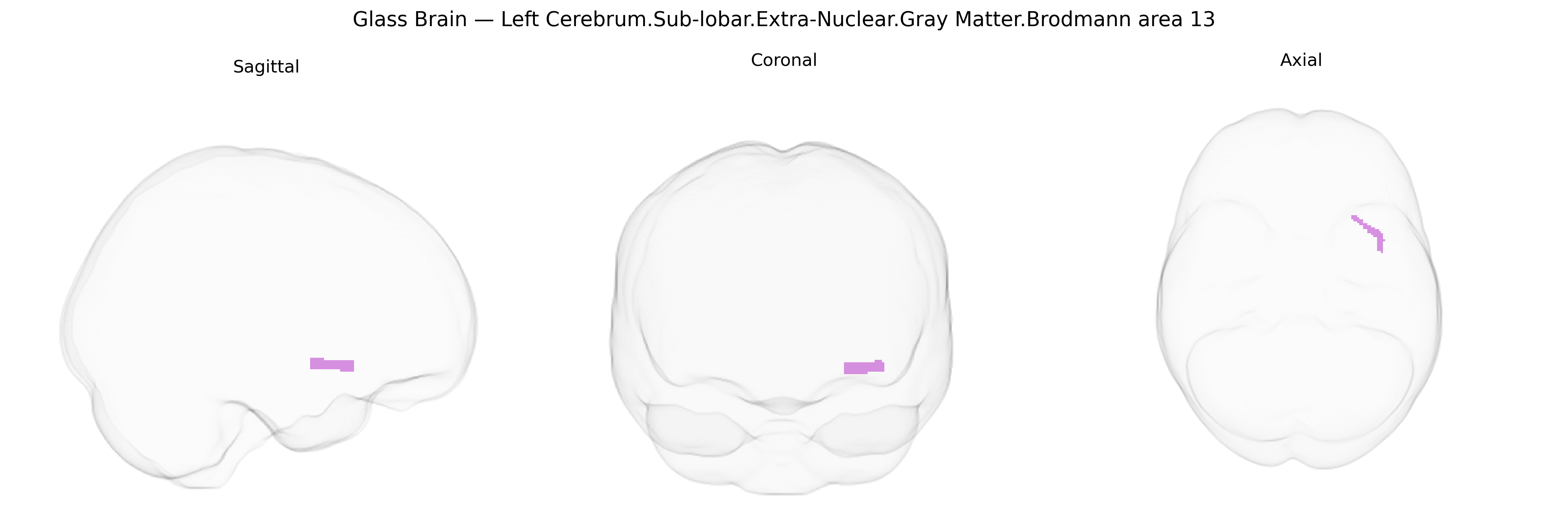
The bilateral Left Cerebrum.Sub-lobar.Extra-Nuclear.Gray Matter.Brodmann area 13 corresponds primarily to the insular cortex (particularly its anterior and middle portions) buried within the lateral sulcus beneath the frontal, parietal, and temporal opercula. Cytoarchitectonically, Brodmann area 13 is characterized by a granular to dysgranular neocortical organization and extensive connectivity with limbic, prefrontal, somatosensory, and viscerosensory regions. Functionally, this area is implicated in interoception, autonomic and visceral regulation, affective and subjective feeling states, gustatory processing, pain and temperature integration, and higher-order emotional and cognitive processes such as risk evaluation and decision-making. In the Talairach 1 mm atlas, its classification as “sub-lobar extra-nuclear gray matter” reflects its deep position beneath the cortical surface and its role as an integrative hub between sensory, motor, and limbic systems. There is no direct Wikipedia article specifically for Brodmann area 13; a closely related structure with substantial overlap is the Insular cortex.
Brodmann area 13, a core subregion of the insular and adjacent sub-lobar cortex (often encompassing agranular insula and parts of the claustrum/extranuclear gray), has been implicated in genetic studies primarily through its roles in salience processing, interoception, and affect regulation, with GWAS and imaging–genetics work linking structural and functional variation in this region to several psychiatric and behavioral phenotypes. Large-scale neuroimaging GWAS (e.g., ENIGMA and UK Biobank–based studies) have reported SNP-based heritability and associations between common variants in genes involved in synaptic function, neurodevelopment, and cortical patterning (such as variants near GRM3, DRD2, and other glutamatergic and dopaminergic genes) and insular/ventrolateral frontal cortical thickness or volume encompassing BA13-like territories, as well as global sulcal patterns that include this sub-lobar region. BA13 and adjacent insular cortex have repeatedly shown altered volume, cortical thickness, or activation in schizophrenia, major depression, bipolar disorder, anxiety disorders, and substance-use disorders, with genetic liability indices (polygenic risk scores for schizophrenia, depression, and alcohol/nicotine dependence) correlating with structural measures and functional connectivity of this territory. Additional associations have been reported for autism spectrum disorder, obsessive–compulsive traits, and pain sensitivity or interoceptive traits, where genetic variants influencing insula/BA13 structure or activity partially overlap with genes implicated in neurodevelopmental patterning, immune signaling, and neurotransmission. Overall, while no single gene is uniquely tied to BA13, this region emerges in imaging-genetics and GWAS as a convergence point where distributed polygenic risk for psychiatric illness, addiction-related traits, and affective/interoceptive phenotypes manifests as structural and functional variability in the bilateral sub-lobar extranuclear gray matter corresponding to Brodmann area 13.
Overview generated by GPT-4o (2026).
Region ID: 369
Hemisphere: bilateral
Atlas: Talairach labels 1mm
Full Quality Version: Download MP4
Full Quality Version: Download MP4
Wali Sidiqyar*, Gaurav Rudravaram*, Elyssa M. McMaster, Trent M. Schwartz, Adam M. Saunders, Kurt G. Schilling, Bennett A. Landman "Introducing SPINS: A Shared Public Visualization Library of Neuroanatomical Structures." Medical Imaging with Deep Learning- short paper
This resource is licensed under CC0 1.0 Universal (Public Domain).