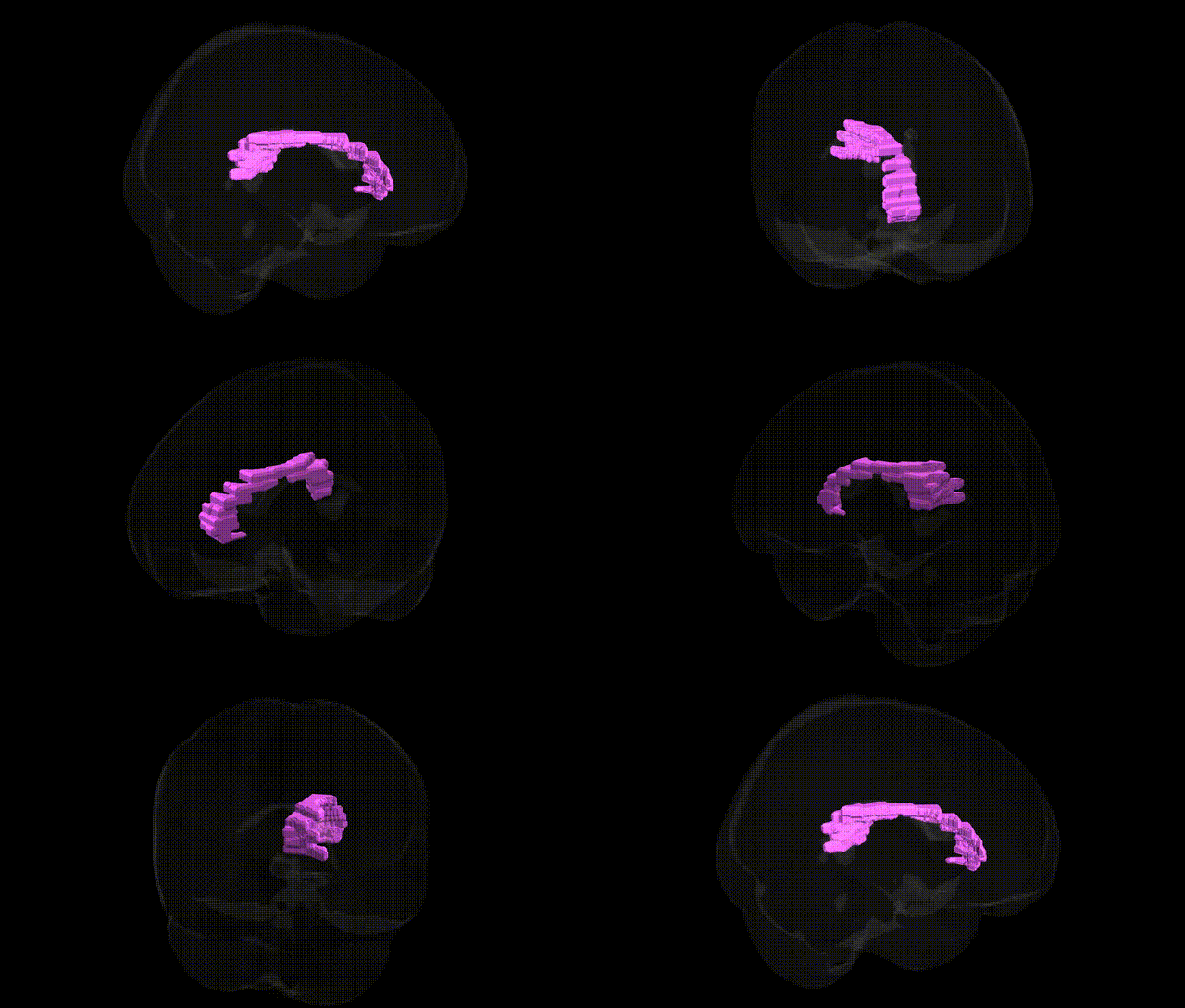
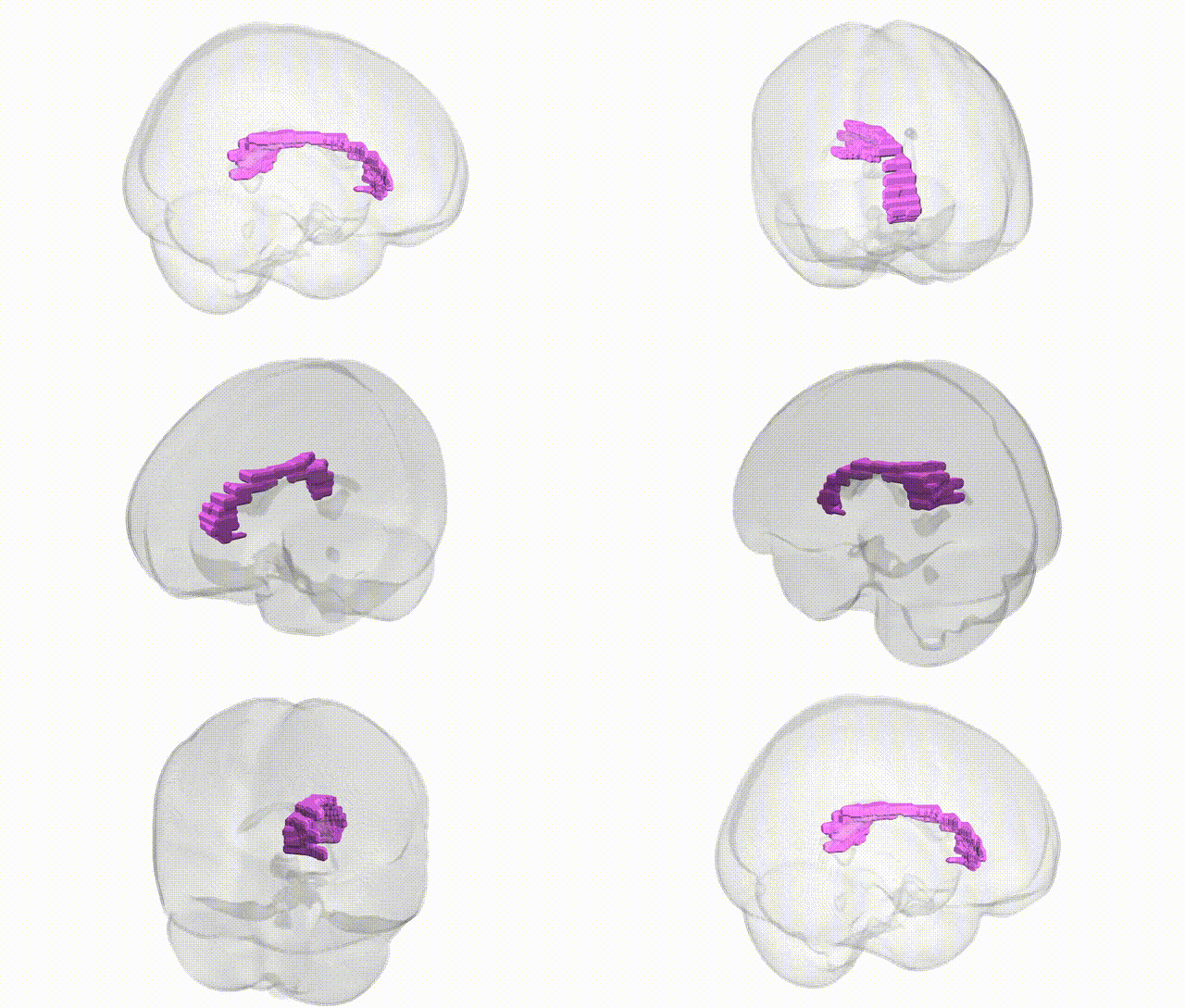
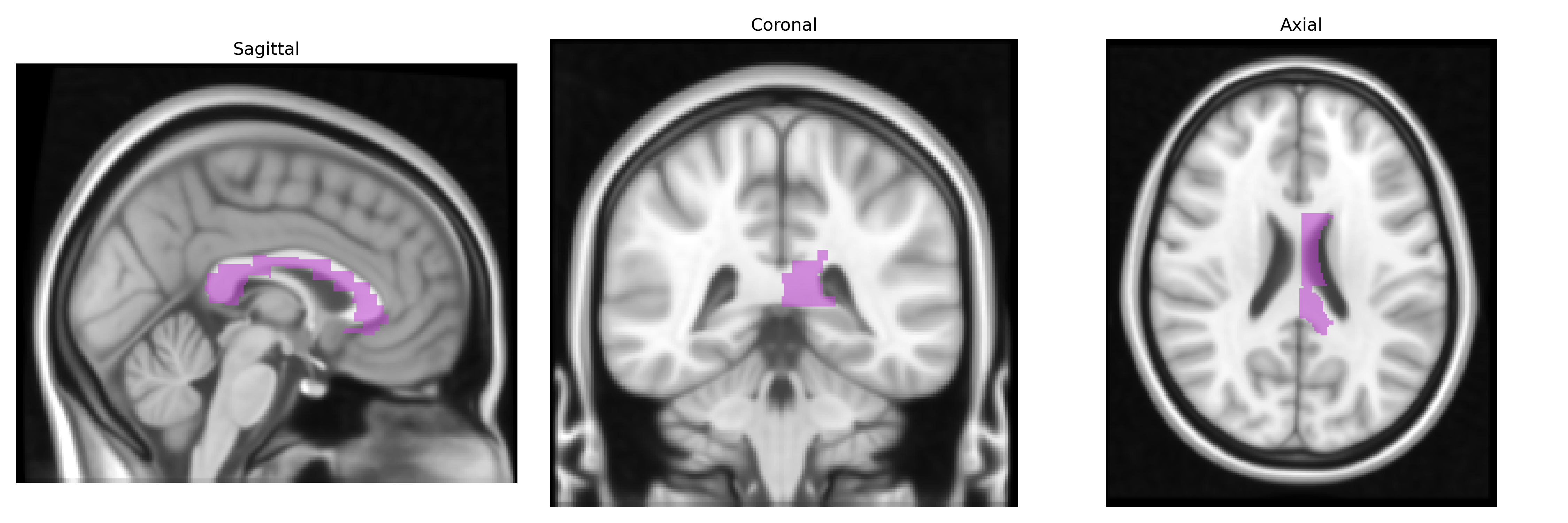
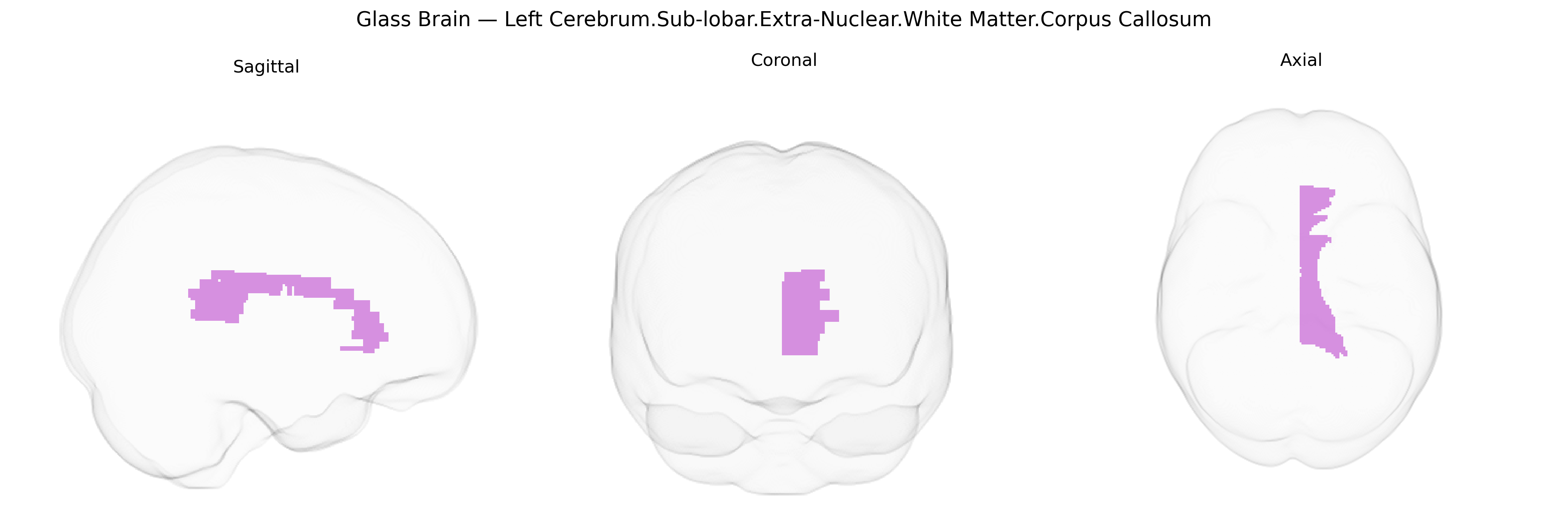
The bilateral Left Cerebrum.Sub-lobar.Extra-Nuclear.White Matter.Corpus Callosum region, as defined in the Talairach 1 mm atlas, corresponds to the major interhemispheric white matter commissure that connects homologous and heterologous areas of the cerebral cortex across the midline. Composed predominantly of heavily myelinated axons, the corpus callosum integrates sensory, motor, and higher-order cognitive information between the two cerebral hemispheres, supporting functions such as bimanual coordination, language lateralization, attention, and complex problem solving. Anatomically, it is subdivided into regions (rostrum, genu, body, isthmus, splenium) that roughly map to frontal, parietal, temporal, and occipital cortical connections, respectively, and lesions or developmental anomalies in this structure can lead to disconnection syndromes, cognitive deficits, and altered interhemispheric transfer. Corpus callosum
The corpus callosum, as defined in Talairach 1 mm atlas sub-lobar white matter (including “extra-nuclear” callosal fibers), shows robust heritability and multiple genome-wide associations, particularly for thickness, area, and microstructural measures derived from MRI and diffusion imaging. Large GWAS of callosal morphology and white-matter integrity have implicated genes involved in axon guidance, myelination, and neural development (for example variants near or within NTRK2, DCC, ROBO1/2, L1CAM-family genes, and oligodendrocyte-related loci such as MAG and other myelin genes), as well as polygenic overlap with cognitive performance, educational attainment, and general brain volume. Callosal measures share genetic correlations with neurodevelopmental and psychiatric conditions, including autism spectrum disorder, ADHD, schizophrenia, and bipolar disorder, consistent with observed callosal thinning, hypoplasia, or altered fractional anisotropy in these disorders; additional associations have been reported with multiple sclerosis and other demyelinating or white-matter diseases where risk loci in immune and myelin pathways affect callosal integrity. Overall, genetic studies suggest that common variants influencing interhemispheric connectivity, axon pathfinding, and myelin structure contribute to individual differences in corpus callosum anatomy and to susceptibility for a range of neuropsychiatric and neurodevelopmental traits.
Overview generated by GPT-4o (2026).
Region ID: 508
Hemisphere: bilateral
Atlas: Talairach labels 1mm
Full Quality Version: Download MP4
Full Quality Version: Download MP4
Wali Sidiqyar*, Gaurav Rudravaram*, Elyssa M. McMaster, Trent M. Schwartz, Adam M. Saunders, Kurt G. Schilling, Bennett A. Landman "Introducing SPINS: A Shared Public Visualization Library of Neuroanatomical Structures." Medical Imaging with Deep Learning- short paper
This resource is licensed under CC0 1.0 Universal (Public Domain).