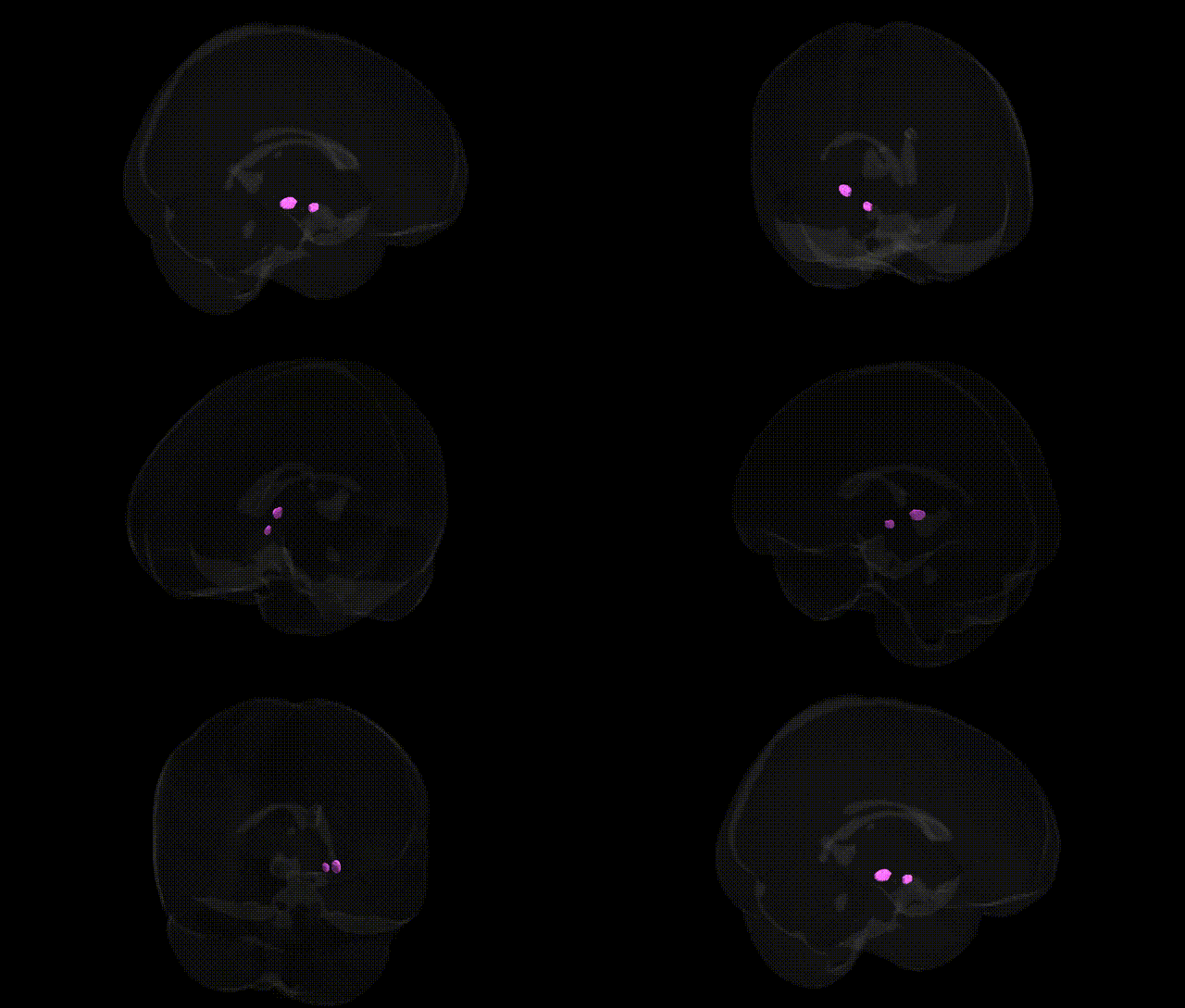
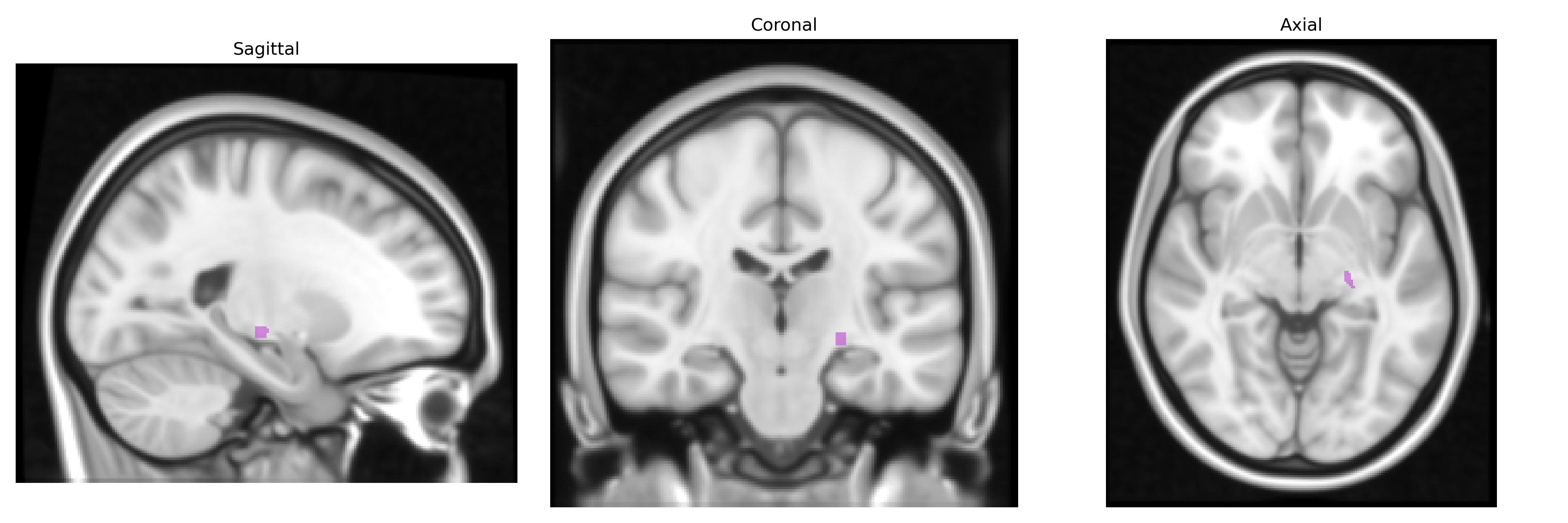
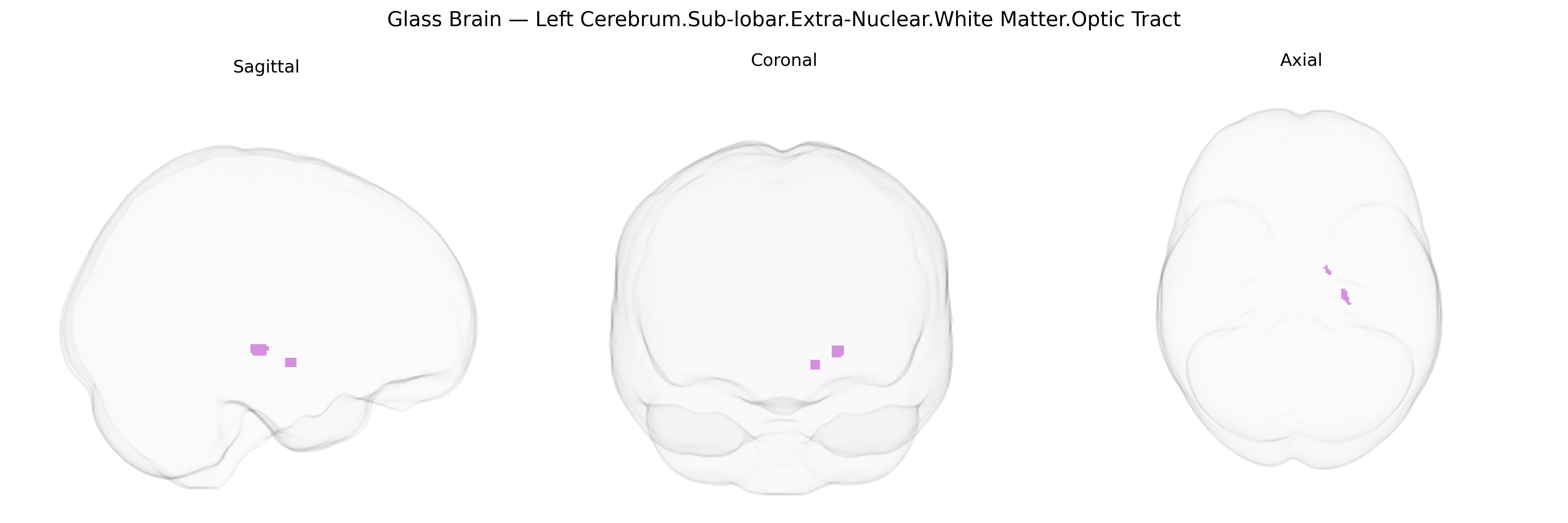
The bilateral Left Cerebrum.Sub-lobar.Extra-Nuclear.White Matter.Optic Tract region corresponds to the paired optic tracts, major white matter pathways that carry visual information from the optic chiasm to the lateral geniculate nucleus (LGN) of the thalamus, as well as to other visual relay and reflex centers in the midbrain. Composed of heavily myelinated axons originating from retinal ganglion cells, the optic tracts contain fibers that have already undergone partial decussation at the chiasm, such that each tract predominantly conveys information from the contralateral visual hemifield. Functionally, these tracts are critical for the relay and preprocessing of visual signals required for conscious vision, visual reflexes, and circadian photoentrainment, and lesions here can lead to characteristic visual field defects (e.g., homonymous hemianopia). There is no direct link for this exact atlas label; the closest related structure is the Optic tract.
Genetic associations specific to the bilateral Left Cerebrum.Sub-lobar.Extra-Nuclear.White Matter.Optic Tract region, as defined in the Talairach 1 mm Atlas, are not well characterized at fine-grained atlas-label resolution, but converging evidence from imaging genetics and GWAS of optic nerve/tract structure, white-matter microstructure, and visual pathway disorders provides relevant links. Variants in genes involved in axonal guidance, myelination, and neurodevelopment—such as AQP4, MOG, MBP, MAG, CNTN4, ROBO1/2, and PLP1—have been associated with optic neuritis, neuromyelitis optica spectrum disorders, inherited optic neuropathies, and structural integrity of visual white-matter pathways. Large-scale diffusion MRI GWAS (e.g., UK Biobank–based studies of white-matter tracts and fractional anisotropy) have identified common variants near genes implicated in oligodendrocyte function (e.g., PLEKHG1, SLC39A8, NME8, and others) that influence overall visual and association white-matter microstructure, which likely extend to the optic tract. Monogenic disorders affecting the optic tract and adjacent visual pathways, such as Leber hereditary optic neuropathy (MT-ND1, MT-ND4, MT-ND6), OPA1-related dominant optic atrophy, and certain lysosomal or peroxisomal disorders (e.g., ABCD1 in adrenoleukodystrophy), further underscore the genetic sensitivity of this region’s white matter. However, few GWAS explicitly target the Talairach-defined optic tract label, and most insights derive from broader visual pathway and white-matter studies rather than this exact atlas region.
Overview generated by GPT-4o (2026).
Region ID: 359
Hemisphere: bilateral
Atlas: Talairach labels 1mm
Full Quality Version: Download MP4
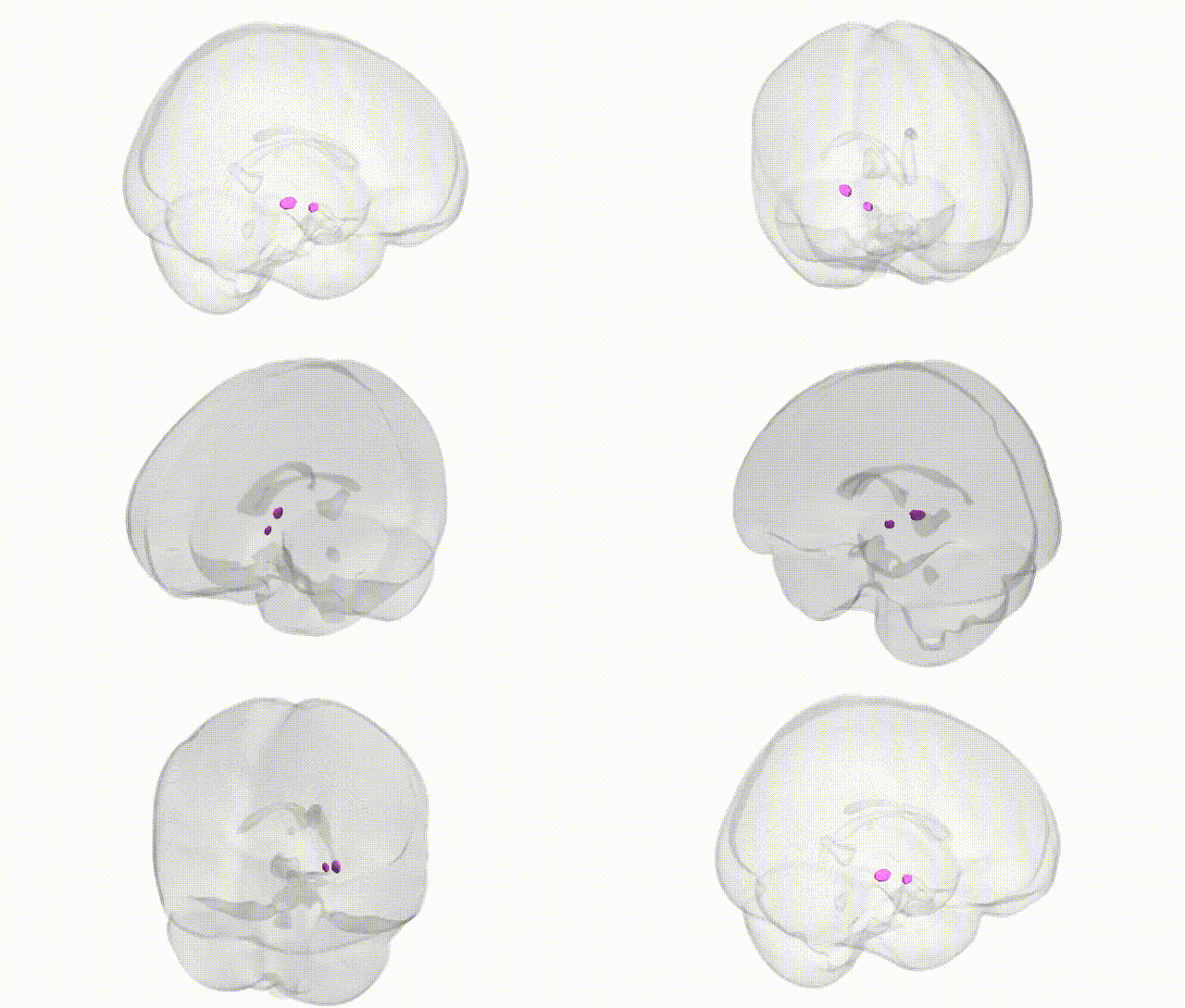
Full Quality Version: Download MP4
Wali Sidiqyar*, Gaurav Rudravaram*, Elyssa M. McMaster, Trent M. Schwartz, Adam M. Saunders, Kurt G. Schilling, Bennett A. Landman "Introducing SPINS: A Shared Public Visualization Library of Neuroanatomical Structures." Medical Imaging with Deep Learning- short paper
This resource is licensed under CC0 1.0 Universal (Public Domain).