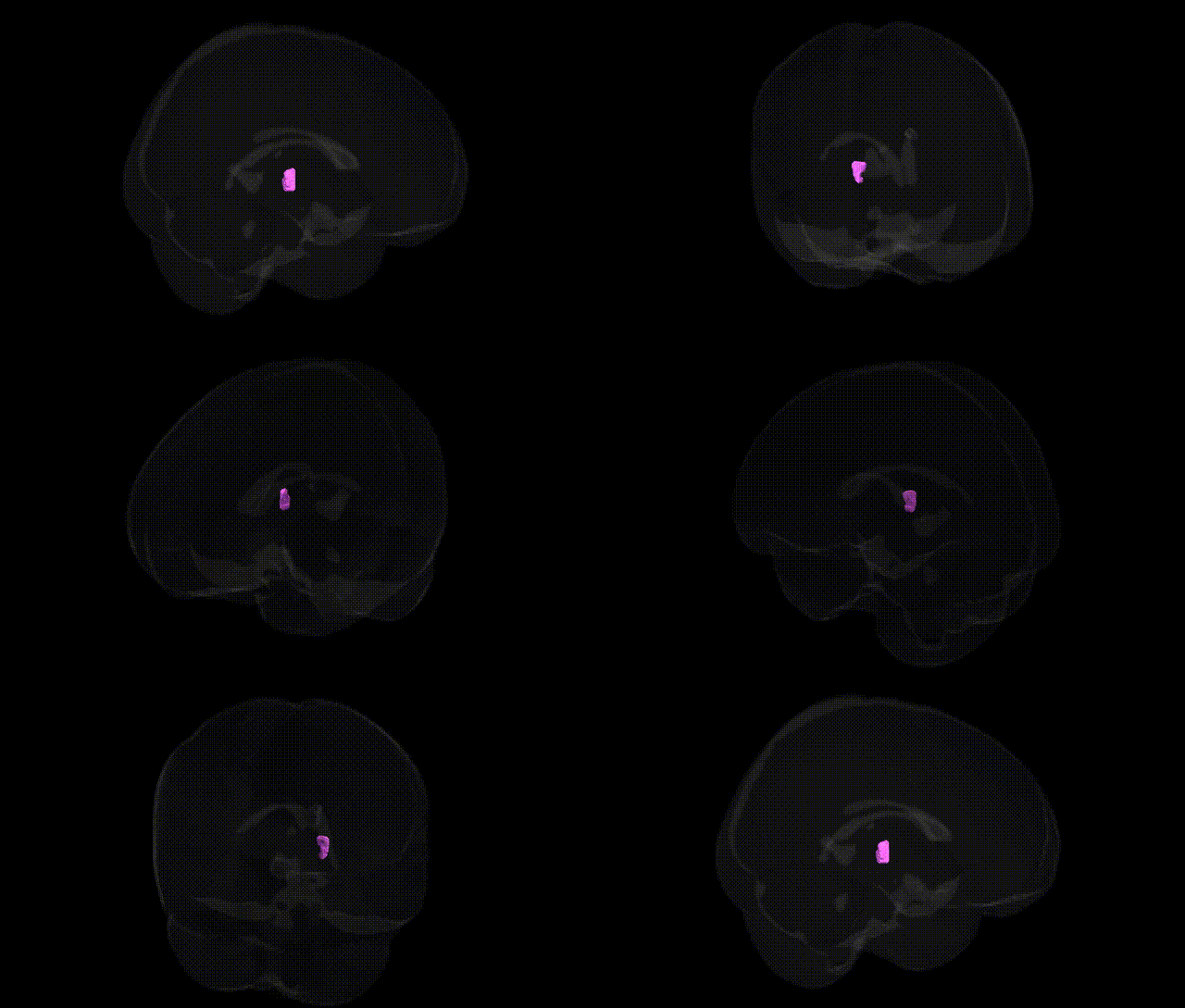
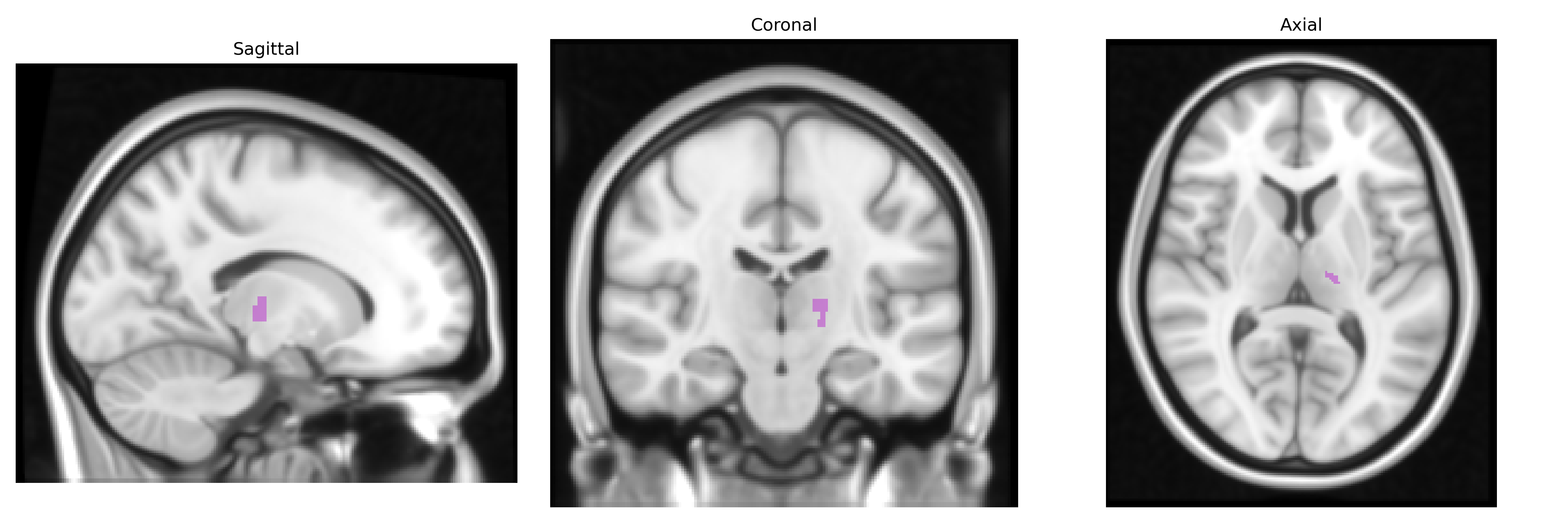
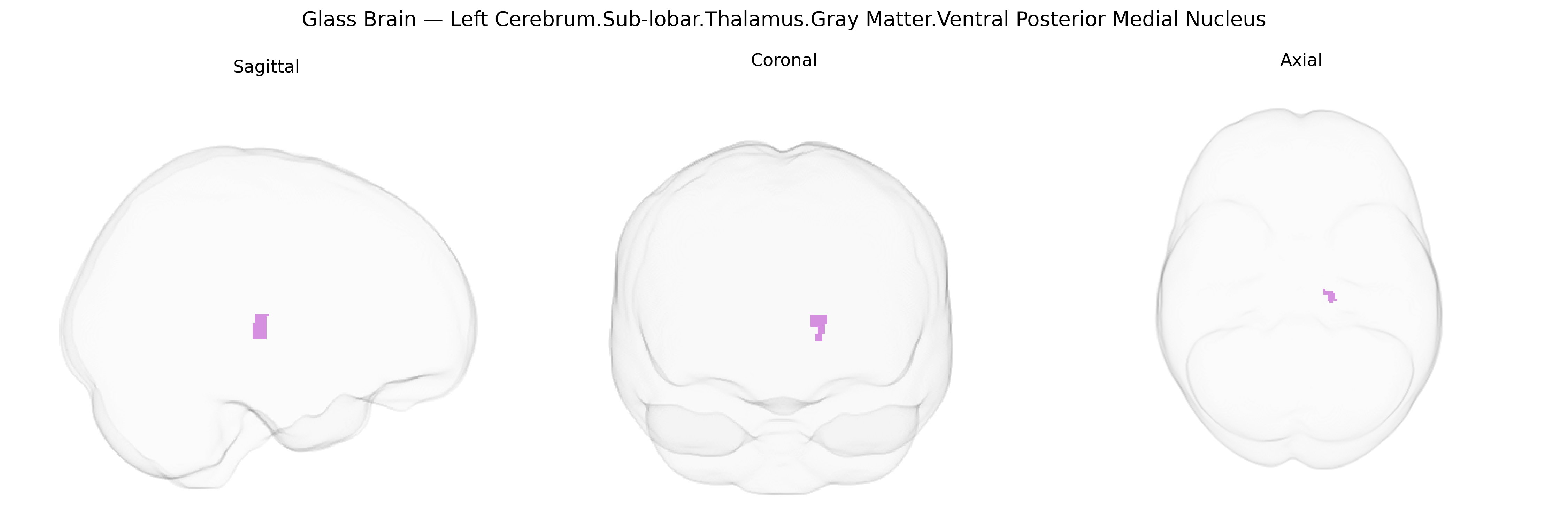
The bilateral Left Cerebrum.Sub-lobar.Thalamus.Gray Matter.Ventral Posterior Medial Nucleus corresponds to the ventral posteromedial nucleus (VPM) of the thalamus, a key somatosensory relay nucleus that primarily transmits sensory information from the face and oral structures to primary and secondary somatosensory cortices. It receives afferent input mainly via the trigeminothalamic pathways (including pain, temperature, touch, and proprioceptive signals from cranial territories), as well as gustatory information from the solitary tract, and projects topographically organized outputs to cortical regions involved in facial somatosensation and taste perception. Functionally, the VPM contributes to conscious perception and fine discrimination of facial sensory stimuli and plays an important role in integrating somatic and gustatory signals; lesions or dysfunction within this nucleus can result in selective deficits in facial sensation and taste, or contribute to central post-stroke pain syndromes. Ventral posteromedial nucleus of thalamus
The bilateral ventral posterior medial (VPM) nucleus of the thalamus, a key somatosensory relay for facial and oral sensory inputs, has not often been targeted explicitly in GWAS, but convergent imaging-genetic and neurogenetic evidence implicates thalamic somatosensory nuclei, including VPM, in several traits and disorders. Large brain-structure GWAS consortia (e.g., ENIGMA) have shown that thalamic volume and microstructure are heritable and associated with common variants in genes involved in neurodevelopment, axon guidance, and synaptic function (such as those in the CACNA1C, MEF2C, and NCAM pathways), although these findings usually treat the thalamus as a whole or by broad nuclei groups rather than isolating VPM. Polygenic risk for schizophrenia, bipolar disorder, and major depression has been associated with thalamic dysconnectivity in imaging–genetics studies, and thalamic somatosensory nuclei abnormalities have been linked to chronic pain conditions, migraine, and neuropathic facial pain, suggesting that genetic variants influencing thalamocortical circuitry and pain processing (e.g., in ion channel and inflammatory pathway genes) may indirectly modulate VPM structure or function. Additionally, rare monogenic or high-penetrance mutations affecting thalamic development and sensory pathways (such as in genes related to neuronal migration and thalamocortical projection, including some tubulin and LIS1-related pathways) can alter somatosensory thalamic nuclei, though these are typically characterized at the level of global thalamic or sensory system anomalies rather than specifically mapped to VPM in Talairach-defined atlases. Overall, current genetic evidence points to heritable influences on thalamic sensory relay systems and their involvement in psychiatric, pain, and neurodevelopmental phenotypes, but precise GWAS-level associations localized exclusively to the VPM nucleus in the Talairach 1 mm atlas remain limited.
Overview generated by GPT-4o (2026).
Region ID: 580
Hemisphere: bilateral
Atlas: Talairach labels 1mm
Full Quality Version: Download MP4
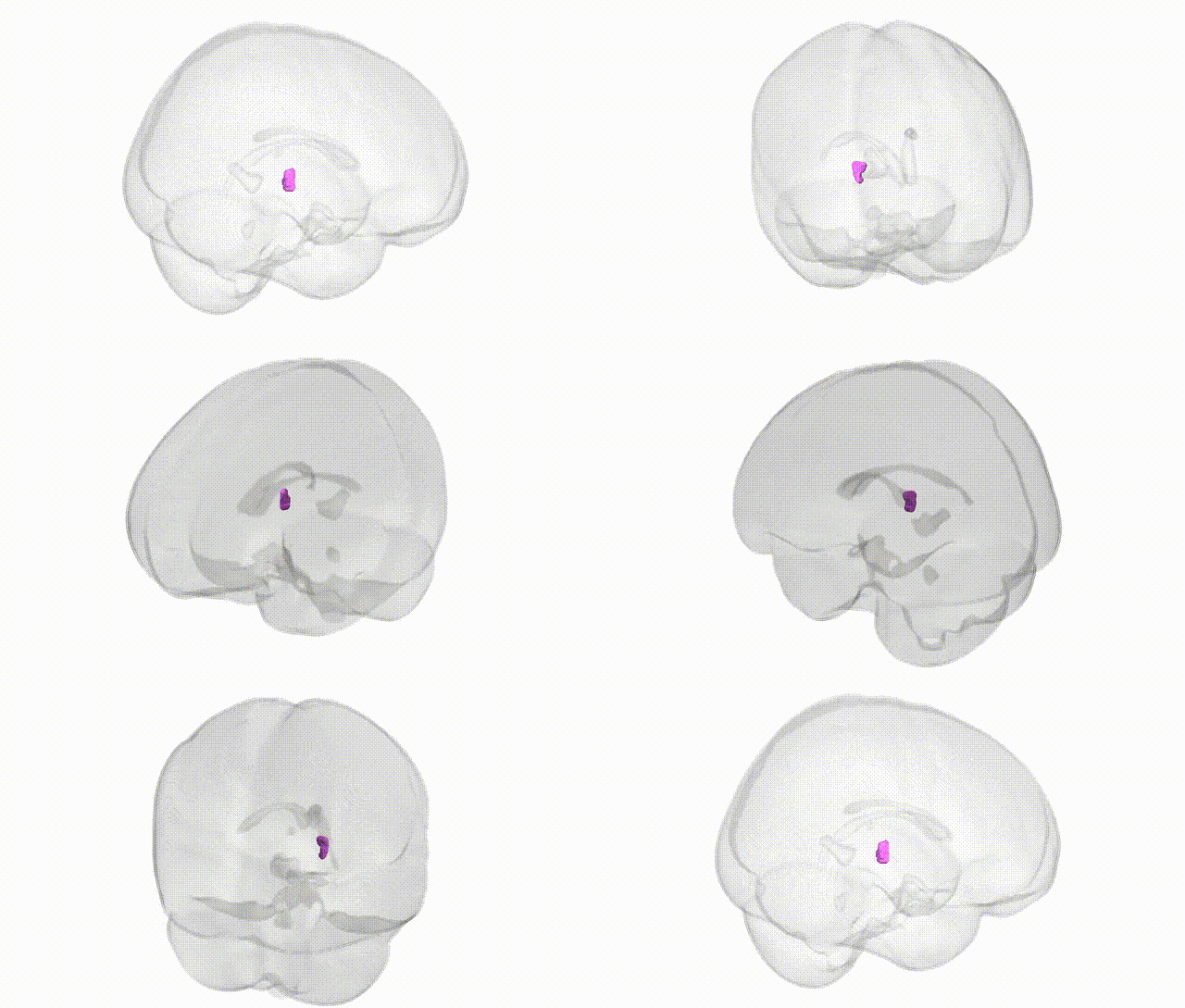
Full Quality Version: Download MP4
Wali Sidiqyar*, Gaurav Rudravaram*, Elyssa M. McMaster, Trent M. Schwartz, Adam M. Saunders, Kurt G. Schilling, Bennett A. Landman "Introducing SPINS: A Shared Public Visualization Library of Neuroanatomical Structures." Medical Imaging with Deep Learning- short paper
This resource is licensed under CC0 1.0 Universal (Public Domain).